Lisianthus Cessna Blue Picotee coated seeds - Eustoma russelianu
Lisianthus Cessna Blue Picotee coated seeds - Eustoma russelianu

Lisianthus Cessna Blue Picotee coated seeds - Eustoma russelianu
Lisianthus Cessna Blue Picotee coated seeds - Eustoma russelianu
Lisianthus russellianus Cessna Blue Picotee
Lisianthius, Lisianthus, Prairie gentian
Back-to-school special offer!
Get €10 off for every €50 you spend! And get up to €40 off on a single order.
How does it work?
1. Shop your favourites
Add your favourite plants to your basket. For every €50 you spend (excluding delivery charges, store credit and the plastic-free option), you’ll receive a €10 voucher.
€50 spent = €10 voucher
€100 spent = €20 voucher
€150 spent = €30 voucher
€200 spent = €40 voucher
2. Place your order
Once your basket reaches one of the spending thresholds, place your order. You can even choose your delivery date!
3. Receive your voucher
As soon as your order has been shipped, you’ll receive an email containing your personal voucher code and its value.
4. Use it on your next order
Your voucher is valid for 90 days from the date you receive it. It can be used once only, on a new order worth at least the value of the voucher, excluding delivery charges.
Please note: Vouchers can be combined with other offers, but cannot be split or refunded.
Home or relay delivery (depending on size and destination)
Important: You may be charged customs duties by your country’s customs authorities upon delivery.
Schedule delivery date
and select date in basket
This plant carries a 6 months recovery warranty
More information
We guarantee the quality of our plants for a full growing cycle, and will replace at our expense any plant that fails to recover under normal climatic and planting conditions.
Would this plant suit my garden?
Set up your Plantfit profile →
Description
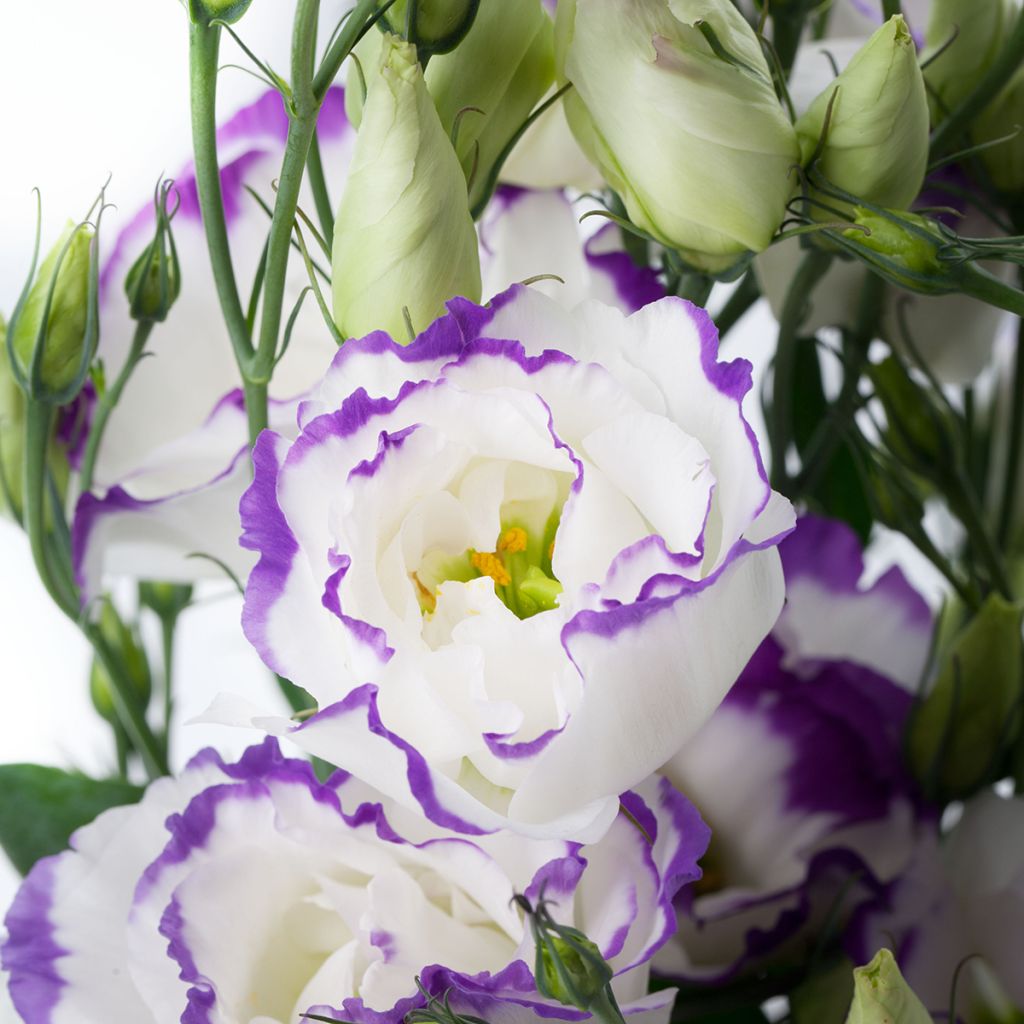
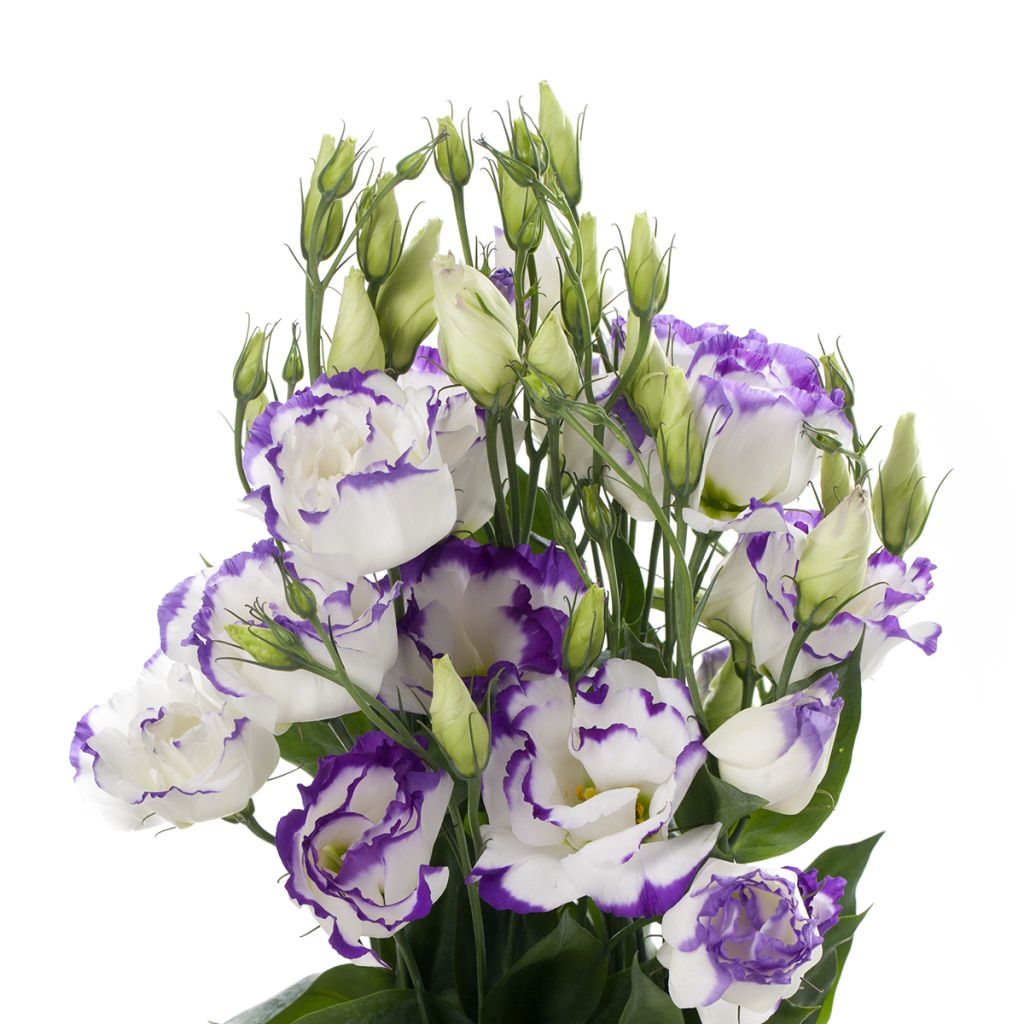
Eustoma russellianum, or large‑flowered lisianthus, excels in this F1 ‘Cessna Blue Picotee III’ cultivar, a selection with white double corollas delicately edged with blue‑violet. Very popular for making cut flower arrangements due to its long stems, this variety can be grown in borders, in a potager or in large pots. It offers regular flowering throughout the summer. The pelleted seeds are larger and easier to handle, simplifying sowing.
Member of the Gentianaceae family, Eustoma russellianum (syn. Eustoma grandiflorum, Lisianthus russelianum) is native to the Great Plains of North America, from Wyoming and Nebraska to Texas and northern Mexico. This species grows naturally in wet meadows, stream banks and sandy prairies. It is a short‑lived perennial, which can behave as an annual or biennial depending on conditions.
Widely cultivated in Japan since the 1930s and then by European breeders, lisianthus has become a major cut flower.
‘Blue Picotee’ belongs to the Cessna series (group III), a line developed for ‘high‑end’ cut flowers. It was selected by Evanthia for its productivity, robust root system and reliable behaviour even in less favourable conditions. Group III flowers in summer; the flower harvest takes place after 11 to 16 weeks of cultivation. The plants reach 80 to 90cm in height and 25–35cm in width in open ground. Growth is rather slow initially, then steady. When grown in a large pot (7 to 10 litres), the plants measure 40 to 60 cm in height. Each has an upright habit, sometimes branched from the base. The glaucous stems bear waxy, blue‑green, oval to lanceolate leaves. They persist only if it does not freeze and when the plant is grown as a biennial. The taproot system is sensitive to transplanting.
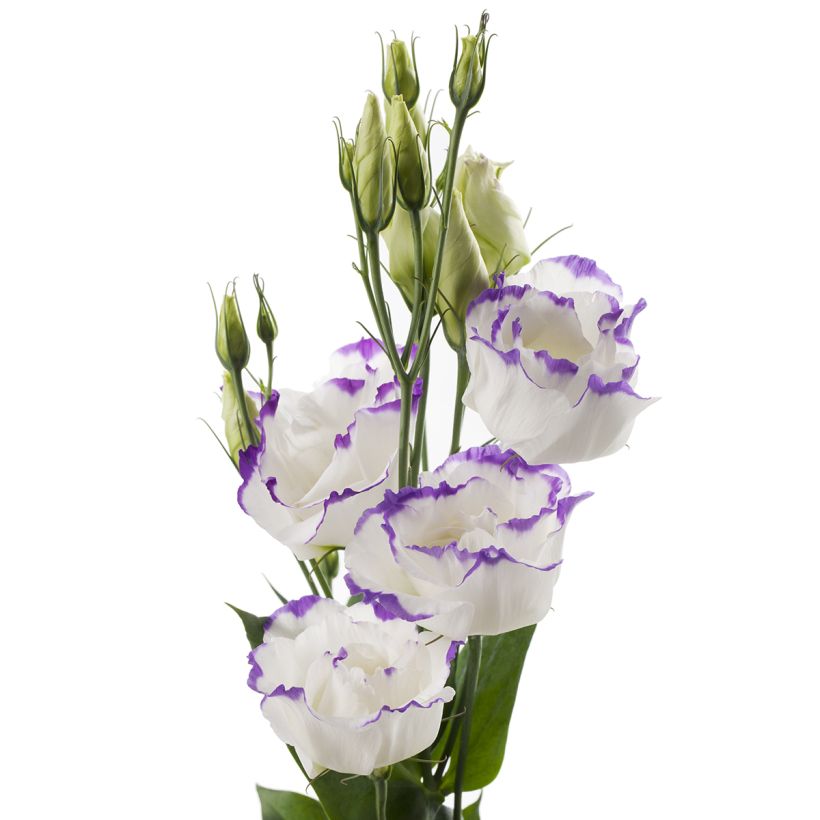
The full, double flowers measure approximately 6–8 cm in diameter. They are cup‑shaped, slightly overlapping, resembling a small rose. The corolla is white with a clear blue‑violet edge (picotee). The flowers are borne in terminal panicles on long, sturdy stems; flowering extends from mid‑June to September, depending on the planting date.
Plant this Lisianthus ‘Cessna Blue Picotee III’ in full sun, in fertile, well‑drained soil that remains moist. In a cut flower border, plant it in rows or in groups of 5 to 7 plants, discreetly staked if the location is windy. Its slender silhouette and numerous flower buds enhance fine foliage and light shrubs: small‑flowered roses (‘The Fairy’ or 'Pomponella'), pale blue scabious 'Oxford Blue' and nigellas go well with its refined colouring. In a flower container, combine it with soft grasses like Carex oshimensis, compact perennial salvias and a few ball dahlias of medium size; also combine it with other lisianthus such as ‘Cessna Blue III’, ‘Cessna Yellow III’ or ‘Adom Red Picotee III’, providing a beautiful armful of flowers for summer bouquets.
Report an error about the product description
Lisianthus Cessna Blue Picotee coated seeds - Eustoma russelianu in pictures
Flowering
Foliage
Plant habit
Botanical data
Lisianthus
russellianus
Cessna Blue Picotee
Gentianaceae
Lisianthius, Lisianthus, Prairie gentian
Eustoma russellianum 'F1 Cessna Blue Picotee', Bilamista grandiflora F1 'Cessna Blue Picotee'
Cultivar or hybrid
Planting and care
Sowing of coated lisianthus F1 Cessna Blue Picotee III seeds:
Under a bright, heated cover: January to March for summer flowering (allow 12–15 weeks before planting out). Sowing is possible from December for well-equipped amateurs. Professionals under heated glass: in October-November to advance the season.
In very mild climates, sowing in August-September can be attempted under protection for early planting out in spring.
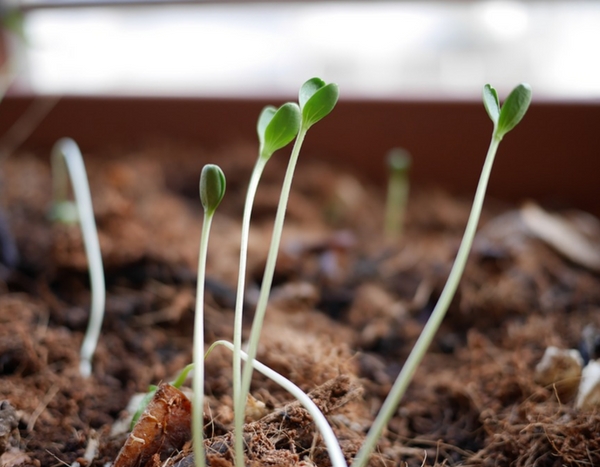
Sow on the surface, without covering, in fine, sterile seed compost (pH 6.3–6.8) kept uniformly moist, but never waterlogged; they need light to germinate. Ideal temperatures: 20–22 °C until germination (10–20 days), under a lid or film to retain moisture, then 18–20 °C with good ventilation and 14–16 hours of light.
Water by capillary action, provide gentle nutrition (diluted balanced fertiliser) and prick out into plug plants when the seedlings have 2–3 true leaves, handling the root ball without breaking the roots. Harden them off for 10 to 14 days (gradually more light and air) before planting out after all risk of frost.
In open ground, choose a spot in full sun with well-drained, fertile soil deeply loosened; plant 15–20 cm apart, mulch to retain moisture, install a support net if the site is exposed to wind, and water regularly at first, then more sparingly once the roots have established. Maintain steady growth with small applications of potassium-rich fertiliser (avoid excessive ammoniacal nitrogen), monitor ventilation to limit Botrytis and damping off, and act quickly against aphids and thrips.
In pots, use a container of at least 25–30 cm with drainage holes, filled with an aerated substrate (quality compost + 20–30% perlite or lava rock); water when the top 2cm are dry, allow to drain, and feed every 2–3 weeks at a light dose or with a slow-release fertiliser. Pinching is not essential for cut flowers (it delays flowering), but can be attempted very early (4–6 pairs of leaves) on potted plants to encourage a few decorative side shoots.
Growing temperatures after planting: 16–18 °C at night and 18–24 °C during the day; avoid heat spikes and water on the flowers.
For cutting, harvest when the first flower is open, or the buds are well coloured; remove lower leaves, recut the stems and place them quickly in clean water: vase life is excellent if the plant has grown without water stress.
Sowing period
Intended location
Planting & care advice
-

-
-

-

-

-

-

-

This item has not been reviewed yet - be the first to leave a review about it.
Recently viewed products
Haven't found what you were looking for?
Hardiness is the lowest winter temperature a plant can endure without suffering serious damage or even dying. However, hardiness is affected by location (a sheltered area, such as a patio), protection (winter cover) and soil type (hardiness is improved by well-drained soil).

The flowering period indicated on our website applies to countries and regions located in USDA zone 8 (France, the United Kingdom, Ireland, the Netherlands, etc.)
It will vary according to where you live:- In zones 9 to 10 (Italy, Spain, Greece, etc.), flowering will occur about 2 to 4 weeks earlier.
- In zones 6 to 7 (Germany, Poland, Slovenia, and lower mountainous regions), flowering will be delayed by 2 to 3 weeks.
- In zone 5 (Central Europe, Scandinavia), blooming will be delayed by 3 to 5 weeks.
In temperate climates, pruning of spring-flowering shrubs (forsythia, spireas, etc.) should be done just after flowering.
Pruning of summer-flowering shrubs (Indian Lilac, Perovskia, etc.) can be done in winter or spring.
In cold regions as well as with frost-sensitive plants, avoid pruning too early when severe frosts may still occur.
The planting period indicated on our website applies to countries and regions located in USDA zone 8 (France, United Kingdom, Ireland, Netherlands).
It will vary according to where you live:
- In Mediterranean zones (Marseille, Madrid, Milan, etc.), autumn and winter are the best planting periods.
- In continental zones (Strasbourg, Munich, Vienna, etc.), delay planting by 2 to 3 weeks in spring and bring it forward by 2 to 4 weeks in autumn.
- In mountainous regions (the Alps, Pyrenees, Carpathians, etc.), it is best to plant in late spring (May-June) or late summer (August-September).
The harvesting period indicated on our website applies to countries and regions in USDA zone 8 (France, England, Ireland, the Netherlands).
In colder areas (Scandinavia, Poland, Austria...) fruit and vegetable harvests are likely to be delayed by 3-4 weeks.
In warmer areas (Italy, Spain, Greece, etc.), harvesting will probably take place earlier, depending on weather conditions.
The sowing periods indicated on our website apply to countries and regions within USDA Zone 8 (France, UK, Ireland, Netherlands).
In colder areas (Scandinavia, Poland, Austria...), delay any outdoor sowing by 3-4 weeks, or sow under glass.
In warmer climes (Italy, Spain, Greece, etc.), bring outdoor sowing forward by a few weeks.
Shipping country and language
Your country of residence may be:
Your country of residence is:
For a better user experience on our website, you can select:
Your shipping country:
-
 Austria
-
 Belgium
-
 Bosnia & Herzegovina
-
 Bulgaria
-
 Croatia
-
 Cyprus
-
 Czechia
-
 Denmark
-
 Estonia
-
 Finland
-
 France
-
 Germany
-
 Greece
-
 Hungary
-
 Iceland
-
 Ireland
-
 Italy
Italy
-
 Latvia
-
 Liechtenstein
-
 Lithuania
-
 Luxembourg
-
 Malta
Malta
-
 Netherlands
-
 Poland
-
 Portugal
-
 Romania
-
 Serbia
-
 Slovakia
-
 Slovenia
-
 Spain
Spain
-
 Sweden
-
 Switzerland
Language:
-
French
-
 English
-
Spanish
-
Italian
-
German
-
Portuguese
-
Dutch
-
Finnish
My Account
Hello
My wish lists
My cart
Log in / Register
Existing customer?
This form is protected by reCAPTCHA - the Google Privacy Policy and Terms of Service apply.
New customer?
Create an account to track your orders, access our customer service and, if you wish, make the most of our upcoming offers.