Evergreen groundcovers are a valuable aid in the garden. They help combat adventive plants, reduce soil dehydration, and fight erosion. Besides these proven functional qualities, these plants cover a wide range of uses in the garden. And since functional doesn't have to mean ugly, here are the 10 best evergreen groundcovers to have in your garden.
1 - For shade: Pachysandra terminalis
Yes, I could have mentioned ivy, epimediums, Chrysospleniums, Ophiopogons... But if I had to name just one for shade, Pachysandra terminalis is an excellent candidate. While it grows very slowly in the first few years, it's only to establish its root system and develop at an astonishing speed in the following years. It doesn't run; it gallops. Its glossy foliage, perfect all year round, and its white flowers make it an excellent perennial for cool woodlands, let's be clear!
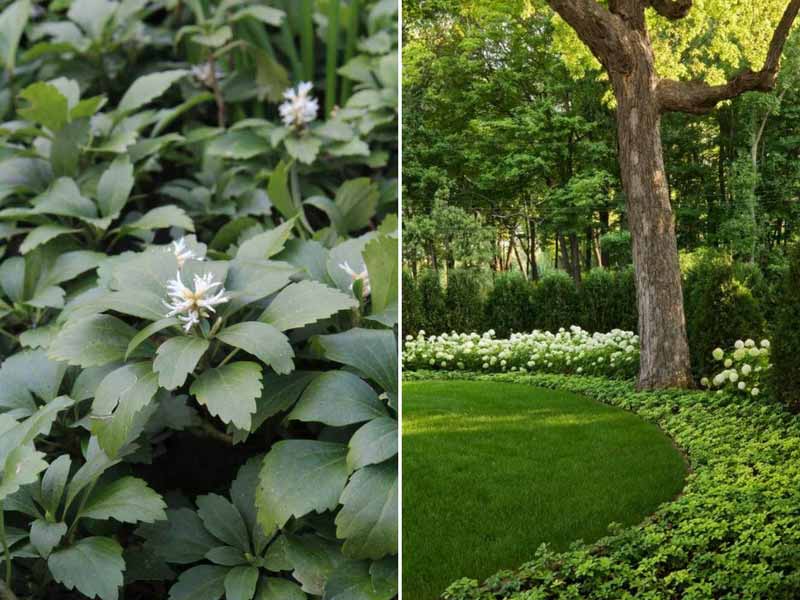
Pachysandra in bloom in spring / Pachysandra terminalis growing at the edge of a tree (source: Pinterest)
2 - For clay soils: Ajuga reptans Catlin's Giant
Ajuga reptans (or "creeping bugle") is one of those perennials that withstand Siberian winters and grow without issue with their feet in the clay, which shows just how tough it is. Its only flaw is that it loves moisture. Heavy soils, yes, but cool or even damp. When it gets what it desires, its stems form stolons like a strawberry plant and quickly colonise.
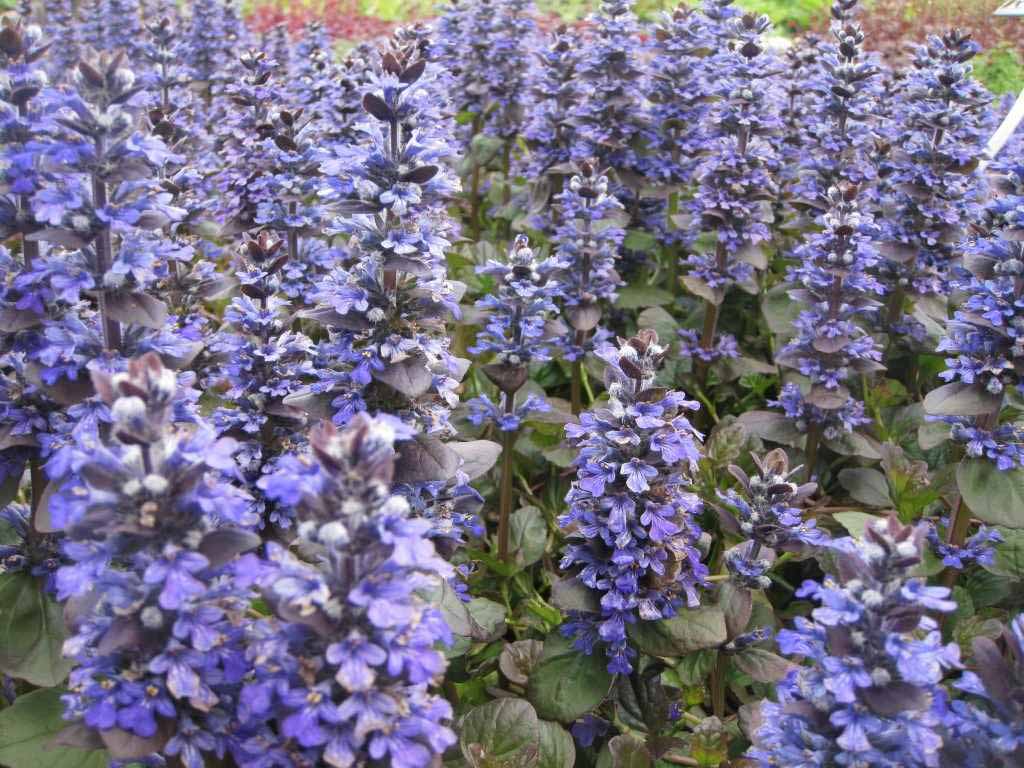
Ajuga reptans Catlin's Giant with its superb bronze foliage and blue spikes.
3 - For arid corners: Stachys byzantina
Have you always wanted to pet a bear's ears but never could? Close your eyes and stroke the velvety foliage of Stachys byzantina. You'll feel like you're petting a bear... or a rabbit, depending on your perspective. Behind this undeniably soft foliage lies a tenacious perennial that grows without flinching under blazing sun and colonises surfaces thanks to creeping stems that root themselves. Use it at the edge or in rockeries with Armeria, euphorbias, lavenders, or carnations.
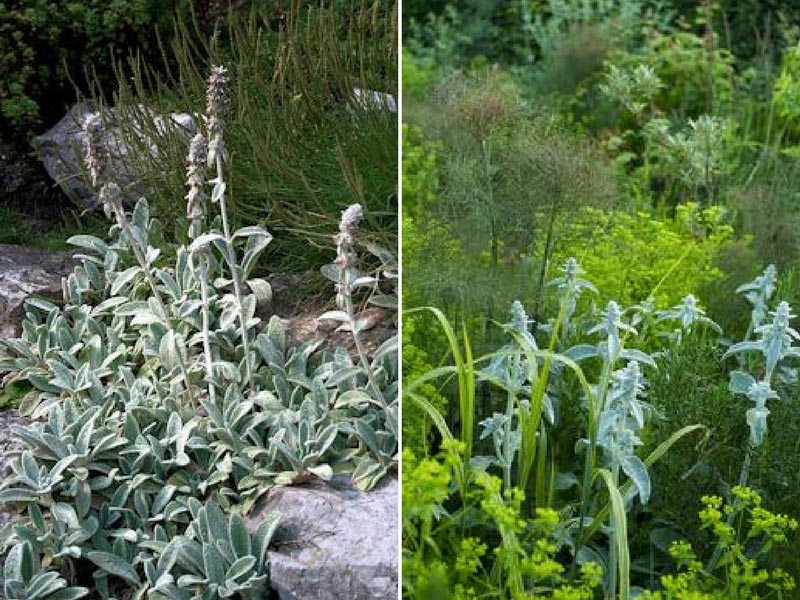
Stachys byzantina / Stachys in bloom, mixed with purple fennel, euphorbia, and rosemary - source: Pinterest
4 - For growth speed: Lesser Periwinkle (Vinca minor Atropurpurea)
I'm not talking about the greater periwinkle (Vinca major) with its bland foliage and chaotic growth, but its smaller sister, Vinca minor Atropurpurea, which is more refined. With finer leaves, it produces a string of small flowers whose often paler centre gives it a bicoloured appearance. As vigorous as its larger sister, it dresses semi-shaded borders with great class and restraint. Its stems elongate and root themselves here and there, so one single plant can spread and cover several square metres in just 2-3 years.
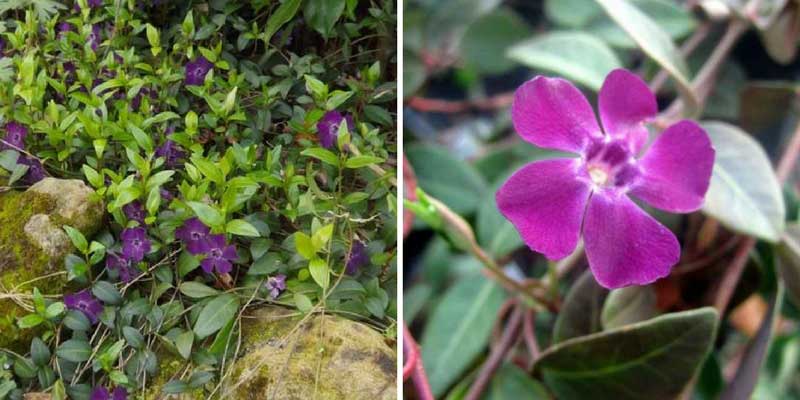
Vinca minor atropurpurea (Source: Pinterest)
5 - For calcareous soils: Thyme
No, Thyme is not just an herb confined to the edges of the vegetable garden. It is also, and above all, an excellent groundcover plant for calcareous and dry soils. It is used at the edge of a mineral path in gravel or on rocky slopes. However, not all are evergreen; opt for Thymus serpyllum or, for something more original, the stunning semi-evergreen Thymus pseudolanuginosus.
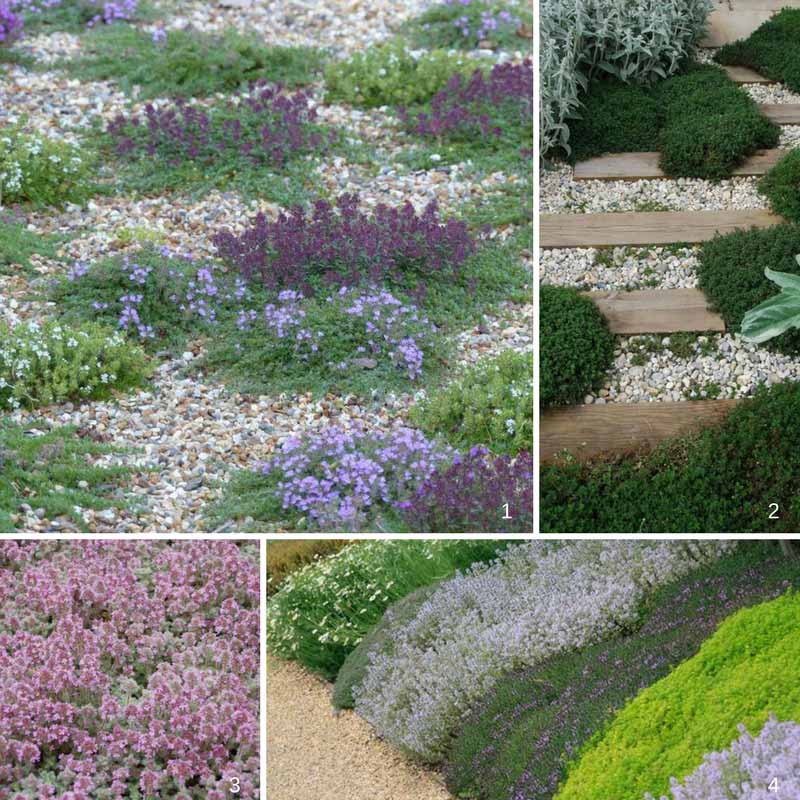
1) Thyme in bloom in early summer / 2) Thyme bordering a mineral path alongside Stachys byzantina (source: Pinterest) - 3) Thymus pseudolanuginosus - 4) Carpet of thyme on a calcareous slope (source: Pinterest)
6 - For early flowering: heather (Erica x darleyensis)
The advantage of heathers is that they thrive in challenging regions, in arid heaths swept by winds, on limestone cliffs, or at the edge of woodlands, so it's impossible to say, "Oh no, I gave up on heather; it won't grow in my garden!" Therefore, you can plant it almost anywhere in your garden, and it will grow at varying speeds. But its main asset lies in its early winter flowering, and neither frost nor a bit of snow will stop it from blooming.
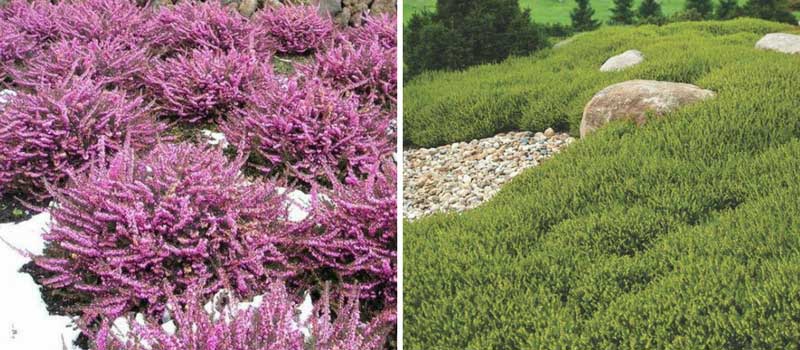
Erica darleyensis Red October in bloom despite the snow - Erica darleyensis forming an impenetrable carpet, no need to plant it on a tarp! (Source: Pinterest)
7 - For its fragrance: Sarcococca hookeriana humilis
At first glance, it's not the size of the flowers that impresses in Sarcococca, as they are insignificant, but rather its sweet fragrance with floral and citrus notes that lasts a good part of winter. Then, it's its lovely glossy foliage and ability to grow in shade, even under trees, that appeals. Finally, this small groundcover shrub slips along the edge of a shaded path and suckers to form lovely colonies over time.
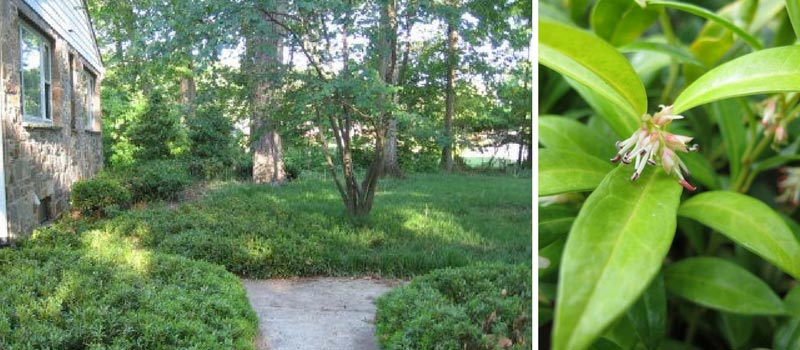
Sarcococca hookeriana humilis in bloom. How can such small flowers exude such a fragrance? A mystery! / Sarcococca hookeriana var. humilis at the edge of woodlands (Source: Pinterest)
8 - For its abundant flowering: Phlox subulata
When thinking of flowering groundcovers, Phlox doesn't immediately come to mind. And when thinking of Phlox, one primarily thinks of Phlox paniculata known for its beautiful coloured panicles in summer. However, Phlox subulata deserves to be better known and planted because its flowering is simply stunning. This small groundcover transforms into a colourful mass from early spring. It literally becomes covered in flowers, to the point that when exposed to full light, in well-drained, rich soil, the foliage disappears beneath the flowers for three solid weeks.
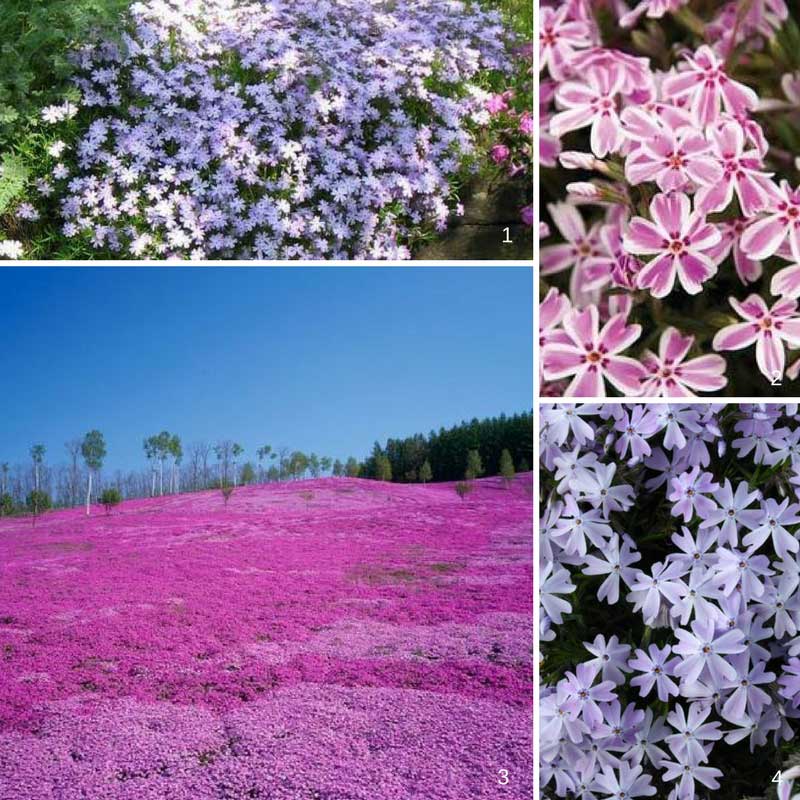
1 and 4) Phlox subulata Emerald Cushion - 2) Phlox subulata Candy Stripe - 3) The Japanese have appreciated Phlox subulata for a long time and plant it in masses on hillside slopes. You either love it or hate it, but after a dreary winter, it wakes you up! (Source: Pinterest)
9 - For decorative fruit in winter: Cotoneaster Coral Beauty
It's not that I'm a huge fan of cotoneasters, but one must acknowledge at least one thing: they are the kings of fruiting. When winter comes and the light intensity decreases, the small orange-red berries take on intense colours, making winter seem less dreary. Moreover, birds feast on their providential berries in winter, so keep that in mind!
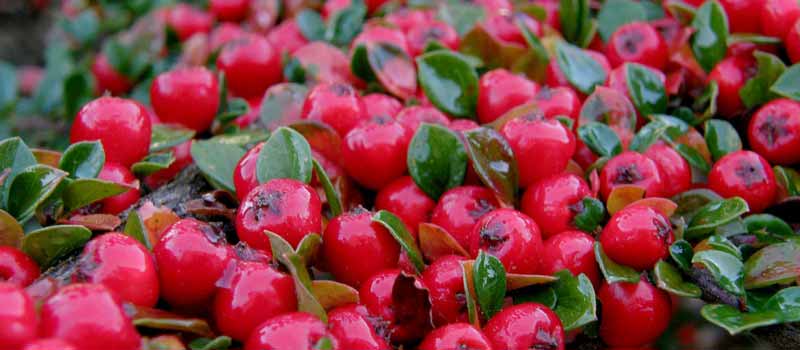 Cotoneaster suecicus Coral Beauty in fruit in autumn[/caption>
10 - For all the reasons: Geranium macrorrhizum Spessart
It was nearly impossible to finish a top 10 of the best evergreen groundcovers without mentioning Geranium macrorrhizum Spessart. It is the ultimate groundcover that grows everywhere, in sun or shade, in clay or clay-limestone soils. It is one of the few that grows in dry shade, on slopes, along paths, at the foot of trees or roses. It spreads its rhizomes across the ground and suffocates everything in its path, even ivy, which speaks to its robustness. It grows slowly but surely, has foliage with a questionable scent but blooms profusely and for a long time in spring. And when the cold arrives, its foliage turns copper and red, it may wither but does not disappear, revealing its dense network of rhizomes. It’s the best, and it’s my favourite (objectively speaking!).
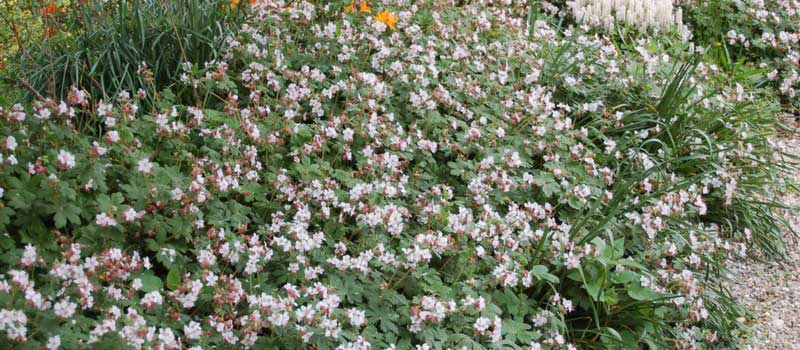 Geranium macrorrhizum 'Spessart' on my slope in spring.[/caption>
And you, which is your best evergreen groundcover? Tell us why!
Evergreen groundcovers are a valuable aid in the garden. They help combat adventive plants, reduce soil dehydration, and fight erosion. Besides these proven functional qualities, these plants cover a wide range of uses in the garden. And since functional doesn’t have to mean ugly, here are the 10 best evergreen groundcovers to have in your […]
After the lull in flowering during the height of summer, gardens often regain beautiful floral scenes in late summer. To prolong the pleasure into late autumn, depending on the arrival of the first frosts, you can plant perennial plants, bulbs, and bushes that bloom late in the season.
Often overlooked: bulbs that bloom in autumn
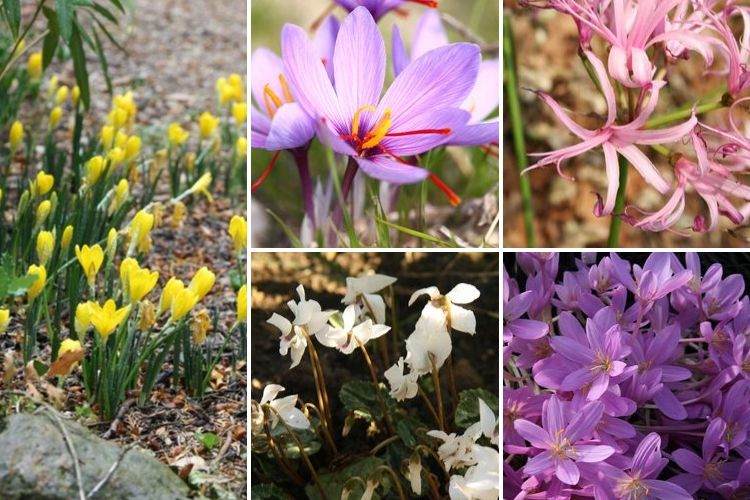
Autumn-flowering bulbous plants are too often ignored by gardeners, who tend to plant in autumn for spring blooms. It would be a shame not to enjoy these lovely late-flowering bulbs, as they are quite easy to grow.
Among them, we particularly love:
- Autumn Crocus: Discover the true saffron, Crocus sativus, with mauve flowers veined in violet and orange stigmas, or try, in full sun and very well-drained soil, Crocus cartwrightianus albus, with white flowers sometimes lasting until December.
- Sternbergia lutea: It blooms like a large crocus with bright yellow flowers in September-October.
- Colchicum: With their large flowers devoid of foliage (which wilts in summer), they punctuate the foreground of a flowerbed or lawn with their white, pink, and almost mauve flowers.
- Autumn Flowering > Cyclamens or Naples cyclamen: To naturalise in partial shade, this small cyclamen gradually forms a carpet of marbled silver foliage dominated by its white or pink flowers from late summer to autumn.
- Nerine: Planted against a warm wall or grown in pots to escape severe frosts, nerines display their large trumpet-shaped flowers in white or pink umbels in October-November.
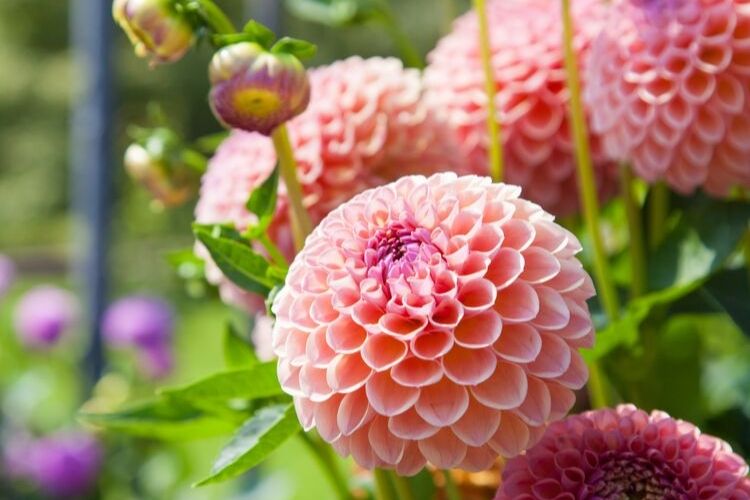
The dahlias, stars of autumn
These are, of course, must-haves for the autumn garden, which will never disappoint if planted in full sun, in deep, fertile, well-enriched soil. Choose from the vast palette of colours, flower shapes, and plant sizes. They easily blend among perennials and create beautiful scenes with soft-stemmed grasses. Planted in spring, they bloom in late summer; planted in early summer, they bloom throughout autumn.
Generous perennials in late season
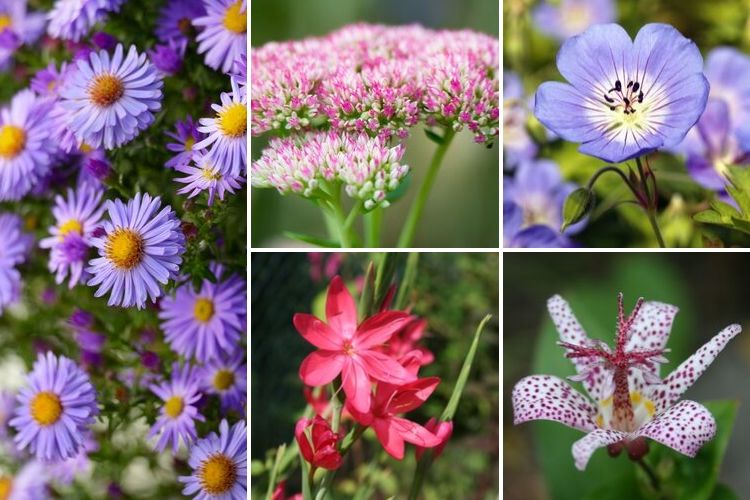
Among these, look for the latest species and varieties, such as Sedum ‘Herbstfreude’ or ‘Ruby Glow’, or among asters, besides the large autumn asters, the airy blooms of Aster laterifolius and its varieties.
Also consider hardy geraniums, some of which are tireless in autumn, like ‘Rozanne’ with its bright violet flowers, the varieties of Geranium pratense, or G. endressii.
Also to discover is the toad lily or orchid lily, Tricyrtis hirta, a little-known rhizomatous perennial, yet precious for its elegant flowering from August to October, with white flowers speckled with garnet, to be planted in shade and in rich, humus-rich soil. The Kaffir lily, Schizostylis coccinea, which should be protected from severe frosts and winter moisture, is another rhizomatous perennial with generous autumn flowering, featuring spikes of bright star-shaped flowers in white, pink, and red.
Grasses for contrast, flexibility, and soft hues
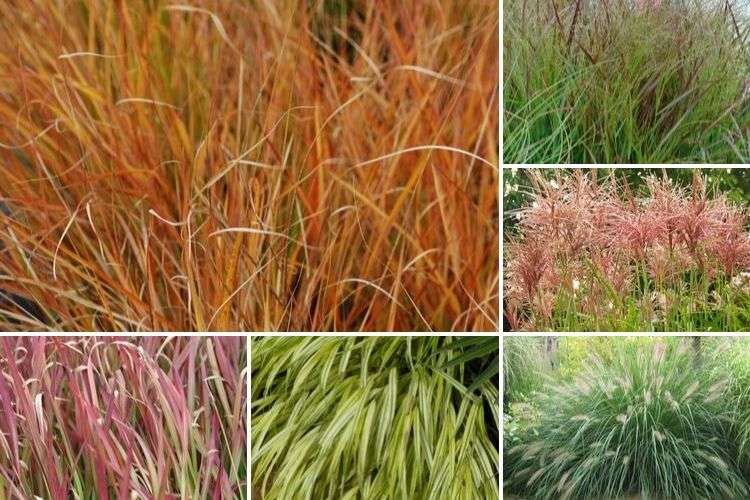
Our favourites for autumn:
- Stipa arundinacea with green and orange foliage, and purple and silver spikelets in autumn,
- Varieties of Panicum virgatum, with light and colourful plumes in autumn, often accompanied by beautiful autumn foliage colour. You can choose between shades of blonde, purple, brown…
- The tall miscanthus structure autumn scenes with their tall upright tufts, reaching nearly 2 m, with their light pink-silver to purple inflorescences and their blonde to brown foliage.
- The pennisetums with a soft habit, whose light feathery blooms last from summer to autumn and whose foliage takes on warm and soft tones.
- Hakonechloa macra ‘Aureola’ whose spreading tufts of variegated golden foliage turn red in autumn, accompanied by reddish spikelets.
- Imperata cylindrica ‘Red Baron’ whose leaves become increasingly red as the season progresses, crimson in autumn with a light silver bloom.
Some late-flowering shrubs
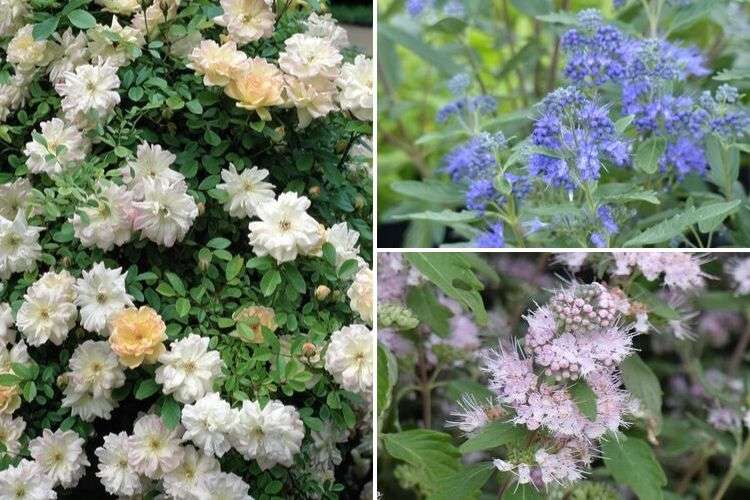
Late-flowering shrubs are quite rare, except for the repeat-flowering roses of which some may bloom as late as Christmas when autumn is mild, such as the climbing rose ‘Phyllis Bide’.
If you love blue flowers, don’t wait to plant a caryopteris, blooming between mid-August and October in clusters of small bright blue-violet flowers, on grey-green foliage. Pair it, for example, with the tireless gaura and white-flowering Japanese anemones.
To complete the colourful effects in autumn
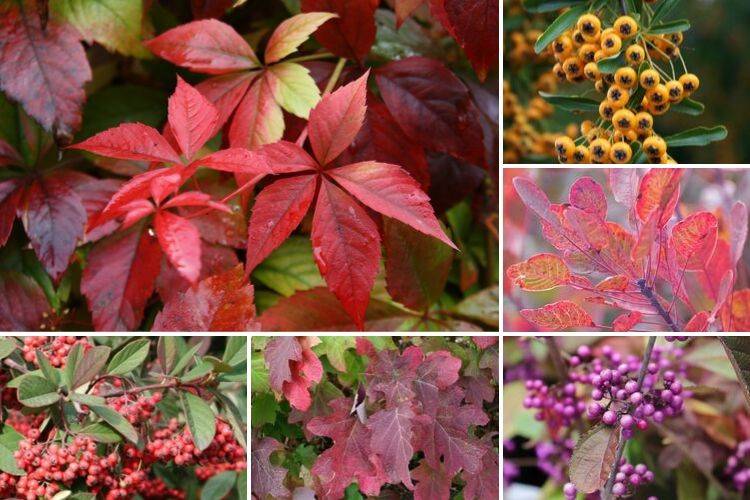
Compose varied and colourful scenes by combining these autumn blooms with fiery foliage (oak-leaved hydrangea, Virginia creeper, smoke bush, sumac, maples…) and decorative fruits (numerous among shrubs, pyracantha, cotoneaster, callicarpa, rowan, European spindle…)
After the lull in flowering during the height of summer, gardens often regain beautiful floral scenes in late summer. To prolong the pleasure into late autumn, depending on the arrival of the first frosts, you can plant perennial plants, bulbs, and bushes that bloom late in the season. Often overlooked: bulbs that bloom in autumn […]
Winter gardens are not necessarily synonymous with dry clumps, bare soil, and sad branches!
Flowering is certainly much rarer than in summer, but if you create a few scenes specifically for winter, combining interesting and colourful flowers and foliage, you will appreciate them even more. Discover the scents of winter as well...
Indispensable, the early small bulbs
They bloom almost at ground level, but what a delight! Plant them in fairly large groups, at least ten, to create colourful patches visible from afar, and place them in strategic locations, near the terrace, the front door, along the path between the garage and the house, within view of windows and French doors.
- The Cyclamen of Cos, Cyclamen coum, unfolds its round leaves, marbled with silver or solid dark green, and its small light pink to deep purplish-pink flowers almost simultaneously, at the end of winter or sometimes as early as Christmas.
- The Ipheion, Ipheion uniflorum ‘Wisley Blue’, enchants at the end of winter, from November to December when the winter is mild, with its star-shaped lilac-blue flowers.
- Among the irises, look for the small Iris reticulata, 10-15 cm tall, which bloom in February-March in light blue to dark violet or purple, and the Iris unguicularis which can flower as early as November-December, in lavender blue to dark violet.
- The Winter Aconite, Eranthis hyemalis, unfolds just above the ground, as soon as the weather becomes milder in February, with its bright yellow cup-shaped flowers set on a dark green collar.
- The Snowdrops are, of course, among the first to appear in the garden, bright and delicate at the end of winter. Plant them in groups and let them naturalise over the years. For something out of the ordinary, look for the double-flowered form, Galanthus ‘Flore Pleno’ or Galanthus elwesii, which is larger.
If you plant them in full sun, in a well-sheltered spot, the first botanical crocuses will also bloom as early as February, sometimes late January. Choose from varieties of Crocus chrysanthus, with yellow or white flowers, and C. tommasinianus, with pale blue to violet-blue flowers.
While daffodils rarely bloom before March, ‘February Gold’ deserves a mention for its bright yellow flowers on 20-25 cm stems, blooming in February as its name suggests!
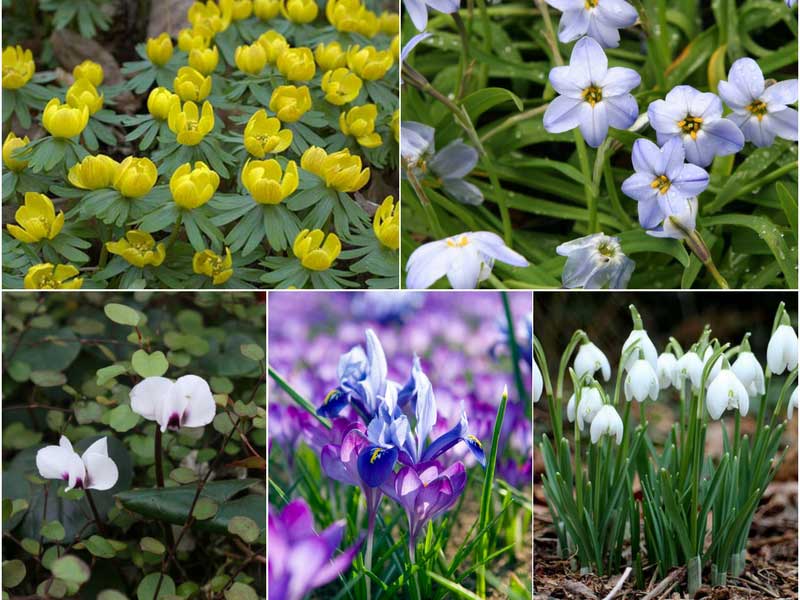 Eranthis hyemalis, Ipheion, Cyclamen coum, Iris reticulata, and Snowdrops
The winter perennials
- Hellebores are often the first perennials that come to mind for winter... and rightly so! The queen is, of course, the Christmas Rose, Helleborus niger, with its large pure white flowers, even if it is not always present for the year-end festivities. The countless and stunning hybrid hellebores that offer extraordinary colours, from white to almost black purple through all shades of pink, bloom from January or February. Original and robust, discover the Corsican Hellebore, Helleborus argutifolius, with its clusters of pale green flowers.
- Bergenias are another reliable choice for the winter garden, with their evergreen foliage often tinged with bronze or purple in cold weather, and their tight clusters of white, pink, or purple flowers. For early blooms, look for Bergenia cordifolia, which flowers as early as February.
- A dwarf shrub often classified among perennials, the Winter Heather, Erica carnea, is another ally for gardeners to enliven winter. It comes in many varieties with fine green to golden or bronze foliage, flowering white, pink, or red from December to April. It tolerates calcareous soils.
- The Pulmonarias are other perennials for late winter and early spring, combining characteristic foliage more or less punctuated or marbled with silver, and bouquets of flowers ranging from blue to pink, sometimes red. Look for the earliest, such as Pulmonaria longifolia, P. rubra, P. saccharata and their varieties.
- Pansies make valuable colourful fillers, and the current selection is such that it is hard not to find something to suit your needs for a few pots or clumps along a path or against a wall of the house.
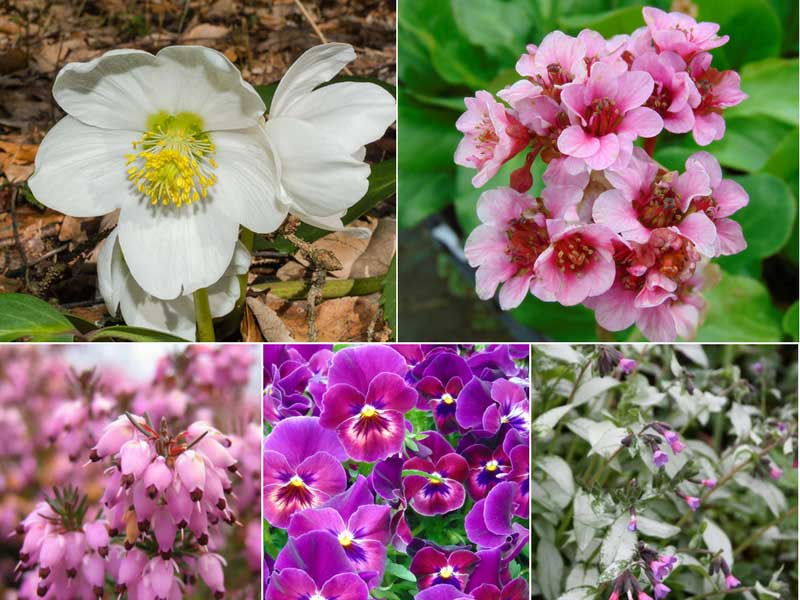 Helleborus niger, Bergenia, Erica carnea, Pansies, and Pulmonaria
Little-known shrubs, winter stars
Often, gardeners design shrub plantings for the beautiful season. It would be a shame to overlook those that bloom and bring colourful touches in the heart of winter!
- The laurel-tin, Viburnum tinus is a must-have, combining evergreen foliage and clusters of small pale pink flowers from autumn to spring.
- Another Viburnum, with deciduous foliage, Viburnum bodnantense, deserves to be planted for its clusters of small waxy pink flowers, fragrant, blooming at the slightest thaw between autumn and spring.
- The Witch Hazels are also among the winter stars, with their astonishing bright yellow to warm orange flowers on bare wood.
- Little known, the Chimonanthus (Chimonanthus praecox) also reveals itself in winter, with its cup-shaped sulphur-yellow flowers, fragrant, on bare branches.
- Very robust, with leathery and spiny foliage, the Mahonia Charity (Mahonia x media ‘Charity’) unfolds its compact clusters, bright yellow, between December and March.
- To discover, a bush honeysuckle, Lonicera fragrantissima, with clusters of very fragrant cream-white flowers throughout winter.
- With discreet white fragrant flowers, the Sarcococca also offers dark, glossy foliage.
- The Skimmias with beautiful glossy foliage are interesting in winter, either for their colourful berries on female plants, or for their dark red flower buds in winter for male forms like Skimmia japonica ‘Rubella’, blooming in spring with white flowers.
- Essential and so easy, the Winter Jasmine (Jasminum nudiflorum) is more of a climber, with light yellow flowers dotting the bare stems all winter and sometimes as early as November when the weather is mild.
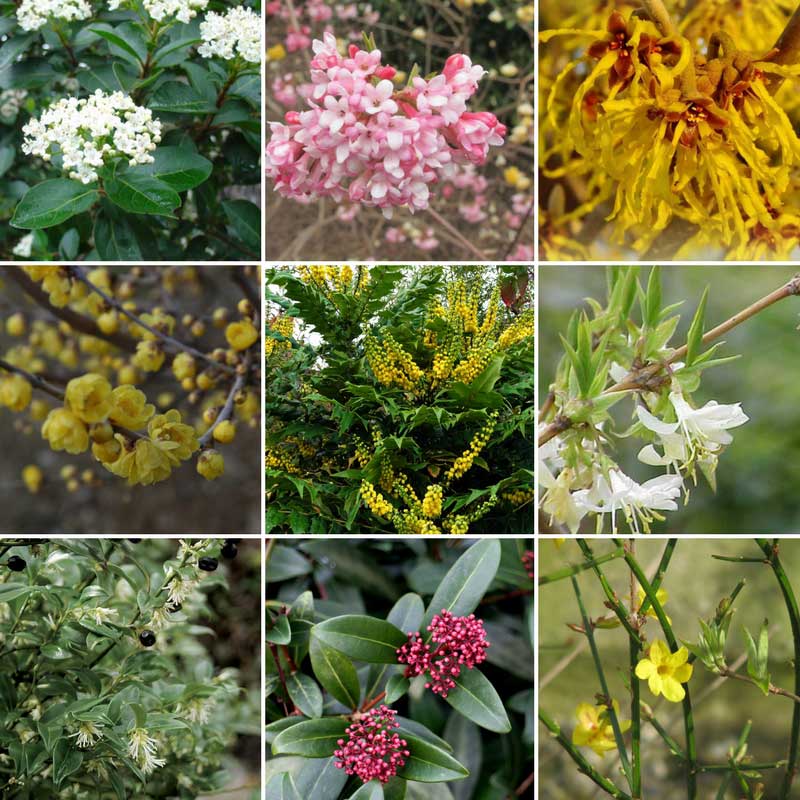 Viburnum tinus, Viburnum bodnantense, Witch Hazel, Chimonanthus praecox, Mahonia, Lonicera fragrantissima, Sarcococca, Skimmia, and Jasminum nudiflorum
Foliage, bark, graphic silhouettes... think of these too to enliven the winter garden!
To animate and structure the garden in winter, be sure to introduce evergreen foliage (box, cotoneaster, yew...), original silhouettes once bare, like that of the contorted hazel, colourful or beautifully exfoliating barks like those of certain Prunus, maples, birches.
Do not rush at the end of autumn to cut back perennials. Some clumps or dried inflorescences retain their beauty until the heart of winter, especially when highlighted by frost. This is often the case with large grasses, large sedums, and certain asters with very small flowers... there will always be time to cut them back at the end of winter!
Winter gardens are not necessarily synonymous with dry clumps, bare soil, and sad branches! Flowering is certainly much rarer than in summer, but if you create a few scenes specifically for winter, combining interesting and colourful flowers and foliage, you will appreciate them even more. Discover the scents of winter as well… Indispensable, the early […]