I had the opportunity to learn basketry a few years ago while volunteering with a basketmaker who grows willow. This technique, which consists of weaving plants, is an art accessible to everyone and requires little in the way of resources (and few tools)... Especially as plants suitable for weaving are easy to find in the wild! There is something quite fascinating about assembling the rods, passing them over and under one another, and watching an object gradually take shape. Basketry is a task of patience. It is a craft that is disappearing, and basketmakers have become quite rare in France, because the craft is time-consuming and therefore costly... However, for personal use it is still possible to have fun weaving willow!
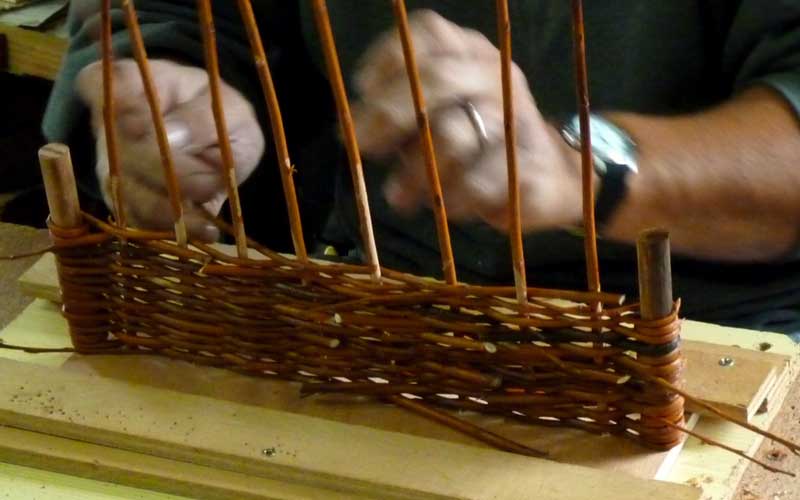
Basketry consists of weaving rods by passing them from one side to the other around fixed vertical rods that serve as uprights (photo Marthe Lelievre)
Various uses in the garden
Basketry is often used to make willow baskets, but you can also create many items for the garden: a nest box for birds, supports for climbing plants, partitions to separate different parts of the garden, small edging for flowerbeds... Hedges, screens, arbors, pergolas, tipis, playhouses for children... Just let your imagination run free! Basketry makes it possible to create genuine works of art and plant sculptures. Possibilities are endless, and woven objects fit easily into garden furniture.
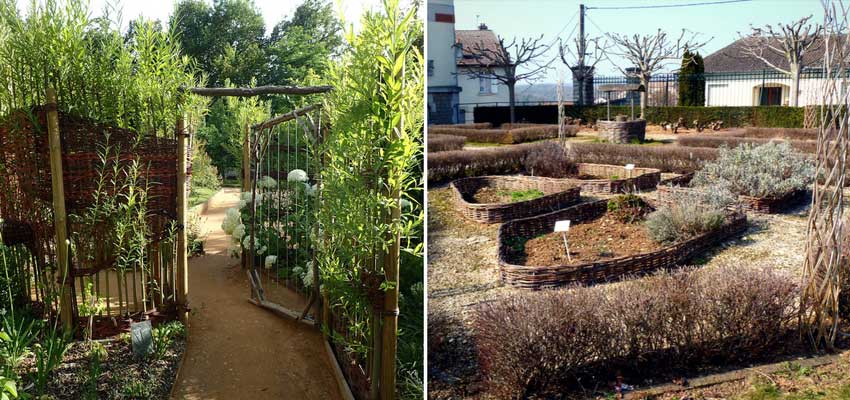
Willow fits easily into garden settings! Left, in the garden "A la recherche du lupin blanc", at Chaumont-sur-Loire Garden Festival (2017). Right, in front of Ecole Nationale de vannerie de Fayl-Billot (photo Ji-Elle).
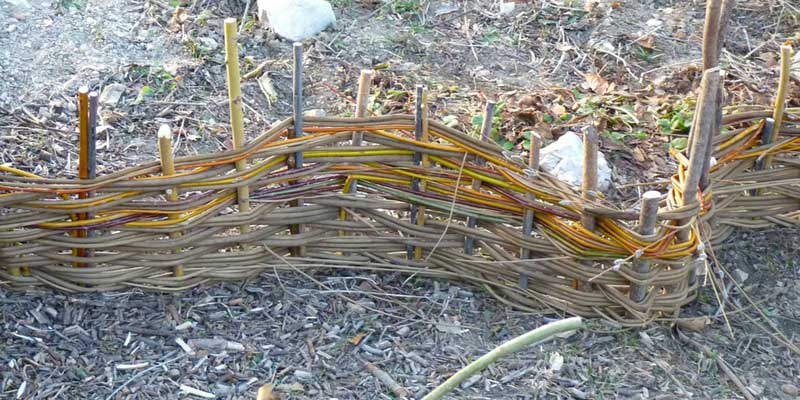
A small willow edging can be integrated into a garden to define flowerbeds, for example (photo: Hugues-Mircea Paillet)
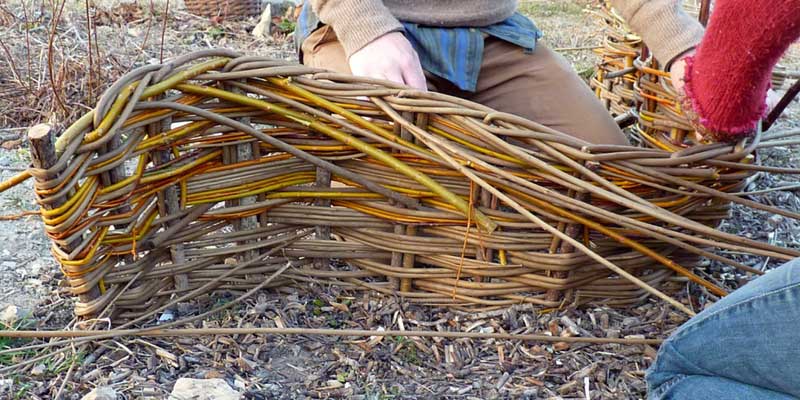
Weaving a willow edging (photo: Hugues-Mircea Paillet)
Grow your own willow?
The willow rods used for basketry are actually branches of willow intended for weaving. It is perfectly possible to grow willow for this purpose. Many varieties exist, which allows you to obtain different colours! Species commonly used are Salix triandra, Salix purpurea, Salix alba and Salix viminalis, and one of the best varieties for basketry is Salix triandra 'Noir de Villaines'. Willow multiplies very easily by propagation by cuttings, and many willow growers and basketmakers sell cuttings. Feel free to grow willow: besides providing material for weaving, it can be used for medicinal purposes (its bark contains salicylic acid, close to aspirin), for RCW (mulch) or as a rooting stimulant to help your cuttings take root (willow water can replace rooting hormone). Plant preferably at the end of winter, around March, in deep soil that stays relatively cool in summer. You can also buy willow rods ready for weaving directly from basketmakers! You can find raw, natural willow rods and rods from which the bark has been removed to obtain a white-coloured rod.
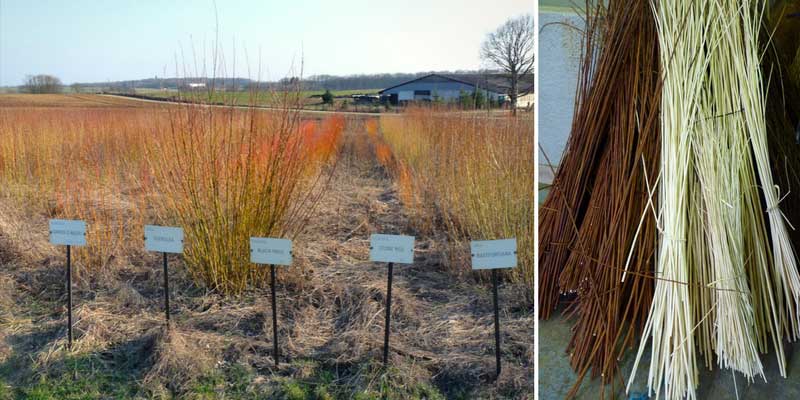
A willow bed: willow cultivation intended for basketry (photo Ji-Elle) / Bundles of willow rods ready for weaving (photo Marthe Lelievre). White rods are peeled willow, from which bark has been removed.
... or harvest it in the wild?
You can easily find wild willow suitable for weaving. Species used for basketry (Salix alba, S. purpurea, S. viminalis and S. triandra) grow wild in France, mainly along watercourses. You can look for and harvest them. Choose the longest, straightest, relatively thin branches. And although willow is by far the most used species in basketry, many other plants can be used! These include hedge clematis, dogwood (Cornus sanguinea), hazel, honeysuckle, hops and rush, to name a few. You can even mix several species to obtain different colours, for example by using some dogwood branches within a willow structure.
Harvesting is done from late November–early December through to February, when the plant is dormant (leaves have fallen and sap has not yet risen).
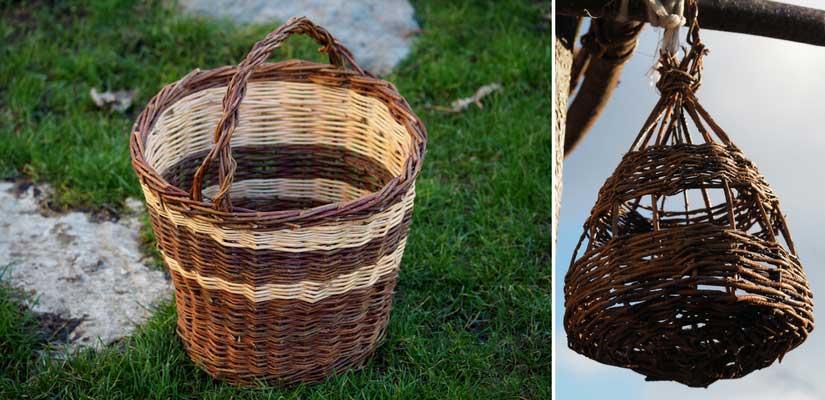
A basket I made / a nest box for birds
Further reading...
Basketry is a somewhat technical art... If you are interested, many basketmakers offer workshops or training! Also discover books written on the subject.
- La Vannerie Sauvage, by Bernard Bertrand, published by Editions de Terran. A superb book in two volumes that explains how to weave wild plants. Each volume comes with a DVD.
- Ecole Nationale d'Osiériculture et de Vannerie in Fayl-Billot, unique of its kind, offers courses that prepare students for the profession of basketmaker.
- Website of Tresselavie, which offers workshops and training
- Website of L’Oseraie du possible, a basketmakers' collective
I had the opportunity to learn basketry a few years ago while volunteering with a basketmaker who grows willow. This technique, which consists of weaving plants, is an art accessible to everyone and requires little in the way of resources (and few tools)… Especially as plants suitable for weaving are easy to find in the […]
In the garden, hazels offer their innumerable pendulous aments, before the willows enter the dance with their silky inflorescences... The season of aments is upon us! Yellow, purple, silver... they are very decorative and spectacular in the setting sun. I invite you to discover some of these catkin-bearing shrubs, some very well known, others much less so.
1. Hazels
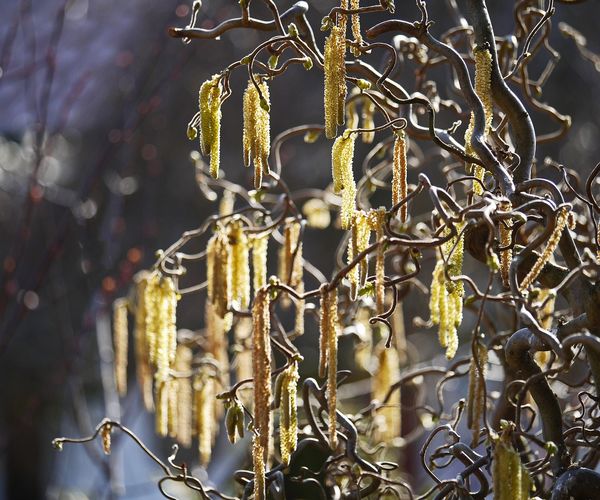
The hazel aments are highlighted by the sunlight. Here: Corylus avellana 'Contorta'.
At the moment, hazels are dressed in their finest green-yellow or reddish aments depending on the species.
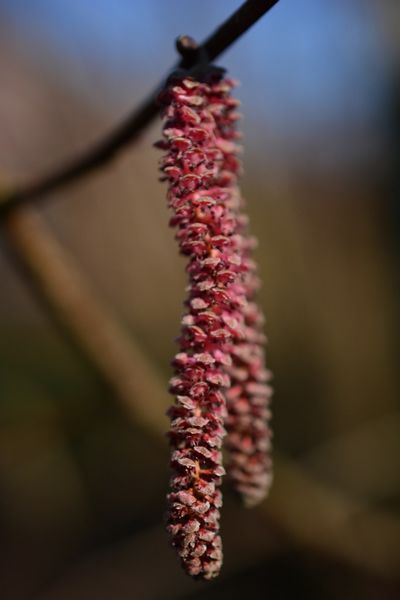
The purple aments of Corylus maxima 'Red Majestic'.
This hazel with sinuous branches has the remarkable feature of spring foliage that is vividly purple and reddish aments of the finest effect! It can perfectly be included in an informal hedge. Its only fault (if there is one) is that it does not stay purple all season, but you should know that it makes up for it with its autumn colours.
2. Willows
They are undoubtedly my favourites when it comes to aments! To begin with, their early flowering provides pollen and nectar in abundance as winter ends. Bees buzz with happiness! Next, their silky aments are really beautiful and photogenic. Finally, willows thrive in my damp soil, which is a considerable advantage. I always advise my customers to favour plants suited to their garden! It saves many disappointments...
- Salix caprea
How can one talk about aments without mentioning the famous goat willow? It is the very first to flower!
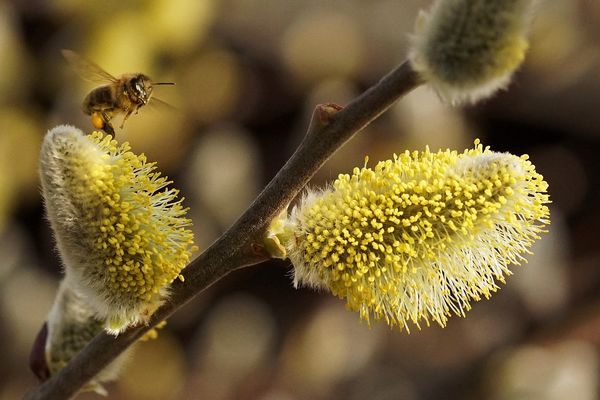
Bees delight in foraging the willows' aments (Salix caprea).
The variety 'Kilmarnock' with trailing branches becomes adorned with large silver aments in February–March.
It is also known as the willow "Wolf's Claw" and is really easy to grow. My specimen, derived from a cutting a gardening friend gave me, is now several years old. It is a handsome shrub about 3 m tall which I prune to keep a transparent habit so that a few sunbeams reach the plants at its base. Each year, in March, I photograph its incredible black aments with reddish anthers heavily visited by foragers.
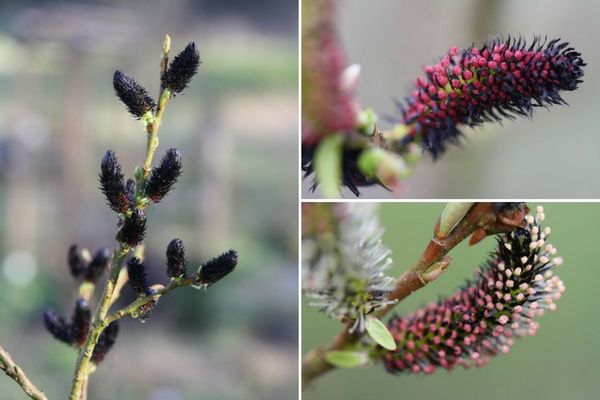
The distinctive black aments of Salix gracilistyla (Melanostachys).
It flowers a little later than the other willows since its catkins appear in March–April. This willow offers fabulous dark pink aments that are the talk of bouquets. It has a rightful place in a hedge, but I find its beauty is better showcased when planted as a standalone specimen, positioned so that the sun’s rays rising or setting illuminate the catkins.
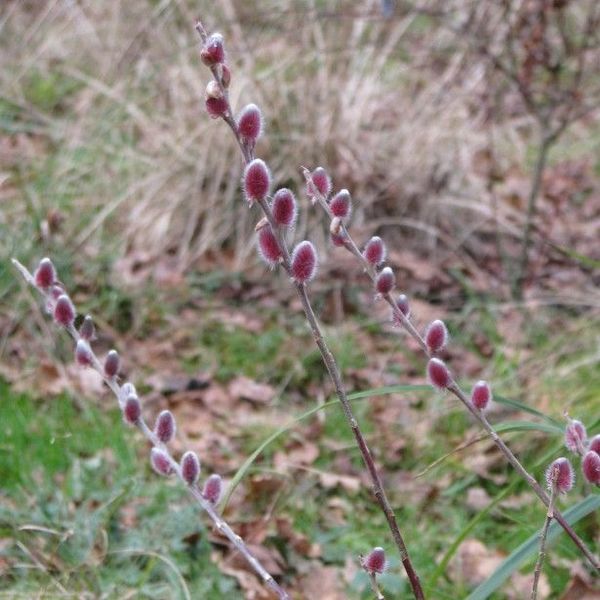
The softness of the pink aments of Salix chaenomeloides 'Mount Aso'.
3. Garrya elliptica
Little known, the Garrya elliptica features long grey-silvery aments shaded with pink that stand out well from its evergreen foliage, in February–March.
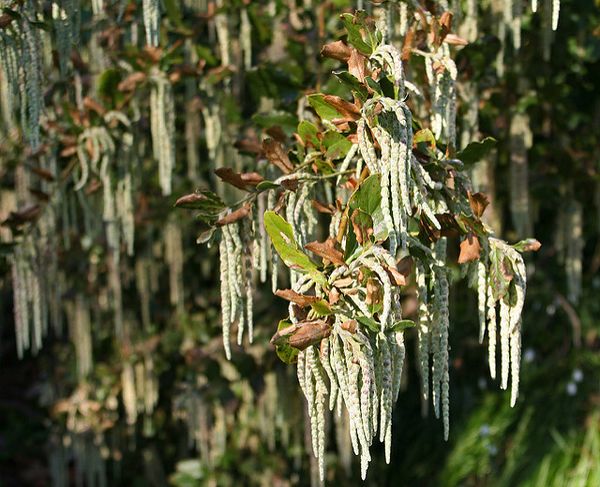
Garry Elliptica (Photo Andy Andrew Fogg on Flickr)
Michael once dedicated a post to it: "The Garrya elliptica, a flowering shrub in winter." Ten years ago, I would probably have said that my climate wouldn’t suit it given its somewhat borderline hardiness (-12°C) for the Ardennes. Today, given that we hardly have proper winters any more, I could probably give it a go. But first, I’d need to find it a well-drained spot, which isn’t easy! In short, I’d be tempted to train it against a wall... Now to find a wall still available!
4. Stachyurus praecox
Even more obscure, Stachyurus praecox also releases long strings of pale yellow beads in March–April. I still remember the first time I discovered this wonder. It was in the exquisite book by Princess Sturdza, "A Garden for All Seasons".
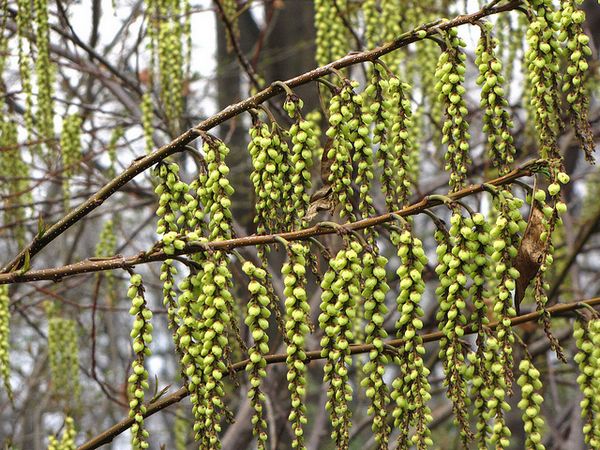
Stachyurus praecox (photo Katja Schulz on Flickr)
The variety 'Celina' offers charming cream-white bells in March.
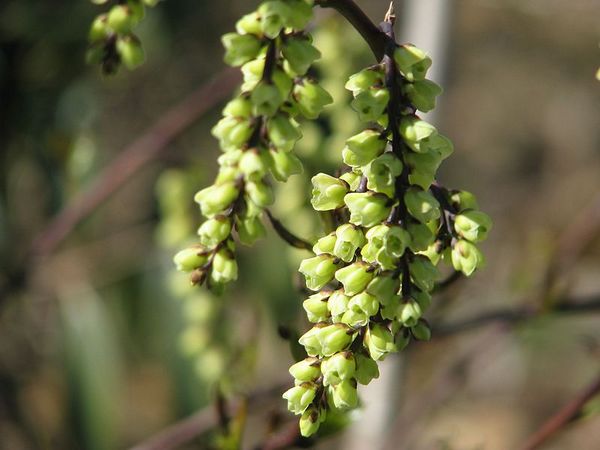
Inflorescences of Stachyurus chinensis 'Celina' (photo Peganum on Flickr).
The housing crisis is looming! I’ll have to push the garden's boundaries to plant all my desires... But I imagine that’s the concern of all garden enthusiasts!
In the garden, hazels offer their innumerable pendulous aments, before the willows enter the dance with their silky inflorescences… The season of aments is upon us! Yellow, purple, silver… they are very decorative and spectacular in the setting sun. I invite you to discover some of these catkin-bearing shrubs, some very well known, others much […]
Picking your own fruit straight from the tree is a dream for many food lovers... even if they don't have the space for a full orchard. Why not combine the useful with the edible and plant a fruit hedge?
Fruit trees and berry bushes can all be planted in an edible hedge, regardless of the size of your garden.
Which fruit trees or bushes should I plant in my edible hedge?
Of course, the ideal is to design your fruit hedge according to your tastes (don't plant a medlar if you're not the type to eat over-ripe fruit!). Cherry, Apple, Pear, Plum trees, as well as Hazelnut, Raspberry, and Currant bushes are all classics. I don't think it's necessary to elaborate on these. Moreover, nature... and horticulture often hold delightful surprises, including in terms of taste. Here’s a small selection of trees or bushes, less common options chosen for their good productivity, originality, or the nutritional value of their fruits.
- The Black Elder 'Haschberg' (Sambucus nigra) is a highly regarded variety for its high productivity. However, you'll need to make a choice: pick its flowers in May to prepare fritters, make the famous elderflower lemonade, or wait until September to harvest its berries, which make delicious jams. This is a vigorous shrub that grows quickly, typically reaching a height of 4 metres and a width of 2 metres... but it prunes well and even forgives mistakes!
- The Thornless Blackberry (Rubus fruticosus) offers only advantages: fruit without the scratches! It can be easily trained on a trellis, making harvesting much easier. Among the many varieties, I particularly like 'Little Black Prince', a dwarf and compact variety that doesn't exceed one metre in height, as well as 'Thornfree', which is fast-growing, productive, and produces large fruit. Their only downside: children will help themselves long before you do.
- The Fig 'Icecrystal' (Ficus carica), which has a low growth habit (about 2 metres high and wide), is quite hardy, ideal for areas north of the Loire, and offers two fruiting periods per year. And, as the icing on the cake, its foliage, which is very lobed, is particularly ornamental. In heavy soil, be sure to plant it on a mound. Like all figs, it dislikes humidity.
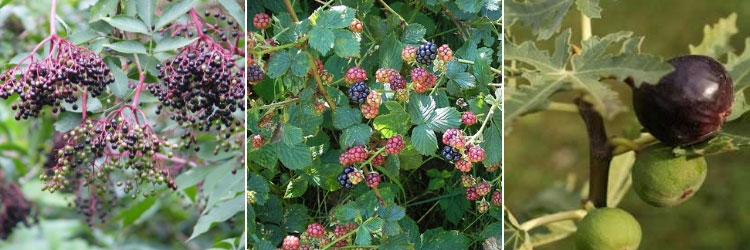
Black Elder 'Haschberg', Thornless Blackberry, and Fig 'Icecrystal'
- The "Mayberry" or Honeyberry (Lonicera caerula kamtschatica) is a bush honeysuckle with edible fruit. It hails from Siberia, which speaks to its hardiness... but it is not self-fertile, so you need to plant at least two for its lovely white flowers to produce, from mid-May, small, pruinose blue fruits, whose flavour lies somewhere between blueberry and kiwi. These prunes can be enjoyed fresh or dried, in juice, jam, or jelly.
- The Goji or Wolfberry (Lycium barbarum) is best known for its red berries with numerous properties (rich in vitamins, minerals, and antioxidants). Its origin is controversial (China? Mediterranean?), but I won't delve into the debate... because, in the end, it grows very well here! Its size varies depending on the variety: 'Sweet Lifeberry®' and 'Instant Success®' form compact shrubs (1.5 metres in all directions), while the species type can reach 3 metres under favourable conditions. Note that the purple flowers of the Wolfberry are charming and fit well in an ornamental garden.
- The Jostaberry or Caseille (Ribes x) gets its name from the contraction of blackcurrant and gooseberry. It’s the ideal fruit for those who can’t decide and for small gardens that require a choice. Self-fertile, this small fruit tree manages well on its own and forms a beautiful bush, without thorns, reaching 2 metres at maturity. Its black berries, larger than those of blackcurrants, develop a tart flavour... and can be enjoyed, as you might have guessed, like blackcurrants or gooseberries.
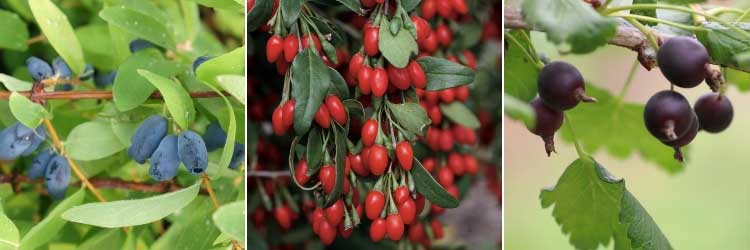
Mayberry, Goji, and Jostaberry
- The Sea Buckthorn (Hippophae rhamnoides), not to be confused with the Strawberry Tree (whose fruits are also edible), is not just popular with chickens! This is a low-maintenance thorny shrub that produces decorative orange berries and, most importantly, is very high in vitamin C, which can be consumed fresh, in compote, jam, or syrup. Self-fertile, the variety 'Friesdorfer orange' is now available in our catalogue, so don't miss out!
- The Nashi (Pyrus pyrifolia) is also one of those fruit trees that could be described as "2 in 1": it’s no wonder it’s called, interchangeably, "Apple Pear" or "Pear Apple." It is not the result of hybridization, as it is actually an Asian pear that produces round fruits like apples, with a taste closer to that of pears. Some varieties like 'Shinseiki' or 'Nijisseki' are self-fertile. Non-self-fertile varieties can be pollinated by a different variety or by the Williams Pear.
- The Serviceberry, particularly the variety Saskatoon berry (amelanchier alnifolia), is a variety that comes straight from the USA. Hardy and robust, it forms a small shrub about 3 metres high and can produce up to 8 kg of sweet berries.
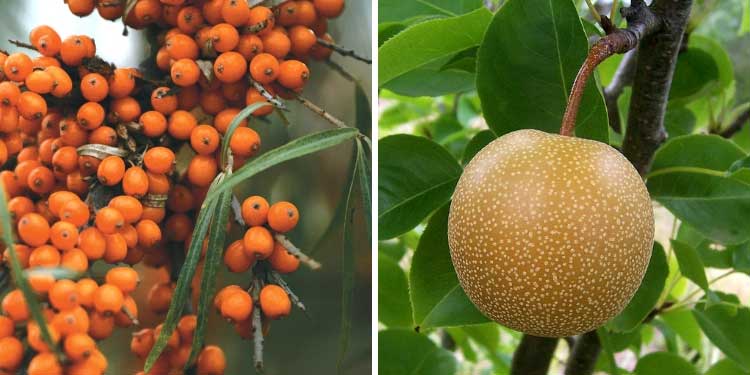 Sea Buckthorn and Nashi
And to top it all off, don't hesitate to plant some herbs (Mint, Lemon Balm, Golden Oregano) at the base of your edible hedge; they will create a lovely border and help reduce weeding.
Planting a fruit hedge: some tips
Unlike traditional hedges, the primary goal of a fruit hedge is not to create a green wall but to harvest fruit.
To achieve this, when planting, allow for generous spacing to:
- let each tree or bush fully express itself,
- allow light to penetrate,
- facilitate pruning, which should be tailored to each fruit tree to encourage fruiting.
Depending on the size and layout of your garden, fruit hedges can be installed:
- on the perimeter, to mark the property line or as a boundary (discuss with your neighbours... when it comes to fruit, creating a hedge and especially sharing the harvest is generally a well-received idea)
- within the garden itself to define spaces... and ideally, in two rows and staggered to save space in length while also achieving a beautiful natural appearance.
Picking your own fruit straight from the tree is a dream for many food lovers… even if they don’t have the space for a full orchard. Why not combine the useful with the edible and plant a fruit hedge? Fruit trees and berry bushes can all be planted in an edible hedge, regardless of the […]