Floriferous, understated, and sturdy, this sums up the qualities of this essential shrub for summer gardens.
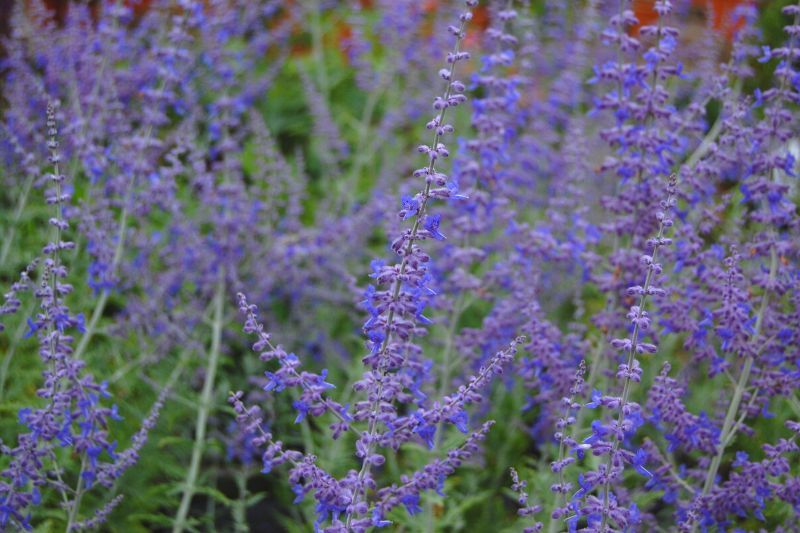
The 'Blue Spire' variety is one of the few plants that flowers continuously from June to September. It forms a large bushy clump of 1.20 m in height and produces fine stems adorned with slender spikes laden with lavender-blue flowers, exceptionally generous in number. Its small, dentate, grey-white foliage is highly aromatic, indicating excellent adaptation to dry, even arid summers. Airy and luminous, the Afghan sage fits seamlessly into sunny borders, thriving in well-drained, rather poor soils.
Planted in my garden near Aix-en-Provence, in a border for 7 years, this variety grows effortlessly, without watering, and thrives regardless of conditions. Resistant to wind, cold, and severe drought, indifferent to the presence of lime, it is for its incredible robustness that I selected this variety. It enlivens the garden with its steel-blue plumes alongside gauras, bushy sages, lavenders, and California fuchsias.
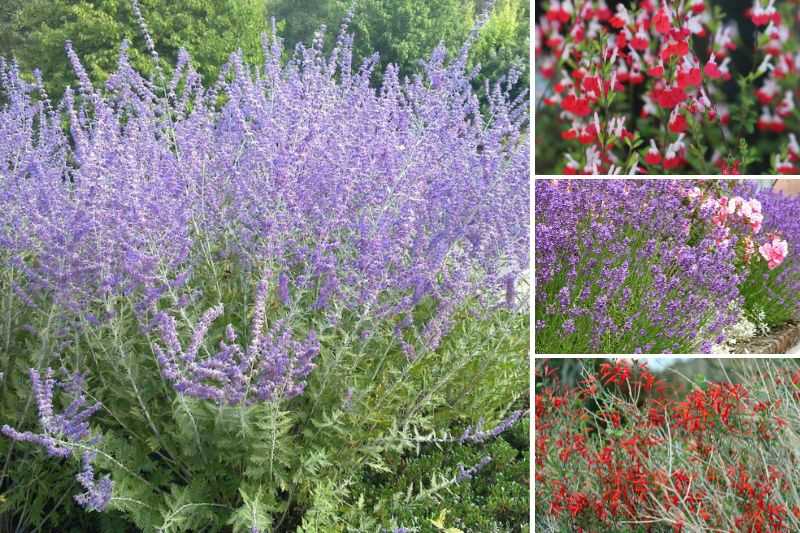
This is a plant that requires no maintenance other than a severe pruning with shears at the end of winter: I simply cut it back to 15 cm above the ground. One last piece of advice, overly fertile soil will lead to more vigorous growth but will harm the density of the plant, as the bush will tend to open up. Don’t hesitate to plant it in soil mixed with sand and gravel.
Its strengths:
- Grows in full sun
- Drought-resistant
- Robust against diseases
- Requires very little maintenance
- A plant of great simplicity
Floriferous, understated, and sturdy, this sums up the qualities of this essential shrub for summer gardens. The ‘Blue Spire’ variety is one of the few plants that flowers continuously from June to September. It forms a large bushy clump of 1.20 m in height and produces fine stems adorned with slender spikes laden with lavender-blue […]
Today marked start of the famous Chelsea Flower Show in England. This festival of plants and gardens, held each year at this time, also gave its name to a green pruning technique for perennial plants practised in mid to late May and nicknamed by skilled English gardeners "Chelsea Chop". It can be applied to many summer-flowering perennials or late-flowering perennials that branch, such as Heleniums, sedums, asters, Helianthus, and even Phlox paniculata or Perovskia!
This green pruning of perennial plants has two major advantages:
- Pruned plants are stockier and more branched, and better withstand rain and wind (and no, unfortunately this isn't just an English-climate issue... it's the same here in the North!) — this prevents them from flopping onto neighbouring plants once laden with flowers, and can reduce or even replace need for staking of tall perennials.
- Flowering of cut-back plants is later, so this technique helps stagger and prolong flowering across a single plant or a whole border. You can easily prune only half of a plant or every other stem; the pruned stems will then flower after the unpruned ones, extending the display. In a large border where perennials are planted in groups of the same variety, you can also choose to cut back only some specimens, which will flower after the uncut plants. This extends the overall decorative effect: a very useful technique in medium and small gardens like mine, where every plant must "earn its place" and long-flowering plants are much sought after.
How to perform the "Chelsea Chop"?
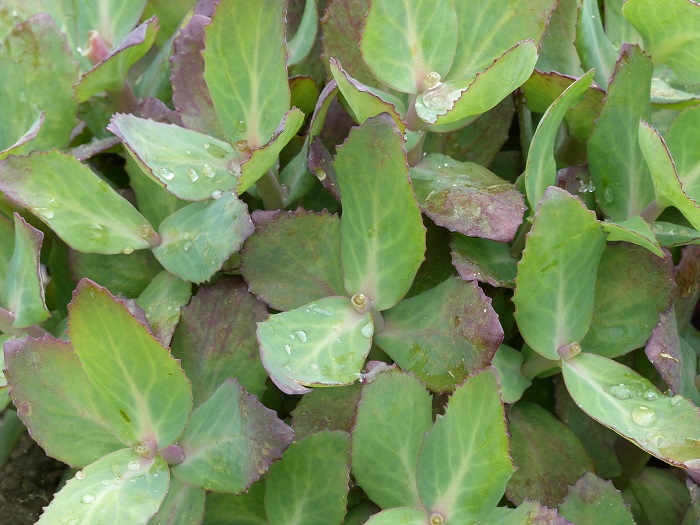
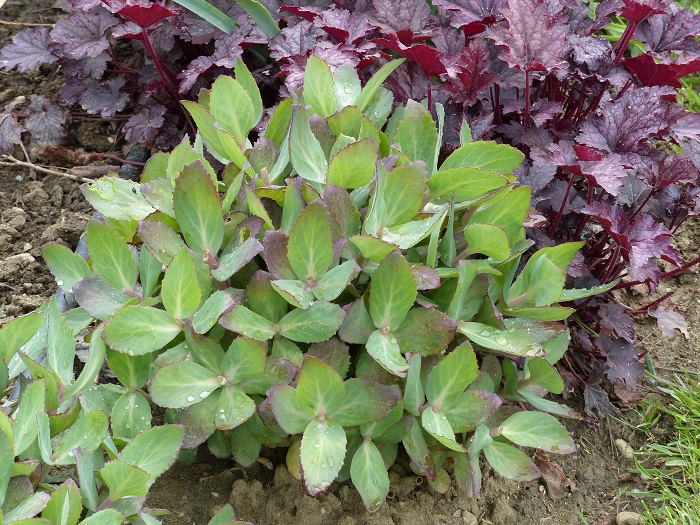
Nothing could be simpler! Walk round your garden now to identify plants that flower in summer (from July) and late season (until October) and cut them back by one third of their height. You can even reduce some plants by half to obtain compact specimens, particularly in the front of borders. Use a well-sharpened shear to make a neat rounded cut on clumps of finely-leaved perennials (asters, Heleniums) or a pruning shear if you choose to cut every other branch. For perennials with larger leaves such as tall sedums, favour a stem-to-stem pinch with the pruning shear for a cleaner finish.
That is not the case this year, but when spring is dry, a good watering after pruning will benefit cut-back perennial plants. Very soon, buds in the axils of the leaves directly below the pruning wound will give rise to 2, 3, 5, 7... new stems, a little slimmer but nevertheless sturdy, which will produce a multitude of flowers a few weeks later! Finally, if you wish to delay a plant's flowering even more significantly, you can repeat the operation once or several times up to 6–8 weeks before the plant's natural flowering period.
Finally, discover this technique on video with Olivier: The Chelsea Chop.
Today marked start of the famous Chelsea Flower Show in England. This festival of plants and gardens, held each year at this time, also gave its name to a green pruning technique for perennial plants practised in mid to late May and nicknamed by skilled English gardeners “Chelsea Chop”. It can be applied to many […]