Today, I am angry! Angry but also weary because, along the roadsides, in parks, and even in gardens, it’s always the same horror film that starts again: “Chain saw massacre of trees…”
Despite the awareness campaigns by arborists, we are coppicing, pruning too severely, cutting back too short, topping, mutilating... sometimes even tearing out entire parts with a large machine... Any old how and at any time!

I could, at a pinch, forgive my neighbours who are certainly not informed. However, I find it much harder when it comes to certain professionals who are supposed to practice a trade for which they have been trained.
Why does severe pruning harm trees?
These mutilations, let’s not be afraid of the words, weaken or even kill trees by causing rot in the central wood and making them vulnerable to fungal and parasitic attacks.
The structure of the tree itself is compromised, and the production of plant hormones is "disrupted," producing new shoots in all directions. Embolisms form, stopping the circulation of sap in certain areas.
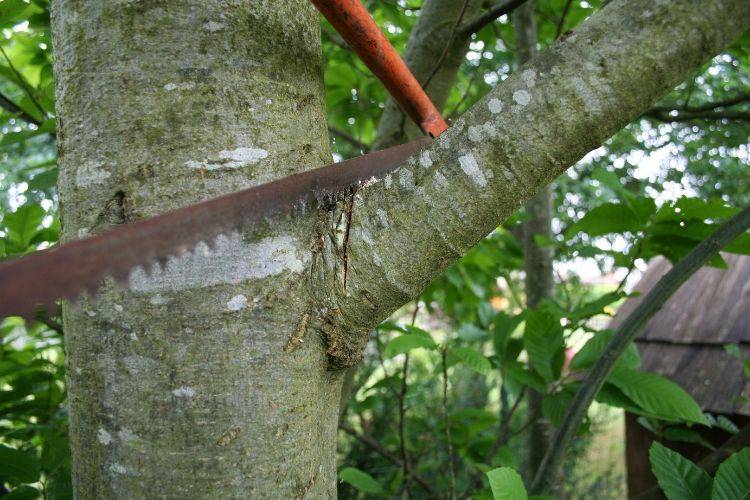
Please note: this type of pruning is also detrimental to wildlife as the tree can no longer provide shelter and cover for a good season, or even longer if the tree does not recover. Especially if the pruning occurs during the nesting period of birds: which is now prohibited by a European directive! However, in the case of pollarded trees, the tree stumps of our countryside (willows and other species), it’s actually the opposite that happens. Indeed, the tree thus (mis)treated will gradually hollow out to provide shelter for various animals (Little Owl, tits, small mammals, bats, ...), food for wood-boring insects and fungi and lichens. It can even provide a substrate for the proliferation of some plants. A true mini-ecosystem!
Should we prune trees?
"When and how should I prune?" This is the eternal question posed by many gardeners when planting a tree.
But isn’t the better question: "Should I prune?"
Without falling into anthropomorphism, a tree is a living being, and cutting off pieces of it clearly does not do it any good. Ultimately, it depends on the piece... A twig here and there: all is well. Cutting off a branch the diameter of a pipeline or removing all its branches: hello damage, as this opens the door to chaotic development and various fungal diseases.
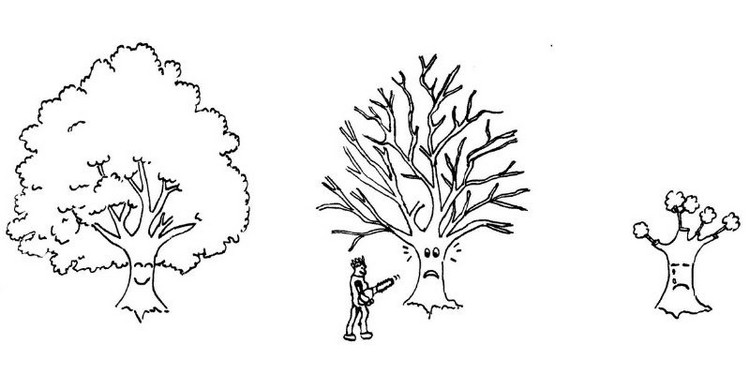
So, the answer to the question is yes... and no. A tree does not need you to live. It has been taking care of its little affairs long before Homo sapiens became this invasive and harmful species.
But...
Pruning, a helping hand for the tree
However, pruning, when done with respect for the tree and at the right time, does indeed offer significant advantages:
- Sanitary first: removing dead wood and damaged branches, lightening the canopy, ... The tree will present fewer openings to potential diseases and will be more aerated. Removing dead wood also provides a safety aspect. If the tree borders a busy road or hangs over a school, for example, it is advisable to avoid unexpected branch falls.
- Aesthetic: balancing the canopy, removing the lowest branches, ... In their younger years, trees sometimes have a "chaotic" growth (at least in our minds!), and pruning can help guide this growth to give it a more "tree-like appearance" quickly.
- Volumetric: reducing the volume and spread that a tree can take on once well established in its life. One must always consider the adult size of a plant when planting it. Moreover, there are increasingly more dwarf varieties that will prevent the need to drastically cut back a beautiful tree, ultimately turning it into a sort of giant bonsai.
Why not trying transparent pruning?
Princess Greta Sturdza understood all this well when she embarked on the idea of transparent pruning in her "garden" at Vasterival.
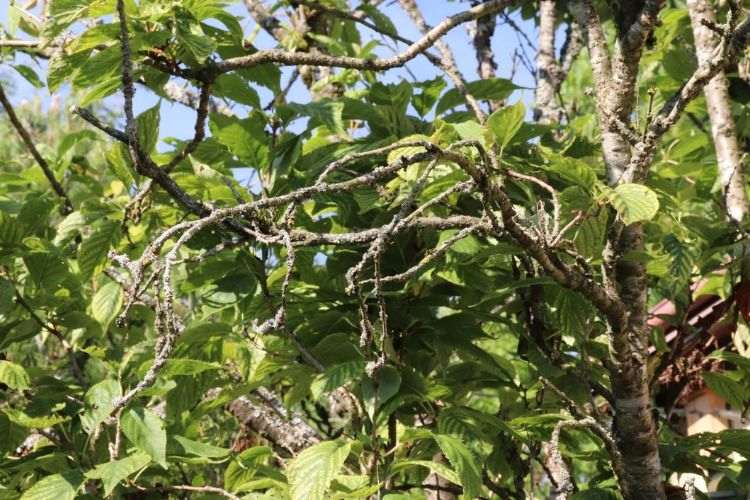
This gentle pruning allows, in addition to removing dead or diseased parts, to balance and lighten the canopy, which brings undeniable aesthetic appeal but above all provides light and rainwater to the plants below. Furthermore, this transparent pruning allows both the visitor's gaze to pass through the garden and the wind, thus reducing accidents due to storms.
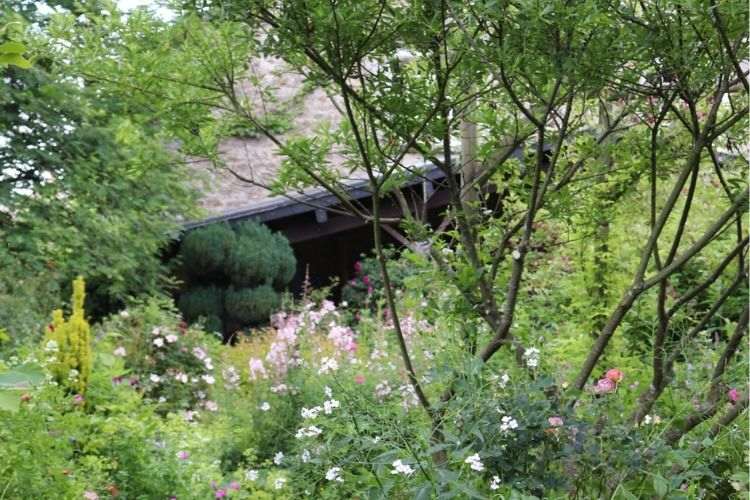
If this type of pruning interests you, we recommend visiting the results at the Vasterival garden in Normandy and reading the French book by Dominique Cousin: "Transparent Pruning" published by Ulmer.
The best pruner is the wind...
(Anonymous author)
In conclusion...
You will have understood, pruning trees is sometimes necessary, of course, but it requires understanding how a tree grows and what suits it best so that it can survive and thrive for many years.
Let’s avoid as much as possible trauma to our dear trees by cutting only rarely, always wisely and with good tools. And let’s also be calm and thoughtful in action: "When in doubt, abstain or... come back another day". That branch may not have been so problematic after all...
Finally, if you have doubts, consult a professional. A good one! Indeed, times are changing (slowly…) and so are people (a bit). More and more tree surgeons practice gentle pruning and think about the best way to keep trees in good health while only intervening when absolutely necessary. Don’t hesitate to use their services!
Today, I am angry! Angry but also weary because, along the roadsides, in parks, and even in gardens, it’s always the same horror film that starts again: “Chain saw massacre of trees…” Despite the awareness campaigns by arborists, we are coppicing, pruning too severely, cutting back too short, topping, mutilating… sometimes even tearing out entire […]
You may have noticed that last spring, articles became scarcer on the blog... To be honest, we experienced what we modestly call "a period of rapid growth", which means it was hot, very hot indeed! To tell you the truth, it felt like all the gardeners in France and beyond had decided to frantically place orders. Let’s just say that everyone was on deck, and even the boss was preparing the parcels. As a domino effect, those who were, like me, a bit "hidden" behind their advice sheets found themselves responding to emails from worried, even desperate gardeners facing their dying plants. This sometimes challenging experience was rich in lessons, as I can confidently say I now know how our clients manage to kill their plants in their gardens!
Here’s how they go about it!
1) They use acidic soil, pure, preferably
Using acidic or heather soil, we agree, starts from a good intention: to provide an appropriate substrate for acidophilous plants (like Japanese Maples, rhododendrons, hydrangeas...), which need a soil with an acidic tendency (pH between 4 and 6.5) to thrive. It’s also a logical approach because in the term "heather soil plants," there is "heather soil." Finally, if the local garden centre sells it, it must be good to use! Well, believe it or not, it’s not, because heather soil is a substrate that seems to have been invented to kill plants.
Indeed, heather soil, which contains a significant amount of blonde peat, is certainly acidic but it is also very low in nutrients. Moreover, when it is soaked it often retains too much moisture, and when it is dry, it is nearly impossible to rehydrate; water just runs off it and does not penetrate the heart of the plant. As a result, it is impossible to properly water a plant in pure heather soil. And worst of all, the plant that manages to grow will just struggle and eventually die due to a lack of substantial nutrients!
2) They water every day, a little... or every day, a lot... or not at all.
80% of replanting issues are due to overwatering or underwatering.
The problem is that an overwatered plant shows roughly the same signs as a plant that is not watered enough: wilting leaves that dry out and eventually fall off. Faced with these symptoms, the first reflex of inexperienced gardeners is to water again, more often and more abundantly... until death ensues, or nearly. Those who do not water generally do not speak up: they often realise their neglect when it is really too late and no rescue measures are feasible. In truth, I think they feel a bit ashamed.
Our advice for proper watering is simple: to know if your plant needs watering, touch the soil! If the soil is damp and your finger comes out muddy, it has too much water, so stop watering. If, on the contrary, your finger comes out dry and without soil, water it; it is too dry! The ideal is to keep the soil always fresh and loose, where your finger comes out slightly damp with a bit of soil stuck to it. And the hotter and drier it is, the more you should not water, but check the moisture at the base of the plant. Also consider your plants' needs: a lavender plant does not need constantly moist soil, while butterbur, planted in regular soil, does.

3) They install frost-sensitive plants... where it freezes, hard and often.
The notion of hardiness sometimes leads to very personal interpretations, bordering on the fanciful. For many gardeners, a hardy plant is a robust plant (a bit like our grandparents' furniture... so far, so good) capable of withstanding Siberian cold, everywhere in France (that’s where things go awry). Indeed, there are several degrees of hardiness, and a plant will not react the same way in all gardens... as its age, exposure, soil type, and drainage also matter.
It frequently happens that optimistic gardeners living in harsh climates like Alsace, the Vosges, or Aveyron realise their exotic garden dreams with a plethora of callistemons, Musa basjoo, or Gunnera... Generally, they call us in spring to report the failure of their plant. And, of course, we can do nothing!
To avoid this type of inconvenience, take the time to read the information contained in the plant sheets: hardiness is clearly indicated! And to learn all about hardy plants and the concept of hardiness, feel free to consult our complete guide.
4) In pots and containers, they use garden soil and rely on the sky for watering.
Sometimes it works. Often, it does not.
Growing plants in pots may seem simpler. In reality, it is not that easy. Not only do you need suitable containers, but you also need, above all, a quality substrate.
What could be better than garden soil? Indeed, when it is rich and light, it works. When it is heavy, a bit suffocating, or stony and very draining, it’s a whole different story. In pots, plants must make do with little: a reduced volume of soil and the water that you are willing to give them through watering. Moreover, their root system is inevitably a bit constrained. These plants are therefore more sensitive to potential nutrient and water shortages. To have beautiful potted plants, the quality of the substrate is crucial! Instead of digging who knows where to beautify your balcony or terrace, invest in quality, nutrient-rich compost that retains water well. If possible, choose from professional quality ranges (like Klasmann), and use it pure, without trying to make improbable mixtures like: Aunt Brigitte's garden soil + the sand from the nearby construction site + the old geranium compost from the neighbour below.
Regarding watering, do not rely on rainwater. Even if it floods your garden, it is unlikely to be sufficient to meet the essential needs of your potted plants. Why? Because, often, the leaves form a barrier that prevents rainwater from penetrating the soil, and then, because pots, unlike garden soil, do not retain moisture for long. Potted plants must therefore be watered, without excess, but as soon as they need it (see above) and especially, all year round, even in winter, after a severe frost or if the weather is dry.
5) They plant quickly (and poorly), in concrete-like soil or, conversely, overly worked and fertilised soil.
We trust our clients, but, as we know our plants well, some failures leave us puzzled. To get to the bottom of it, we ask for a photo of the dying plant, in situ. Let’s just say that we have a collection of images that could open a genuine little museum of gardening horrors: perennials planted in compact soil, visibly as hard as concrete, understorey plants in stony soil, shrubs planted in the lawn with just a hole the size of the pot dug...
Conversely, some go to great lengths and fertilise with wheelbarrows of manure, sometimes fresh. The road to hell is paved with good intentions.
Let’s remind ourselves once and for all: apart from a few very greedy vegetables like squashes, plants do not need such inputs. And when a plant likes rich soils, we are talking about humus-rich soil... rich in humus that will be the result of the slow decomposition of balanced compost, good leaf mulch, or green waste... but, under no circumstances, brutal fertilisations or those too rich in nitrogen that, on the contrary, weaken them by making them grow too quickly or, at worst, burn their roots.
Plants, to thrive, need a welcoming environment: soil, more or less rich (but never too much) and at least well loosened. You need to dig a comfortable hole, wide enough for it to spread its roots. Remember, in this regard, to gently untangle the root hairs before planting. This simple gesture will allow the rootlets to make contact with their new soil. Also, be mindful of competition: if we advise planting in weeded soil, it’s not just to make you sweat; it’s to allow your little newcomers to gather strength before having to make their place in the sometimes hostile environment of the garden!
6) They plant rhododendrons in calcareous soil, agaves in wet soil...
Who knows why, but multi-recidivist plant killers all have one thing in common: they dream of what they cannot grow at home, like hydrangeas in calcareous soil, Gunneras, or a shrimp willow in dry soil, agaves in wet soil. The problem is that they take action and plant anyway (sometimes adding heather soil, see point 1...). Inevitably, at best, the plant struggles fighting against chlorosis or root rot, at worst, it dies. It’s usually at this point that they call customer service for a replacement (yes, I assure you!).
Errare humanum est, perseverare diabolicum.
If a type of plant does not suit your soil or climate, stop insisting and adopt "The right plant in the right place" as your mantra!
As with hardiness, the information regarding the type of soil required to grow the plants is included in the descriptions of our plants. Read them, take them into account, or take some time to consult a reference book like "All the plants, for all desires and all situations" by Didier Willery.
7) They fall for a perennial or a shrub without knowing exactly where to place it
A slight variation on the previous point, this mistake is often made by experienced gardeners whose garden is already bursting at the seams... because they too often fall for... a new, charming variety, a rare species, or a crush during a plant fair. Three clicks and 48 hours later, these same gardeners are wandering the garden, the new addition in hand, looking for a little spot. It’s usually after 20 minutes of wandering that they find a few square centimetres to squeeze it in. Along the way, they will have forgotten its requirements and, despite their experience, they will have planted a shade plant in full sun (or vice versa). The plant may not necessarily die, but its foliage may look sad or it may not flower... which will undoubtedly earn us a little remark!
Moral: not planting a plant in the right place is not just the domain of beginners. Experienced gardeners can do it just as well...
8) They plant on the day of delivery, even in heatwaves or severe cold... or they wait, a long time
Our plants are delivered all year round, in pots or containers. Weather conditions mean they sometimes arrive at an inopportune time: severe cold, intense heat, or waterlogged soil... Some even plant anyway, pulling out the ice pick and headlamp (it gets dark early in winter). Let’s just say that this compromises their establishment.
We also sell plants in vegetative rest (we explain why in this article), with no visible signs of life or just a few small leaves. I won’t dwell on those who angrily throw them in the compost (they are rare... and I believe they are among those cases where we can do nothing) but will focus on anxious gardeners who, even when conditions are ideal, are afraid to plant such small "things" in the garden and decide to let them "harden off." Once again, letting plants grow comes from a good intention. The problem is twofold: the pots in which the plants are sold quickly become too small, nutrients deplete rapidly, and, above all, potted plants need almost daily watering! Result: the plants die. My advice: do not necessarily plant as soon as you receive them, but plant as soon as possible!
Please, we no longer want to hear "I know it’s hardy, but I’m going to wait until after the Ice Saints to put it in the garden" or "I’m ordering now, I know it’s not the right time, so I’ll keep it in a pot and plant in October"... or promise us to: 1) repot the plant in a much larger pot, 2) use good compost, 3) ensure regular watering whenever necessary until planting in the ground.
Finally, as a side note, know that no, keeping plants in a garage during your holidays, even with the light on, is not possible!
9) They prune, without knowing why or how, but they prune!
For some, it’s an obsession: pruning is a must. It doesn’t matter when, why, or how; nothing must stick out, so they chop away. If the shrub is of the friendly type (hornbeam, boxwood, Lonicera nitida...), things generally go well. Where pruning becomes problematic is:
- when they prune down to the ground shrubs that cannot tolerate it (like Japanese maples, daphnes, forsythias...),
- when they prune at the wrong time: at the end of winter for spring-flowering shrubs or at the end of spring for summer or autumn-flowering shrubs.
To be completely honest, poor pruning or excessive pruning rarely kills a plant, but this massacre with shears will deprive you of blooms and cause the shrub to lose the harmony of its natural shape, which is somewhat similar!
Remember: pruning a shrub is not always necessary. If you don’t know how to prune, do nothing without informing yourself!

10) They worry
"Don’t worry, it just got a bit hot, give it some water" "Yes, it will grow, I assure you" "No, white spots are not a serious disease", "It’s just a pest, there are many this year."
No, you are not in a paediatrician's office, but at the customer service of Promesse de Fleurs. Like young parents, gardeners develop all sorts of anxieties. They are particularly afraid of diseases.
However, many "diseases" like powdery mildew on a young Aster or Monarda plant, a bit of Marsonia on rose leaves are like a cold in kindergarten: normal and benign. There’s no need to rush to the sprayer; treating in full sun, for example, will do more harm than good. Remember, plants are like children: they need to be raised in good conditions to grow well; they need love... but let them live their lives; nothing is worse than being overindulged or overly sheltered!
You may have noticed that last spring, articles became scarcer on the blog… To be honest, we experienced what we modestly call “a period of rapid growth”, which means it was hot, very hot indeed! To tell you the truth, it felt like all the gardeners in France and beyond had decided to frantically place […]
The pruning of roses often raises questions. However, there is no need to be a highly experienced gardener to engage in it; it’s not rocket science. I am a proponent of letting go and gardening without stress—believe me, I know all about it!
First, let’s remember that the main pruning of roses is done at the end of winter or the beginning of spring. This is not what we are focusing on today. Instead, let’s talk about the small autumn pruning, which is not commonly practiced as it is not strictly necessary, but it does make the gardener's life easier in spring. Since that period is already quite busy, why not take advantage of it?
This autumn pruning simply involves a preliminary cleaning cut before the more severe spring pruning.
So, let me get straight to the point (of the rose!), this noble task is not recommended in very cold regions, and those with mild winters can perfectly do without it.
Also, know that enthusiasts are divided into two main camps: those who prune now, in November, just after the first autumn frosts when the roses have lost their last leaves and are entering dormancy, and those who prune at the beginning of winter.
-
THOSE WHO PRACTISE AUTUMN PRUNING
They don’t wait; they get straight to the point and recommend cutting one third of each branch in November.
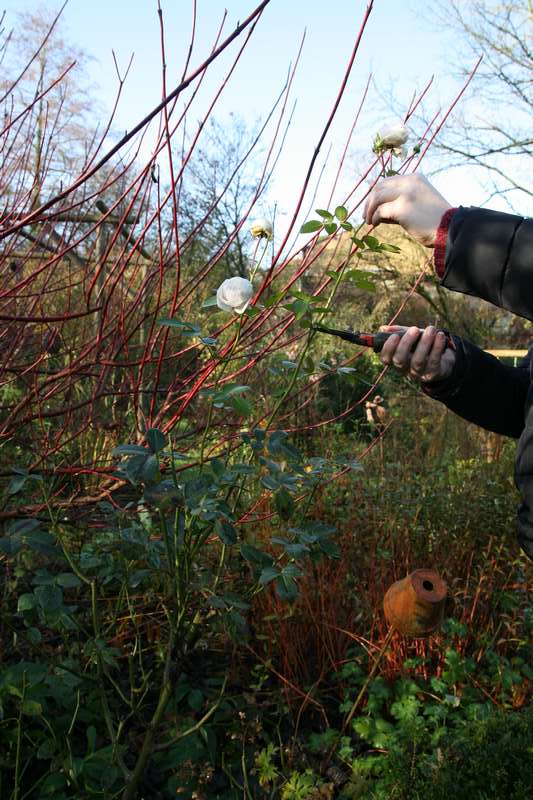
Cut 1/3 of all branches in autumn.
-
THOSE WHO PRACTISE CHRISTMAS PRUNING
These are the more tactical ones; they prefer to wait and enjoy the Christmas festivities before diving headfirst into their garden. This time, it is advisable to prune between Christmas and the end of January. As clever strategists, they plan to prune to 4 or 5 buds instead of 2 or 3, so that if a severe frost causes damage, they can cut back a bit more.
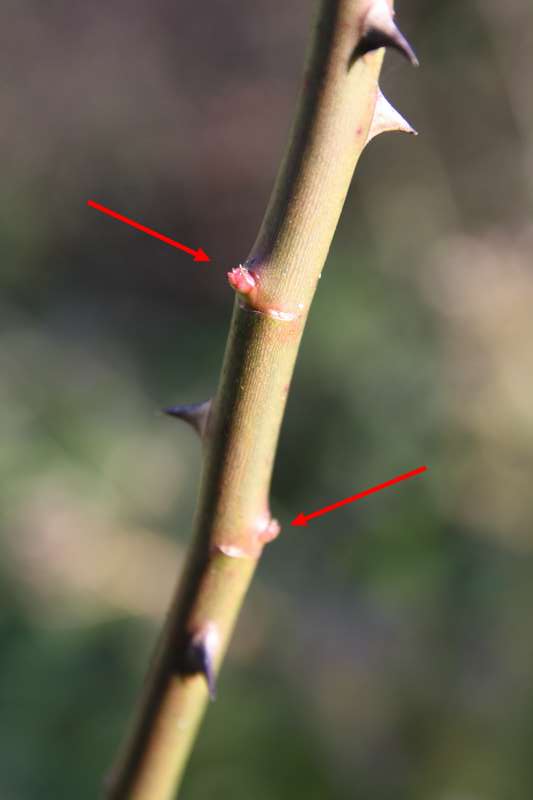
Count 4 or 5 buds and cut just above at an angle in winter.
-
IN BOTH CASES, HOW TO PROCEED?
Choose one of the two methods mentioned above, then take the opportunity to remove dead wood and broken branches damaged by the elements or friction, which are gateways to diseases. Cut as low as possible; this way, the rose is cleaner and more open.
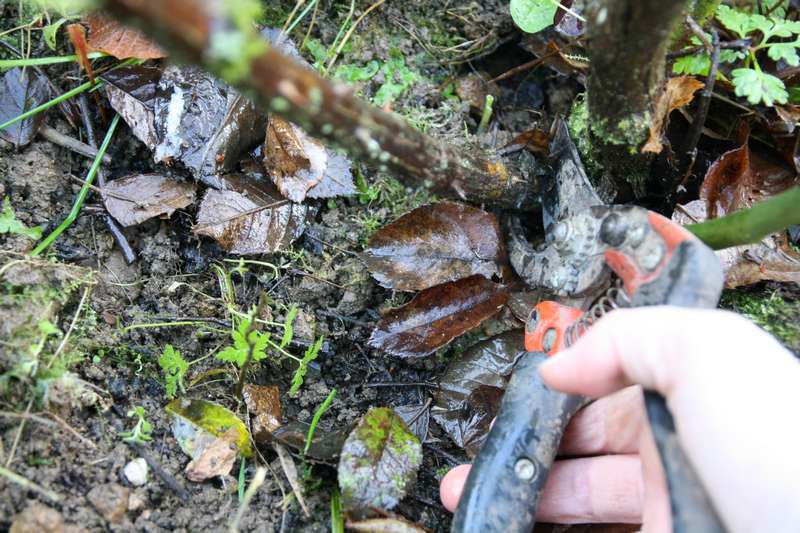
Cut dead branches as low as possible.
Don’t forget to collect fallen leaves as well, especially if they show black spots or powdery mildew.
Advantages:
- This helps prevent breakage in very windy or snowy gardens
- The spring pruning work is lightened
- Flowering is earlier
- There is less sap loss
Disadvantages:
- This approach should be avoided in very cold regions
Remember that cuts are always made a few millimetres above a bud. They are angled so that water does not pool on the cut (which encourages the onset of diseases) and slanted away from the bud, so that water does not run onto it.
Finally, in all cases, adjust the pruning period according to your climate!
-
THOSE WHO PRACTISE THE ART OF LETTING BE
Of course, you can also do nothing but do it well… It’s up to you!
-
THE CASE OF NON-REPEAT FLOWERING ROSES
This is the particular case of this old family of roses, namely the non-repeat flowering ones that are pruned just after their single flowering. For this, simply remove all the stems that have already bloomed, the old wood, and the dead wood. It couldn’t be simpler!
And you, which clan do you belong to?
For further reading, discover our advice sheet: pruning roses and Michael's video tips for pruning old roses as well as for pruning modern roses.
The pruning of roses often raises questions. However, there is no need to be a highly experienced gardener to engage in it; it’s not rocket science. I am a proponent of letting go and gardening without stress—believe me, I know all about it! First, let’s remember that the main pruning of roses is done at […]
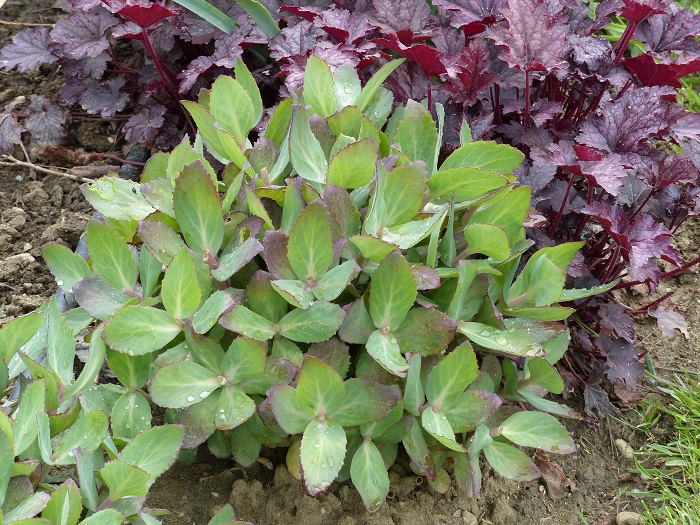
Today marked start of the famous Chelsea Flower Show in England. This festival of plants and gardens, held each year at this time, also gave its name to a green pruning technique for perennial plants practised in mid to late May and nicknamed by skilled English gardeners "Chelsea Chop". It can be applied to many summer-flowering perennials or late-flowering perennials that branch, such as Heleniums, sedums, asters, Helianthus, and even Phlox paniculata or Perovskia!
This green pruning of perennial plants has two major advantages:
- Pruned plants are stockier and more branched, and better withstand rain and wind (and no, unfortunately this isn't just an English-climate issue... it's the same here in the North!) — this prevents them from flopping onto neighbouring plants once laden with flowers, and can reduce or even replace need for staking of tall perennials.
- Flowering of cut-back plants is later, so this technique helps stagger and prolong flowering across a single plant or a whole border. You can easily prune only half of a plant or every other stem; the pruned stems will then flower after the unpruned ones, extending the display. In a large border where perennials are planted in groups of the same variety, you can also choose to cut back only some specimens, which will flower after the uncut plants. This extends the overall decorative effect: a very useful technique in medium and small gardens like mine, where every plant must "earn its place" and long-flowering plants are much sought after.
How to perform the "Chelsea Chop"?
Nothing could be simpler! Walk round your garden now to identify plants that flower in summer (from July) and late season (until October) and cut them back by one third of their height. You can even reduce some plants by half to obtain compact specimens, particularly in the front of borders. Use a well-sharpened shear to make a neat rounded cut on clumps of finely-leaved perennials (asters, Heleniums) or a pruning shear if you choose to cut every other branch. For perennials with larger leaves such as tall sedums, favour a stem-to-stem pinch with the pruning shear for a cleaner finish.
That is not the case this year, but when spring is dry, a good watering after pruning will benefit cut-back perennial plants. Very soon, buds in the axils of the leaves directly below the pruning wound will give rise to 2, 3, 5, 7... new stems, a little slimmer but nevertheless sturdy, which will produce a multitude of flowers a few weeks later! Finally, if you wish to delay a plant's flowering even more significantly, you can repeat the operation once or several times up to 6–8 weeks before the plant's natural flowering period.
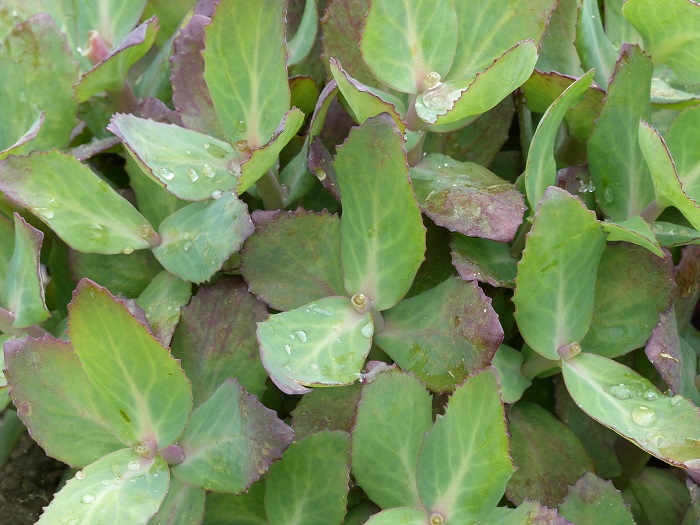
Finally, discover this technique on video with Olivier: The Chelsea Chop.
Today marked start of the famous Chelsea Flower Show in England. This festival of plants and gardens, held each year at this time, also gave its name to a green pruning technique for perennial plants practised in mid to late May and nicknamed by skilled English gardeners “Chelsea Chop”. It can be applied to many […]
It is still time to prune your shrubs, but you should not delay and carry out this essential operation for their good flowering in the coming days.
In any case, you must:
1- Cut back the stems in height
2- Remove dead wood and thin out the centre
3- Add manure or a rose fertiliser to nourish the bush
However, there is a crucial difference between old roses – varieties developed before the Second World War – and modern roses.
Modern roses, with long and often repeat flowering, bloom on the wood of the year; they should be pruned every year from November to March, outside of frost periods, to three buds.
Old roses bloom on aged wood; their flowering is shorter but very dense. They are pruned less frequently, every two to three years, at the end of winter.
If you want to find all our "garden advice" videos, don't wait any longer!
It is still time to prune your shrubs, but you should not delay and carry out this essential operation for their good flowering in the coming days. In any case, you must: 1- Cut back the stems in height 2- Remove dead wood and thin out the centre 3- Add manure or a rose fertiliser […]