In the peaceful world of gardening, a new threat is emerging, sending shivers down the spines of agapanthus lovers across France. Indeed, the agapanthus gall midge, a small African insect that was previously harmless, is becoming a growing scourge for these majestic plants. With an increase in cases in France, the question is no longer whether, but rather when and how this pest can be stopped. What is the impact of the agapanthus gall midge on our agapanthuses? How can we identify the signs of this infestation? Are there effective control methods to protect agapanthuses across the country? The beauty of our gardens is at stake: it is time to act!
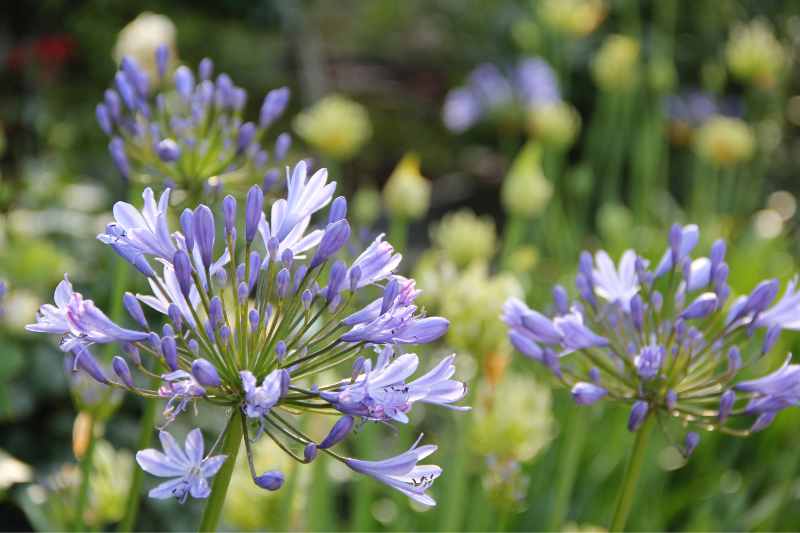
Agapanthus gall midge: what is this insect?
The agapanthus gall midge, or Enigmadiplosis agapanthi, is a particularly harmful pest for agapanthuses. This insect, which belongs to the Cecidomyiidae family, originates from South Africa, like the agapanthuses themselves, but has since migrated to other parts of the world, including Europe.
The agapanthus gall midge is a tiny midge whose larvae develop within the buds and stems of agapanthuses, causing deformities and often inhibiting flowering. The damage can be significant, potentially leading to the death of the plant in the most severe (but very rare) cases.
The insect is so minuscule that only symptoms can help us determine its presence rather than direct observation.
What are the symptoms of an infestation?
Signs of an infestation by the agapanthus gall midge may include deformed or unopened flower buds, stems that wilt or turn yellow or brown, and the presence of small white larvae or orange pupae inside the stems or buds. The larvae of the agapanthus gall midge develop within the flower buds themselves. In cases of heavy infestation, the entire flowering may be halted in agapanthus crops.
How to act?
Controlling this pest can be challenging, as there is no specifically approved control method for the agapanthus gall midge. Control methods include the removal and destruction of the infested parts of the plant. But there is no need to uproot or remove your agapanthuses! Research is ongoing to find other effective control methods against this pest. However, we remain hopeful that a natural predator will come to regulate the gall midges naturally. Fingers crossed!
What is the situation in France?
Let’s not panic just yet! In Europe, the first official observations were recorded in the UK in 2015, then in the south-west of France in 2017 and later in Brittany in 2019. Since then, the agapanthus gall midge has been steadily progressing without the situation being, for now at least, truly alarming. However, the national agapanthus conservatory on the island of Bréhat, in Côtes d'Armor, is sounding the alarm and urging gardeners to be vigilant. Be sure to check your agapanthuses at home, in your gardens, and act quickly by removing the parts of the plant suspected of being attacked by this gall midge.
In Belgium, for now, the agapanthus gall midge seems to be absent. (Note: yes, we assure you, certain agapanthuses more resistant to cold, such as Agapanthus 'Black Buddhist', can be grown in Belgium and northern France, but in well-drained soil or in pots!)
To learn more, here is the document from the French Ministry of Agriculture on the subject.
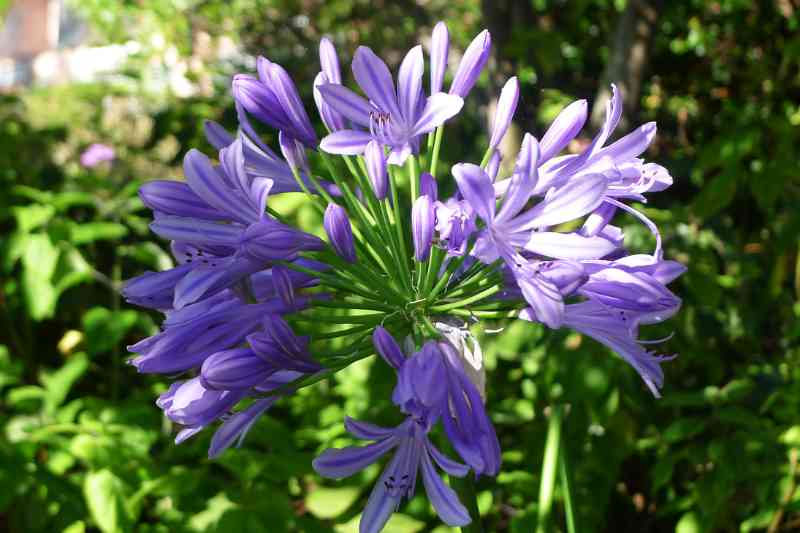
In the peaceful world of gardening, a new threat is emerging, sending shivers down the spines of agapanthus lovers across France. Indeed, the agapanthus gall midge, a small African insect that was previously harmless, is becoming a growing scourge for these majestic plants. With an increase in cases in France, the question is no longer […]
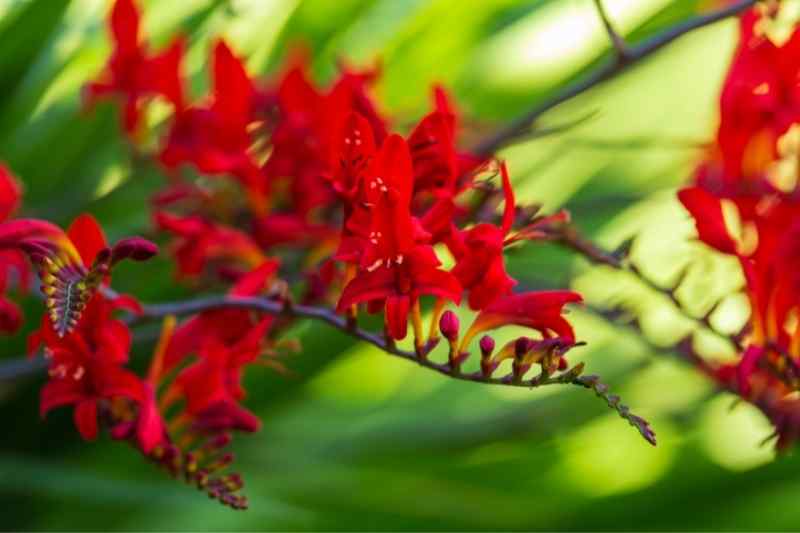
Let’s continue our world tour of plants by discovering stunning South African bulbs: crocosmias. Commonly known as Montbretias, these bulbous plants resemble small gladioli and grow wild in the meadows and forest edges along the eastern coast of South Africa for the most part. With their vibrant and warm colours—orange, red, yellow—these exotic summer bulbs instantly add a bright and refreshing touch to any decor. Let’s explore how they have acclimatised over the centuries in our European gardens and why these small, floriferous summer bulbs, once out of fashion, are making a grand comeback today!
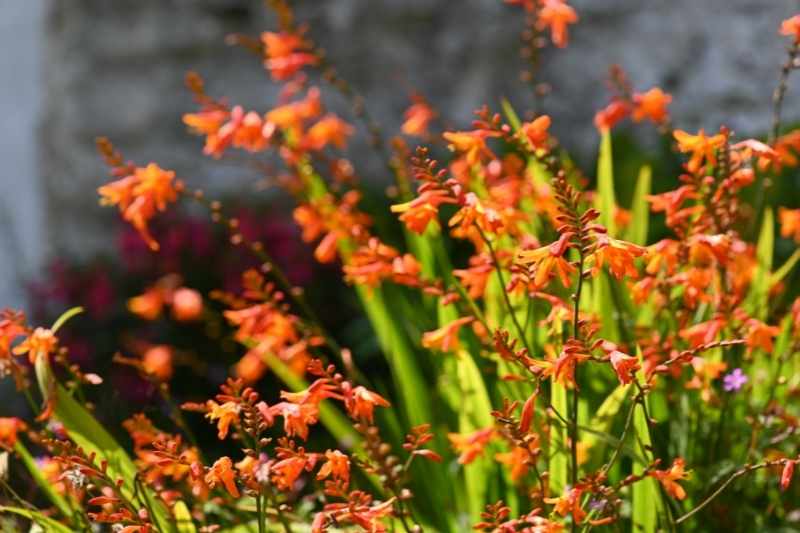
What are Crocosmias?
Part bulb, part corm, crocosmias or Montbretias, also known as “crocosmie” or “montbretie,” are herbaceous perennial plants from the iris family, just like gladioli, with which they share many similarities. These beautiful exotic perennials are moderately hardy and can be grown in the same way outside of our mildest regions (it is safer to lift the corms for winter storage). They form a clump that typically reaches 60 cm in height. The larger varieties, such as ‘Lucifer’, can grow up to 1.20 m. Not demanding, crocosmia bulbs should be planted in full sun, in fertile, moist soil. And when the growing conditions suit them, they multiply over the years, returning faithfully each year, more beautiful and floriferous.
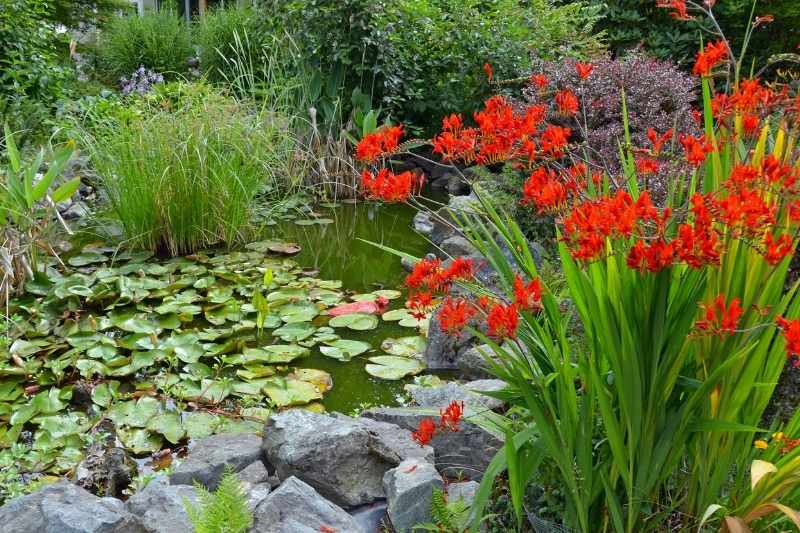
The origin of their name
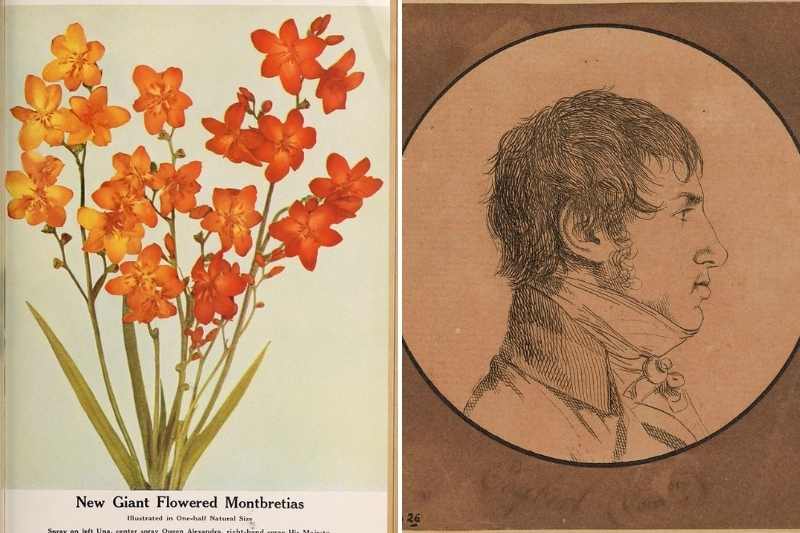
The plant derives its name from the Greek words krokos (saffron) and osme (smell), due to the characteristic saffron scent emitted by its dried flowers when immersed in hot water. Its other name, Montbretia, was given to the crocosmia in honour of the botanist Antoine-François-Ernest Coquebert de Montbret (1780-1801), who was attached to the military and scientific expedition to Egypt led by General Bonaparte and his successors, and was the librarian of the first Institute of Egypt.
Africa, the cradle of Crocosmias
While Crocosmias are now cultivated worldwide, the genus comprises 9 species, all native to South Africa except for one, Crocosmia ambongensis, which is endemic to Madagascar.
The Crocosmia pottsii was introduced to England in 1877 by the English botanist and naturalist Thomas Henry Potts in the mid-19th century. Three years later, in 1880, the famous horticulturist from Nancy, Victor Lemoine, created the first hybrid: the Crocosmia X Crocosmiiflora. This is how crocosmia managed to conquer gardens in the UK, and then ours. In France, it was first observed in the wild in 1889, in the Creuse department. Its cultivation then spread to the Netherlands in the 1990s. Once rarely cultivated and neglected, Crocosmia has found its nobility by making a grand return to our gardens today!
The arrival of Crocosmias on our French coasts
Initially found mainly on the west coast of our country, particularly in Brittany and Loire-Atlantique (they thrive in open ground, especially under the Breton climate), crocosmias have spread. The Crocosmia X Crocosmiiflora has naturalised to the point of becoming invasive and is considered a pest in Great Britain and New Zealand.
Cousins and descendants
Over 400 hybrids have been created by horticulturists. Most of these varieties are derived from Crocosmia x crocosmiiflora, which results from a cross between two South African species: Crocosmia aurea and Crocosmia pottsii. Crocosmia x crocosmiiflora has produced numerous cultivars that are mostly still marketed under the name "Montbretia." Among the most remarkable fruits of these various hybridisations:
- The Crocosmia 'Emily McKenzie'; striking with its very bright orange flowers highlighted by a dark red centre.
- The Crocosmia ‘Lucifer’; the star of summer borders! It is the most well-known and certainly the tallest! This English horticultural creation was born in 1966 from the marriage of Crocosmia masoniorum and C. paniculata.
- The Crocosmia (x) crocosmiiflora 'Carmine Brillant'; one of the most floriferous Montbretias, each flower stem carries up to 100 flowers throughout the summer.
- The Crocosmia (x) crocosmiiflora 'George Davison'; a very bright variety, covered in summer with an abundant golden yellow flowering.
Crocosmias in the iarden
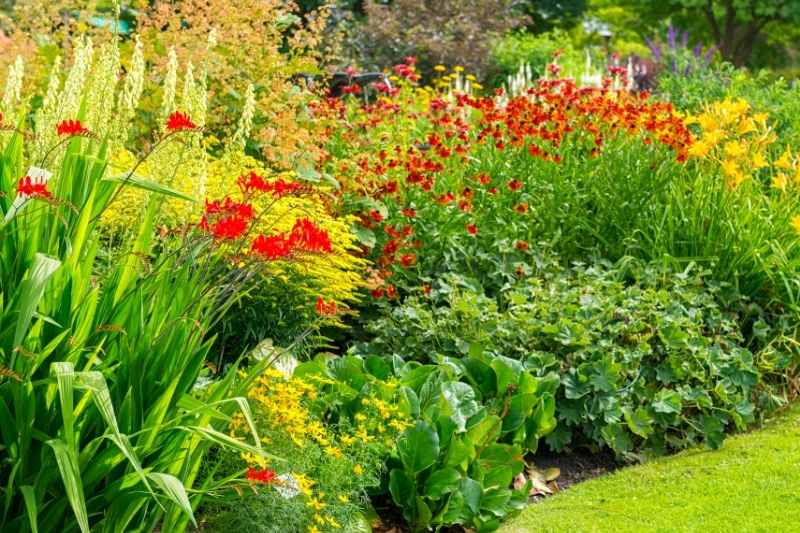
With their flowers reminiscent of small lilies in a wide range of warm colours, Crocosmias bring an exotic and cheerful touch to vibrant perennial borders. Their bright colours—yellow, orange, or red—create vivid and joyful splashes of colour in gardens. They are easy to mix with other flamboyant and colourful blooms such as Cannas, Castor Beans, Coreopsis, Dahlias, or Rudbeckias, along with light perennials like salvias or nepeta and/or with ornamental grasses (Stipa tenuifolia, Pennisetum...).
Discover more ideas in our sheet “Crocosmia or Montbretia: 9 pairing ideas”.
Further Reading
Let’s continue our world tour of plants by discovering stunning South African bulbs: crocosmias. Commonly known as Montbretias, these bulbous plants resemble small gladioli and grow wild in the meadows and forest edges along the eastern coast of South Africa for the most part. With their vibrant and warm colours—orange, red, yellow—these exotic summer bulbs […]
The Agapanthus 'Navy Blue', also known as ‘Midnight Star’, is a very popular variety of agapanthus in northern gardens and for good reason, it is one of the few that withstands the cold so well (it can survive down to about -10°C). It is also one of the few to provide a myriad of flowers in a deep navy blue that is intense.
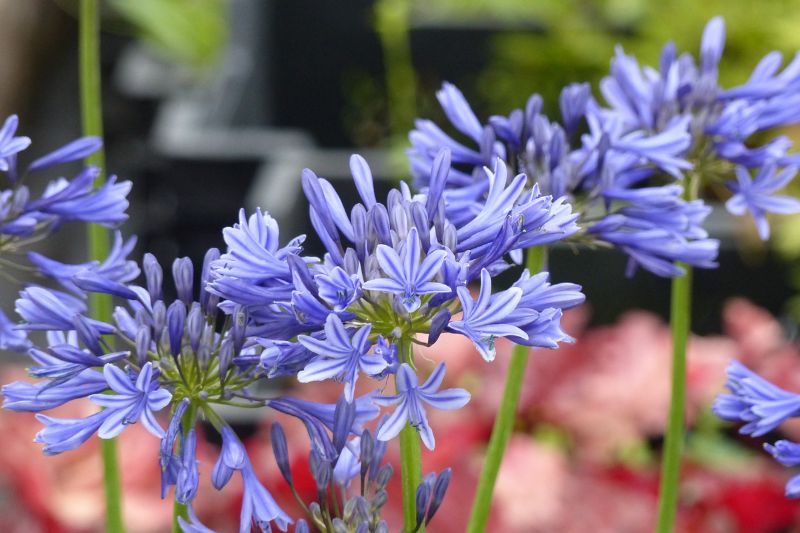
Particularly floriferous and vigorous, this medium-sized variety does not exceed 60 cm in height. It has a deciduous foliage of wide, bright green ribbons that elegantly covers the ground throughout the beautiful season. When its flowers appear, usually in July-August, it transforms into a bouquet of intense blue.
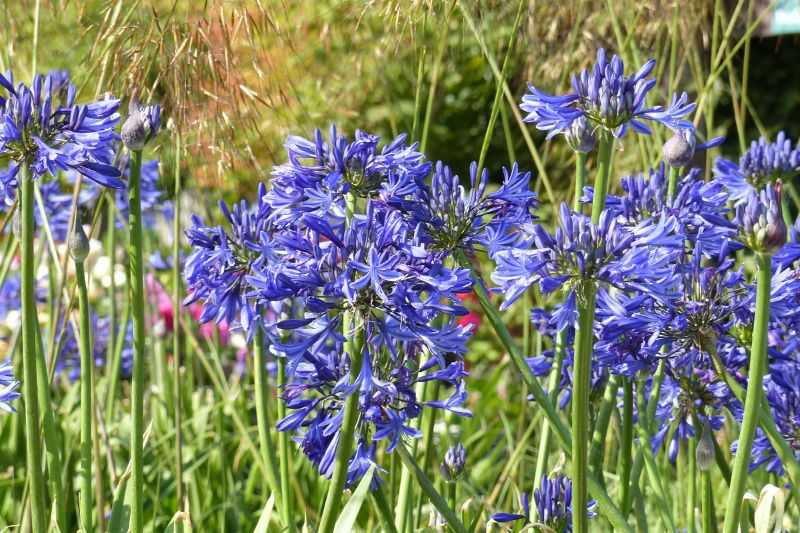
It is in a naturalistic garden, alongside Gaura, Stipa, Panicum, Crambe cordifolia and Silphium that this variety has thrived in my garden for nearly 20 years now. It has endured winters well below -10°C, scorching summer heat, and yet it is still here. From a single plant, which I divide every 4 years at the end of winter, I propagate it in my borders, and it now covers 5 m².
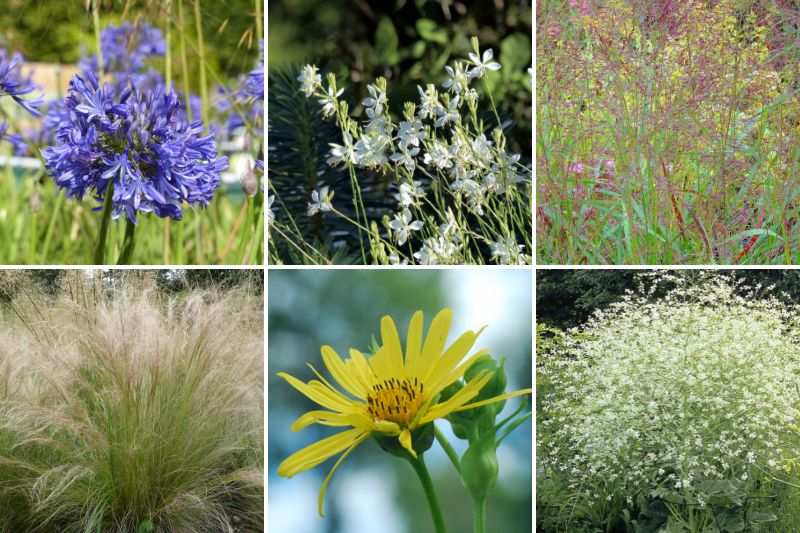
Final tip: To keep it thriving in my clay soil, at planting, I replace my sticky soil with pure sand (2 to 3 times the volume of the stump) so the stump is protected from excess water in winter.
The Agapanthus ‘Navy Blue’, also known as ‘Midnight Star’, is a very popular variety of agapanthus in northern gardens and for good reason, it is one of the few that withstands the cold so well (it can survive down to about -10°C). It is also one of the few to provide a myriad of flowers […]
Agapanthus are spectacular flowers often found in seaside gardens, particularly along the West Coast and in Brittany. In summer, they display beautiful blue, white, or mauve flowers in umbels that are both graphic and elegant.
As a worry-free perennial, the Agapanthus thrives in full sun in ordinary, well-drained soil that is not too dry in summer. Its lightness and ease of cultivation are real assets for creating a flowering bed or a pot.
Historically, their use in gardens was limited by their lack of hardiness and the small number of varieties... Today, Agapanthus now come in many varieties, and some even show good cold resistance, which presents another challenge: choice!
To help you, here is a selection of 7 reliable Agapanthus that will suit all gardens, regardless of their size, style, or climate.
Agapanthus Navy Blue (Midnight Star): the hardy one
The Agapanthus 'Navy Blue', also known as Agapanthus ‘Midnight Star’, is one of the most popular Agapanthus. This variety ranks at the top for best rating and best seller at Promesse de Fleurs, and you'll soon see why!
Its light umbels bear an intense navy blue. They appear abundantly from July to August. Its light green ribbon-like foliage is deciduous, but this variety is one of the hardiest Agapanthus, with a resistance down to -10°C in well-drained soil.
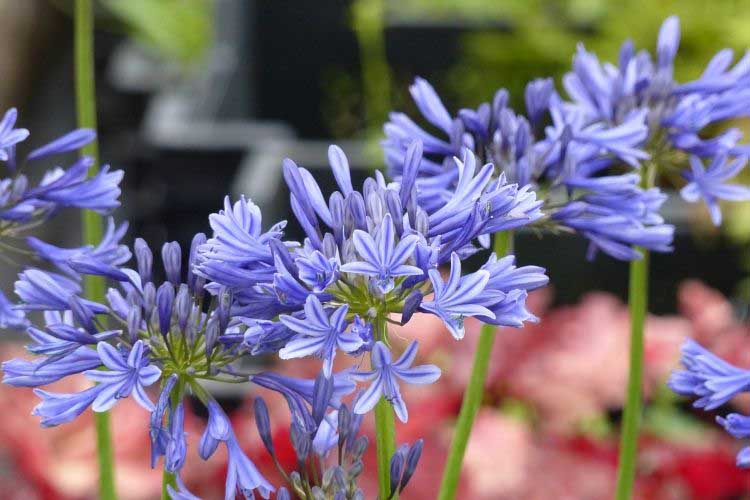
The hardy and popular Agapanthus Navy Blue
Vigorous and medium-sized, reaching 60 cm in height and 40 cm in spread, it adapts well both in pots and as a border plant.
→ To learn more about this variety, check out our article: "Agapanthus 'Navy Blue': a cold-resistant beauty"
Agapanthus Blue Giant: the iconic giant
The Agapanthus Blue Giant is a must-have perennial in Brittany! Often planted, it is valued for its very large dark blue flowers measuring 18 cm in diameter that can reach up to 1.5 meters in height. Its height makes it a remarkable plant for borders and backdrops. It creates significant, elegant vertical lines. You can also enjoy its beautiful large flowers as cut flowers.
Vigorous and robust with fleshy roots, it withstands temperatures down to -12°C.
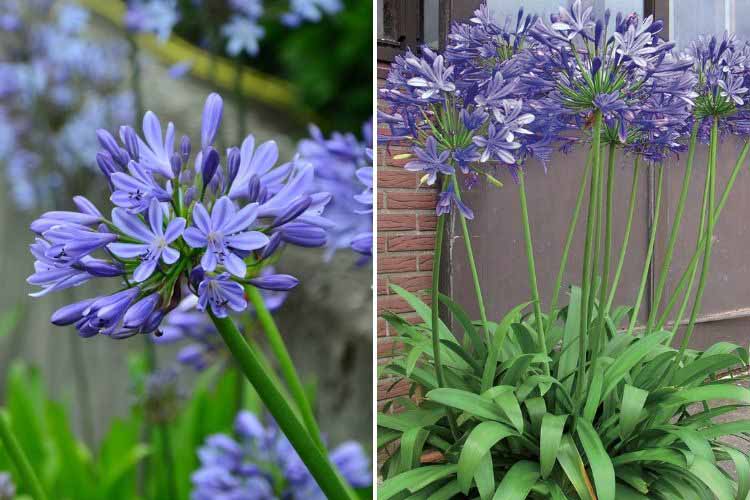
The Agapanthus Blue Giant reaches great heights
Agapanthus Albus: the essential one
Ideal for white gardens, the Agapanthus umbellatus Albus, also known as Agapanthus africanus albus, is distinguished by its white flowering. Its umbels of 15 cm in diameter rise to 1 meter above a ribbon-like semi-evergreen foliage. The umbels consist of snow-white flowers shaped like campanulas. Not very hardy, it tolerates temperatures down to -5°C, limiting its use to mild climates.
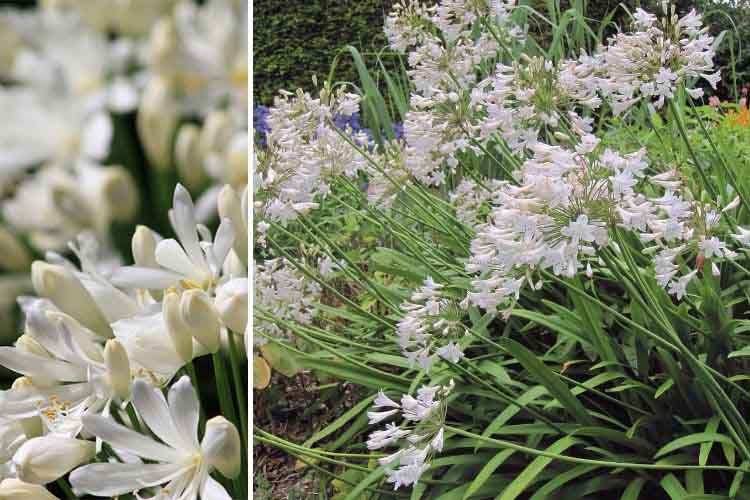
The white-flowered Agapanthus: Agapanthus albus
Agapanthus Royal Velvet: the new star
Original and recent, the Agapanthus Royal Velvet is a new star among Agapanthus due to its intense, trendy colour described as 'ultra violet'. It produces a stunning effect with its unique umbels of 10 to 12 cm in diameter, featuring a deep violet colour streaked with very dark blue-violet. The umbels rise to 80 cm above the ground, clearly above the (deciduous) foliage that forms a lovely clump. The elegance of the Agapanthus Royal Velvet is undeniable!
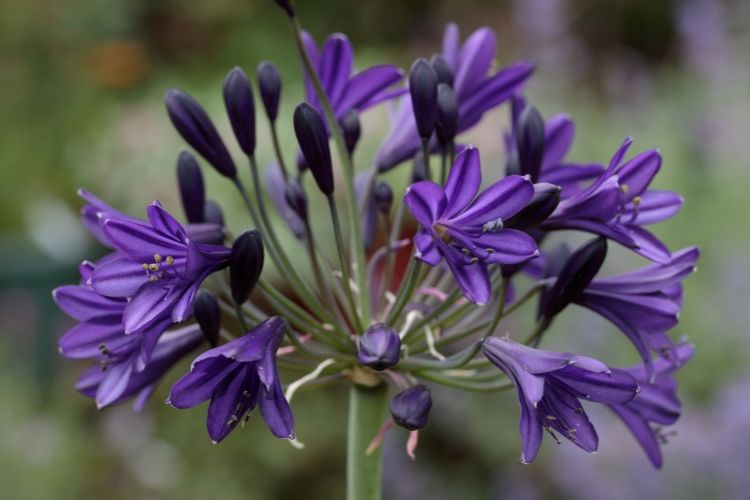
The Agapanthus Royal Velvet, a new variety with ultra violet flowers
Its intensely coloured flowers make it ideal for contemporary gardens as well as for exotic scenes featuring orange flowers like kniphofias, cannas, or hemerocallis.
In addition to its original colour, this variety boasts many advantages with its abundant flowering, robustness, and cold resistance down to -10°C.
Agapanthus Double Diamond: the compact one with double flowers
Recent, the Agapanthus Double Diamond is a variety that combines two qualities: a compact habit and generous flowering. Its main asset lies in its pure white double trumpet-shaped flowers. Grouped in umbels, they measure 10 cm in diameter and appear above a clump of persistent leaves in mild climates. Its compact habit (35 cm high and 30 cm wide) makes it ideal for pots, on terraces or balconies, as well as for borders in areas where winters are not too cold, as it does not tolerate temperatures below -5°C.
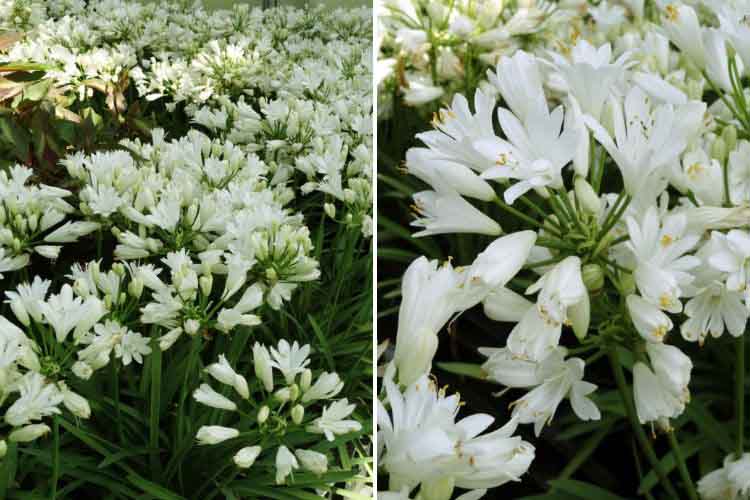 The Agapanthus Double Diamond, a small variety with generous double flowers
Agapanthus Twister: the bicolour
The Agapanthus Twister is an original variety appreciated for its bicoloured flowers. Large, up to 18 cm in diameter, its umbels consist of white flowers with a dark blue base. These two-coloured flowers provide a certain dynamism while blending the softness of the shades, accentuated by the green-grey foliage. Medium-sized, this Agapanthus reaches 60 cm in height and 50 cm in width, making it ideal for the middle of borders, behind ground-cover plants, and it can also be grown in large pots.
Finally, the Agapanthus Twister can be planted in many climates as it is one of the hardiest Agapanthus, tolerating temperatures down to -12°C.
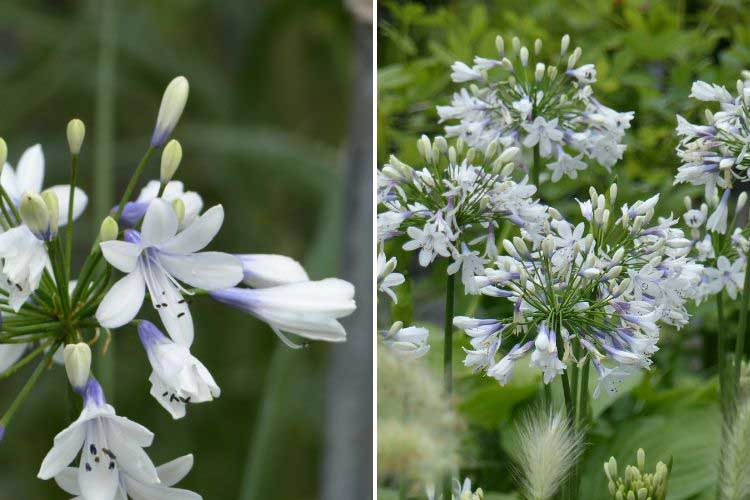
The Agapanthus Twister: bicoloured flowers, white and blue
Agapanthus Pitchoune Blue: the perfect cute pot plant
The Agapanthus Pitchoune Blue lives up to its name. All cute and small, this compact variety measures only 50 cm in height and 50 cm in width. Dwarf, it is perfect for border planting but also for pot cultivation, allowing it to be brought indoors for protection in winter, as it is not very hardy and only tolerates -5°C.
Although small, the Pitchoune Blue variety stands out for its abundant flowering. It pleasantly blooms in an overseas blue above persistent ribbon-like foliage. In the garden, it can be associated with or replaced by its "little sister" with white flowers, Pitchoune White, which offers the same qualities.
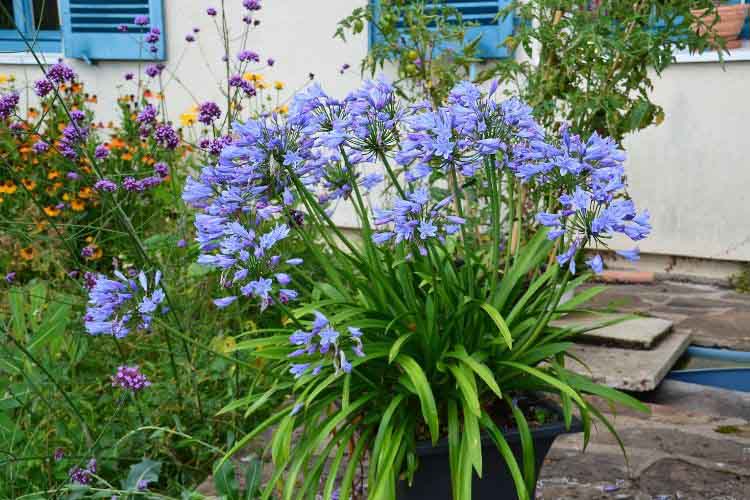
The Agapanthus Pitchoune Blue, a reliable choice, ideal for pots
Do you have other varieties to recommend? Feel free to share their names with us in the comments!
Agapanthus are spectacular flowers often found in seaside gardens, particularly along the West Coast and in Brittany. In summer, they display beautiful blue, white, or mauve flowers in umbels that are both graphic and elegant. As a worry-free perennial, the Agapanthus thrives in full sun in ordinary, well-drained soil that is not too dry in […]
Agapanthus in pots require regular and appropriate care: watering, fertilising, and pruning are essential actions to ensure their beautiful and long-lasting graphic flowering. However, after a few years, they can become cramped and start to languish. Symptoms include: flowers becoming smaller and stems shorter, yellowing foliage that regenerates more slowly, a hollowing out of the centre of the rootstock, and more frequent watering becoming less effective... Once the diagnosis is made, it's time for surgery! With a knife and some elbow grease, in just 10 minutes, your agapanthus will be revitalised for another four years. When and how should you divide your agapanthus? We’ll tell you everything.

Agapanthus 'Pitchoune Blue', a compact variety suitable for pot cultivation (photo credit: Sapho)
Division should be done at the end of winter
Whether your agapanthus is deciduous or evergreen, it should be divided at the end of winter or the beginning of spring (ideally from March to April). The temperatures are still cool, the days are short, and the growth of evergreen agapanthus is slowed down, making it the optimal time to intervene. You might say, "it also works at the end of summer, from mid-August to early October when the plant is no longer producing flower stems!" That’s true, but the rootstock will need to heal during autumn and winter, when its vegetative activity is at its lowest, and that’s not ideal.
Carefully remove the plant and clean the roots
First, remove the plant from its pot. If the rootstock is very old and roots are protruding from the top of the pot, cut as many roots as possible that are coming out of the bottom of the pot, turn it upside down, and tap it several times to release the root ball. Be careful with terracotta pots, as they are more fragile than plastic pots and roots adhere more easily to the porous wall, so proceed with care. You can slide a long knife blade between the root ball and the pot to detach the roots from the wall. Once the rootstock is extracted, untangle as many roots as possible by hand. Cut away any old black roots and scrape off the old compost.
Cut at the heart and slice into 2, 3, 4...
Equip yourself with a long knife (ideally a bread knife) whose blade has been cleaned and disinfected beforehand. Then, cut into 2, 3, 4, 5... But be careful, if you want a plant that will flower again this year, divide the rootstock into 2 to avoid any stress. If, on the other hand, you want to replant in several pots, in the garden, and share with your neighbour, you can divide it into as many pieces as possible. As long as you cut and keep a piece of rootstock with a root, a rhizome, and a bud, you can produce enough to replant throughout the neighbourhood.
Repot immediately and water generously
Once the rootstock is cut in two, apply wood ash to promote healing and prevent rot. Then repot it immediately in the same pot, adding rich compost mixed with some slow-release fertiliser. Water generously and store your agapanthus in a cool, well-lit room. New leaves will quickly develop, followed later in the season by flower stems.
If you have divided a lot, repot the fragments of rootstock in a pot or a cell, cut the roots in half, and also trim the foliage of the evergreen varieties by half. Water and then closely monitor daily watering during hot weather. Your "babies" can be replanted after 5 to 7 weeks.
What not to do!
If, like me, you had the great foresight to plant your agapanthus in a beautiful bulbous pot... then don’t even try to remove it: it’s impossible! The mass of roots formed prevents the plant from coming out. What to do? Break that beautiful pot or sacrifice the plant? That’s more akin to butchery than division, but the best option is to slice the plant into small pieces to extract it from its pot. The lesson to be learned? Don’t plant directly in a bulbous pot, but in a straight horticultural pot, inserted into a bulbous pot!
Agapanthus in pots require regular and appropriate care: watering, fertilising, and pruning are essential actions to ensure their beautiful and long-lasting graphic flowering. However, after a few years, they can become cramped and start to languish. Symptoms include: flowers becoming smaller and stems shorter, yellowing foliage that regenerates more slowly, a hollowing out of the […]
Although my Dahlias are still displaying a vibrant flowering, I sense that their days are now numbered.
This raises the perennial question of wintering dahlias: do we really need to dig them up? Where and how should we store them during winter?
Is it really necessary to dig up dahlias?
Well, it depends! Native to Mexico, Dahlias have frost sensitivity embedded in their genes and although they have acclimatised well here, their hardiness is not without limits. Therefore, to keep it simple, I would say that digging up Dahlias is, depending on the case, obligatory, prudent, or facultative.
An obligatory measure in cold climates
If you live in a region with harsh winters, where temperatures can regularly and persistently drop below -5 °C, digging them up is mandatory to avoid losing them all to frost. And although we have some splendid new varieties lined up for next spring, it would be a shame, wouldn’t it?
A prudent gesture in heavy soil
Dahlias are not only afraid of frost, they also dread moisture. In a mild but humid climate (you can’t have it all!), everything will go well as long as your soil is light, preferably sandy, or if they are planted on a mound or slope. However, in clay soil or in areas that are regularly waterlogged in winter, rot is a major risk. To avoid this, I strongly advise you to muster your courage (and your fork) with both hands!
An optional precaution in mild climates and well-drained soil
In well-drained soil and anywhere where frost is occasional and light, you can perfectly leave them in the ground, while protecting them with a thick layer of mulch, ideally made of dead leaves, straw, or dry materials (under no circumstances should it be under a layer of fresh grass!)
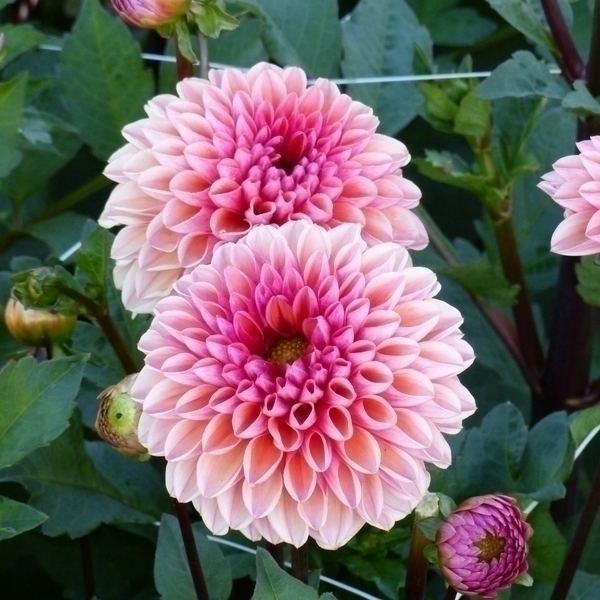
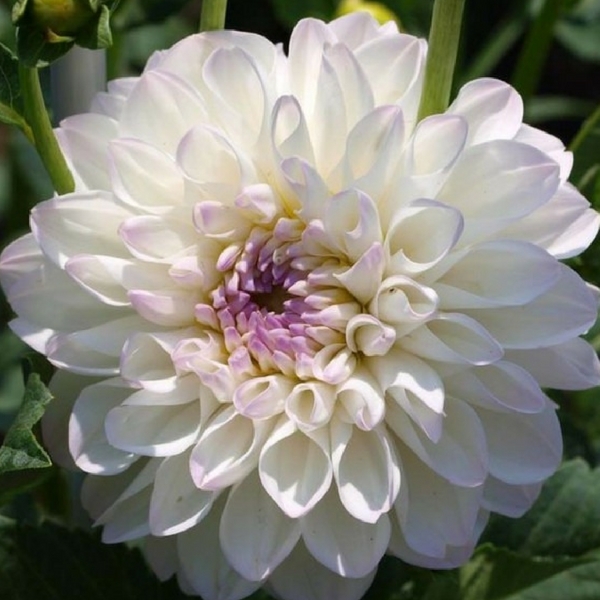
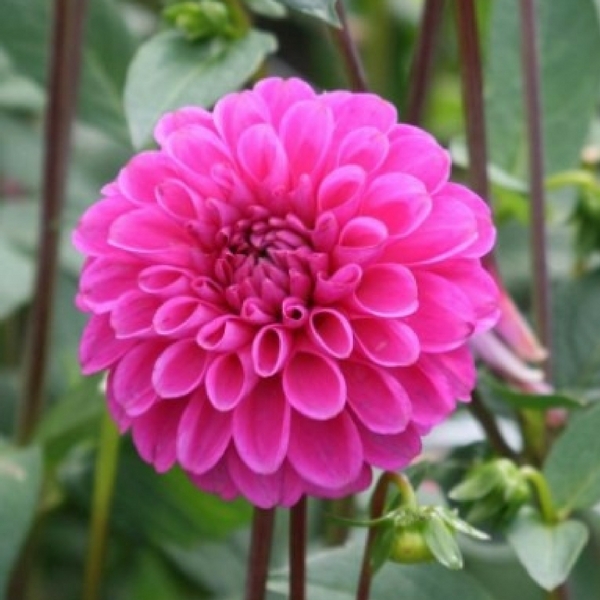
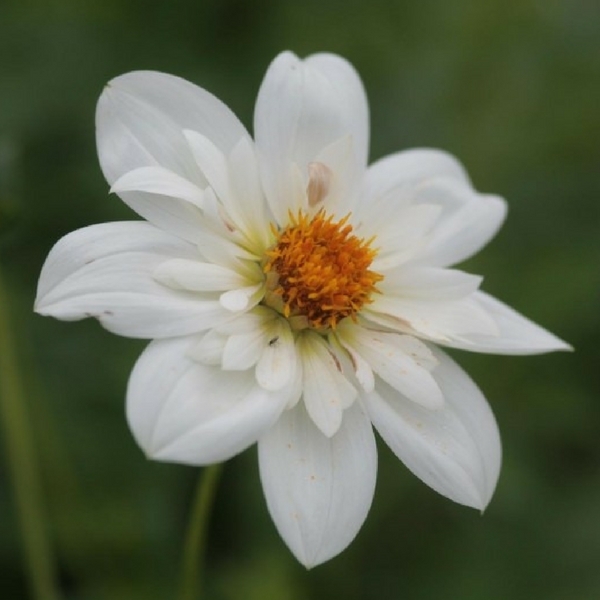
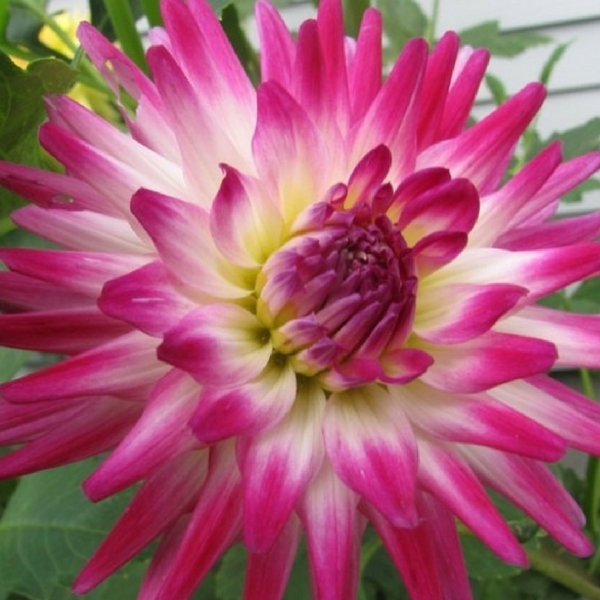
Digging up vs. leaving in the ground
Ultimately, it’s in mild regions that the decision to dig up or not dahlias is the most difficult to make.
To weigh the pros and cons, let’s examine the advantages of digging up and leaving in the ground.
Advantages of digging up
- Digging up dahlias is a change from potatoes 😉 and discovering huge tubers is simply exhilarating!
- Digging up dahlias allows for variety in creating new beds each year, by moving them around or associating them in different ways,
- Digging up allows you to divide the tubers (useful when you have a large garden or many friends), but also a potting up in March - April to achieve earlier flowering, as well as to protect them from the spring appetite of slugs
- In good conditions (frost-free, in a dark and well-ventilated place), dahlias store remarkably well, the risk of loss is close to zero.
Advantages of leaving in the ground
- Leaving dahlias in the ground means saving time and space, as cleaning, labelling, and storing different varieties is a task that requires some availability and suitable storage… which not all gardeners have!
- In the ground all year, your dahlias are undisturbed. And you won’t risk injuring them (an unfortunate fork mishap happens often) and they can continue to grow comfortably to form a lovely clump.
When and how to dig up dahlias? How to store them?
Every gardener has their habits regarding the best time to dig up dahlias. For some, the starting signal is the first fires in the fireplace, while for others it’s the first real frosts that blacken the foliage. Do as you see fit, the important thing is not to intervene too late!
As for the digging up itself, it’s a simple operation, summarised in this tutorial.
For storage, equip yourself with crates or boxes made of cardboard or plastic filled with straw, turf, or sand, labels, and a good felt pen... whose ink won’t fade in a few weeks.
As with your favourite wines, and failing to find a dahlia cellar on the market, choose your location wisely: it should be dark, frost-free, but not too warm and well-ventilated… This could be a basement or a not-too-damp cellar, or simply your garage.
Finally, remember to check on them regularly, as this is the best way to prevent any issues and ensure optimal storage!
Although my Dahlias are still displaying a vibrant flowering, I sense that their days are now numbered. This raises the perennial question of wintering dahlias: do we really need to dig them up? Where and how should we store them during winter? Is it really necessary to dig up dahlias? Well, it depends! Native to […]
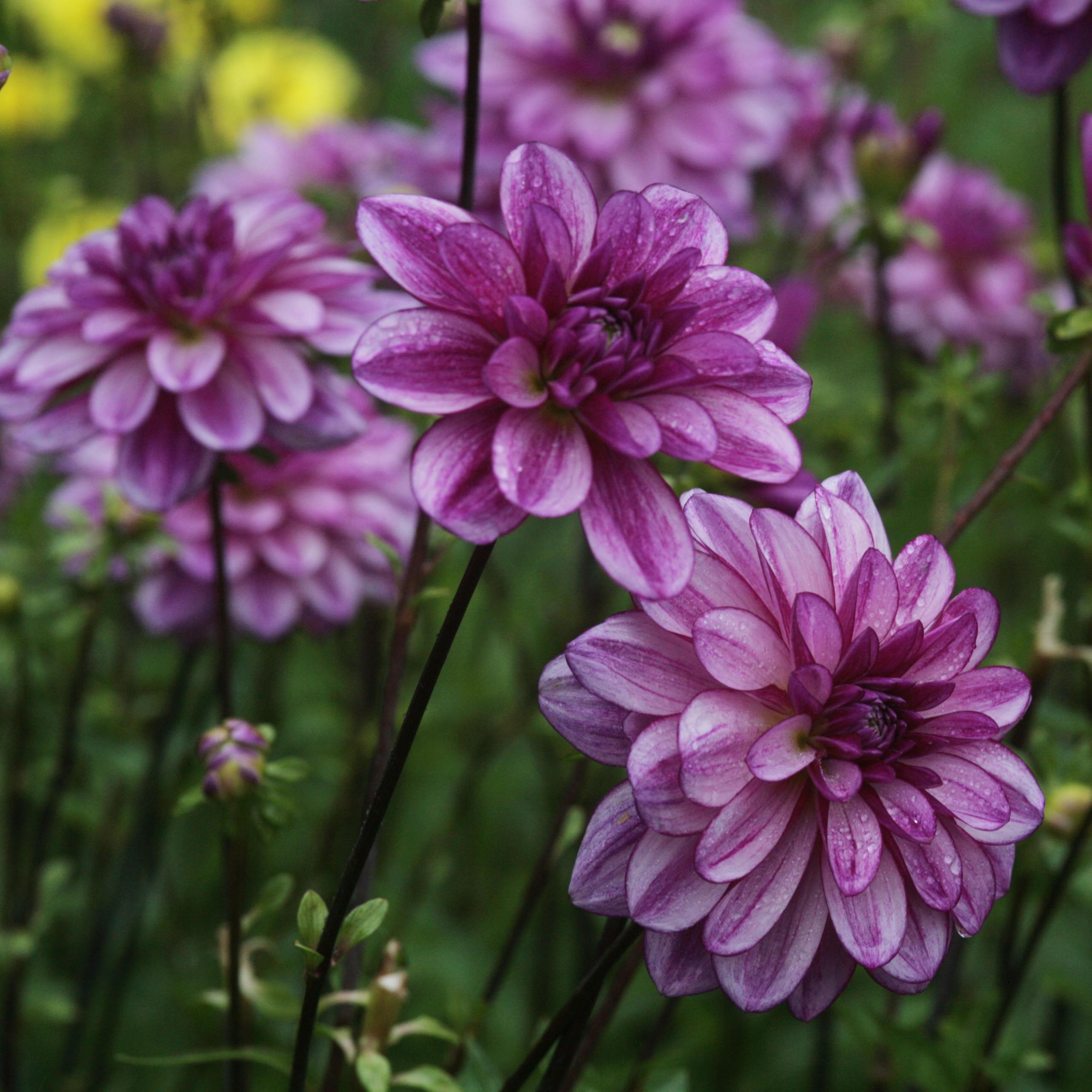 About dahlias, it used to be simple, almost black and white :
- either you cautiously sided with the majority and hated them,
- or you more or less proudly owned your taste for this 'grandmother's flower' and were, at best, seen as eccentric, at worst, as tacky.
Those days are over! The dahlia has finally come out of disfavour and confirmed its big comeback.
And if I applaud, it’s because justice has been done: easy to grow, it offers profuse, long-lasting flowering, it is as splendid in the garden as in a cut flower arrangement, it comes in a multitude of shapes and colours... and above all, it suits every garden style.
3 (modern) ways to use dahlias in the garden :
Traditionally planted in « mixed borders » and in unassuming spots, such as vicar's gardens or around vegetable plots, dahlias are equally perfect in many different settings, because they can also:
1) Pep up and colour expanses of grasses in naturalistic beds
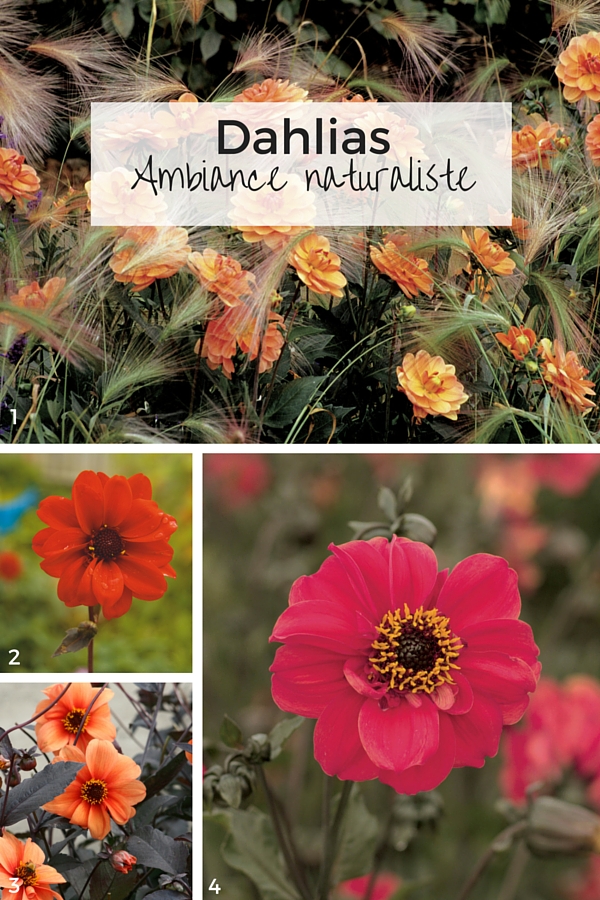
In order: Dr Ph. Riedell - Bishop of Landaff - Catherine Deneuve - Bishop of Canterbury
2) Shine with pure radiance within elegant white gardens...
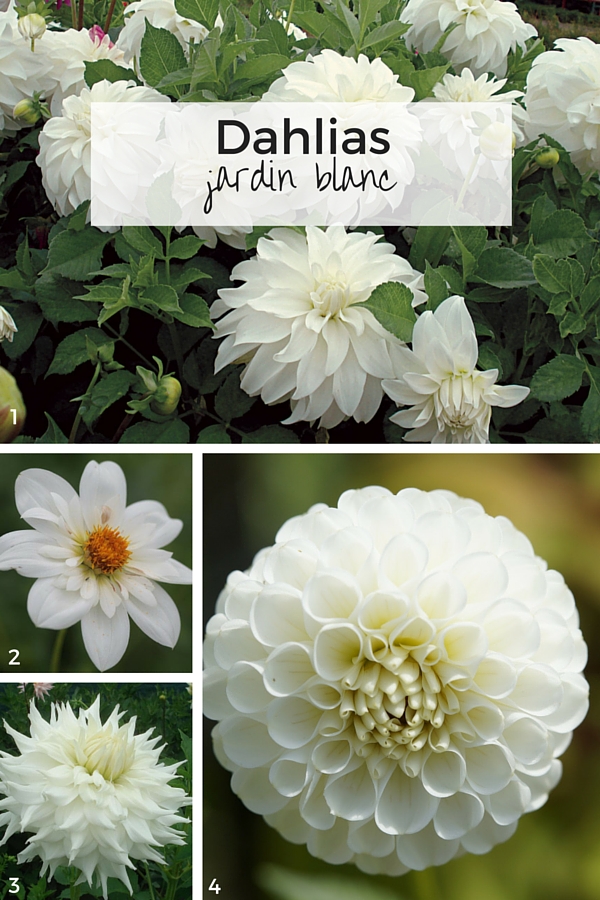
In order: Lady Liberty - Bride's Bouquet - Klondyke - White Pompon
3) Surprise with their whimsy, draw the eye with the precision of their geometry and mesmerise with their mystery in bold, modern, graphic scenes :
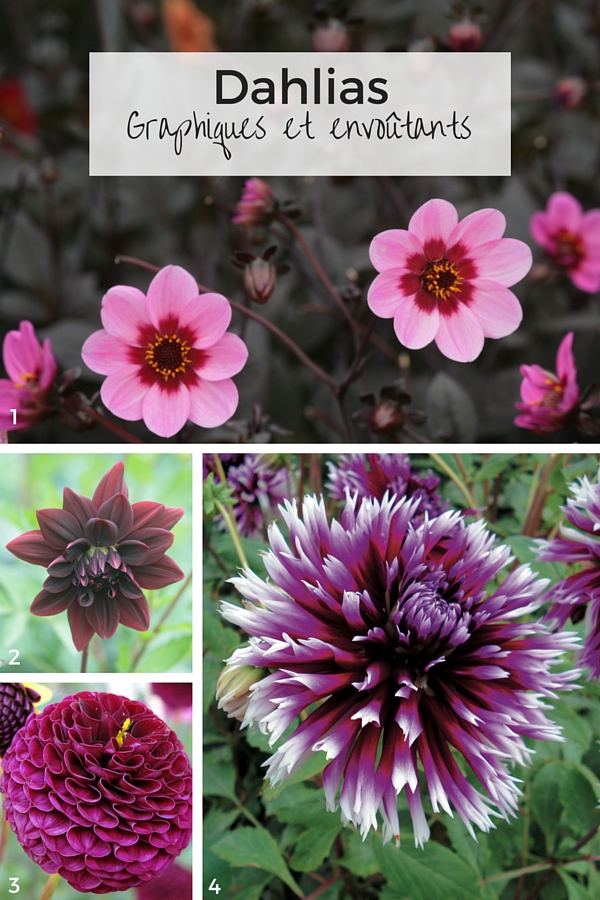
In order: Happy single Juliet - Sam Hopkins – Rocco – Clair Obscur
And while some regret that you have to lift them in autumn, I see this rather as an advantage: it’s an excellent opportunity to divide them (very handy when gardening budget is inversely proportional to garden size), but also to change their position each year and so vary the pleasures. Note that this operation isn’t always necessary in mild climates. Protected under a thick mulch, they can quite happily remain in the ground.
As you’ve probably gathered, this year, for us, it’s « all out for dahlias! » (they’ve been pre-sprouting in the greenhouse for a few days; I’m eagerly awaiting their awakening).
And you? Dahlias in your garden? What are your favourite varieties? Your reliable performers and your favourite picks?
PS: As an anecdote, I had left to my future mother-in-law (love of risk...) the task of choosing my wedding bouquet. Two hours before the ceremony, when it was presented to me, I thought I’d faint: it was largely made up of cactus dahlias, chick-yellow to boot! The village florist, ordered to make another bouquet with what he had to hand and in 15 minutes flat, must still remember it… Only fools never change their minds, right?
Growing dahlias :
Our advice sheets: Succeeding with your Dahlias - How to grow beautiful dahlias - Dividing dahlias
Admire dahlia collections :
- at the Parc Floral de Paris (75) - France’s largest dahlia competition
- at the Parc Floral d'Orléans-La Source (45) – from August to October
- at the Lycée nature de Coutances (50) - Dahlias and Gardens festival in September
About dahlias, it used to be simple, almost black and white : – either you cautiously sided with the majority and hated them, – or you more or less proudly owned your taste for this ‘grandmother’s flower’ and were, at best, seen as eccentric, at worst, as tacky. Those days are over! The dahlia has finally […]
Every year we search for the rare bulb that is hard to find, highly sought after, and will surprise you. Among the new offerings in our spring catalogue this year, we have uncovered some gems for you.
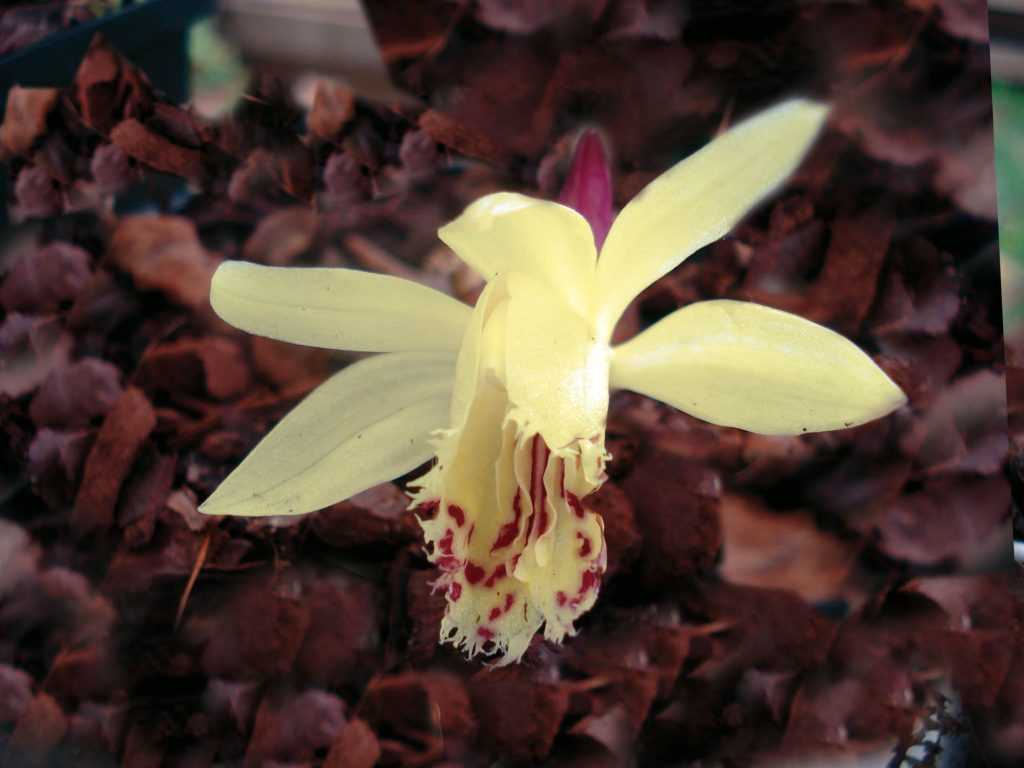 Pleione forrestii: The lemon-yellow flowers of this terrestrial orchid reveal a subtle spicy fragrance. Hardy down to -5°C, it can be grown in a pot or in a shady rockery, protected.
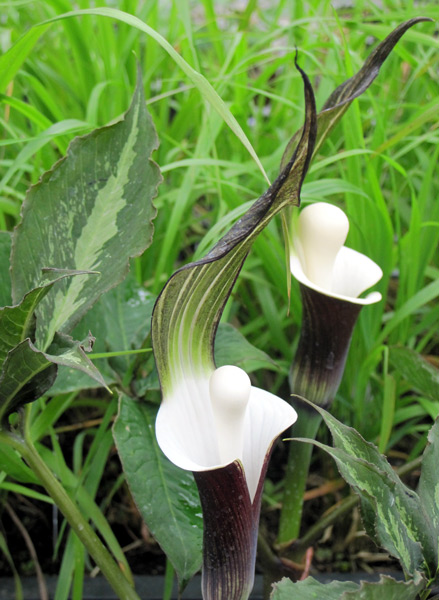 Arisaema sikokianum: This is the earliest species of the genus and undoubtedly one of the most graceful.
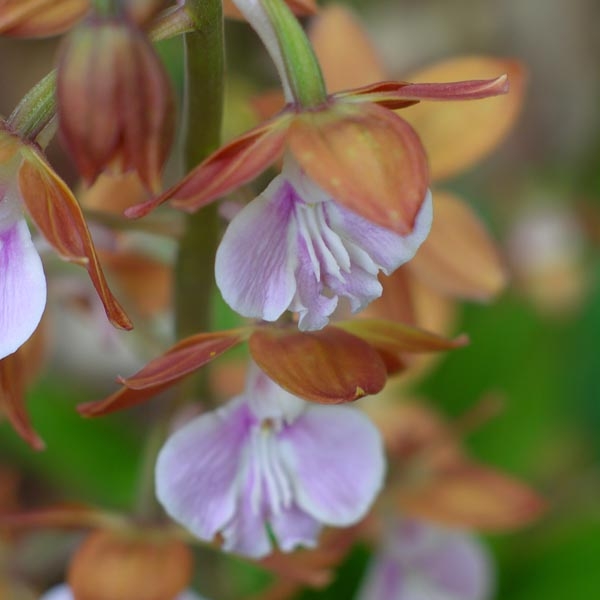 Calanthe discolor: Native to the Japanese mountains, this terrestrial orchid with evergreen foliage is quite hardy in our woodlands. It is hardy down to -12°C.
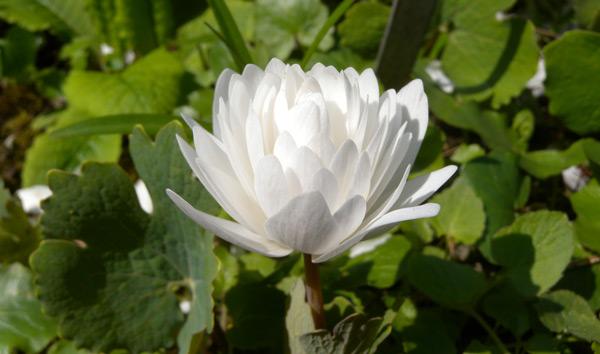 Sanguinaria canadensis Flore Pleno: This small perennial groundcover reveals magnificent double flowers of immaculate white. Its stump suckers in rich, cool, and light soils.
A rare plant is not always synonymous with "uncultivable plant"; rare bulbs are not necessarily the hardest to grow, they are rare due to their shape, cross-breeding, colour, fragrance... But all possess a touch of originality. They do not like excess: not too much shade, sun, wind, water, or dryness.
The ideal conditions for growing them long-term involve having light, cool soil rich in humus with a neutral or acidic tendency. They should ideally be planted in a shady rockery or in a bed facing north or west, against the wall of the house, with the soil amended with compost.
Rest assured, if you do not have these conditions, rare bulbs adapt very well to pot cultivation; in fact, the more tender varieties will be exclusively planted in pots. Just be careful not to overwater them during dormancy, as they do not tolerate excess water. A tip: when planting, place your bulb on a bed of 5cm of gravel or sand to ensure good drainage and promote longevity.
Every year we search for the rare bulb that is hard to find, highly sought after, and will surprise you. Among the new offerings in our spring catalogue this year, we have uncovered some gems for you. Pleione forrestii: The lemon-yellow flowers of this terrestrial orchid reveal a subtle spicy fragrance. Hardy down to -5°C, […]
In my opinion, evening and morning are the best times to admire the flowers in the garden. The colours are softer, less overwhelmed by sunlight, and the contrasts are more pronounced. This is even more evident with white flowerings; when the flowers are exposed to full light, it's wise to have a good pair of sunglasses to fully enjoy the blooms without straining your eyes.
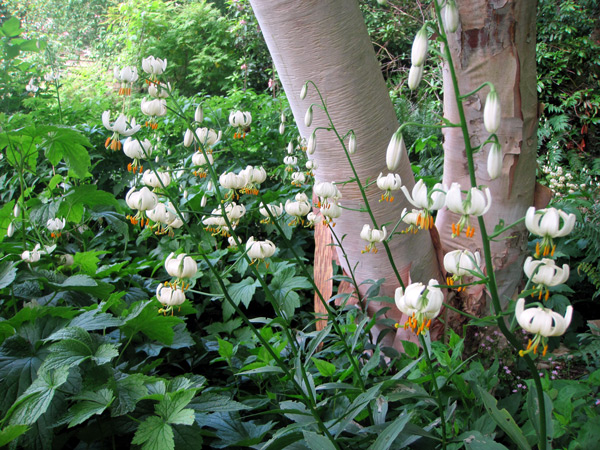
Flowers of the Lilium martagon Album
White should be used sparingly, and when creating an entirely white garden, the exposure must be thoughtfully considered. The most beautiful white gardens are those that are partially shaded or even completely shaded, as white does not jump out at you; it is soft, and one can better discern the nuances. At the moment, there is a plant I particularly love, which is the white form of the martagon lily (Lilium martagon 'Album'). Bulbous plants have the great advantage of being able to spring up, almost overnight, from a bed and quickly add a touch of colour. This lily blooms early but, more importantly, it flowers during the lull period, that is, when the spring flowerings are finishing and the summer ones are just beginning. It allows for a gentle transition from spring to summer.
In this partially shaded white garden, the Manchurian birch (Betula costata) structures the bed, and the flowerings are arranged around it. The bulbous plants with white flowers (Narcissus, Trillium, Cardiocrinum, and lilies) punctuate the bed and enliven it, supported by a large number of perennials: hostas, anemones, astilbes, primroses, strobilanthes, etc., which have a stronger presence.
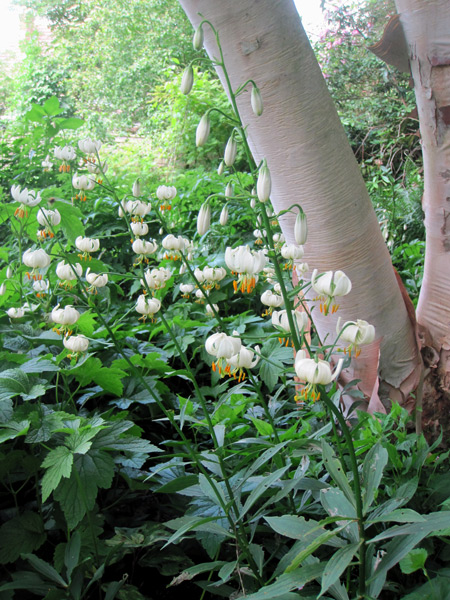
Cultivating martagon lilies is simple; they thrive in sun or partial shade and prefer soil rich in humus, cool, and light. One must be cautious of one thing: the lily beetle, which tends to puncture the leaves, as can be seen.
In my opinion, evening and morning are the best times to admire the flowers in the garden. The colours are softer, less overwhelmed by sunlight, and the contrasts are more pronounced. This is even more evident with white flowerings; when the flowers are exposed to full light, it’s wise to have a good pair of […]
The first agapanthus are starting to flower now, like the beautiful Dr Brouwer Agapanthus, photographed yesterday in the greenhouses below.
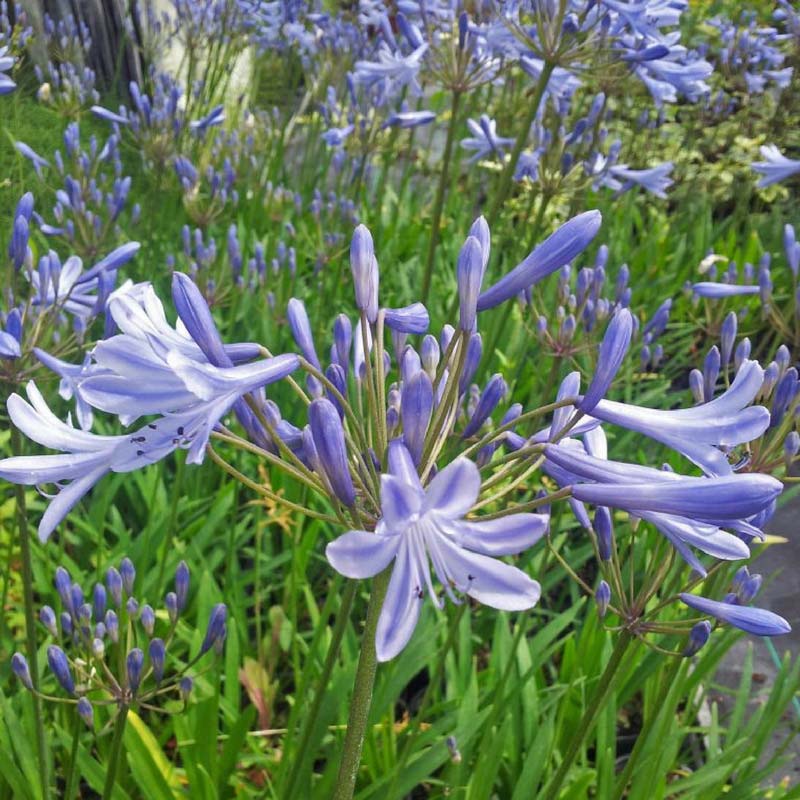
This is a great opportunity to revisit some classic questions about agapanthus...
When should agapanthus be planted?
Not now, in summer, but in spring: they have time to settle in before the heat. Ideally, plant just after the last frosts.
Autumn planting is possible (but in that case, buy them in pots), though tricky, as they are sensitive to winter cold. This is only for experienced gardeners!
Is it better to buy an agapanthus in a pot or bare roots?
There is an advantage to planting in pots: the plant is already established, which saves time in the growing cycle.
However, "bare roots" (actually stumps) are often much larger than what you can find in pots, so they tend to flower better... and are generally less expensive. Personally, I prefer bare roots: you know exactly what you're planting!
By the way, if you plant bare roots, bury the stump 5 to 10 cm deep.
Do agapanthus fear the cold?
Yes. But most can withstand a light frost: they can survive -5°C for one night, but not much more. So be careful, except in a narrow coastal strip (and yes, that's why the most beautiful agapanthus are by the sea...), they need winter protection!
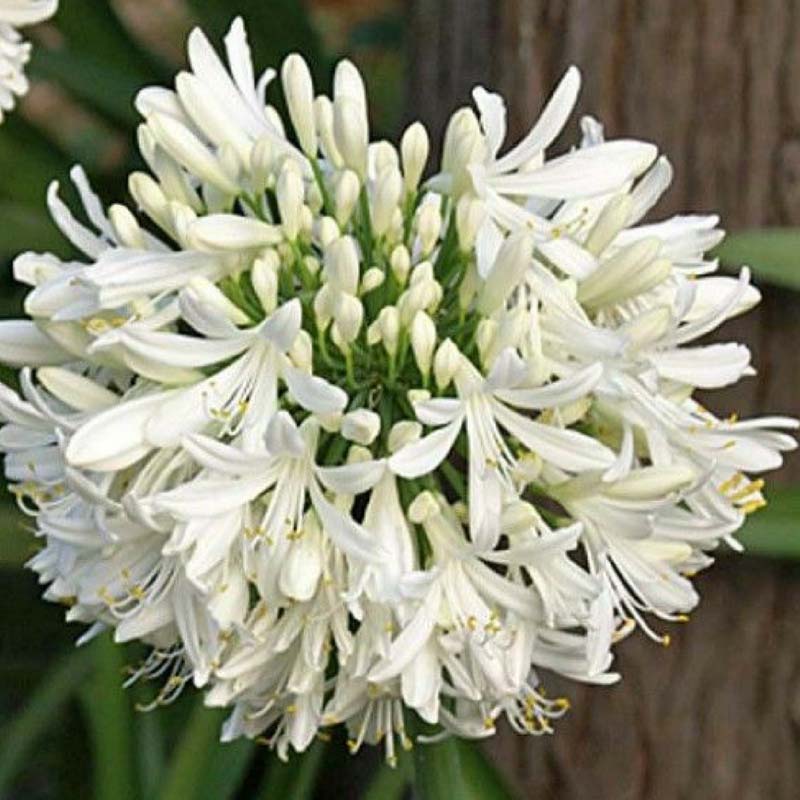
Agapanthus umbellatum album
As always, local conditions will play a role: an agapanthus in a sheltered south-facing position, in well-drained sandy soil, will withstand -10°C better than its counterpart planted in a windy spot in clay soil saturated with moisture at -3°C.
Note that there are some varieties that are quite hardy, like Headbourne, the most resistant, which can endure down to -8°C.
How to protect agapanthus in winter?
It's not complicated; there are two solutions:
1) A pot planting, which can be placed in a shed or unheated garage (or, if not possible, generously protected from the cold with cardboard, newspaper, etc.) when the first frosts arrive, to be brought out after the last frosts. Be careful not to bring them out too early, as young shoots are sensitive to frost....
2) A mulch, which will vary in thickness depending on the region and the chill... Generally, 10 cm is sufficient. We have successfully kept our agapanthus in the ground in our northern garden, even during the terrible winter of 2011, with a 25 cm layer of leaf mulch, covered with a tarp to hold it in place.
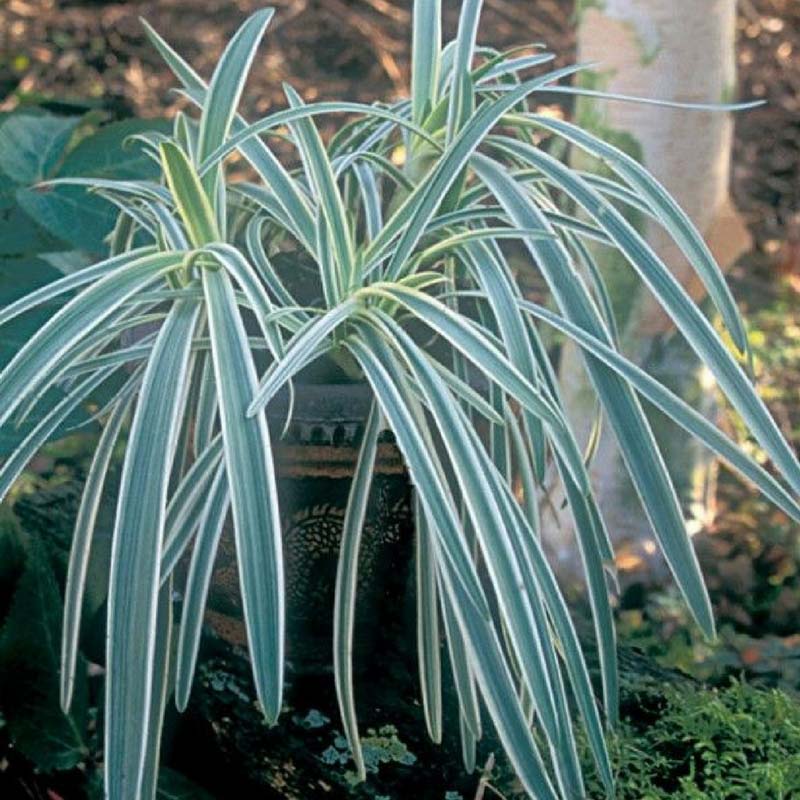
Agapanthus Tinkerbell
Why didn't my agapanthus flower last summer?
Young agapanthus do not flower well. Opt for quality 2/3 eyes - meaning 2 or 3 shoots emerging from the stump (this is the quality we practice....) - which are strong enough to flower in the first year.
Agapanthus need a lot of sun to flower. In "poor summers", flowering is compromised in the northern half of France... Even more so if the agapanthus are not planted in full sun!
They do not like excessive watering, but can tolerate drought if it doesn't last too long: in pots, water about once a week, twice in very hot weather.
Should I add fertiliser to my agapanthus?
Agapanthus prefer fairly rich, well-drained soil, but are not very greedy. In the ground, they do not need fertiliser. In pots, you can add a base fertiliser once a year, or a liquid fertiliser once a month in spring.
Why are my potted agapanthus more beautiful than those I planted in the garden?
Often, indeed, they are paradoxically more beautiful in pots.
Three factors:
- they like to be a bit crowded, which stimulates their flowering...
- Pots are often less humid than the ground, and agapanthus prefer fairly dry, well-drained soils (they are Mediterranean plants).
- In pots, you can better manage the planting location: clever gardeners will place their pots in the sunniest and most sheltered spot in the garden.... To bring them back to the semi-shaded terrace at flowering time!
It is said that agapanthus are evergreen, but mine lose their leaves in winter, why?
Most agapanthus found in commerce are from the Africanus varieties (due to their South African origin): the foliage is evergreen... unless frozen. In our climates, outside a narrow coastal strip, the foliage disappears in autumn and reappears in spring.
Are all agapanthus blue?
The most beautiful (in our opinion) is an electric blue: Blue Giant. But there are also white ones, and nearly all shades of lilac mauve, and even night blue varieties, like the sublime Black Magic. Note that there are also varieties with bright variegated foliage, like Tinkerbell or Silver Moon.
You will find a wide selection of varieties on our website!
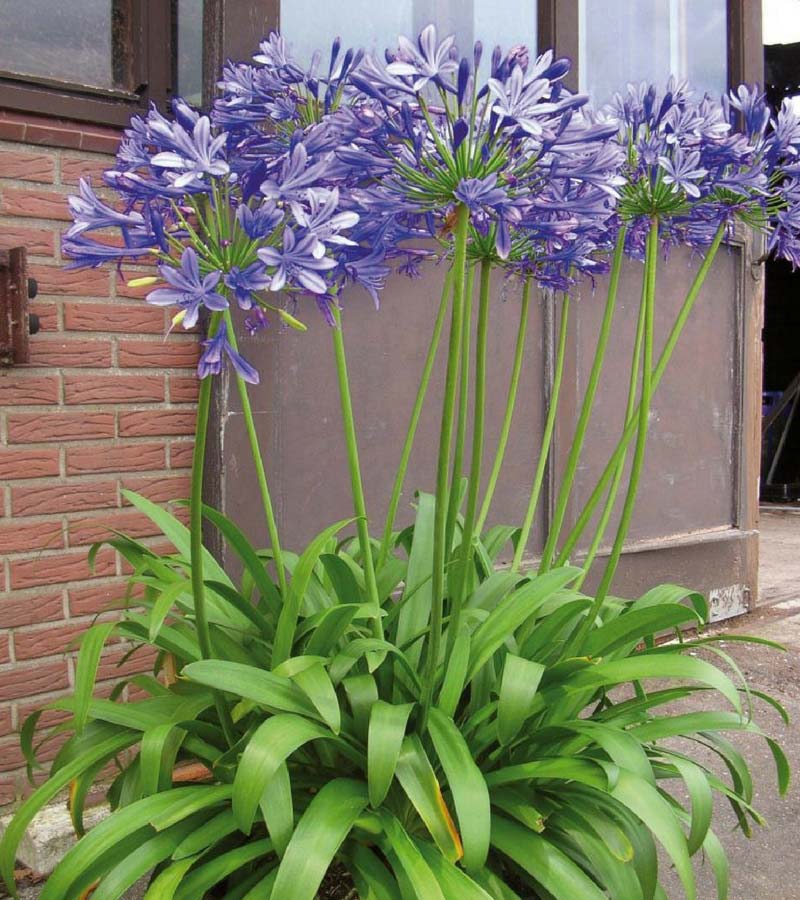
Agapanthus Blue Giant
The first agapanthus are starting to flower now, like the beautiful Dr Brouwer Agapanthus, photographed yesterday in the greenhouses below. This is a great opportunity to revisit some classic questions about agapanthus… When should agapanthus be planted? Not now, in summer, but in spring: they have time to settle in before the heat. Ideally, […]