These plants with unusual scents
Unusual and unexpected scents: what certain flowers and foliage have in store for us…
Contents
Scents of coffee, chocolate or Coca-Cola, and even surprising odours such as tarmac or saucisson, plants can sometimes play strange tricks on us, making their fragrances an added curiosity.
Although alliums all smell of garlic, some plants reveal unappealing or utterly addictive odours when you crush them or simply move closer.
Which plants have these unusual fragrances? Discover a few of them!

Gourmand scents: chocolate, coffee, caramel
Several plants make it onto this rather pleasant, even nostalgic, olfactory podium.
First up is Cosmos atrosanguineus, whose flowers are all an intense chocolate colour, close to deep burgundy. It is in warm weather that they release their velvety, cocoa-like fragrance. They have been hybridised to produce a few other chocolate-scented horticultural gems, such as Cosmos ‘Cherry chocolate’ and ‘Chocamocha’.
These perennial cosmos are more fragile than annual cosmos and should be planted in a mild climate, with protection in winter.
A pretty, bright yellow member of the daisy family, Berlandiera lyrata, also releases a gentle chocolate fragrance on hot summer days.
Campsis capreolata, a trumpet vine with copper-coloured flowers, yellow and orange, is also an interesting plant for its unusual fragrance. An aroma of coffee wafts through the air in the late afternoon, when you approach the trumpet-shaped flowers. It also differs from other trumpet vines through its early flowering, between May and June, sometimes repeating in September, and its semi-evergreen to evergreen foliage.
Cercidiphyllum has an evocative French nickname, “katsura tree”. Here, the phenomenon occurs only in autumn and at the end of summer, when the foliage has fallen to the ground, and after rain or at the end of the day: the leaves then release a powerful fragrance, reminiscent of caramel, gingerbread, candyfloss and malt, depending on individual sensitivity. Cercidiphyllum is a small tree grown for its superb autumn foliage, which takes on a multitude of warm colours.
Finally, among the sweet scents, Euodia danielii creates a very pleasant sensation with its honey-like fragrance when you approach its long white corymbs in summer. This bee-bee tree, as it is also known, certainly lives up to its name, but it is above all the bees that it attracts by the dozen. It also has the advantage of being highly resistant to drought and urban pollution.
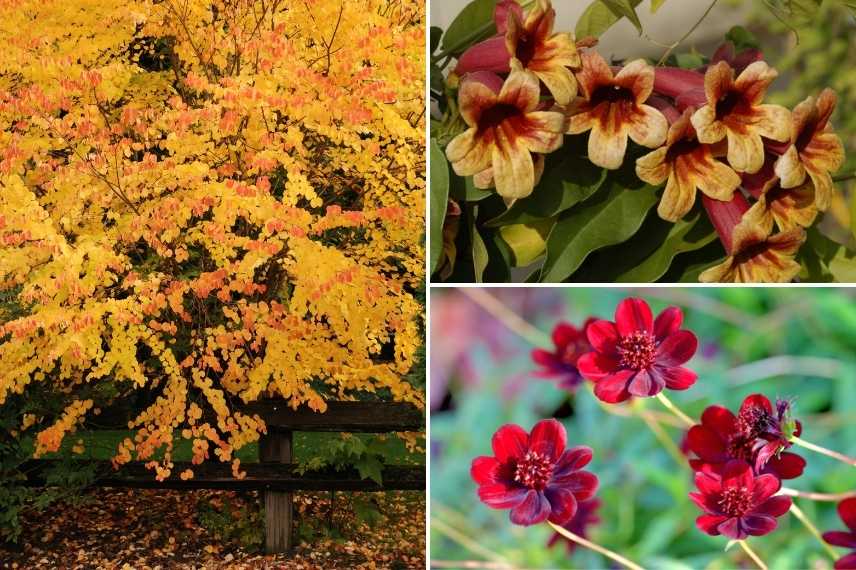
Cercidiphyllum, Campsis capreolata and Cosmos atrosanguineus
Read also
Create a sensory gardenExotic fruit fragrances
The floral note is, of course, common in flowers, but some flowers or foliage have very fruity fragrances, making us think of exotic fruits. This is the case with pineapple sage (Salvia elegans), whose leaves only need to be rubbed to release their typical fragrance, which is remarkably similar to the exotic fruit.
Other plants give off a rather convincing coconut fragrance. Among them is Ulex europaeus, common gorse, also known as European gorse. Its bright yellow flowers brighten the end of winter and spring, leaving a fragrance somewhere between coconut and vanilla in the air. Ulex parviflorus, Provence gorse, which flowers in winter, also releases coconut and vanilla scents into the maquis and garrigue.
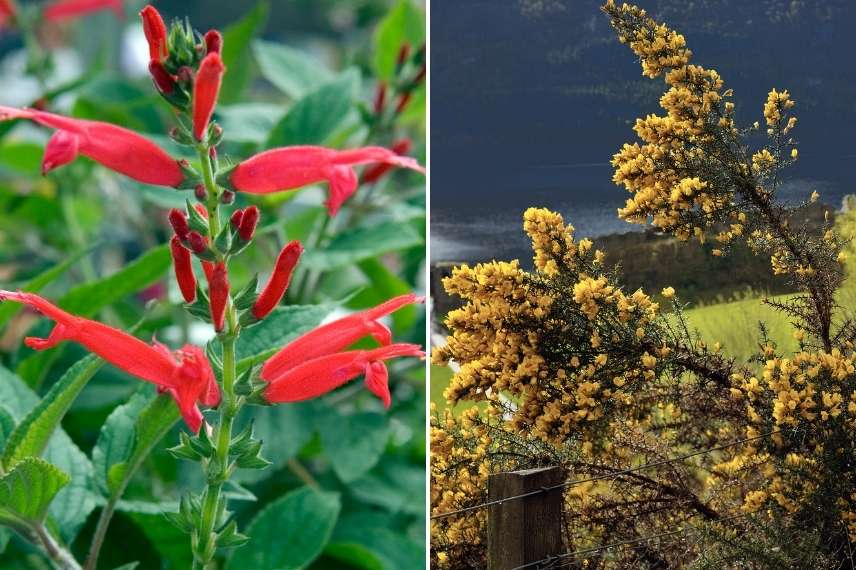
Pineapple sage and European gorse
Cola scent
If there is one scent you would not expect to come across among plants, it is the artificial scent of the North American soft drink. Yet two plants lay claim to it.
Cola plant, as it is often called, is an aromatic perennial plant with very fine, grey-green foliage that gives off the scent of the world-famous soft drink. A little gem to grow in any well-drained soil, in full sun.
One of the most surprising scented pelargoniums, Pelargonium ‘Cola Bottles’ also smells strongly of Coca-Cola when its wavy, toothed leaves are crushed. Its pink flowers are veined with purple at the centre. This pelargonium needs to be brought under cover in winter, as it is highly sensitive to cold.
N.B.: the highly distinctive scent of Cola comes from a combination of cinnamon, vanilla and citrus, which you can try out at home using perfume blotters waved beneath your nose to recreate this unique fragrance!
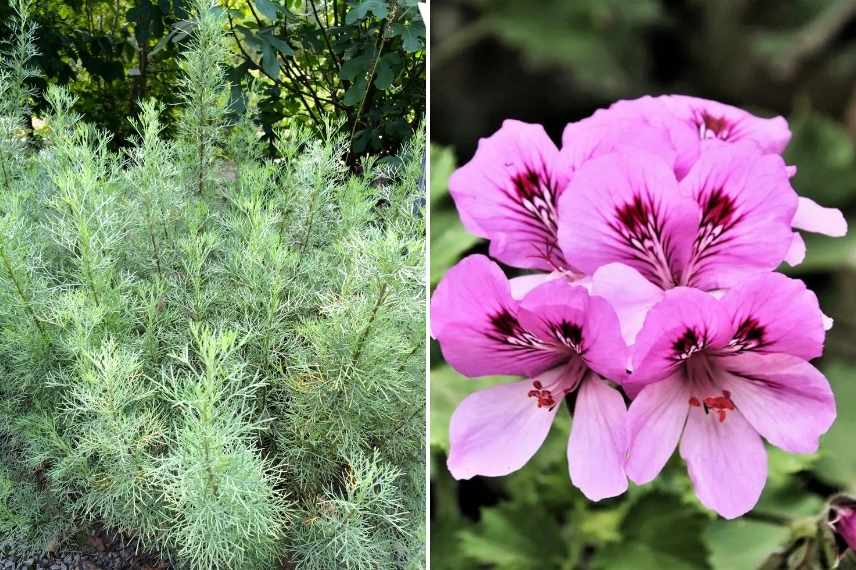
‘Cola’ plant and Pelargonium ‘Cola Bottles’
Read also
8 evergreen and fragrant shrubsPeanut scent
Two plants are vying for the title of peanut tree!
Great honey flower, or Melianthus major, is also known as Touch me not in English, referring to its distinctive scent, which is not actually all that unpleasant (well, that is just my opinion). Let us say that a peanut-like smell can be detected when its large, beautiful and striking leaves are brushed against.
Clerodendron trichotomum, or harlequin glorybower, a name referring to its blue berries set against a bright pink calyx in late summer, also has this particular feature, again in its foliage. It flowers in late summer, producing very beautiful white flowers, almost exotic when they turn pink, with a sweet jasmine fragrance.
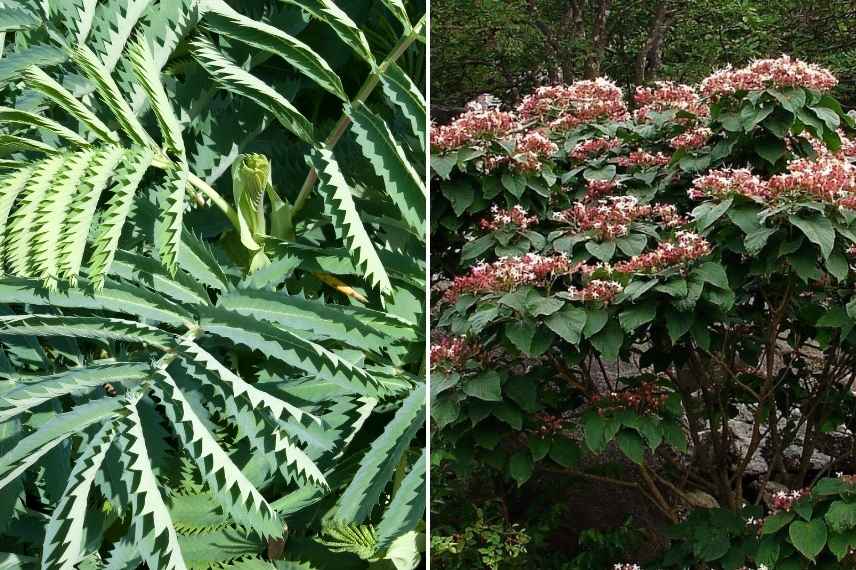
Melianthus major and Clerodendron trichotomum
Smell of tarmac
Its common name leaves little doubt: we are now faced with a flower that smells of bitumen! It is now called Bituminaria bituminosa, perhaps to really drive the point home!
Psoralea bituminosa, or stinking clover, is a legume with leaves resembling clover, but much finer, and blue flowers that are also similar to those of common clover. It is once again when the leaves are gently crushed that this highly unusual smell surprises our nostrils.
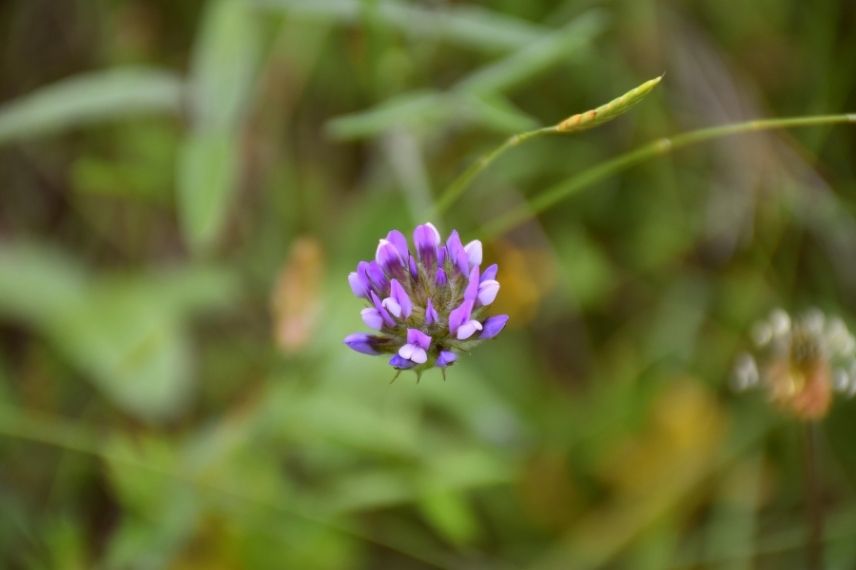
Bituminaria bituminosa
Nauseating smells
Sometimes nature surprises us with scents that are far less appealing. Here are a few olfactory gems bordering on rottenness, meaty notes… or worse:
Ginkgo biloba: as many people know, fallen female fruits give off a scent that we might kindly describe as vomit.
Amorphophallus titanum, or titan arum, sometimes called the titan phallus: rotten fish, decomposing flesh… the descriptions used for this plant’s scent are all more vivid than the last. This time, it is the exceptionally large flower that gives off the foul odour, a simple strategy to attract the flies it feeds on. This unique flower in the plant kingdom opens only once every ten years or so. Smaller, and also belonging to the Araceae family, Dracunculus vulgaris, or dragon arum, has the same “corpse plant” smell.
Native to Africa, the sausage tree (Kigelia africana) bears long fruits resembling large sausages. Its enormous flower opens at night to be pollinated by bats, releasing a truly vile scent somewhere between musk and rotting fruit.
Teucrium polium, or felty germander: it has hints of cured meat, hence its nickname, sausage plant, a botanical oddity…
Stinking iris is also known as roast-lamb iris (Iris foetidissima). Not very flattering, then, and once again it is the rustling of the leaves that produces this smell. In my view, its reputation is somewhat exaggerated, especially as its modest, attractive flowers develop into a profusion of colourful fruits that should not be overlooked.
In the same vein, another plant described as fetid: Helleborus foetidus. It too reveals this unusual characteristic when its pretty, finely divided palmate leaves are rubbed. Far less alarming than Ginkgo or titan arum, and so beautiful with its anise-scented bells at the end of winter!
As for common rue (Ruta officinalis), it does not appeal to everyone, with a rather indefinable yet persistent and powerful smell. It is nevertheless a medicinal and allelopathic plant.
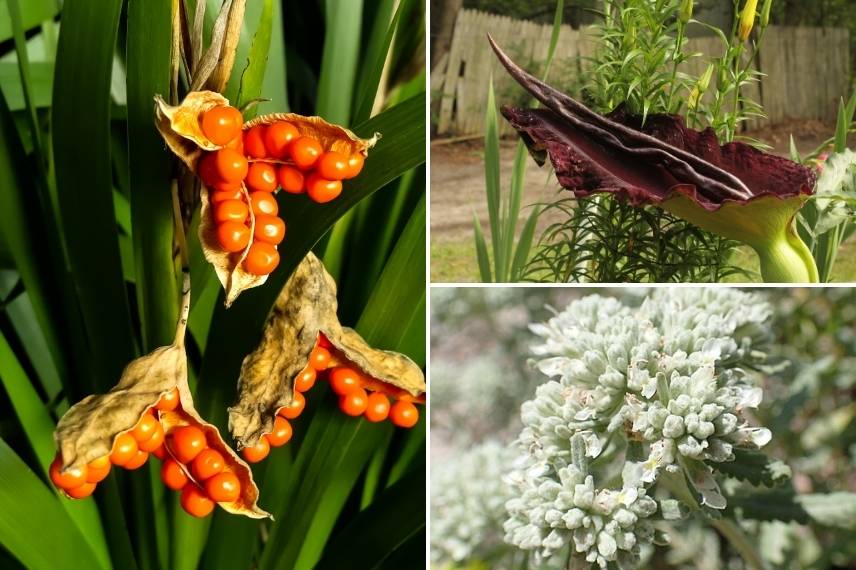
Iris foetidissima, Dracunculus vulgaris and Teucrium polium
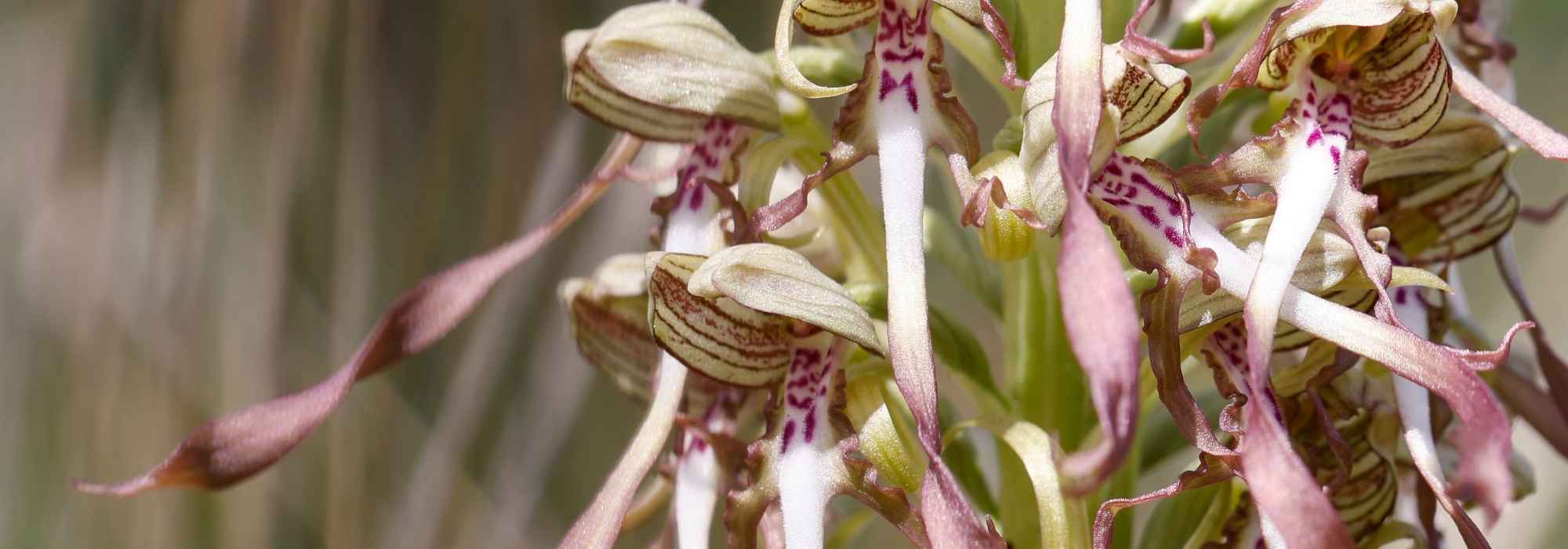
Finally, the lizard orchid, or Himantoglossum hircinum, is no exception! Another scent that is difficult to describe in flattering terms, as its numerous flowers smell of billy goat.
Like titan arum, the lizard orchid uses this olfactory trick to attract insects that can pollinate it.
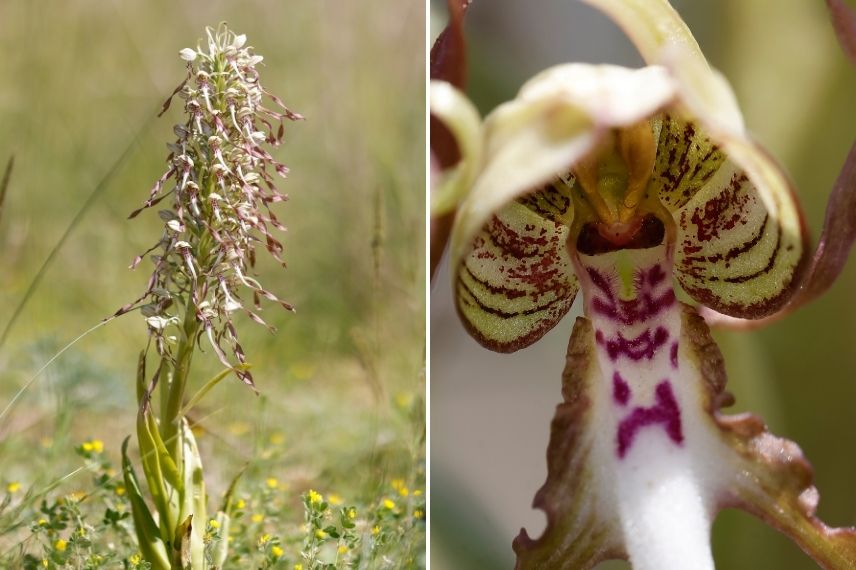
Himantoglossum hircinum
Wine-like odour
With Calycanthus floridus, it is the scent of wine that reaches your nostrils when you approach its flower. Carolina allspice, its other name, is indeed renowned for this wine-like fragrance.
Unlike many other plants, its scent is strongest early in the morning.
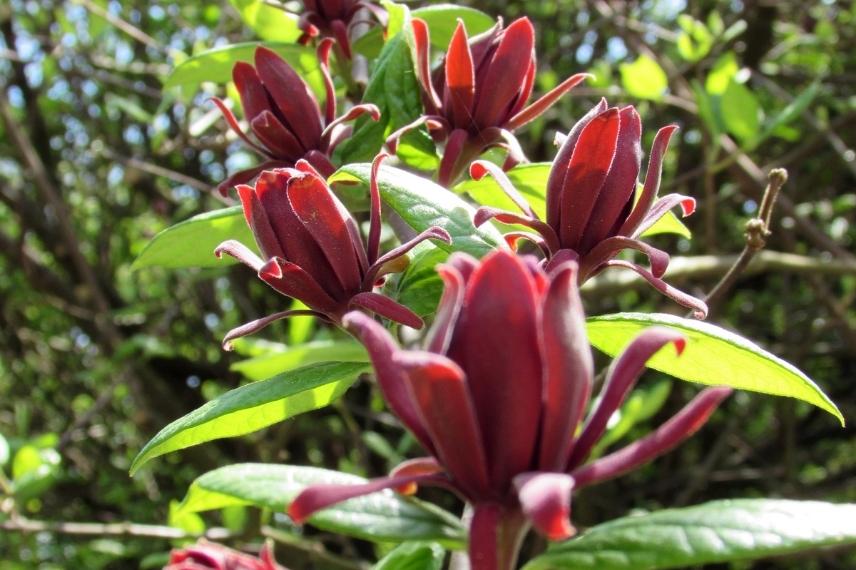
Calycanthus floridus
Oyster smell
Mertensia maritima, or oyster plant, has a vernacular name that perfectly matches its scent.
Like many members of the Boraginaceae family, particularly the common borage (Borago officinalis), whose small star-shaped flowers have a strongly iodised smell and flavour, oyster plant is known for its leaves with a distinctly marine scent. A shot of seawater, or oyster, which goes well with many fish and shellfish dishes.
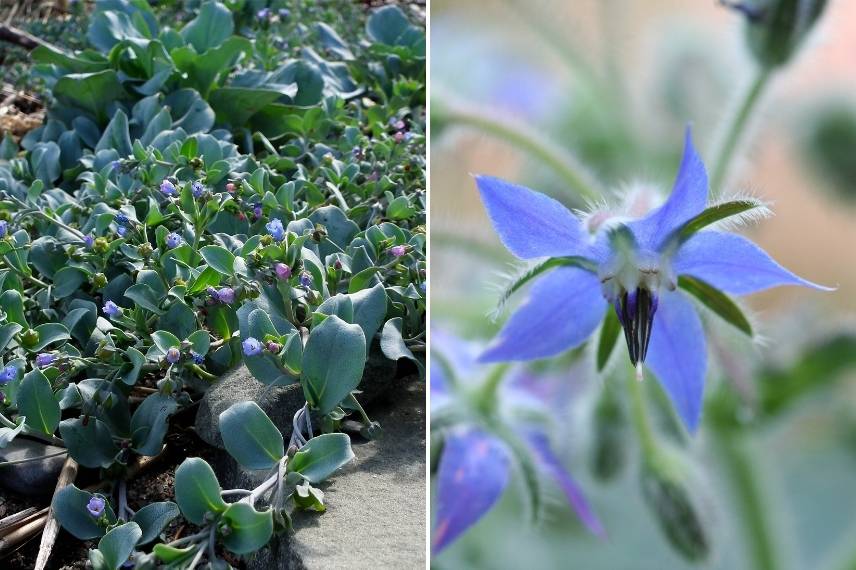
Mertensia maritima and Borago officinalis
Spice scents
Our aromatic plants smell of Provence or cooking! Some of them go even further, taking us to far-flung lands, like the famous curry plant or Helichrysum italicum. Rub your fingers over its greyish leaves and a spicy scent, reminiscent of the blend that makes up Indian curry, lingers on your fingers for a long time.
With wallflower (Erysimum cheiri) and its clove scent, lovage, a less well-known aromatic herb, gives off the smell of stock cubes, hence its common name of lovage!
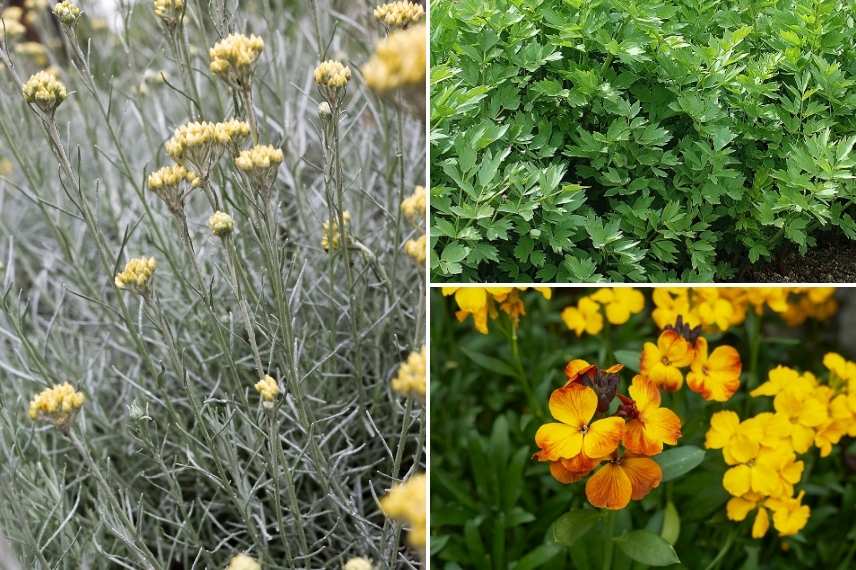
Helichrysum, lovage and wallflower
Exotic fruits that don't smell of roses…
Finally, to end on a fruitier note — although that is putting it rather mildly — some ripe fruits are known for their unique smell, including the famous fruit of the female Ginkgo biloba I mentioned above.
That of the noni, or nono, a tropical fruit from Morinda citrifolia, smells of cheese, somewhere between Camembert and overripe Livarot (or vomit… take your pick — and I can confirm this from personal experience!). The durian (Durio zibethinus), this huge Asian fruit covered in thorns, attempts to compete with it, with a smell somewhere between sewage and rotten onion… Bon appétit!
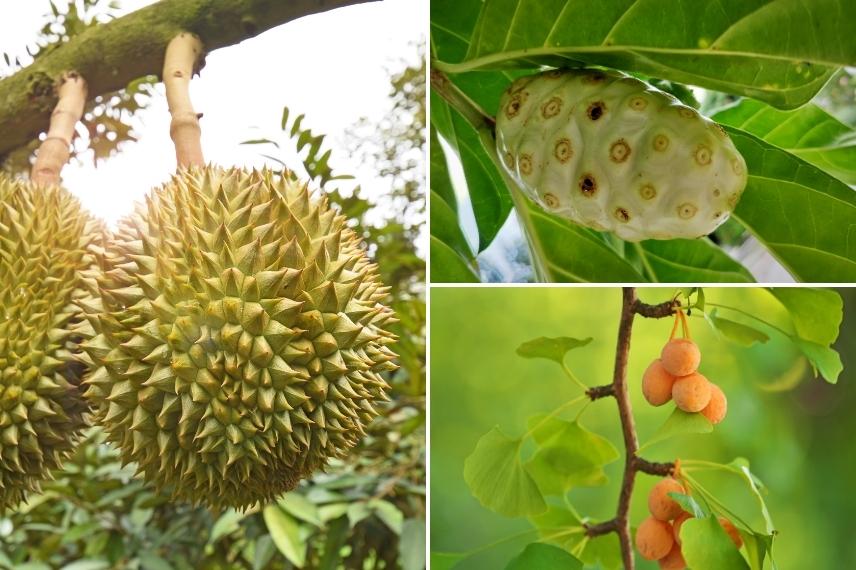
Fruits of the durian, noni and Ginkgo
- Subscribe!
- Contents
This form is protected by reCAPTCHA - the Google Privacy Policy and Terms of Service apply.

































Comments