7 silver-grey-leaved shrubs to have in your garden
Discover our selection
Contents
Silver-grey foliage shrubs are so extraordinary that they deserve to be chosen on this single criterion alone!
Generally undemanding and resistant to sun and sea spray, these shrubs are often essential in dry gardens and are recommended for coastal planting. Their beautiful silvery foliage brightens the garden, blends with pastel shades and softens the brightest colours. They always bring a note of elegance and purity to the garden. In some cases, the colour of the branches or colourful flowering adds considerable extra appeal.
Here are some of the most remarkable shrubs for their colouring.

Buddleia 'Silver Anniversary'
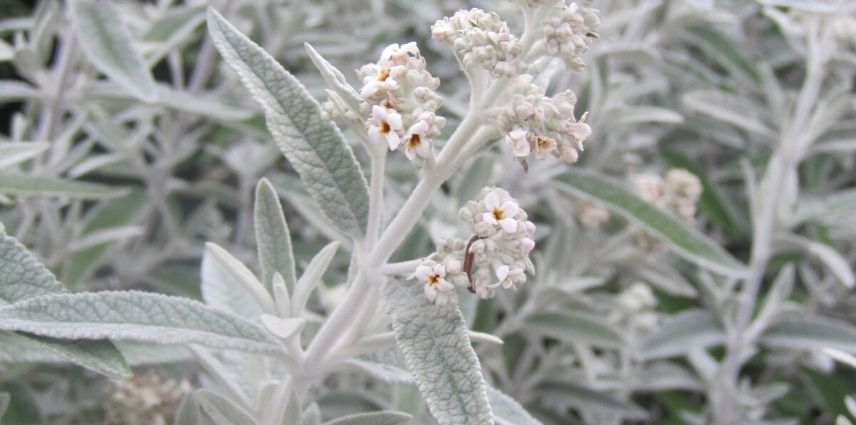
This variety of butterfly tree has bright, silvery-grey tomentose foliage that really sets it apart from classic Buddleias. This attractive shrub produces pubescent leaves that remain more or less evergreen depending on the climate. From August to October, the branches are covered with terminal panicles of small, stocky, white, fragrant flowers that attract numerous butterflies. Less hardy than Buddleia davidii, it can withstand temperatures down to around -7°C. This is a modest-sized variety, particularly well suited to small gardens and growing in containers, especially in colder regions. Not fussy about soil, it thrives in any well-drained soil, even poor, chalky soil, and prefers a sunny position sheltered from strong winds. In a shrub border, it will make a good partner for yellow-flowered potentillas, creating a striking contrast. Its grey foliage will add soft tones that blend perfectly with the pink or lilac colours of phlox, hardy geraniums and lavenders.
- Find out everything you need to know about Buddleia in our complete guide: “Buddleia, Butterfly Tree: planting, pruning, care”
- Discover our wide range of Buddleias
Read also
10 perfect bushes for a seaside gardenElaeagnus commutata 'Zempin'
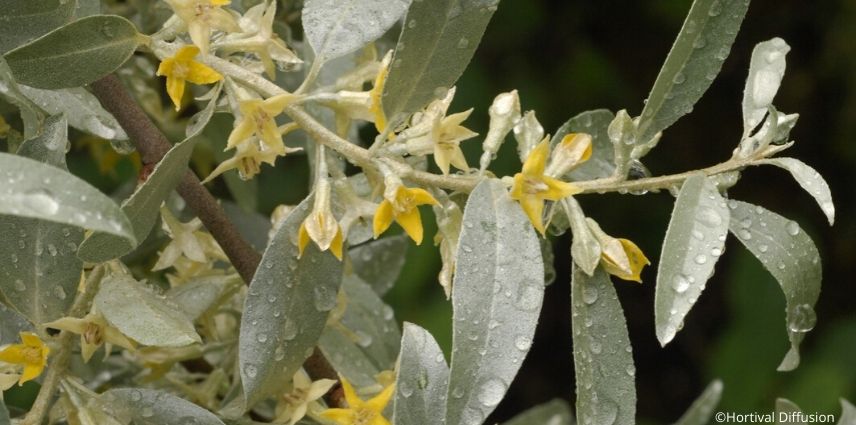
This silverberry with its moonlit charm brings a real source of light to the garden! It quickly forms a handsome, well-ramified shrub with a flexible habit, reaching up to 4m in height and 3m in spread. A bush of Elaeagnus Zempin always stands out from a distance, thanks to the clarity and brilliance of its downy, deciduous, silvery-grey foliage, which is constantly in motion and sparkles in the slightest ray of sunshine. Its slender leaves offer a magnificent greyish, matt colour on the upper surface, with a silvery, glossy underside. From May to June, it produces abundant yet understated flowering, with a spicy fragrance. It adapts to any ordinary, well-drained soil, even poor soil. With its resistance to severe cold, wind, salt-laden spray and drought, this Elaeagnus has a place in every garden, whether by the coast or in a dry garden. It will look superb planted as a specimen, in large silvery groups or as part of a beautiful windbreak hedge along the coast, alongside other particularly attractive shrubs such as ‘Abelia x grandiflora, Buddleia alternifolia ‘argentea’, Amelanchier ovalis or Cistus laurifolius.
- read our fact sheet: “Eleagnus or silverberry: planting, pruning and care tips”
- discover our wide range of silverberries
Hebe pimeleoides 'Quicksilver'
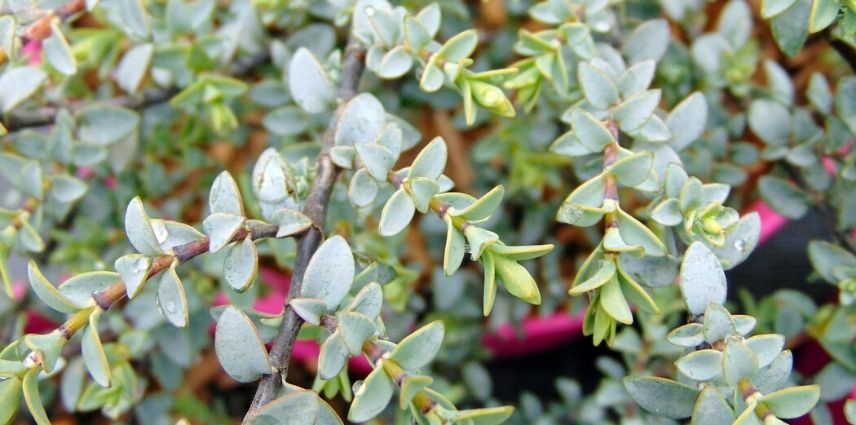
Hebe pimeleoides ‘Quicksilver’ is a small shrubby Veronica with striking evergreen, greyish-silver foliage contrasting with its intensely purple stems. From June to July, it produces spikes of lavender-blue flowers throughout the summer. Together, these features create a compact, spreading shrub up to 90cm wide, with great elegance. It is easy to grow in partial shade or full sun, in rich but always perfectly well-drained soil, where it will withstand temperatures down to -15°C. With its modest dimensions, reaching 45cm in height and 90cm in width, it is ideally suited to use as a groundcover, at the front of a bed, alongside cotoneasters, ceanothuses or a forsythia, in a rock garden or in a pot (it will simply need regular watering during the growing season).
- To find out everything you need to know about this shrub and grow it successfully in your garden, discover our complete guide: “Hebe, shrubby Veronica: planting, pruning and care“
- Discover our wide range of shrubby Veronicas
Read also
12 bushes for dry or free-draining soilPollmix sea buckthorn (Hippophae rhamnoides)
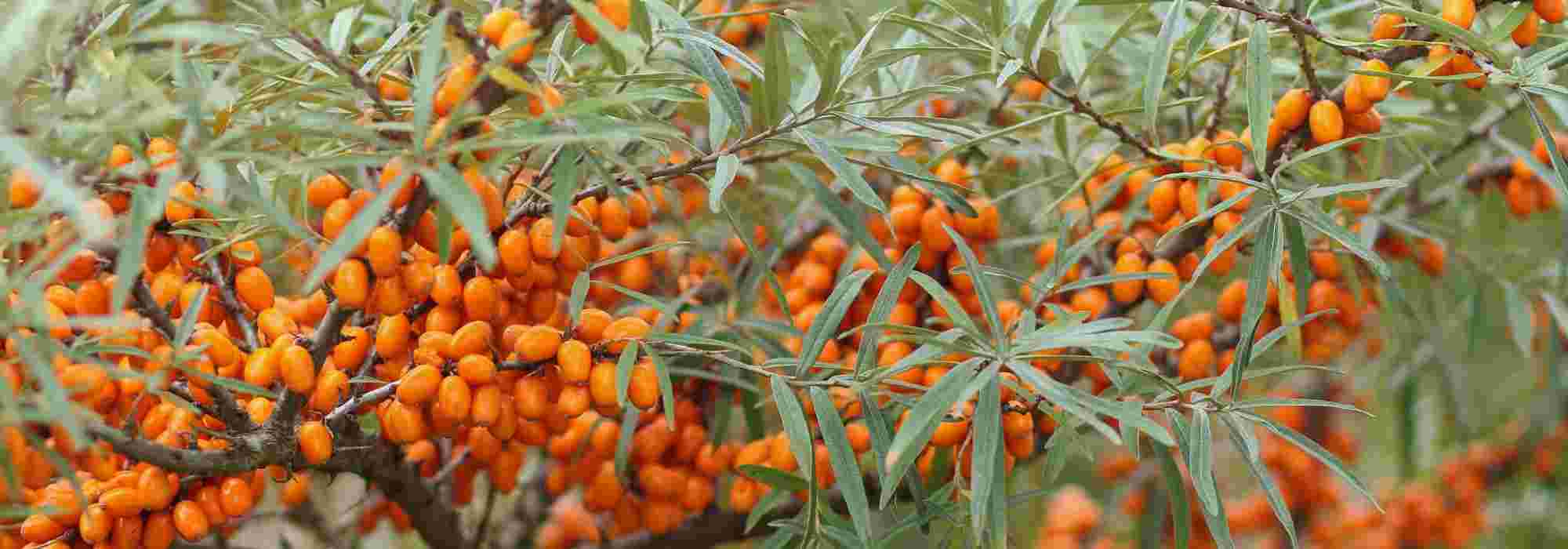
This thorny shrub (Hippophae rhamnoides ‘Pollmix’) is highly decorative, thanks to its slightly twisted appearance, very ramified upright stems and fine deciduous foliage, dark green on the upper surface and silvery grey on the underside. Fast-growing (nearly one metre per year), this bushy shrub will reach a height of 3 to 5 m. Although highly ornamental, this male variety will never produce fruit: small, bright orange edible berries in autumn known as sea buckthorn berries. It is one of the hardiest and most accommodating shrubs. Very hardy, tolerating temperatures down to -30 °C as well as drought, and undemanding as to the nature of the soil, it grows in full sun in all types of soil, even poor soils. In the ornamental garden, plant it as an informal hedge, a defensive hedge or as a standalone specimen. In a shrub border with silvery grey tones, pair it with Perovskia ‘Silvery Blue’ and Salix exigua.
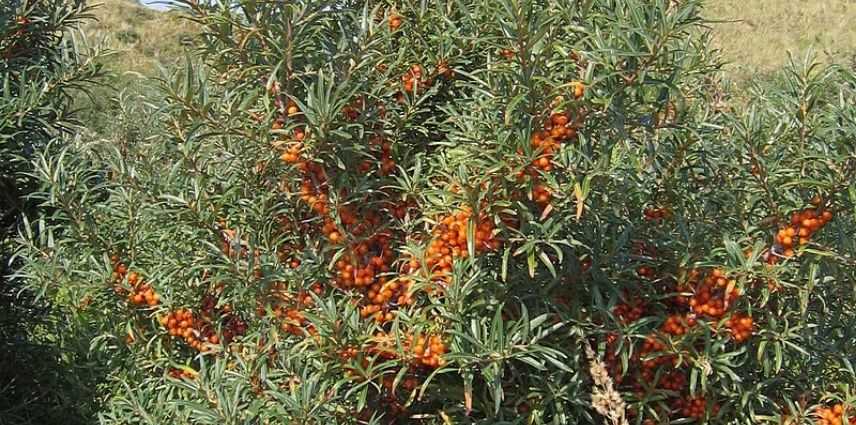
- To find out everything about this shrub and grow it successfully in the garden, discover our complete guide: “Sea Buckthorn: planting, growing and care“
- Discover our wide range of sea buckthorns
Santolina chamaecyparissus
Here is grey santolina, a very robust species of santolina. This very attractive evergreen and hardy Mediterranean shrub immediately evokes the sunshine of southern France. This species forms lovely cushions around 20 to 40cm high and approximately 40 to 80cm across. Its woody stems are covered insoft, silvery-grey, aromatic foliage, giving off a powerful scent of olive oil and turpentine. In Santolina chamaecyparissus, the leaves are finely divided and very toothed, resembling cypress scales, hence its nickname of “cotton lavender”. They are covered with a thick white felt. Small golden-yellow flower heads appear on this rounded bush throughout the summer.
Well adapted to drought, santolina is the quintessential dry-garden plant. It grows in full sun, in any very well-drained soil, even stony and gravelly soil. Give it a rockery or a dry, poor bank, where it will remain unfazed by the sun and heat. It is also ideal as a silvery accent among the plants in a bed, in a formal border or in a pot on the terrace.
In a display evoking Mediterranean scrubland, it will create a beautiful picture of grey foliage paired with Artemisia, Helichrysum italicum and lavenders.
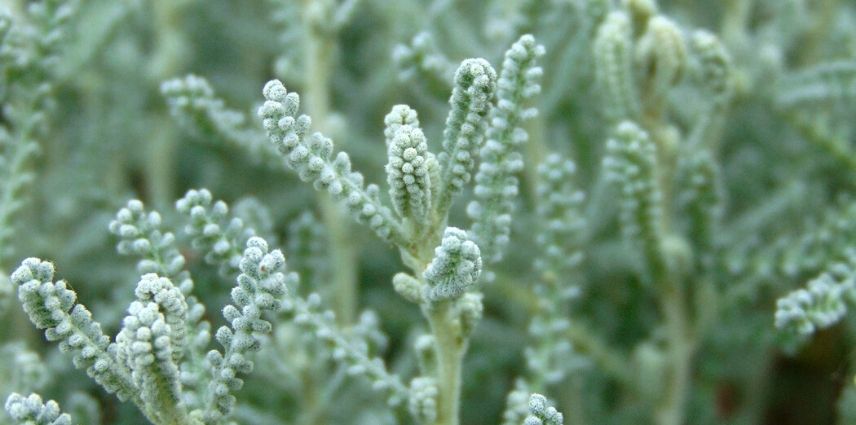
- To find out everything about this shrub and grow it successfully in the garden, discover our complete guide: “Santolina: planting, care and pruning“
- Discover our wide range of santolinas
Salix lanata
Woolly willow is a bushy, compact shrub with nodose wood. Small and fairly slow-growing, it reaches 1 m in height and spreads to 1.50 m. Its appeal lies above all in its woolly, dark grey-green foliage with a matt finish. In spring, it is crowned with large, golden and grey-yellow catkins that are quite spectacular.
Used to very harsh climates, it is highly robust and thrives in full sun in very well-drained but moisture-retentive beds. This willow is well suited to small gardens and will look just as delightful as a specimen plant, in a bed or in a rock garden. For example, you can pair it with perennials and shrubs such as winter savory, Santolina chamaecyparissus, Cytisus purpureus and Arabis.
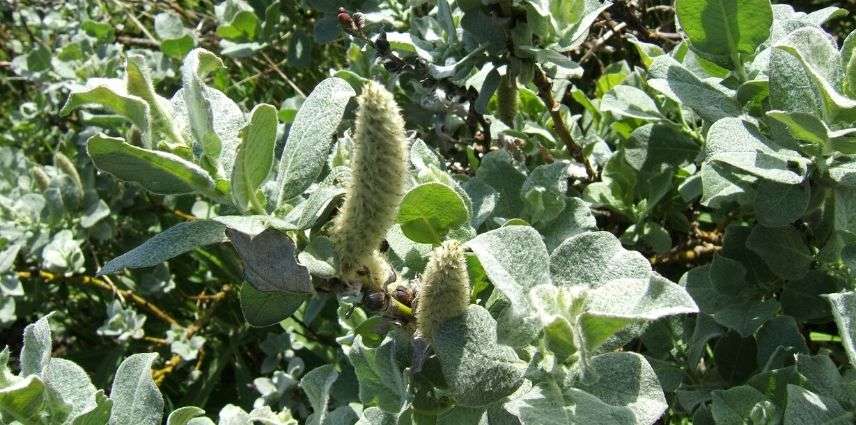
- To find out everything about this shrub, discover the guide devoted to it: “Willow, Salix: planting, pruning and care“
- Discover our wide range of willows
Caryopteris (x) clandonensis 'Sterling Silver'
This hybrid caryopteris stands out for its particularly luminous, silvery-grey deciduous foliage. Like other caryopteris, it is highly aromatic as soon as its leaves are crushed. This light, scented foliage provides a beautiful backdrop for its late-season flowering, with airy clusters of fairly vivid blue flowers. It forms a small, bushy, rounded and ramified shrub, 1 to 1.20 m high and 90 cm wide. This plant thrives in full sun and well-drained, even dry, soil, and is hardy down to -15 to -20 °C in these conditions. Plant this voluptuous and elegant shrub in a very sunny bed, a large rockery or a low hedge, alongside summer-flowering shrubs that are just as undemanding as it is, such as yellow shrubby potentillas, ceratostigma plumbaginoides, lavenders or dwarf buddleias.
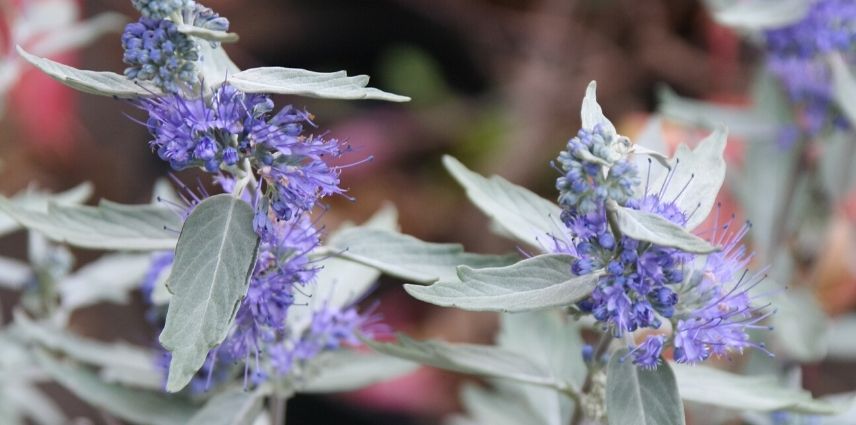
- To learn all about this shrub and grow it successfully in the garden, discover our complete guide: “Caryopteris, Blue Spirea: planting, pruning and care”
- Discover our extensive range of caryopteris
- Subscribe!
- Contents
This form is protected by reCAPTCHA - the Google Privacy Policy and Terms of Service apply.

































Comments