Asian longhorn beetle: a threat to our trees?
How can you identify and control this highly dangerous beetle that attacks broad-leaved trees?
Contents
Anoplophora glabripennis and Anoplophora chinensis are the scientific names of feared wood-boring beetles, more commonly known as the Asian longhorn beetle and the citrus longhorn beetle. So feared that, throughout the European Union, they are classified as “priority quarantine pests (PQPs)” under Regulation (EU) 2016/2031 of 26 October 2016 on protective measures against plant pests. In some regions, the Asian longhorn beetle is also regulated by a prefectural order. This is because these two insects from the Cerambycidae family attack leafy trees that are relatively common across the territory, such as maple, poplar and birch, as well as some fruit trees and citrus trees such as lemon trees.
Although most infestation outbreaks in France have now been virtually eradicated, monitoring remains constant and active in certain areas.
Find out who the Asian longhorn beetle really is, how to recognise it and what to do if you suspect its presence.

What exactly is the Asian longhorn beetle?
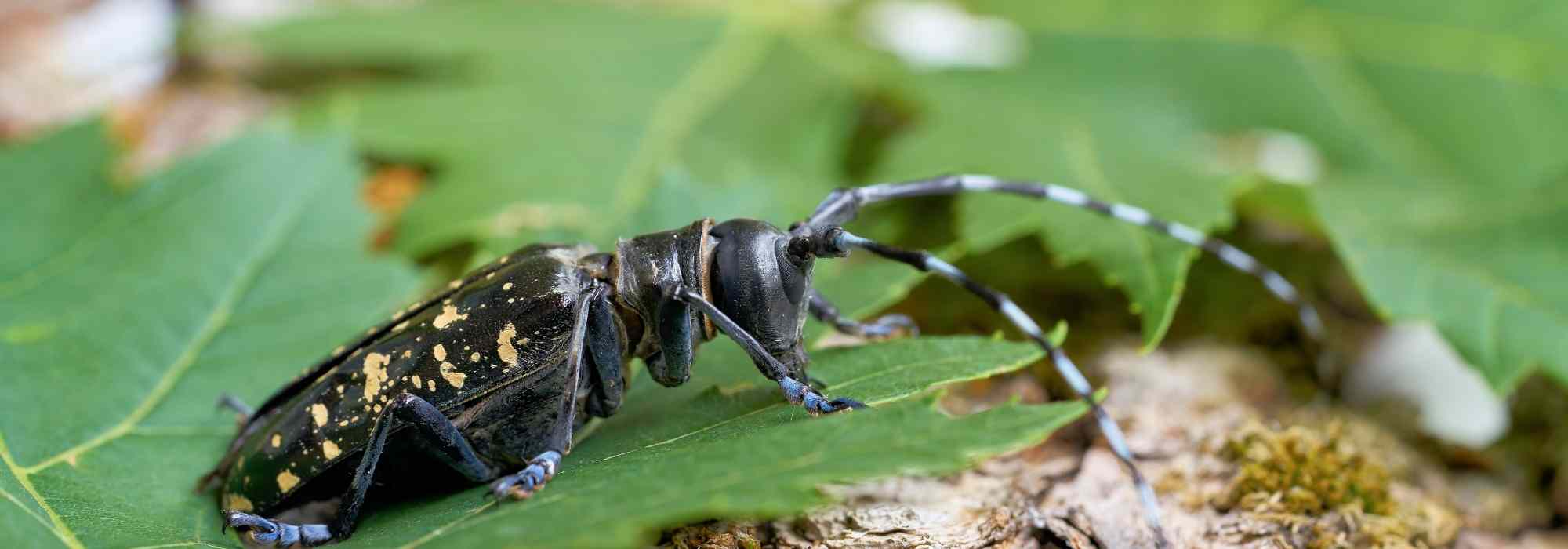
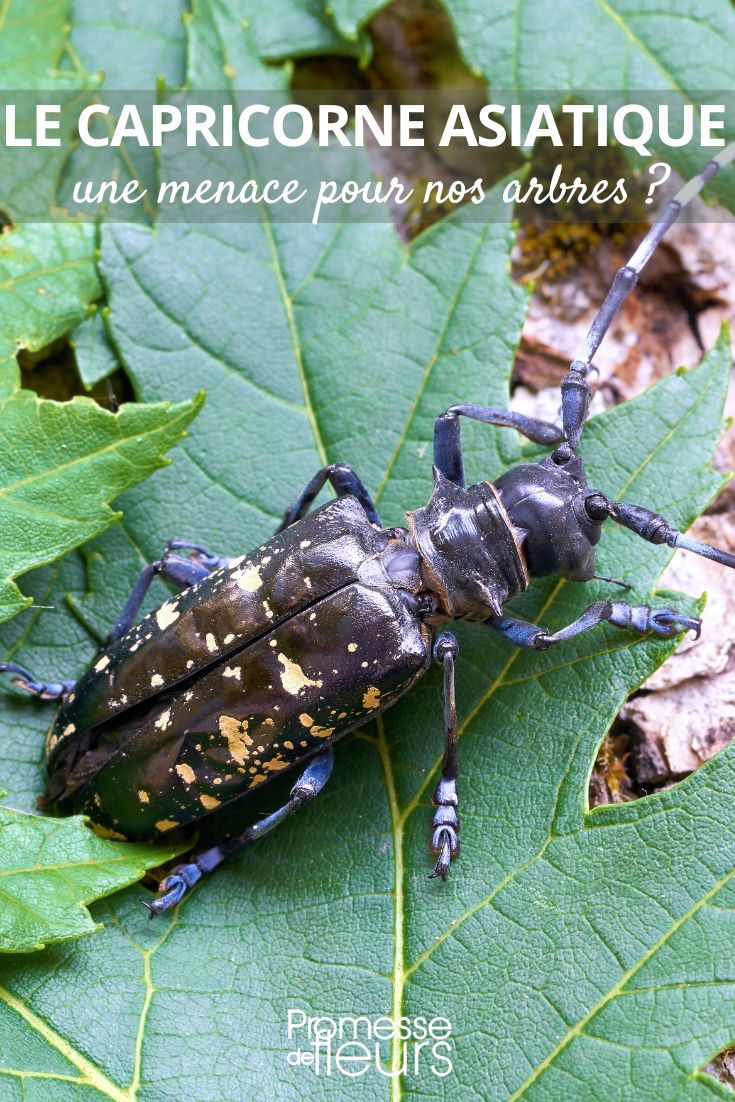
Asian longhorn beetles (Anoplophora glabripennis and chinensis) are beetles recognisable by their black, shiny, smooth elytra (hard wings), marked with whitish spots, and their very long, thread-like antennae, which account for two-thirds of their body length. These same antennae are striped grey-blue. This insect, which feeds on living wood, measures between 20 and 37 mm, with the female being slightly larger than the male.
The legless larvae of this insect are 5 cm long and have one or two bands on the pronotum (the upper part of the first thoracic segment).
Native to eastern Asia, the Asian longhorn beetle appeared in the United States in 1996, then in Europe from 2001 onwards. In France, in 2020, five identified infestation sites were recorded, scattered throughout the country. To date, only the Loire Valley, and more particularly the town of Gien, has been subject to a systematic monitoring campaign.
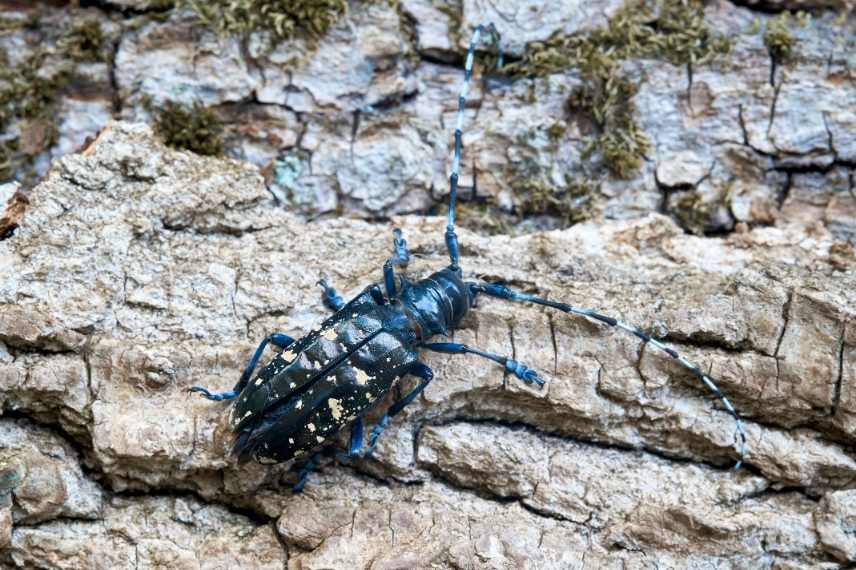
The Asian longhorn beetle has black elytra marked with black spots and very long antennae
As for the citrus longhorn beetle, it was detected in Europe in 2000, more precisely in Milan, and then in France in 2003. Today, it appears to have been eradicated in France.
Nevertheless, vigilance remains essential, as the Asian longhorn beetle is considered a particularly dangerous pest of leafy trees, whether wild or cultivated. Especially since European climatic conditions are highly favourable to it. Trade with China is just as favourable a means of introduction as the climate!
The Life Cycle of the Asian Longhorned Beetle
The Asian longhorn beetle’s life cycle takes one or two years. It all depends on when the eggs are laid! But everything starts with adult longhorn beetles taking flight. Males and females meet close to their host plants during the growing season. However, the period from June to August is the most favourable for mating, as longhorn beetles only fly on fine, sunny days.
The female then seeks out a tree, boring into the bark of its trunk and branches. Between the phloem and the sapwood, it lays between 30 and 60 eggs, then dies. Once they hatch, the larvae feed in the phloem as they develop. By the third larval stage, the larva can penetrate deeper into the tree through galleries. Once the larva has pupated, the adult longhorn beetle returns towards the surface of the bark and bores a perfectly round exit hole approximately 1 cm in diameter. It is ready to fly away. The cycle is complete.
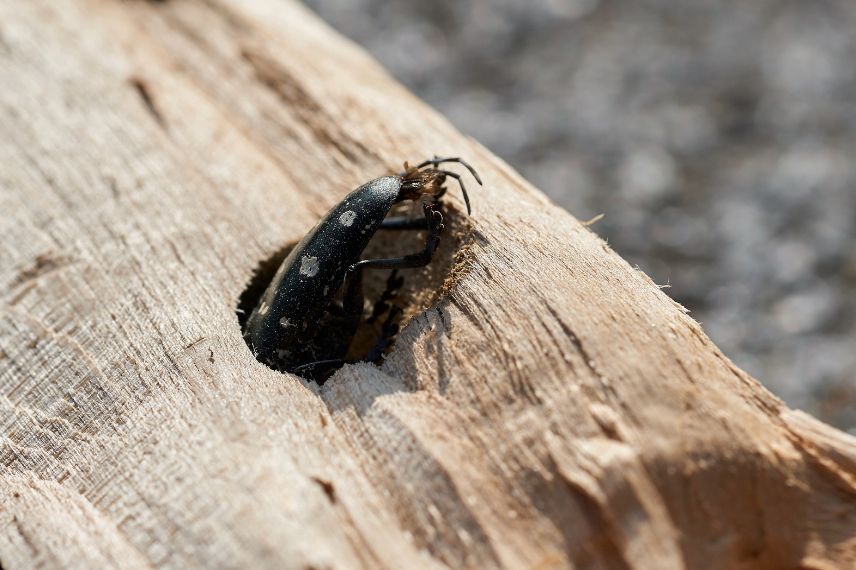
Adult Asian longhorn beetle emerging from the hole bored into the surface of the bark
Which trees are affected and what are the symptoms?
Asian longhorn beetles (Anoplophora glabripennis) mainly attack broadleaved trees with soft wood, particularly species such as maple (Acer), birch (Betula), willow (Salix), hornbeam (Carpinus), poplar (Populus), lime (Tilia), horse chestnut (Aesculus) and beech (Fagus). In its native range, it targets more than 100 species.
As for the citrus longhorn beetle (Anoplophora chinensis), it feeds on the trees listed above, as well as alder (Alnus), hazel (Corylus), plane (Platanus), lemon (Citrus), as well as apple and pear trees.
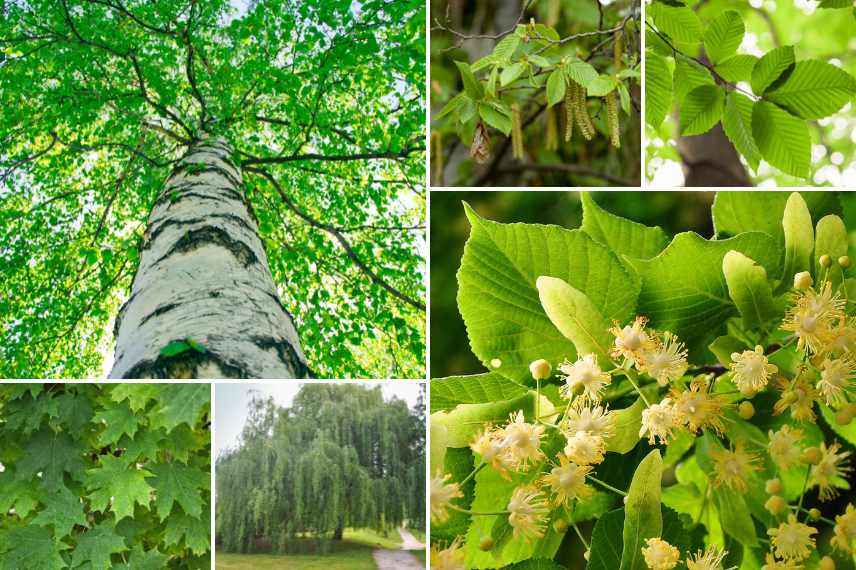
The Asian longhorn beetle favours broadleaved trees with soft wood
In practical terms, these trees, infested with longhorn beetle larvae, slowly decline. This is simply because the galleries prevent the sap from circulating normally, so the tree is no longer supplied with nutrients and water. It becomes weakened and may die. The larvae work discreetly, well concealed beneath the bark. However, several signs can help to detect an infestation of Asian longhorn beetles:
- Small piles of sawdust accumulate at the foot of the trees or in the forks of the branches. This sawdust comes from the holes bored by the larvae in the bark
- Incisions and circular emergence holes made by the adults are visible on the bark of the trunk or branches. The incisions are the egg-laying holes. They can generally be identified by the sap oozing from them. These holes also provide entry points for fungi and bacteria
- Some branches are stripped of their bark by the females to facilitate egg-laying
- Some branches dry out and decline.
Read also
Hazel diseases and parasitic pestsWhat should you do if you suspect the presence of the Asian longhorn beetle?
If you observe one or more suspicious signs of symptoms, it is obligatory and essential to notify the relevant authorities. Start by marking the trees where suspicious signs have been noticed. If you spot an insect, capture it and place it in the freezer. A photograph is also important. You should then contact the Regional Directorate for Food, Agriculture and Forests (DRAAF) in your region, which will arrange for the insect to be identified via the SRAL (Regional Food Service) and/or the FREDON network dedicated to plant health. These two organisations are responsible for monitoring, as well as controlling, these pests.
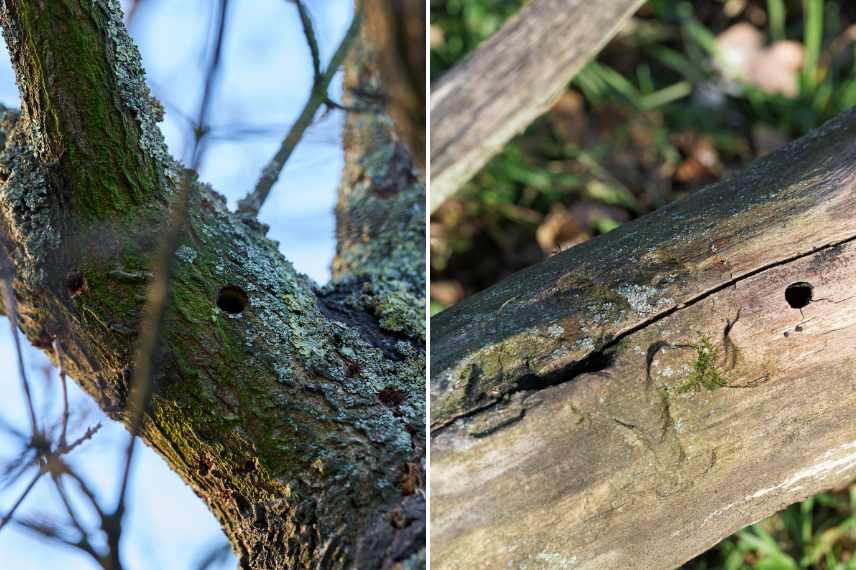
Small circular holes indicate the presence of the Asian longhorn beetle
Controlling this pest involves felling the tree as soon as possible. The tree will then be chipped and incinerated. Next, a monitoring campaign is launched for the trees in the surrounding area. Potentially infested wood products, such as crates and pallets, may also be incinerated.
For example, a monitoring campaign is currently under way in the Centre-Val de Loire region. In 2024, 300,000 host trees were inspected in the communes of Gien, Poilly-lez-Gien and Saint-Martin-sur-Ocre, among others, with the help of a sniffer-dog team. Sixteen trees were felled in March and April 2024, and another felling campaign took place between 17 and 28 June. An outbreak is not declared eradicated until four years after the detection of the last infested tree.
Areas such as Furiani (Corsica), Divonne-les-Bains and Royan are still under surveillance.
- Subscribe!
- Contents
This form is protected by reCAPTCHA - the Google Privacy Policy and Terms of Service apply.

































Comments