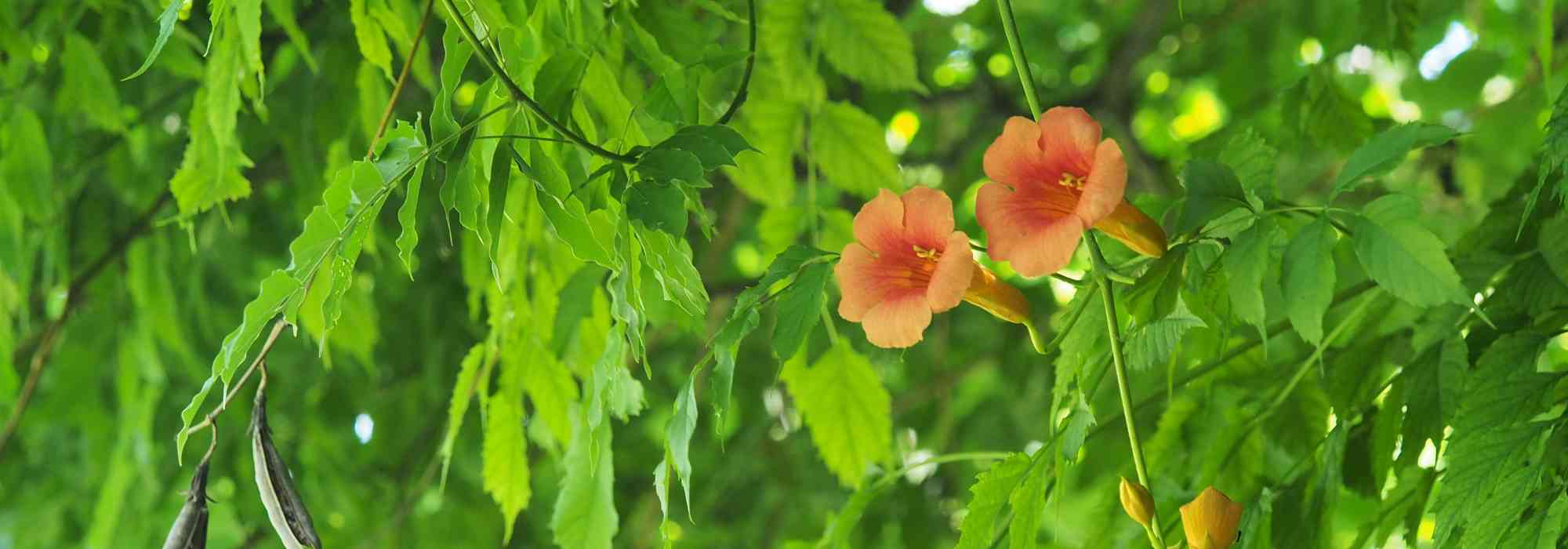
Why isn't my trumpet vine flowering?
Understanding why a trumpet vine has no flowers… and how to remedy it!
Contents
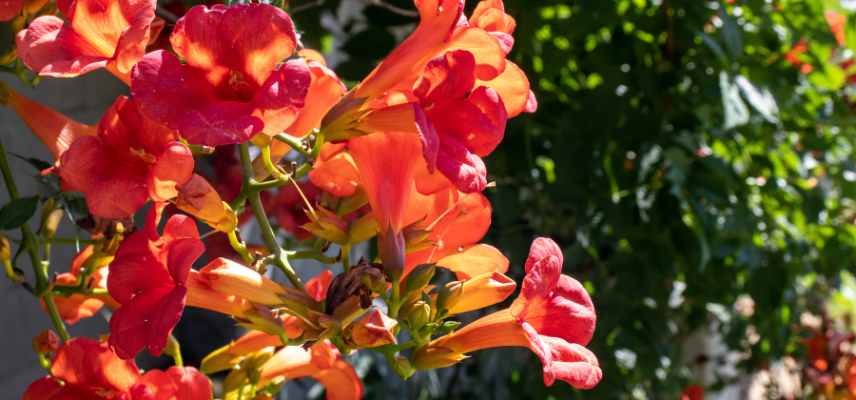
The trumpet vines, also known as “Jericho trumpets”, or campsis in Latin, are exuberant climbing plants, with flowers that are most often orange, but can also range from yellow to scarlet red. Very hardy, we love the exotic appeal of their trumpet-shaped flowers, which normally bloom throughout the summer. Sometimes, however, we are left disappointed, as this vigorous climbing plant does not flower as generously as we had imagined. Why is this? Did we get something wrong when planting it, or is it simply down to the plant itself?
Growing requirements and practical advice for trumpet vine: we tell you everything you need to know to ensure your climbing plant is floriferous!
→ Read also: Trumpet vine: planting, pruning, propagating.
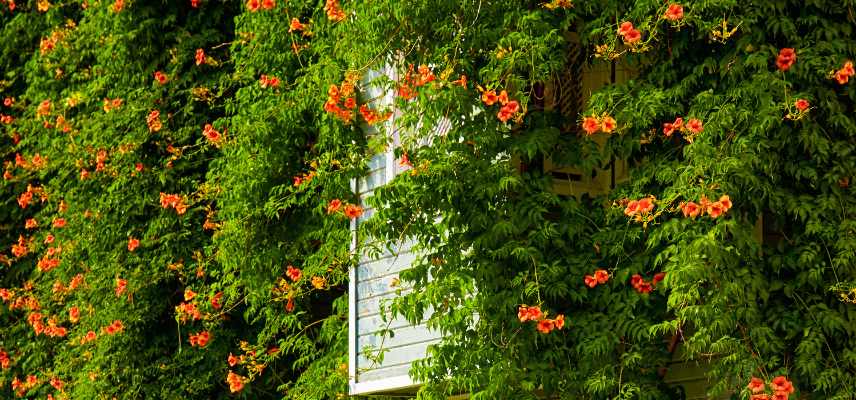
Trumpet vines, spectacular and radiant in the full summer sun!

Trumpet vine growing requirements
Like wisterias, trumpet vines are vigorous and prolific plants, becoming drought-tolerant once established. The two main species are the large-flowered trumpet vine or Campsis grandiflora and the American trumpet vine, known in Latin as the Virginia trumpet vine or Campsis radicans. The two varieties look somewhat alike, flowering in large clusters at the ends of the current year’s shoots, but Campsis grandiflora, which originates from China, produces larger flowers and has fewer clinging roots. Each has given rise to numerous varieties, with orange shades ranging from pale to deep, through to red, and sometimes even yellow.
To understand why a plant does not flower, it is crucial to know its growing requirements and to check that these are being met, so that you can decide on the right action to take. Here are the main characteristics to bear in mind for trumpet vines:
- Soil: They require well-drained, fertile soil that remains cool. As they have shallow roots, they need mulching when planted to ensure essential moisture and protect them from excessive heat while young, as well as from winter cold. As they mature, they will tolerate drier soils and drought. Note that they dislike compact, heavy soils.
- Position: this is an essential criterion for trumpet vines, which always establish themselves in full sun and in a sheltered position. Plant a new trumpet vine in a spot protected from cold winds.
- Hardiness: These exotic-looking climbers have the advantage of being suitable for growing in our gardens, as they are relatively hardy, tolerating frost for a short period, down to -15°C for Campsis radicans and down to -10°C for Campsis grandiflora. Cultivars derived from the hybrid Campsis x tagliabuana are fairly hardy, often down to -12°C. Overall, trumpet vines do well in regions with mild winters.
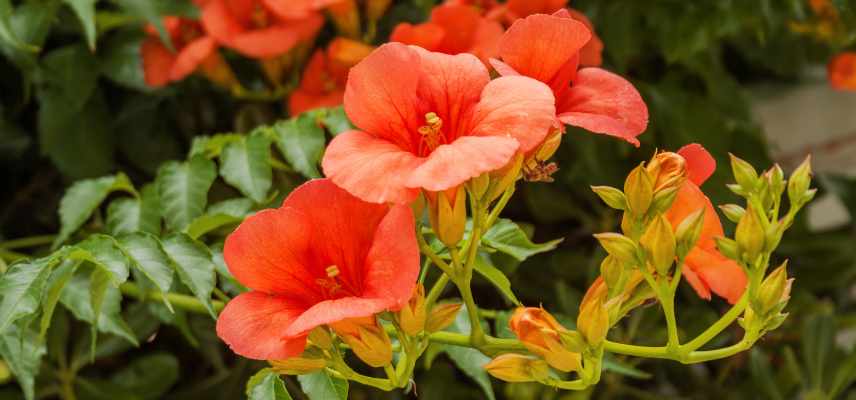
Campsis grandiflora
Read also
Choosing a trumpet vineMain reasons why a trumpet vine does not flower
It does not get enough sunlight
In the vast majority of cases, a lack of sunlight is the reason why a trumpet vine does not flower sufficiently. These plants need warmth and plenty of sunshine to perform at their best. So check its position carefully to make sure it receives at least 6 hours of sunlight per day. You can move a young plant, but older plants will be more difficult to remove because trumpet vine produces suckers. Only in southern regions can it be planted in partial shade.
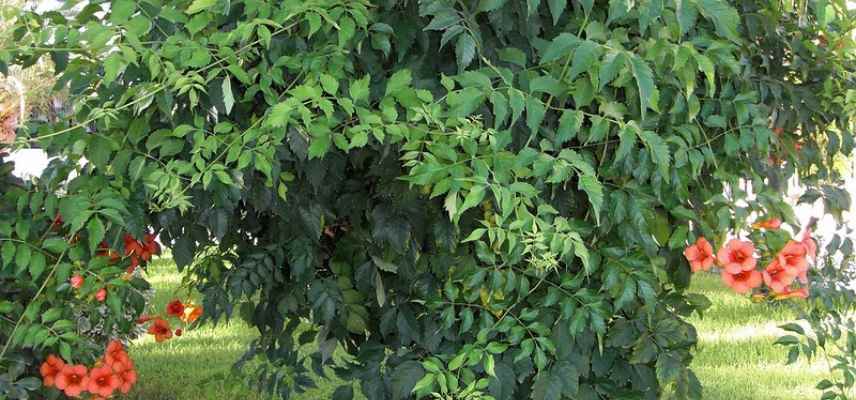
A trumpet vine, here Campsis radicans, receiving too little sunlight, flowers much less (© Maja Dumat)
It has not been pruned
This is often the second factor responsible for poor flower initiation in the plant. If left unpruned, the trumpet vine will produce a limited number of flowers, because pruning encourages it to produce new flowers. If it is pruned at the wrong time, namely in autumn, it will not produce any flowers. For spectacular and abundant flowering, prune it at the end of winter or the beginning of spring.
→ Find out more in When and how to prune trumpet vine?
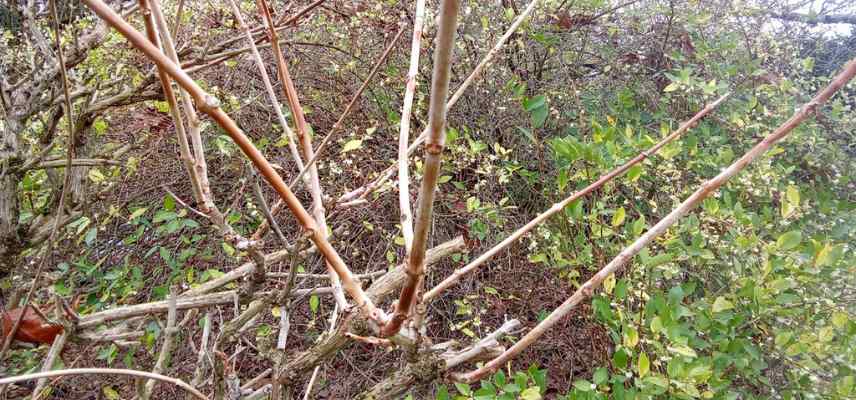
Dry trumpet vine stems in winter (© Gwenaëlle Authier): they should be pruned during February to ensure a beautiful display of flowers
It was propagated by layering or cuttings
Only trumpet vines propagated by grafting flower quickly after planting. If yours was produced by layering or from a cutting, it will take several years before it flowers properly.
The soil is too rich in nitrogen
Soil that is too rich in nitrogen, or receives too much nitrogenous fertiliser, will encourage the climber to produce far more foliage at the expense of flowers.
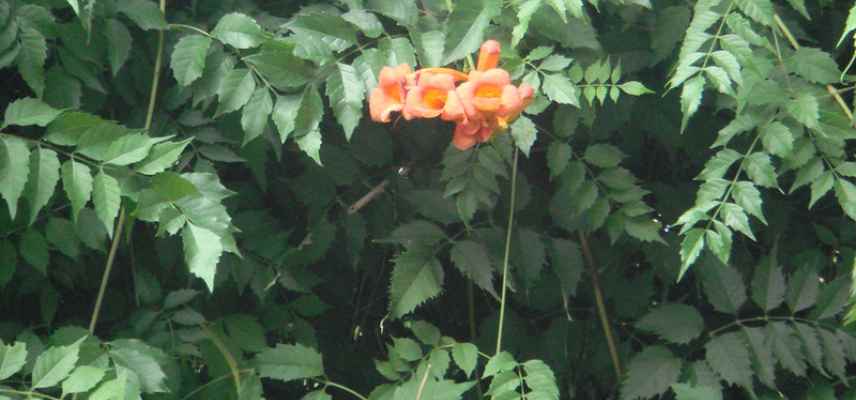
A trumpet vine that produces mainly leaves is often planted in soil with too much nitrogen
It did not like the low night-time temperatures
A trumpet vine exposed to very low night-time temperatures, as well as prolonged drought early in the season, may suffer from bud drop. This will reduce summer flowering accordingly… Once again, choose the position of your trumpet vine carefully (at the foot of a south-facing wall), and do not plant it in regions affected by repeated frosts.
It grows north of the Loire
If you live north of the Loire, trumpet vines generally flower a little later there, from August onwards. So there is no need to worry if the buds have not yet opened in these regions during July. It is worth noting that mild climates are where trumpet vine will flower most abundantly.
→ Find out more in our article: Which trumpet vine should you plant according to your region?
You have a late-flowering or delayed trumpet vine
There are two main species of trumpet vine: Chinese trumpet vine (Chinese), and trumpet creeper (American), with the large-flowered trumpet vine (the Chinese species) being slightly less hardy than the American trumpet vine. Both flower from the middle of summer, but a Campsis grandiflora will flower much more abundantly in regions with mild climates and sunny summers. As for Campsis radicans and its varieties, it can be grown a little further north, but without a sufficiently warm and sunny summer, it will flower less abundantly.
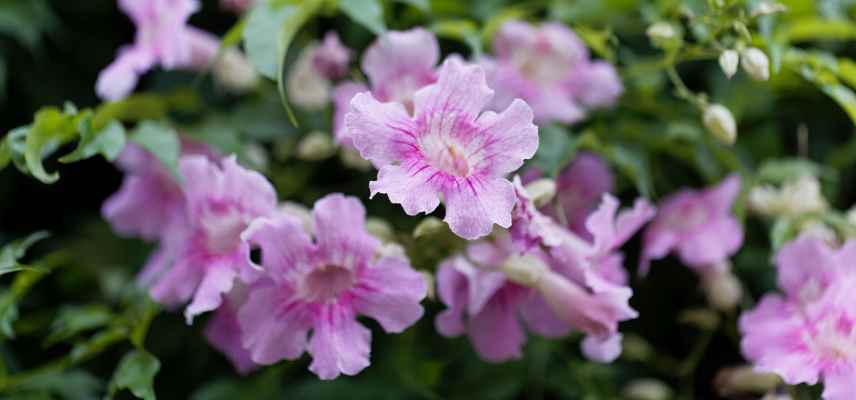
However, there is another very beautiful trumpet vine with pink flowers (it is not a Campsis): Podranea ricasoliana : it is much more tender, but above all, it flowers much later, at the end of summer, and really comes into its own in autumn, continuing until November in mild climates, where it is mainly grown. So do not be surprised if you do not see it flowering in midsummer like the others!
As for Campsis capreolata, with its orange-red and yellow, fragrant flowers, it normally flowers much earlier, between April and May in mild climates.
It is diseased
Finally, although less common than the other reasons mentioned here, an infestation of aphids when the flower buds are forming can nevertheless seriously weaken flowering in a trumpet vine.
A few tips to encourage flowering in trumpet vine
Here are a few pruning tips, an essential task that will ensure sustained flowering from your trumpet vine:
- Cut back the long, dry stems severely, which are shoots from the previous summer, to around 20cm from their base in February or early March (to two or three buds). These stems have helped the plant withstand winter, but they must be pruned to ensure a good production of flower buds.
- Prune flowering stems to stimulate new shoots: as the trumpet vine flowers for a long time, you can afford to do this, and it is even the best way to prolong its flowering. What is more, the new shoots will make the trumpet vine even more prolific the following season. It is better to prune lightly and regularly rather than drastically, which it will not appreciate. This summer pruning will also help to contain its vigour.
- Finally, treat an infestation of red spider mites or aphids as soon as it appears (see our advice in Diseases and pests of the trumpet vine)
- Subscribe!
- Contents
This form is protected by reCAPTCHA - the Google Privacy Policy and Terms of Service apply.


































Comments