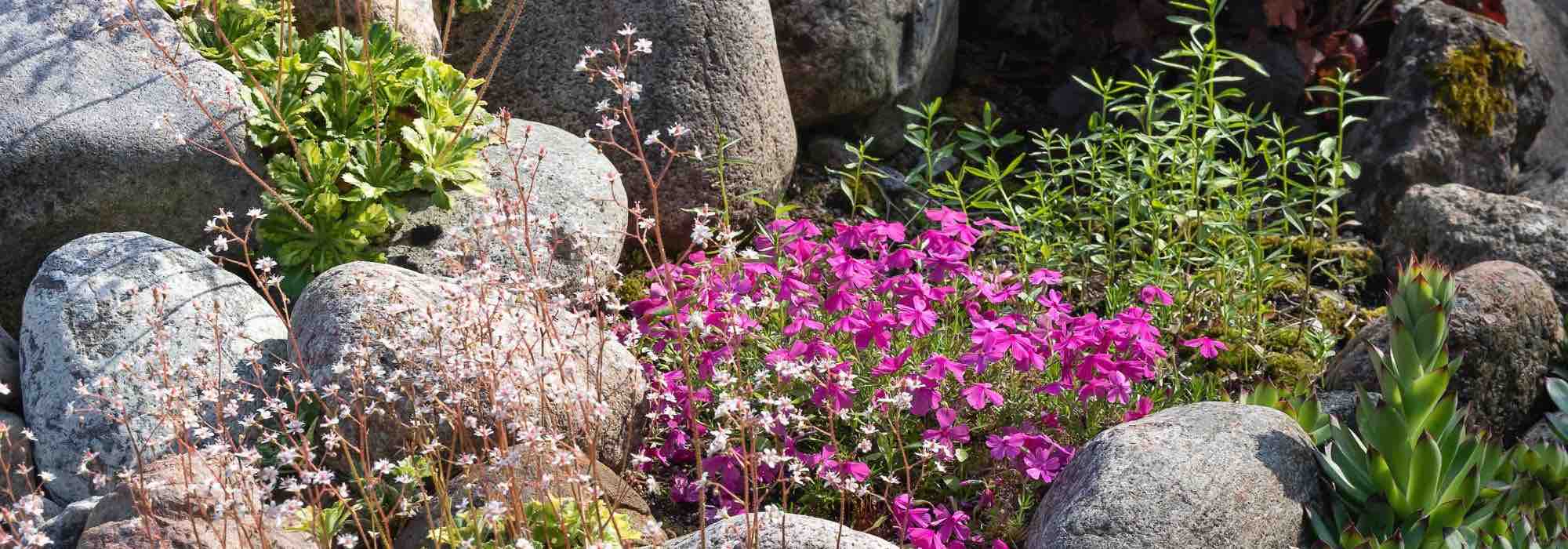
Creating an alpine rock garden
Tips and advice for a successful rockery
Contents
The alpine rock garden (or alpine garden) is a favourite with many gardeners. Although setting one up requires a little preparation, the result fires the imagination, bringing the mountains within sight, as it were. The growing conditions it provides make it possible to acclimatise certain plants that might refuse to grow in a traditional border. A blend of mineral and plant life, it becomes a miniature landscape to admire all year round.
In this article, I invite you to discover what characterises an alpine rock garden, how and where to create one, which plants to choose for a natural-looking result and how to maintain it.
What is an alpine rockery?
An alpine rockery is intended to artificially recreate certain landscapes that can be found in the mountains, where different plants grow on sloping, rocky terrain. In this type of environment, plants are generally well exposed to the sun, and the water they receive from rainfall does not stagnate around the roots or the collar (the junction between the above-ground and underground parts). In addition, the rocks present absorb the day’s heat and release it at night, thereby creating a favourable microclimate. They also ensure a certain degree of coolness (water evaporates less quickly beneath the stones), which plants can benefit from without any risk of overwatering.
Creating a rockery in your garden therefore makes it possible to reproduce some of these conditions and grow plants that might not otherwise accept growing without this little helping hand. Indeed, high humidity or heavy soil, especially when combined with persistently cold temperatures, can suffocate the roots of alpine plants, and this may prove fatal to them.
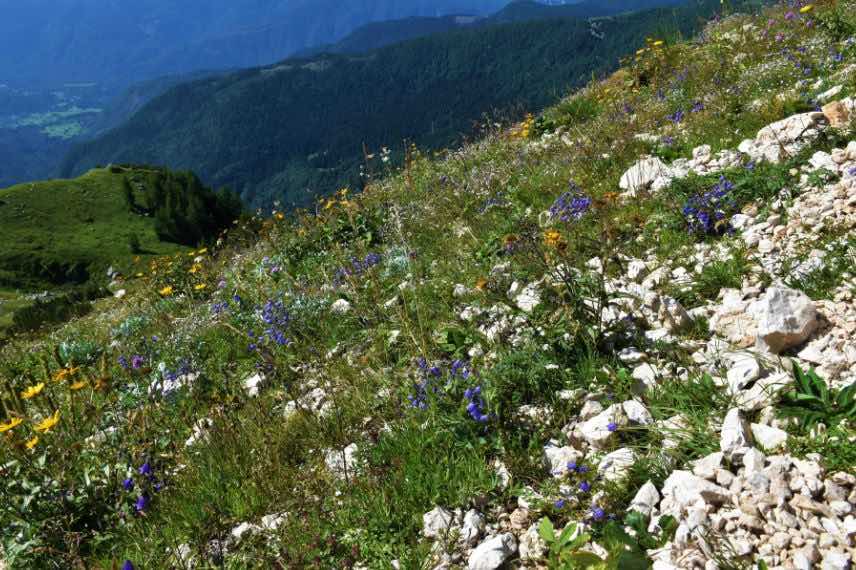
A natural mountain landscape: a slope, rocky soil and typical mountain plants
Read also
Alpine perennial plantsHow to create a rock garden?
- To imitate Nature as closely as possible, you need to work on a site with at least a slight slope. This allows water to run down towards the bottom of your ‘slope’, so the plants are never waterlogged. If your site is already sloping, make the most of it! Otherwise, create an artificial slope by forming a mound. You can do this by setting aside some of the soil excavated when building a house. On an existing site, you can always have topsoil delivered. Don’t worry, there’s no need to create an Everest in your garden! An overall level difference of 60 cm every 2 metres is more than sufficient. If the slope is steeper, that is not a problem, provided you stabilise the whole area properly with rocks. Rather than shaping a regular slope, try creating levels and irregular breaks, with some sections rising slightly from time to time, as happens in the natural environment.
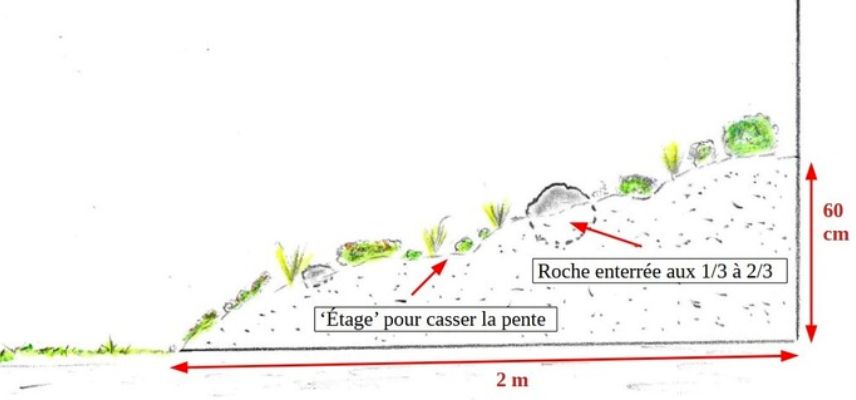
Slope diagram, sketch © Jean-Christophe Aumont
- Once your slope has been laid out, you now need to add the mineral elements to your rockery. Choose rocks of different sizes, some of which are large enough to both create the design and retain the soil. Local stones are preferable, both to integrate the rockery into the surrounding landscape and buildings and to limit its environmental impact. Arrange your rocks in a seemingly random and as natural a way as possible. For the largest rocks, dig trenches so that at least one third of their base is buried, or even two thirds if they are particularly large, in order to ensure their stability. These stones also serve to hold back the soil in your bed and prevent the substrate from ending up at the bottom of your construction after rainfall. For an attractive effect, alternate larger and smaller rocks. Smaller stones and pebbles also help to imitate the scree found on mountain slopes.
- When designing your rockery, plan for future care. You need to be able to access your bed. According to its height, slope and shape, consider possibly creating paths, stepping stones or steps to make the work easier.
- The slope creates natural drainage, but improve it further by adding a good proportion of drainage material to the soil, such as gravel in different grades and coarse sand. As alpine plants grow in poor soil, adding organic matter is rarely necessary.
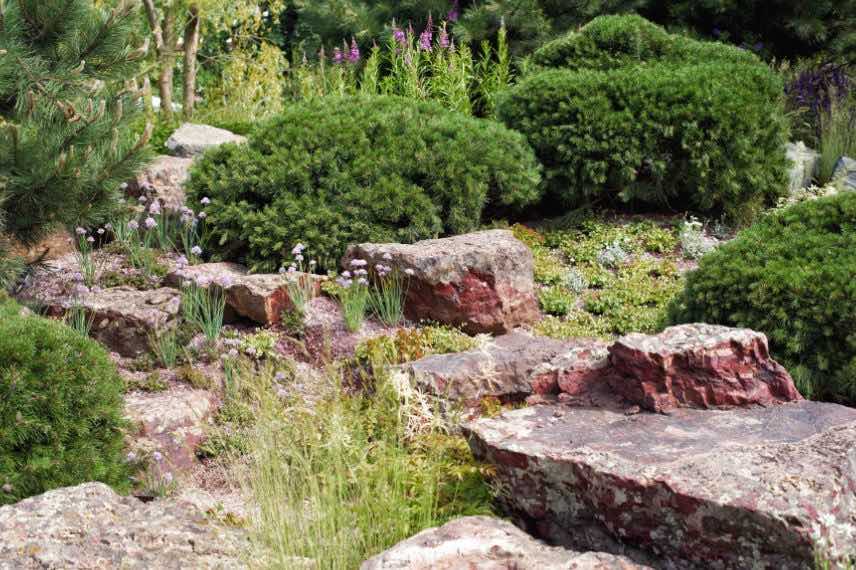
The aim is to create a significant yet irregular slope and to install rocks of different sizes
Which aspect should you choose?
Alpine plants like open, sunny positions. In regions with very hot, dry summers, a west-facing position may be preferable. Elsewhere, south-west-facing or even south-facing positions are possible.
Read also
15 plants for a sunny rockeryHow to plant a rock garden?
Planting in a rock garden generally follows the same principles as planting a traditional bed.
1. Make sure that the soil has been thoroughly weeded.
2. For shrubs, which require larger planting holes, use a spade and dig a hole equivalent, if possible, to twice the size of the pot. A small hand trowel is sufficient for making planting holes for perennials and bulbs (editor’s note: there are special narrow hand trowels for rock gardens). Proceed in the same way as for shrubs, adjusting the proportions.
3. If necessary, add a little drainage material to the soil.
4. After soaking your shrub in a bucket of water to saturate the growing medium, remove it from its pot and place it in the centre of the hole.
5. Backfill with the remaining growing medium and firm it down lightly with your fist.
6. Water your plantings thoroughly using a fine rose, but do so in several small applications.
7. Once planting is complete, spread a layer of gravel over the surface of the soil, around the plants and rocks. This layer both insulates against the cold and prevents the collar of the plants from coming into direct contact with moisture, not to mention the attractive appearance it provides.
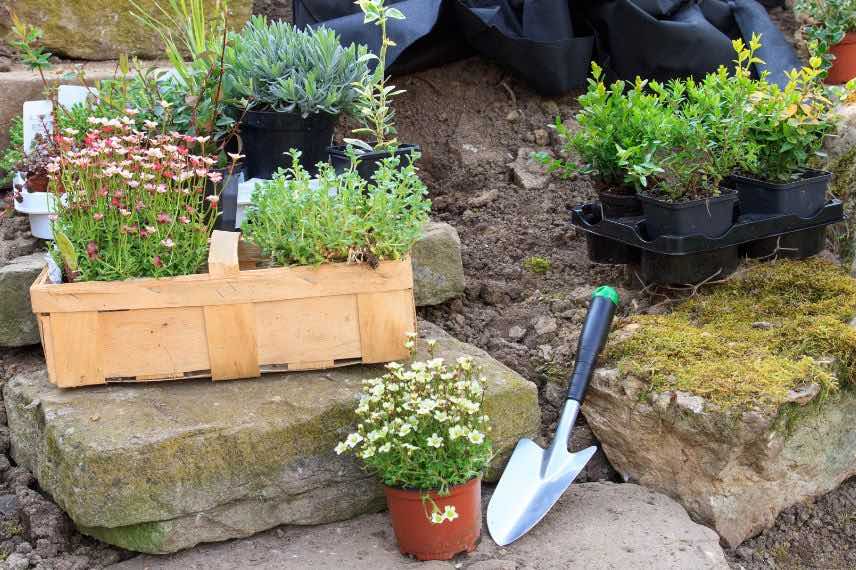
Planting an alpine rock garden is similar to planting a bed once the layout has been created
Which plants for an alpine rockery?
Many different plants can be used to bring such a feature to life, from the tallest plants with an upright habit to those that grow low and spread as ground cover. However, make sure you choose plants that are in proportion to the size of your display to maintain a good balance. The larger your rockery, the more scope you have for planting specimens with a greater spread.
- Generally speaking, alpine shrubs are often evergreen and are mostly represented by conifers, which enables them to cope better with the vagaries of the weather (cold, wind, snow…).
- With perennials, play with flowering times, but also think about foliage, which provides colour over a longer period, particularly in the case of evergreens, whose presence brightens up your rockery all year round.
- Finally, don’t forget early-flowering bulbs, which get the show under way very early in the season, along with a few grasses for their lightness.
Evergreen shrubs
Among the evergreen shrubs and undershrubs that you can use in an alpine rockery, consider, for example, heathers (Erica), cotoneasters or crowberry. It is difficult, if not impossible, to imagine such a feature without rockery conifers, which combine slow growth, modest dimensions and sometimes surprising colours that change with the seasons. Cryptomeria, cypresses, spruces, junipers, pines and arborvitae are just a few examples of shrubs with an upright, more globose or even prostrate habit, allowing you to create attractive contrasts in form and silhouette. Their foliage also comes in different shades of green, as well as bright yellow, intense blue and surprising orange tones that never fail to make an impression.
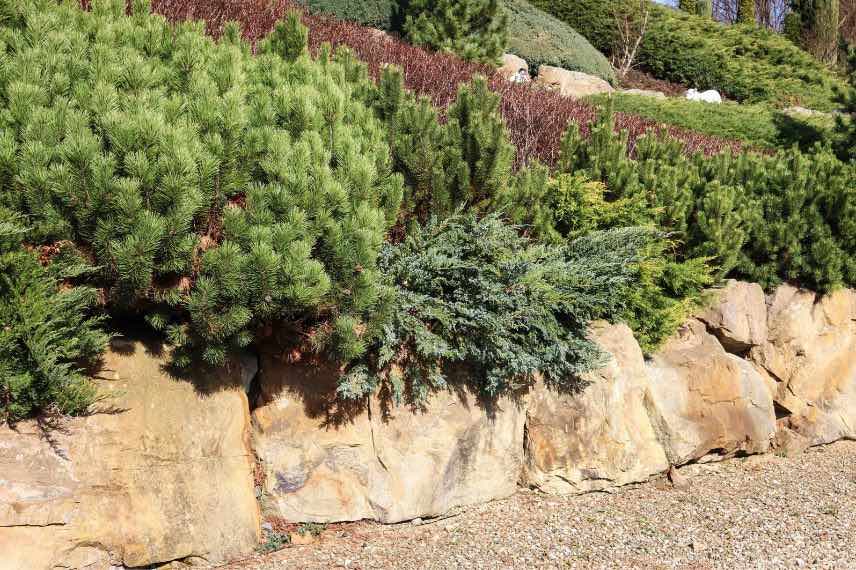
Dwarf conifers are essential in a rockery
Deciduous shrubs
Deciduous shrubs allow you to vary the colour palette and complete the display with cheerful flowers or fruit, intoxicating fragrances or interesting foliage. Among those that can be included in your rockery, consider, among others, berberis, caryopteris, coronillas, brooms and potentillas.
Tall perennials
Alpine perennials that grow above one metre are few and far between, but some can create interesting vertical accents, such as the summer-flowering willowherbs, the ornamental sea hollies with their striking form, or yellow gentian, whose bright flowering requires patience.
Low, cushion-forming or ground-covering perennials
Many rockery perennials have a low habit, forming dense cushions or spreading as a carpet that follows the contours of the ground. Ideal at the front, they also provide a setting for their taller neighbours. Examples include the very popular golden alyssum, aubrieta, Iberis and certain fleabanes, not forgetting alpine gentian, creeping phlox, alpine aster, pearlwort and, of course, the emblematic edelweiss.
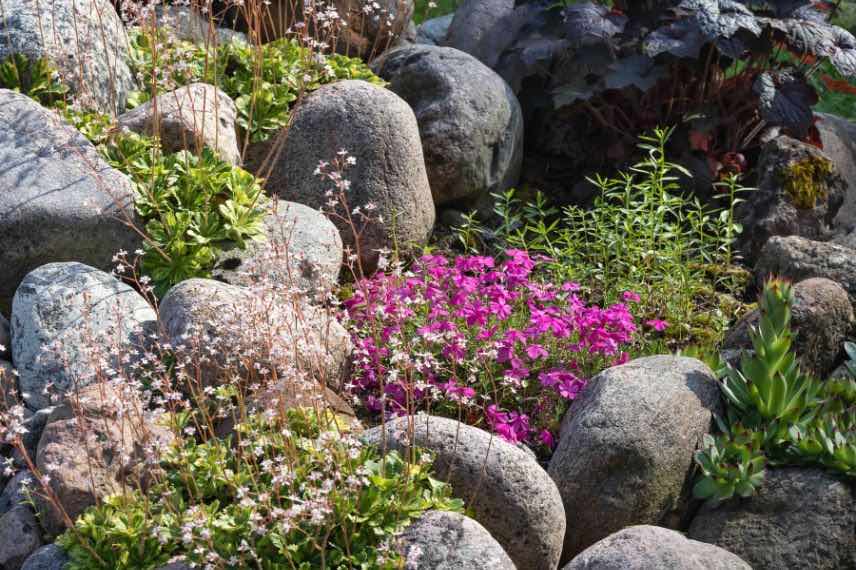
Creeping phlox and certain saxifrages make good alpine rockery plants
Mediterranean and desert perennials
There is nothing to stop you from straying off the beaten (mountain) track and including plants that are not alpine plants at all but which, like them, enjoy well-drained soils and sunshine. Sempervivum, Cacti, Agave, Aloe, Crassula, Delosperma, Echeveria, Mangave and the like add a touch of originality and exoticism. The limit depends on hardiness in your region.
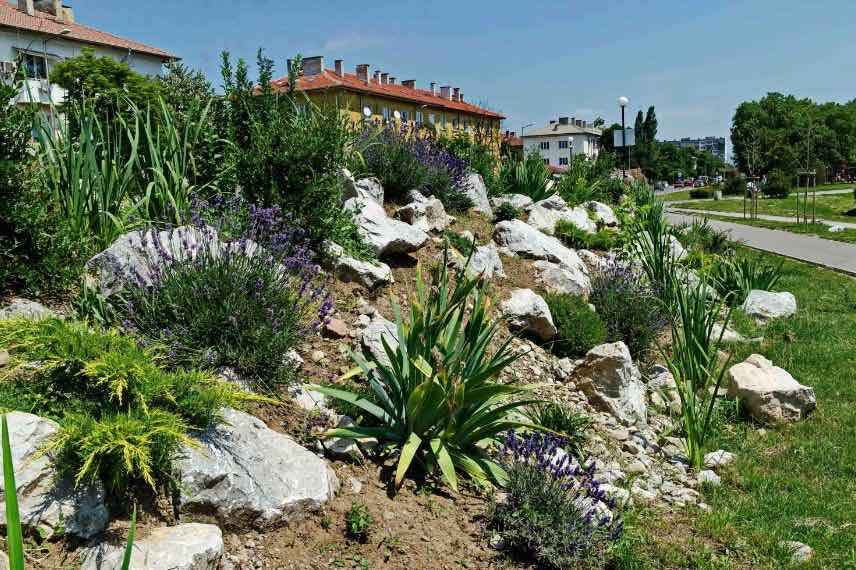
A rockery incorporating desert and Mediterranean plants
Bulbs
It is easy to add here and there groups of bulbs that awaken the end of winter and spring with their sparkling colours. Easy to grow, returning faithfully every year and sometimes naturalising, they guarantee a rockery that flowers easily early in the season. Crocus, Iris pumila and reticulata, Ipheion, botanical daffodils, snowdrops, Scilla ‘Tubergeniana’ and botanical tulips… all have what it takes to make us fall for them!
Grasses
Grasses bring flexibility and movement to a rockery. As alpine plants are often low-growing, keep to this spirit by selecting, for example, blue oat grass, fescues or feather grass.
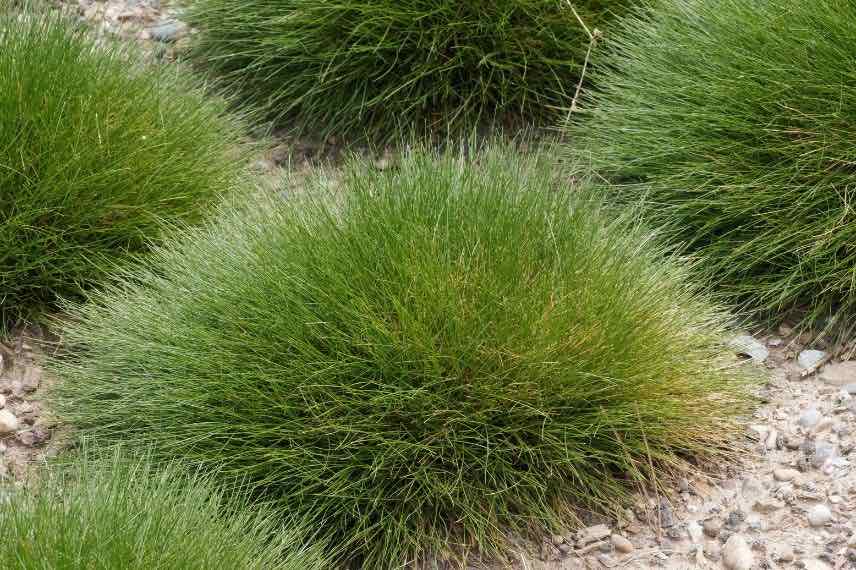
Finally, small grasses such as cushion-forming fescues are excellent rockery plants
Rock garden care
Looking after a rockery is not particularly complicated, especially as the plants grow and cover the soil.
- Initial weeding before planting is, of course, essential, but it must be continued over time whenever necessary, to prevent unwanted plants from competing with your plants and to keep the display looking neat.
- You should water your plants just after planting, but you must also make sure that the soil does not dry out too much during the first few months, while your plants become established. The plants featured here tolerate dry conditions well, but the climate changes we now experience every year may force gardeners to water from time to time during prolonged periods of drought. Water with a fine spray to avoid displacing the surface gravel or loosening your plants.
- Remove faded flowers when necessary and cut back dry parts that have become unsightly.
- After a few years (3 to 4 years on average), some plants benefit from being lifted from the ground and divided, thereby rejuvenating them.
- Some tender plants may need winter protection in the form of a sheet of transparent polycarbonate. Held in place by stakes inserted around the plant, it allows light through but prevents precipitation from reaching its centre, thereby protecting it from rotting.
For further reading...
- Discover our wide range of alpine perennials!
- Find even more inspiration with our rockery perennials.
- Take advantage of the great diversity of rockery conifers!
- Subscribe!
- Contents
This form is protected by reCAPTCHA - the Google Privacy Policy and Terms of Service apply.

































Comments