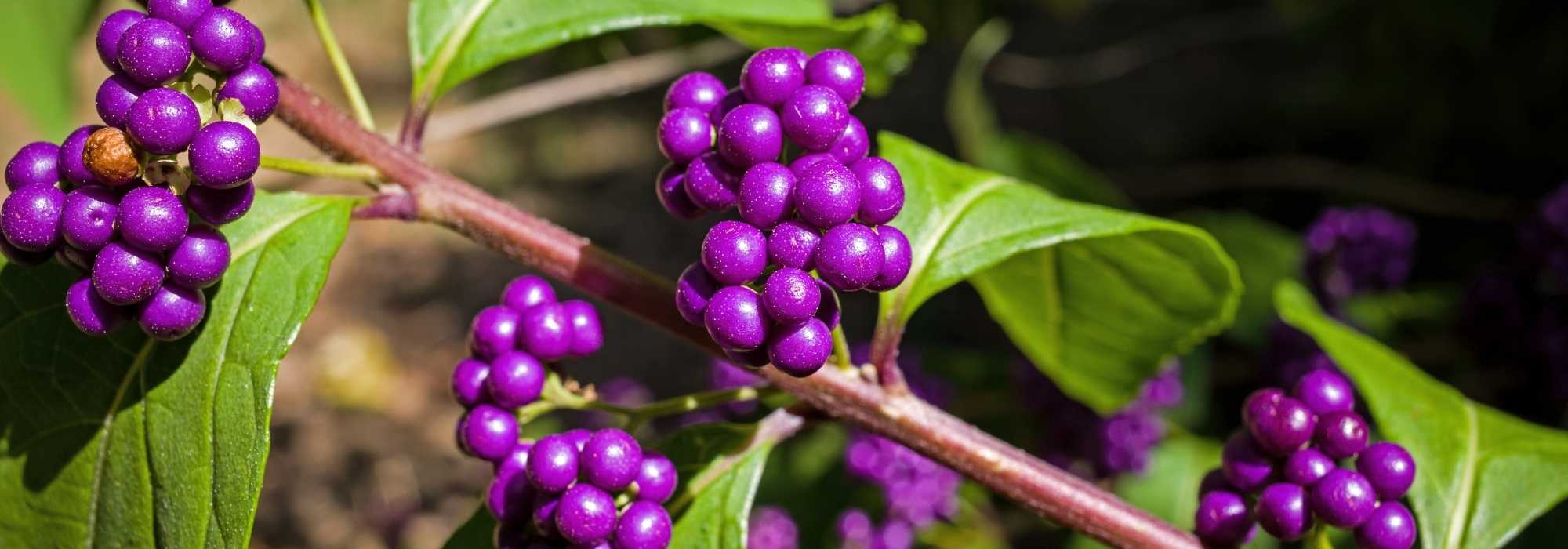
Which Callicarpa to choose for your garden?
Our selection based on berry size, habit and colour
Contents
The beautyberry is a shrub that really catches the eye when the garden starts to lose its colour. Its summer flowering is understated, but in autumn it produces small berries clustered along the branches, usually violet, but sometimes white. They can persist after the leaves have fallen, extending the shrub’s interest into early winter. Yet when faced with the different species and varieties, the choice is not simply about the colour of the fruit. The mature size, the shrub’s habit, the autumn colour of the foliage and the space available in the garden are also criteria to consider. Here is how to find the one that will fit best into your garden.
For a generous crop
If your main aim is to obtain plenty of purple berries, Callicarpa bodinieri plants remain a safe bet.
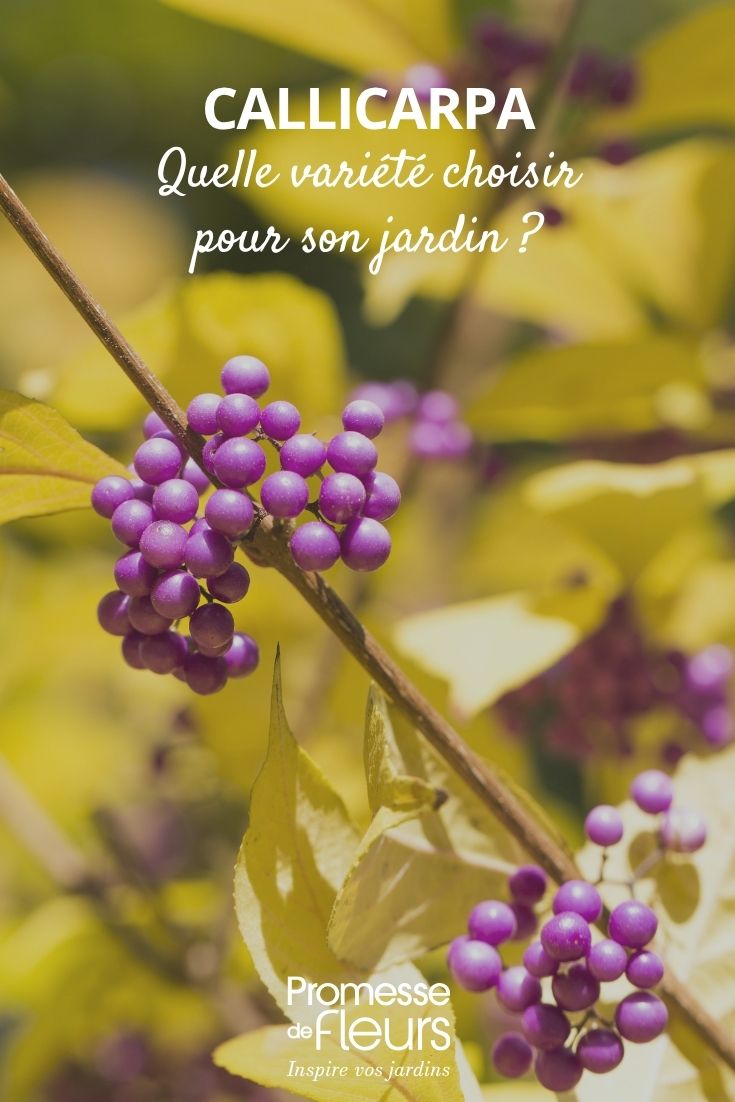
The Callicarpa bodinieri ‘Profusion’ remains THE benchmark. It reaches around 2.50 m in height and produces numerous intensely purple berries. Its foliage provides a second attraction: bronze when young, it later turns green, then yellow in autumn. This shrub is best planted at the back of a bed, in an informal hedge or in a position where it can develop its natural shape.
For an equally generous display in a slightly more compact size, the Callicarpa bodinieri‘Imperial Pearl’ reaches around 2 m in height. Its fruiting is reputed to be even more abundant than that of ‘Profusion’, while its leaves take on orange shades towards the end of the season. It is well suited to situations where you want to combine ornamental berries with attractive autumn colour.
Still with the aim of obtaining a profusion of berries, ‘Magical Deep Purple’ grows to around 1.75 m in height and 1.50 m in spread, while ‘Liebespaar’ reaches around 2 m by 1.50 m. ‘Magical Purple Giant’ needs more room, as it can reach 2.50 m in height and 2 m in width. It will therefore be more at home in a large bed or shrub hedge than in a small space.
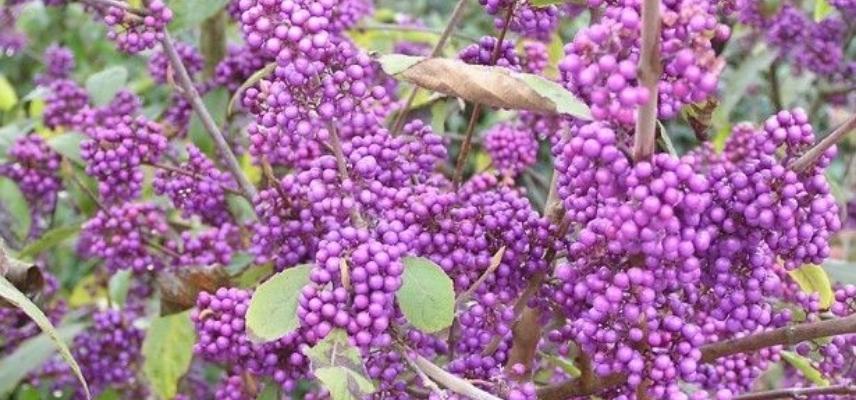
Callicarpa bodinieri ‘Profusion’
Compact varieties for a small garden or container
This is probably where the differences between varieties become most useful. Especially as a beautyberry does not need to be imposing to be spectacular in autumn.
Callicarpa dichotoma ‘Issai’ is one of the easiest to fit into a small space or grow in a pot: around 1.25 m tall and just 80 cm wide. ‘Cardinal’ also remains a manageable size, at around 1.50 m tall and 1 m wide, and offers beautiful autumn colours. Callicarpa bodinieri ‘Pearl Glam’, at around 1.40 m tall and 1 m wide, is also an attractive alternative, valued for its purple foliage, perfect when every square metre counts.
These compact beautyberries are particularly interesting in the middle of a bed, near a terrace or in an urban garden, where a Callicarpa ‘Profusion’ would eventually become too dominant.
Their modest size does not mean that they lack character. Callicarpa dichotoma naturally develops long, arching branches, sometimes trailing, which give the shrub a more flexible and lighter habit. It is a good choice if you like less formal beds, where plants can retain their natural habit.
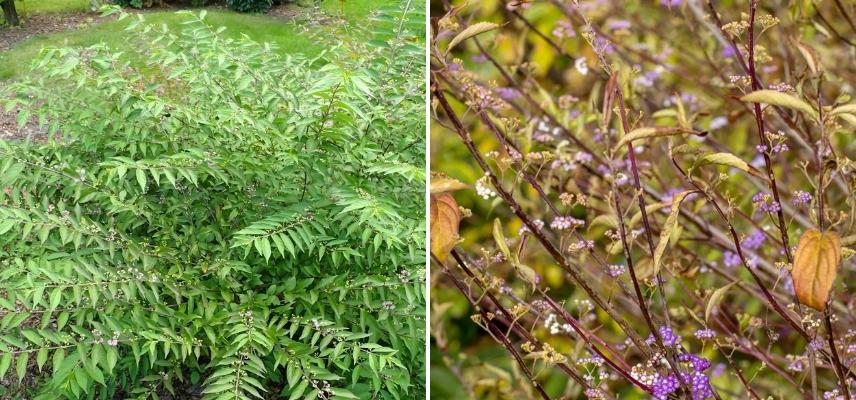
Callicarpa dichotoma ‘Issai’
For unusual white berries
Purple is so closely associated with beautyberry that white-fruited forms often come as a surprise!
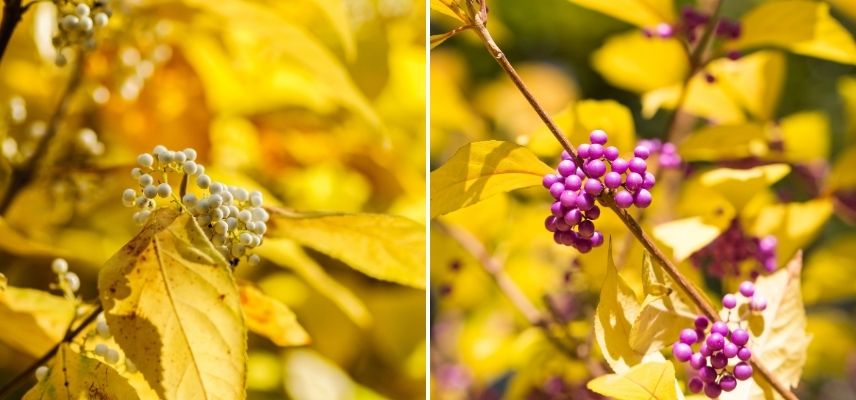
Callicarpa japonica ‘Leucocarpa’ is undoubtedly the most obvious variety. Its white flowers are followed by white berries, and the shrub remains compact, reaching around 1.50 m in all directions. It is particularly useful for brightening up an autumn scene dominated by red, purple or orange foliage.
Callicarpa dichotoma ‘Albibacca’ produces a very long-lasting crop of berries and has an even narrower habit, reaching approximately 1.40 m in height and 90 cm in width. Callicarpa bodinieri ‘Magical Snowstar’ and ‘Magical Snowqueen’ are slightly larger: approximately 2 m tall and 1.50 m wide for ‘Snowstar’, and 1.75 m tall and 1.50 m wide for ‘Snowqueen’.
The choice between these white-fruited forms will therefore depend mainly on the space available: ‘Albibacca’ or ‘Leucocarpa’ for a small garden, and ‘Snowstar’ for adding more volume at the back of a bed or in an informal hedge.
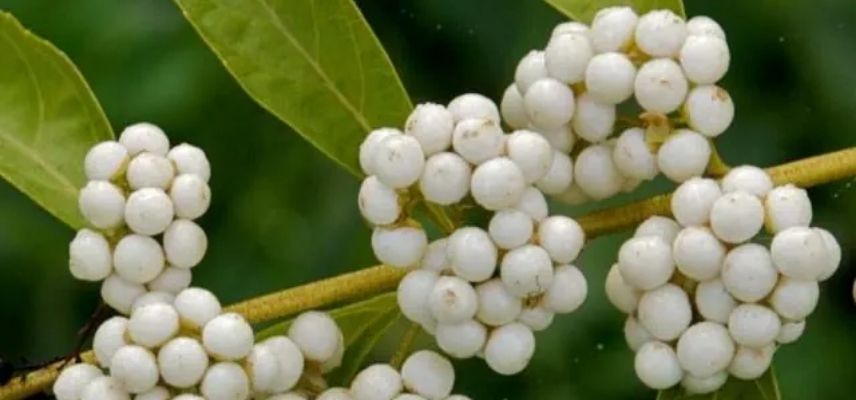
Callicarpa dichotoma ‘Albibacca’
Read also
Callicarpa: 5 pairing ideasFor beautiful autumn foliage
A beautyberry is often bought for its berries, but the foliage can change the overall effect and add colour in September and October. Choosing the foliage alongside the fruit also means having an attractive shrub before its bare branches fully reveal the berries.
Callicarpa japonica is particularly interesting in this respect. Its arching branches bear foliage that takes on golden and orange shades in autumn, providing a beautiful contrast with its purple berries.
Callicarpa kwangtungensis, reaching 1.50 m in all directions, stands out for its finer, more elongated leaves, purple-green in summer and turning orange-pink in autumn, as well as for its pinkish-purple fruit.
For a wonderfully colourful autumn display, ‘Profusion’ brings yellow, ‘Imperial Pearl’ orange, while Callicarpa dichotoma can take on red tones depending on the aspect and soil type.
For an informal hedge, choose varieties with real presence.
Beautyberry fits very well in an informal or wildlife-friendly hedge, mixed with other fruiting shrubs or shrubs with ornamental foliage. Its natural habit and autumn berries are shown off far better there than in a regularly trimmed hedge. As it is deciduous, however, it does not provide a screening effect in winter, but it can be alternated with evergreen shrubs with similar requirements, such as Burkwood osmanthus, laurustinus or photinia, which also thrive in sunny to partially shaded positions and well-drained soils.
For this purpose, ‘Profusion’, ‘Imperial Pearl’ or ‘Magical Purple Giant’ are particularly well suited, as their size (2 to 2.50m tall) allows them to fit into a hedge among other shrubs. You can also combine several beautyberries in the same hedge: as well as creating a decorative effect, their proximity encourages pollination and therefore more abundant fruiting.
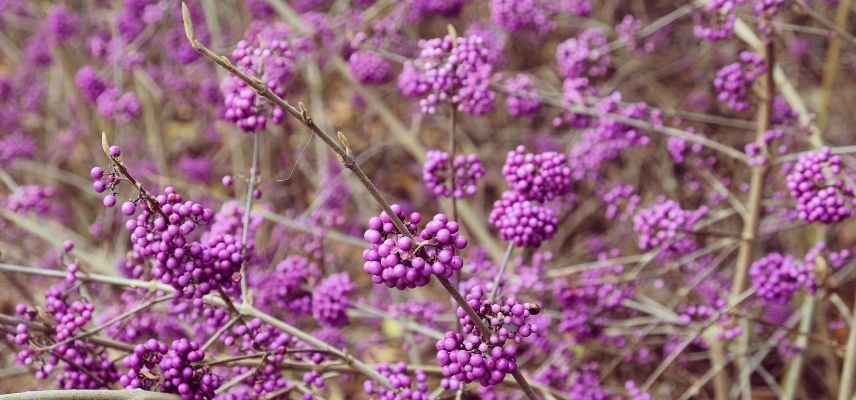
berries of the Imperial Pearl beautyberry
- Subscribe!
- Contents
This form is protected by reCAPTCHA - the Google Privacy Policy and Terms of Service apply.

































Comments