
Video transcript: Begonia grandis Evansiana
an amazing hardy groundcover begonia
Contents
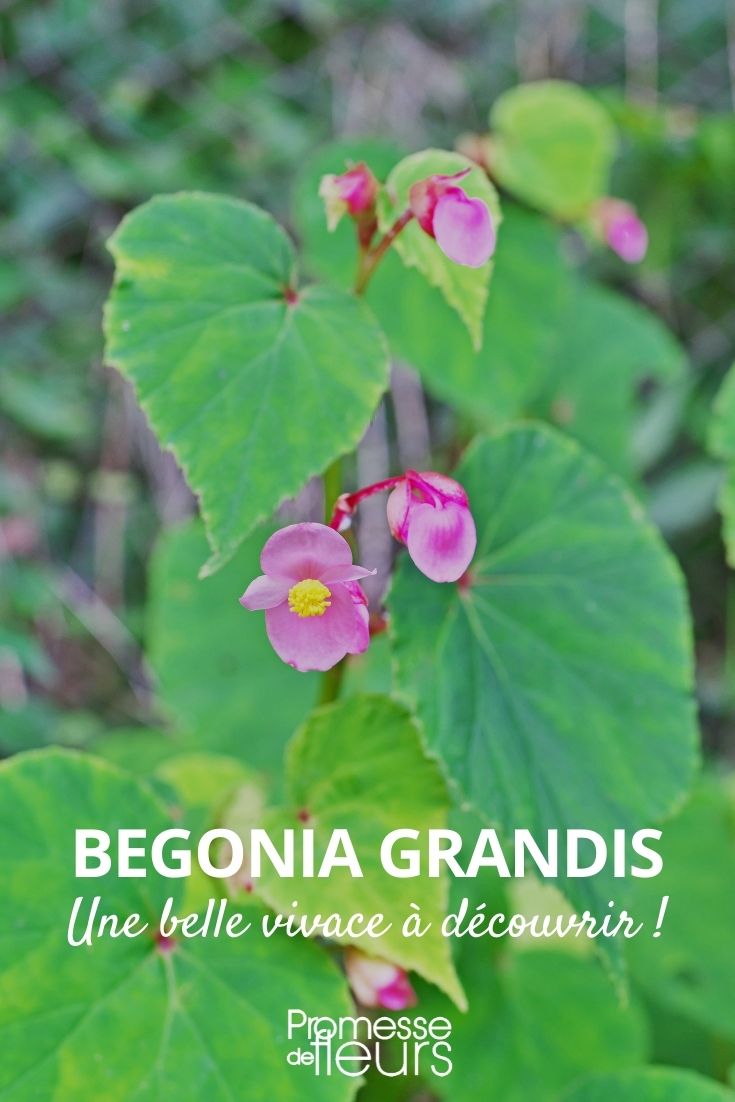
Begonia grandis ssp. evansiana, or Madame Evans’s begonia, is a hardy groundcover begonia native to the damp forests of China. This perennial requires moist to wet, neutral or acidic soil and a partially shaded position, or even shade in southern France. This perennial begonia starts into growth late in the season, but also flowers late, from July to October. Its main assets are its light green foliage, with pink-purple undersides, and its ability to grow and reproduce quickly.

Introducing Begonia grandis evansiana
Read also
How to recognise a perennial begonia?Begonia grandis: a little botany
Begonia grandis subsp. evansiana is a botanical begonia in the Begoniaceae family, native to the damp forests of China.
Madame Evans’ begonia is a fast-growing, bulbous, groundcover perennial reaching a height of 80cm. Its turgid stems remain upright thanks to the pressure of the water inside them.
Flowering takes place from July to October, with clusters of pink flowers (there is also a white-flowered form: Begonia grandis subsp. evansiana var. alba): a time when, ultimately, few flowers are still present in the garden.
The foliage is a beautiful light green, very fresh-looking. However, the undersides of the leaves are pink, veined with red, adding a very colourful touch to partially shaded or even shady beds.
The plant disappears completely in winter, resuming growth late in spring, in May.
Michael’s good idea: grow Begonia grandis in a raised position so that you can make the most of its beautiful foliage colours.
How to grow Begonia grandis
This perennial requires moist to wet soil all year round. The soil must also be fertile and humus-bearing, preferably neutral to acidic, but above all, not chalky.
Begonias are shade-loving plants (in southern France) or plants for partial shade (elsewhere in France and Belgium). It can be planted at the beginning of spring (March-April), before the leaves develop, or in autumn (October).
Begonia grandis is a hardy groundcover perennial (down to -15 °C) that spreads quickly. What is more, Begonia grandis uses a special technique to multiply. After flowering, small bulblets, actually miniature tubercles, develop in the leaf axils. These fall and thus give rise to another plant. You can therefore get spontaneous seedlings of this type of begonia around the original planting site, but… also sometimes several metres away. A chance to give some to friends and neighbours!
Michael’s top tips: although fully hardy, this begonia appreciates a good covering of fallen leaves in winter to protect its tubercles. In addition, the plant starts into growth late in spring, only in May. To avoid accidentally striking it with a spade: remember to place a stake or anything else to mark its location!
- Subscribe!
- Contents
This form is protected by reCAPTCHA - the Google Privacy Policy and Terms of Service apply.

































Comments