
Heuchera Midnight Rose - Heuchère, Heuchera, Désespoir du peintre

Heuchera Midnight Rose - Heuchère, Heuchera, Désespoir du peintre

Heuchera Midnight Rose - Heuchère, Heuchera, Désespoir du peintre

Heuchera Midnight Rose - Heuchère, Heuchera, Désespoir du peintre

Heuchera Midnight Rose - Heuchère, Heuchera, Désespoir du peintre

Heuchera Midnight Rose - Heuchère, Heuchera, Désespoir du peintre
Heuchera Midnight Rose - Heuchère, Heuchera, Désespoir du peintre
Heuchera Midnight Rose
Avis client à traduire : .
philippe bourdariat, 14/03/2026
Back-to-school special offer!
Get €10 off for every €50 you spend! And get up to €40 off on a single order.
How does it work?
1. Shop your favourites
Add your favourite plants to your basket. For every €50 you spend (excluding delivery charges, store credit and the plastic-free option), you’ll receive a €10 voucher.
€50 spent = €10 voucher
€100 spent = €20 voucher
€150 spent = €30 voucher
€200 spent = €40 voucher
2. Place your order
Once your basket reaches one of the spending thresholds, place your order. You can even choose your delivery date!
3. Receive your voucher
As soon as your order has been shipped, you’ll receive an email containing your personal voucher code and its value.
4. Use it on your next order
Your voucher is valid for 90 days from the date you receive it. It can be used once only, on a new order worth at least the value of the voucher, excluding delivery charges.
Please note: Vouchers can be combined with other offers, but cannot be split or refunded.
Home or relay delivery (depending on size and destination)
Important: You may be charged customs duties by your country’s customs authorities upon delivery.
Schedule delivery date,
and select date in basket
This plant carries a 12 months recovery warranty
More information
We guarantee the quality of our plants for a full growing cycle, and will replace at our expense any plant that fails to recover under normal climatic and planting conditions.

Would this plant suit my garden?
Set up your Plantfit profile →
Description
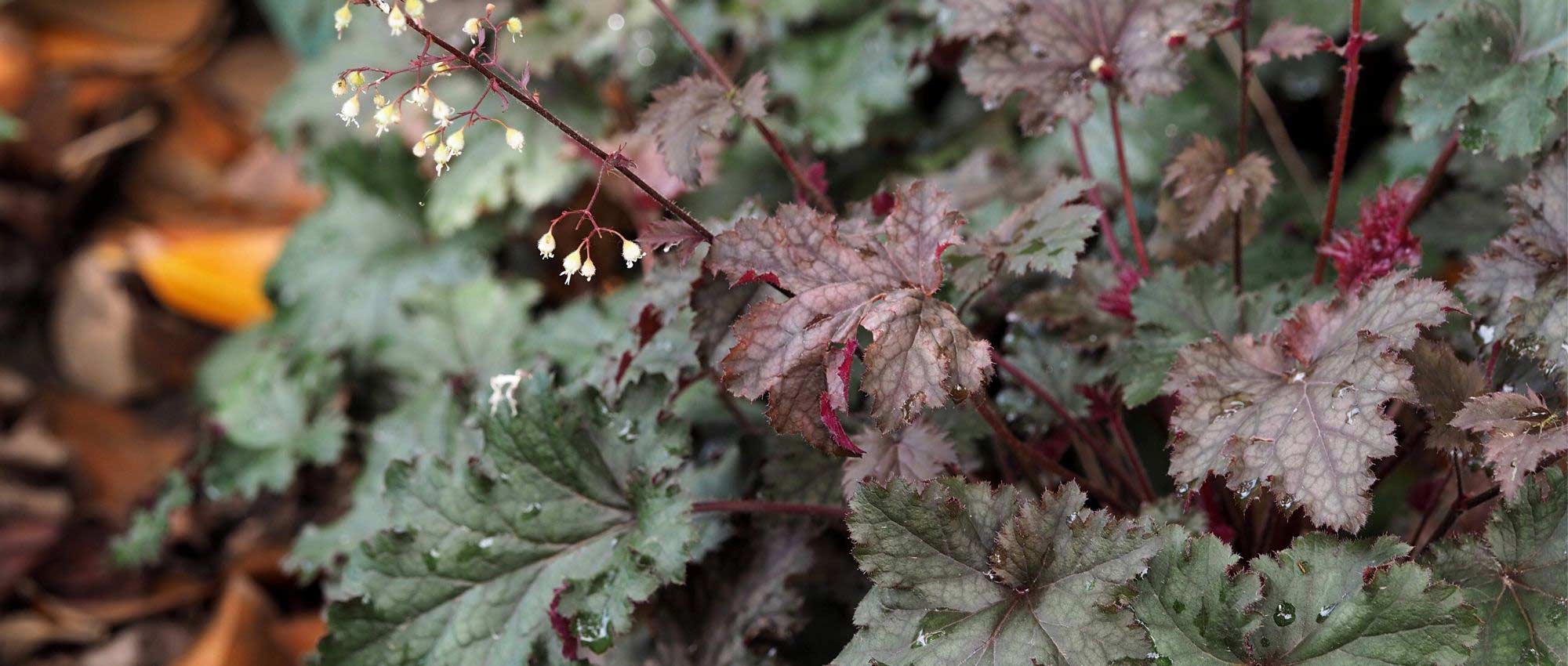
The Heuchera ‘Midnight Rose’ boasts one of the most distinctive foliage displays among heucheras: a near-black, glossy purple base, speckled with bright pink spots. These spots widen before fading to creamy pink as the summer progresses. This ever-changing variegation, different on every leaf, continually refreshes the appearance of the clump. Compact, very hardy and decorative for a large part of the year, this perennial is highly ornamental in partially shaded borders or in a container on the patio.
Belonging to the Saxifragaceae family, ‘Midnight Rose’ is a hybrid herbaceous perennial resulting from a spontaneous mutation of the Heuchera ‘Obsidian’. It was spotted by Terri C. Poindexter among plants propagated through tissue culture at Behnke Nursery in Maryland, then introduced by Terra Nova Nurseries. Protected by a US patent issued in 2008, it retains the very dark foliage of its parent but stands out with its pink speckling. Its complex ancestry notably includes the North American species Heuchera americana. The plant fairly quickly forms a rounded clump 25 to 30 cm tall and 40 to 45 cm wide. Its basal leaves, borne on long purple petioles, measure 8 to 10 cm in length. They are rounded to slightly ovate, gently cupped, divided into seven shallow lobes and edged with rounded teeth. Their texture is firm and their surface glossy. Young leaves unfurl in a very dark brownish purple, dotted with deep pink; as they age, the base may green or brown slightly and the marbling turns pale pink to cream. Several shades thus coexist within the clump, without its dark character ever disappearing. This change is more pronounced in summer. The foliage is evergreen in mild climates and semi-evergreen elsewhere; the oldest leaves may become damaged in winter before being replaced in spring. Flowering occurs between May and July, depending on the climate, and lasts for several weeks. Slender purple stems rise up to 60 cm and bear airy panicles of small creamy white bells. This flowering is graceful, but the main appeal of this variety remains its foliage. Its hardiness reaches at least -25 °C in well-drained soil. Once established, it tolerates short dry spells, even under the light canopy of deciduous trees, but its foliage remains at its best in soil that retains some moisture. In warm regions, afternoon sun can dull the colours or scorch the leaves; prefer filtered light or morning sun.
Plant this Heuchera 'Midnight Rose' along a shaded path, at the base of deciduous shrubs or in a pot placed on a patio with little sun. Planted in groups, it creates a dark carpet dotted with pink; planted alone among light-coloured foliage, it forms an interesting contrast in a contemporary garden as well as in a more romantic display. Pair it with the Heuchera ‘Lime Marmalade’, whose chartreuse green brightens its foliage, with the Brunnera macrophylla ‘Looking Glass’, silvery and blue-flowered in spring, and with the foamflower ‘Pink Skyrocket’, whose pinkish white spikes echo its speckling. These perennials also appreciate cool partial shade. In a container, a single clump is enough to dress a display for a long time; choose a light-coloured pot that will highlight all the whimsy of its foliage.

Heuchera Midnight Rose - Heuchère, Heuchera, Désespoir du peintre in pictures


Flowering
Foliage
Plant habit
Botanical data
Heuchera
Midnight Rose
Saxifragaceae
Cultivar or hybrid
Planting and care
Plant your Heuchera 'Midnight Rose' preferably in spring or early autumn, in partial shade, in soil that has been loosened and enriched with well-rotted compost. Place the collar at soil level: if it is buried, the stump may rot. In very clayey soil, incorporate draining materials and slightly raise the planting. Water regularly during the first summer and during prolonged drought. Under a tree, watch out for root competition during hot periods. In a pot, use a container with drainage holes, a loose, well-draining potting mix, and do not leave water in the saucer. Every three or four years, divide clumps that have become less vigorous and replant the divisions at the correct level. Avoid excess nitrogen fertiliser, which results in less colourful foliage.
Planting period
Intended location
Care
Planting & care advice
-

-

-
-

-

-

-

-

-
, onOrder confirmed
Reply from on Promesse de fleurs
Recently viewed products
Haven't found what you were looking for?
Hardiness is the lowest winter temperature a plant can endure without suffering serious damage or even dying. However, hardiness is affected by location (a sheltered area, such as a patio), protection (winter cover) and soil type (hardiness is improved by well-drained soil).

The flowering period indicated on our website applies to countries and regions located in USDA zone 8 (France, the United Kingdom, Ireland, the Netherlands, etc.)
It will vary according to where you live:- In zones 9 to 10 (Italy, Spain, Greece, etc.), flowering will occur about 2 to 4 weeks earlier.
- In zones 6 to 7 (Germany, Poland, Slovenia, and lower mountainous regions), flowering will be delayed by 2 to 3 weeks.
- In zone 5 (Central Europe, Scandinavia), blooming will be delayed by 3 to 5 weeks.
In temperate climates, pruning of spring-flowering shrubs (forsythia, spireas, etc.) should be done just after flowering.
Pruning of summer-flowering shrubs (Indian Lilac, Perovskia, etc.) can be done in winter or spring.
In cold regions as well as with frost-sensitive plants, avoid pruning too early when severe frosts may still occur.
The planting period indicated on our website applies to countries and regions located in USDA zone 8 (France, United Kingdom, Ireland, Netherlands).
It will vary according to where you live:
- In Mediterranean zones (Marseille, Madrid, Milan, etc.), autumn and winter are the best planting periods.
- In continental zones (Strasbourg, Munich, Vienna, etc.), delay planting by 2 to 3 weeks in spring and bring it forward by 2 to 4 weeks in autumn.
- In mountainous regions (the Alps, Pyrenees, Carpathians, etc.), it is best to plant in late spring (May-June) or late summer (August-September).
The harvesting period indicated on our website applies to countries and regions in USDA zone 8 (France, England, Ireland, the Netherlands).
In colder areas (Scandinavia, Poland, Austria...) fruit and vegetable harvests are likely to be delayed by 3-4 weeks.
In warmer areas (Italy, Spain, Greece, etc.), harvesting will probably take place earlier, depending on weather conditions.
The sowing periods indicated on our website apply to countries and regions within USDA Zone 8 (France, UK, Ireland, Netherlands).
In colder areas (Scandinavia, Poland, Austria...), delay any outdoor sowing by 3-4 weeks, or sow under glass.
In warmer climes (Italy, Spain, Greece, etc.), bring outdoor sowing forward by a few weeks.
Shipping country and language
Your country of residence may be:
Your country of residence is:
For a better user experience on our website, you can select:
Your shipping country:
-
 Austria
-
 Belgium
-
 Bosnia & Herzegovina
-
 Bulgaria
-
 Croatia
-
 Cyprus
-
 Czechia
-
 Denmark
-
 Estonia
-
 Finland
-
 France
-
 Germany
-
 Greece
-
 Hungary
-
 Iceland
-
 Ireland
-
 Italy
Italy
-
 Latvia
-
 Liechtenstein
-
 Lithuania
-
 Luxembourg
-
 Malta
Malta
-
 Netherlands
-
 Poland
-
 Portugal
-
 Romania
-
 Serbia
-
 Slovakia
-
 Slovenia
-
 Spain
Spain
-
 Sweden
-
 Switzerland
Language:
-
French
-
 English
-
Spanish
-
Italian
-
German
-
Portuguese
-
Dutch
-
Finnish
My Account
Hello
My wish lists
My cart
Log in / Register
Existing customer?
This form is protected by reCAPTCHA - the Google Privacy Policy and Terms of Service apply.
New customer?
Create an account to track your orders, access our customer service and, if you wish, make the most of our upcoming offers.