Iris germanica Alpenview - Tall bearded iris
Iris germanica Alpenview - Tall bearded iris
Iris germanica Alpenview
German Iris, Bearded Iris
Back-to-school special offer!
Get €10 off for every €50 you spend! And get up to €40 off on a single order.
How does it work?
1. Shop your favourites
Add your favourite plants to your basket. For every €50 you spend (excluding delivery charges, store credit and the plastic-free option), you’ll receive a €10 voucher.
€50 spent = €10 voucher
€100 spent = €20 voucher
€150 spent = €30 voucher
€200 spent = €40 voucher
2. Place your order
Once your basket reaches one of the spending thresholds, place your order. You can even choose your delivery date!
3. Receive your voucher
As soon as your order has been shipped, you’ll receive an email containing your personal voucher code and its value.
4. Use it on your next order
Your voucher is valid for 90 days from the date you receive it. It can be used once only, on a new order worth at least the value of the voucher, excluding delivery charges.
Please note: Vouchers can be combined with other offers, but cannot be split or refunded.
Why not try an alternative variety in stock?
View all →
Available in 2 sizes
Available in 2 sizes
Available in 2 sizes
Available in 2 sizes
Available in 2 sizes
Available in 2 sizes
Available in 2 sizes
Available in 3 sizes
Available in 2 sizes
Available in 3 sizes
This plant carries a 12 months recovery warranty
More information
We guarantee the quality of our plants for a full growing cycle, and will replace at our expense any plant that fails to recover under normal climatic and planting conditions.
Would this plant suit my garden?
Set up your Plantfit profile →
Description
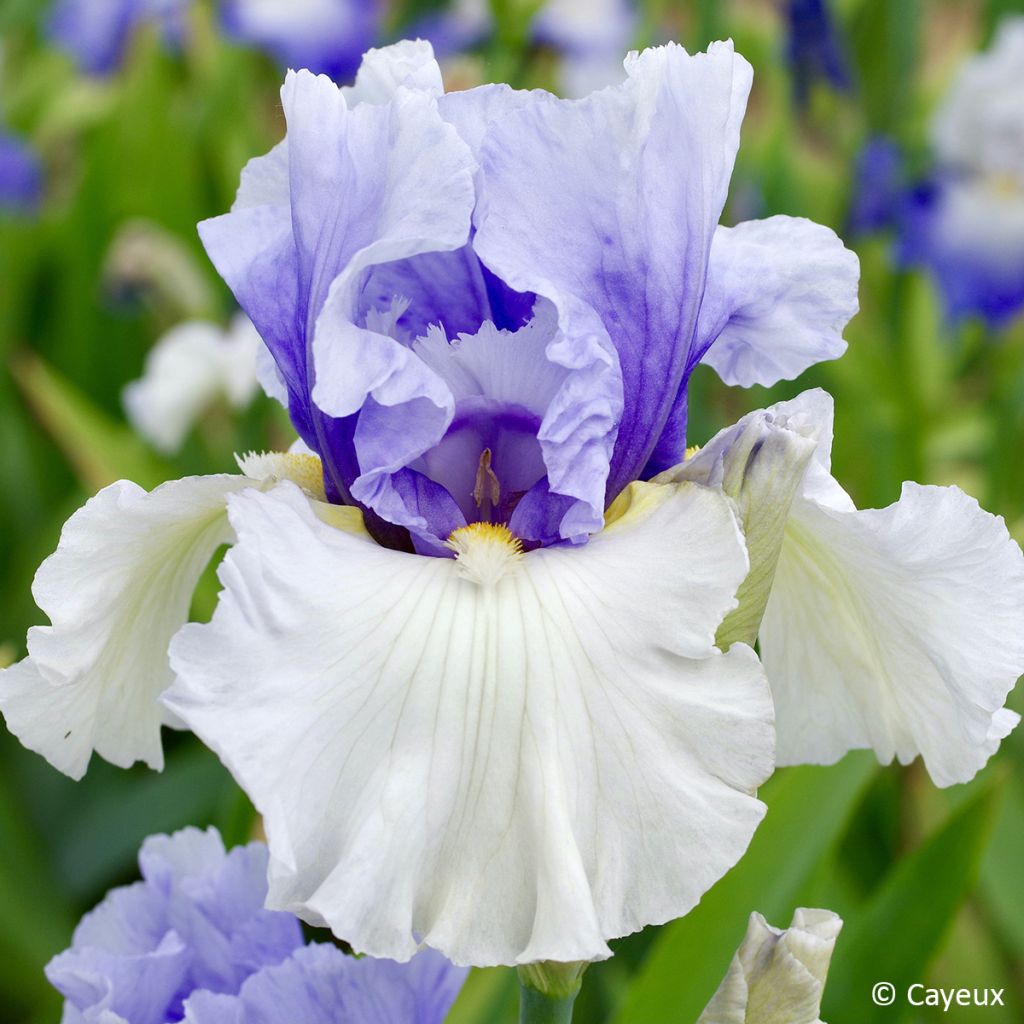
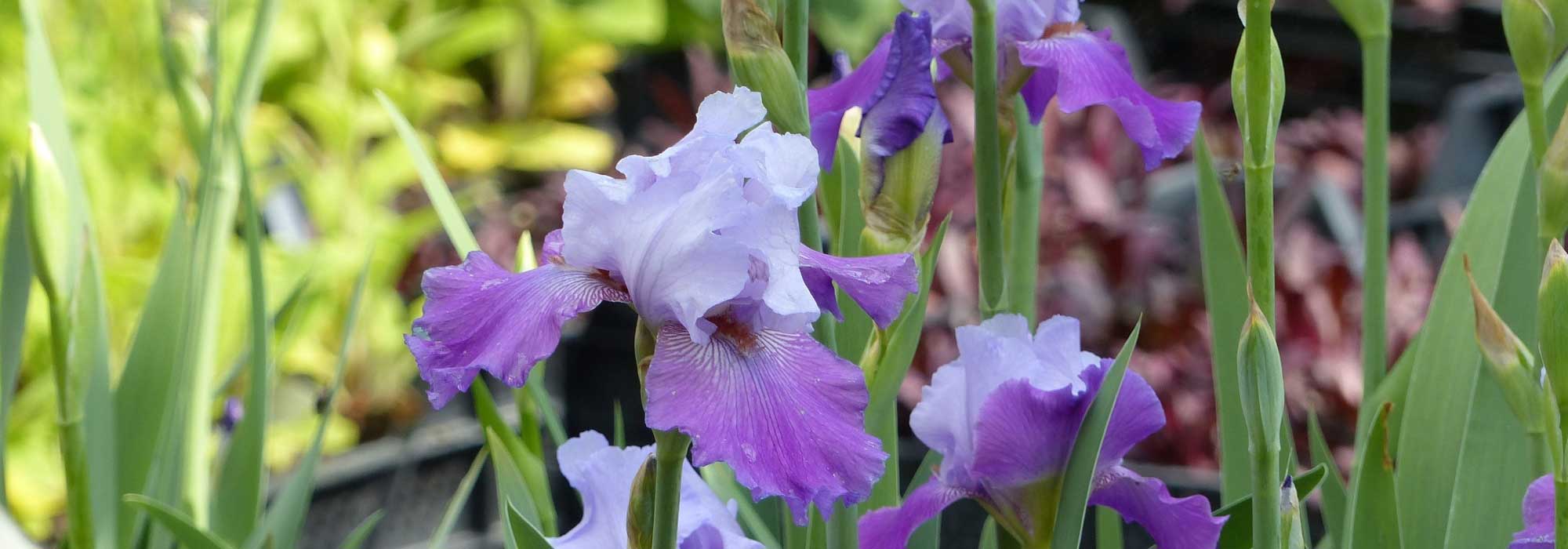
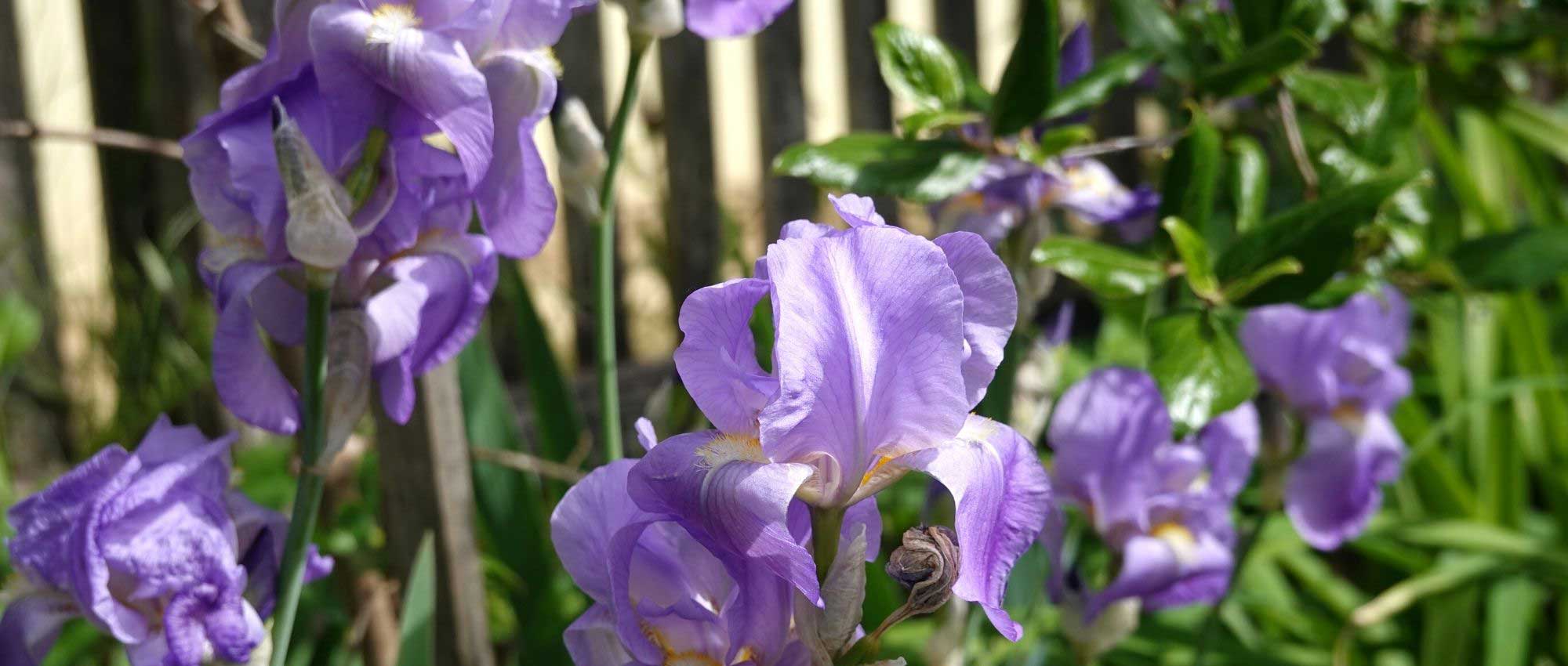
Iris ‘Alpenview’ is a Bearded Iris with an elegant and contrasting bicolour flowering, featuring upright pale blue petals and snow-white sepals, accentuated by a touch of greenish-yellow around golden-yellow beards with white tips. This cultivar, with its slender and harmonious habit, reaches approximately 1 metre in height, gracefully structuring spring borders. Its rapid and vigorous growth makes it a generous plant, equally suited to open ground or large pots. It thrives in sunny positions and perfectly drained soil, typically requiring at least six hours of sunlight per day.
Iris ‘Alpenview’ is a tall Bearded Iris or German Iris cultivar, belonging to the Iridaceae family. It was developed by American hybridiser Keith Keppel in 2002. This cultivar results from the cross-breeding of two award-winning varieties: ‘Crowned Heads’ and ‘Fogbound’. ‘Alpenview’ stands out for its elegant bicolour flowers, with upright pale blue upper petals and snow-white lower sepals, adorned with a hint of greenish-yellow around golden-yellow beards. The flowers exhibit delicate ruffling and emit a light, sweet fragrance. Flowering occurs early to mid-season, typically in May. The plant has an upright habit, reaching a height of around 1 metre in open ground. Its growth is rapid and vigorous, forming dense clumps thanks to its fleshy rhizomes that spread horizontally without theoretical limits. In pots, dimensions may be slightly reduced, but the plant retains its elegant appearance. The foliage consists of sword-shaped, blue-green, deciduous leaves, measuring up to 60 cm long. The root system of fleshy rhizomes ensures both propagation and nutrient storage. ‘Alpenview’ received an Honorable Mention in 2005 and the Award of Merit in 2007 from the American Iris Society, attesting to its exceptional quality.
In a sunny garden, Iris ‘Alpenview’ unfurls its fresh hues of pale blue and white like an alpine breath, bringing a note of purity to spring scenes. It naturally finds its place at the heart of structured borders, paired with the soft clumps of Amsonia, cream Foxgloves, or the airy spikes of Libertias. Its elegance shines fully when contrasted with irises in deeper tones, such as deep violet ‘Yaquina Blue’ or immaculate white ‘Laced Cotton’. In pots, it becomes a refined focal point on a sunny terrace, a floral column to admire in the morning calm. The vegetable garden can be enhanced with a few clumps, or iris borders for cut flowers.
Flowering
Foliage
Plant habit
Botanical data
Iris
germanica
Alpenview
Iridaceae
German Iris, Bearded Iris
Cultivar or hybrid
Planting and care
Do you have a sunny spot, sheltered from the wind, warm and rather dry in summer?
This is the ideal location for planting tall irises such as 'Alpenview'! They can be grown in all regions as they are hardy and do not require winter protection. Well-drained soil is perfect, even if it is rather dry. Iris germanica require calcareous soil: amend your soil with lime if it tends to be acidic. Soil that is too damp encourages rhizome rot. Plant from July to September to give the rhizomes enough time to grow sufficiently before lifting, and then to develop new roots before winter. They should be planted as soon as they are purchased for the best results. Plan to divide irises every 4 years or so to give them fresh soil. They have vigorous growth and need space to develop and flower well. Plant with spacing suited to the size and vigour of the variety: approximately 34-50 cm for tall varieties (5 to 10 young plants per square metre). In a monochrome planting, plant the rhizomes in a staggered pattern. To create a mix of colours, it is advisable for the overall aesthetics of the iris bed to plant them in groups of several plants of the same variety. Always take into account the direction of growth of the rhizomes by arranging them in a star shape, with buds and leaves facing outwards, and spacing them well away from other varieties so they have room to develop.
Planting
Dig a hole wide and deep enough. Make a large conical mound of soil in it, on which you place the rhizome with the roots spread out. Cover the roots. It is important that the rhizome is left just at the soil surface. It should not be planted in a hollow (risk of rot), so allow for the soil to settle and the iris to sink. In clay or damp ground, the rhizome should even be left slightly raised on a small mound a few centimetres high. To help the soil cling to the roots, lightly firm the soil and water generously immediately after planting. Water if needed 2-3 times until established.
Care:
Keep the soil free of weeds by shallow hoeing, taking care not to damage the rhizomes or roots. Weeds shade the irises, retain moisture (leading to rot) and attract slugs. Similarly, cut back dry leaves. If they are diseased (reddish-edged spots from heterosporiosis), burn them. Remove faded flowers.
Planting period
Intended location
Care
Planting & care advice
-
-
-
-
-
-
-
-
This item has not been reviewed yet - be the first to leave a review about it.
Recently viewed products
Haven't found what you were looking for?
Hardiness is the lowest winter temperature a plant can endure without suffering serious damage or even dying. However, hardiness is affected by location (a sheltered area, such as a patio), protection (winter cover) and soil type (hardiness is improved by well-drained soil).

The flowering period indicated on our website applies to countries and regions located in USDA zone 8 (France, the United Kingdom, Ireland, the Netherlands, etc.)
It will vary according to where you live:- In zones 9 to 10 (Italy, Spain, Greece, etc.), flowering will occur about 2 to 4 weeks earlier.
- In zones 6 to 7 (Germany, Poland, Slovenia, and lower mountainous regions), flowering will be delayed by 2 to 3 weeks.
- In zone 5 (Central Europe, Scandinavia), blooming will be delayed by 3 to 5 weeks.
In temperate climates, pruning of spring-flowering shrubs (forsythia, spireas, etc.) should be done just after flowering.
Pruning of summer-flowering shrubs (Indian Lilac, Perovskia, etc.) can be done in winter or spring.
In cold regions as well as with frost-sensitive plants, avoid pruning too early when severe frosts may still occur.
The planting period indicated on our website applies to countries and regions located in USDA zone 8 (France, United Kingdom, Ireland, Netherlands).
It will vary according to where you live:
- In Mediterranean zones (Marseille, Madrid, Milan, etc.), autumn and winter are the best planting periods.
- In continental zones (Strasbourg, Munich, Vienna, etc.), delay planting by 2 to 3 weeks in spring and bring it forward by 2 to 4 weeks in autumn.
- In mountainous regions (the Alps, Pyrenees, Carpathians, etc.), it is best to plant in late spring (May-June) or late summer (August-September).
The harvesting period indicated on our website applies to countries and regions in USDA zone 8 (France, England, Ireland, the Netherlands).
In colder areas (Scandinavia, Poland, Austria...) fruit and vegetable harvests are likely to be delayed by 3-4 weeks.
In warmer areas (Italy, Spain, Greece, etc.), harvesting will probably take place earlier, depending on weather conditions.
The sowing periods indicated on our website apply to countries and regions within USDA Zone 8 (France, UK, Ireland, Netherlands).
In colder areas (Scandinavia, Poland, Austria...), delay any outdoor sowing by 3-4 weeks, or sow under glass.
In warmer climes (Italy, Spain, Greece, etc.), bring outdoor sowing forward by a few weeks.
Shipping country and language
Your country of residence may be:
Your country of residence is:
For a better user experience on our website, you can select:
Your shipping country:
-
 Austria
-
 Belgium
-
 Bosnia & Herzegovina
-
 Bulgaria
-
 Croatia
-
 Cyprus
-
 Czechia
-
 Denmark
-
 Estonia
-
 Finland
-
 France
-
 Germany
-
 Greece
-
 Hungary
-
 Iceland
-
 Ireland
-
 Italy
Italy
-
 Latvia
-
 Liechtenstein
-
 Lithuania
-
 Luxembourg
-
 Malta
Malta
-
 Netherlands
-
 Poland
-
 Portugal
-
 Romania
-
 Serbia
-
 Slovakia
-
 Slovenia
-
 Spain
Spain
-
 Sweden
-
 Switzerland
Language:
-
French
-
 English
-
Spanish
-
Italian
-
German
-
Portuguese
-
Dutch
-
Finnish
My Account
Hello
My wish lists
My cart
Log in / Register
Existing customer?
This form is protected by reCAPTCHA - the Google Privacy Policy and Terms of Service apply.
New customer?
Create an account to track your orders, access our customer service and, if you wish, make the most of our upcoming offers.