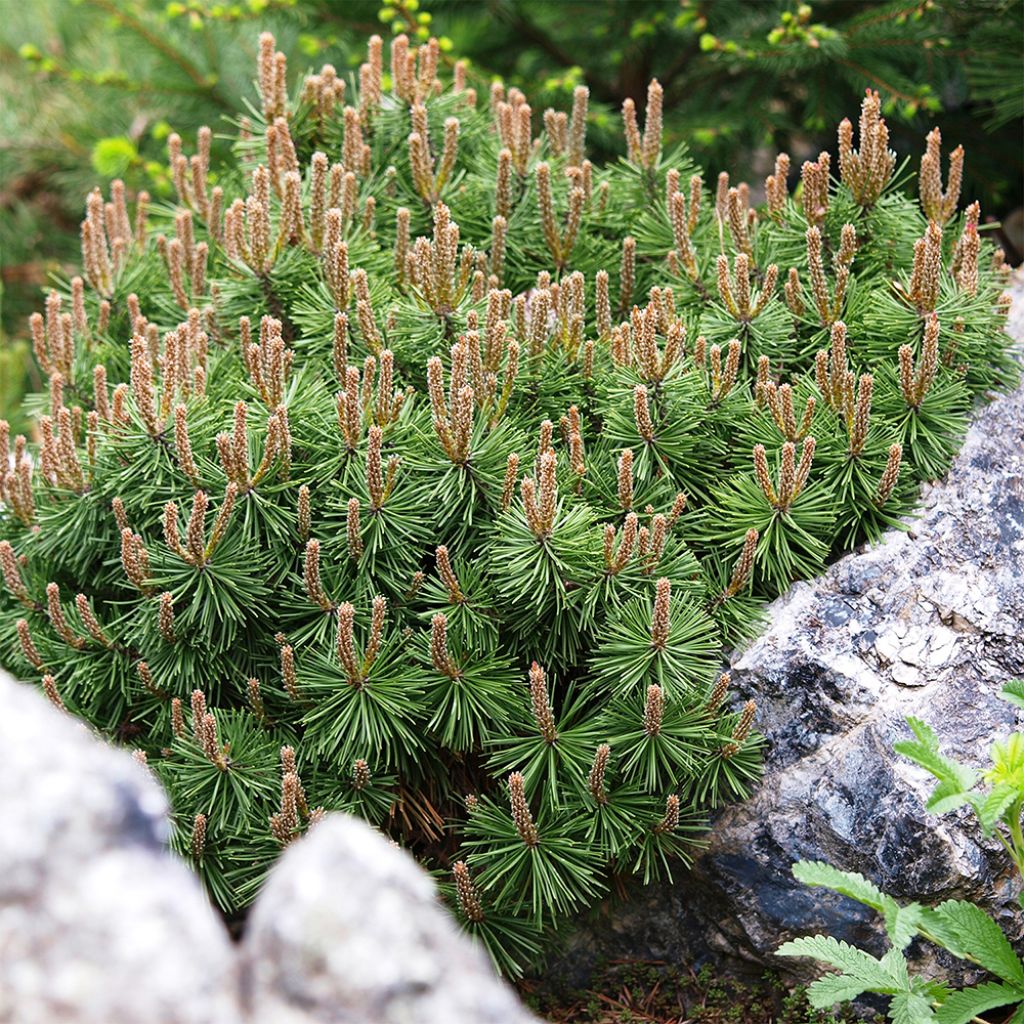
Pinus mugo Mops - Dwarf Mountain Pine
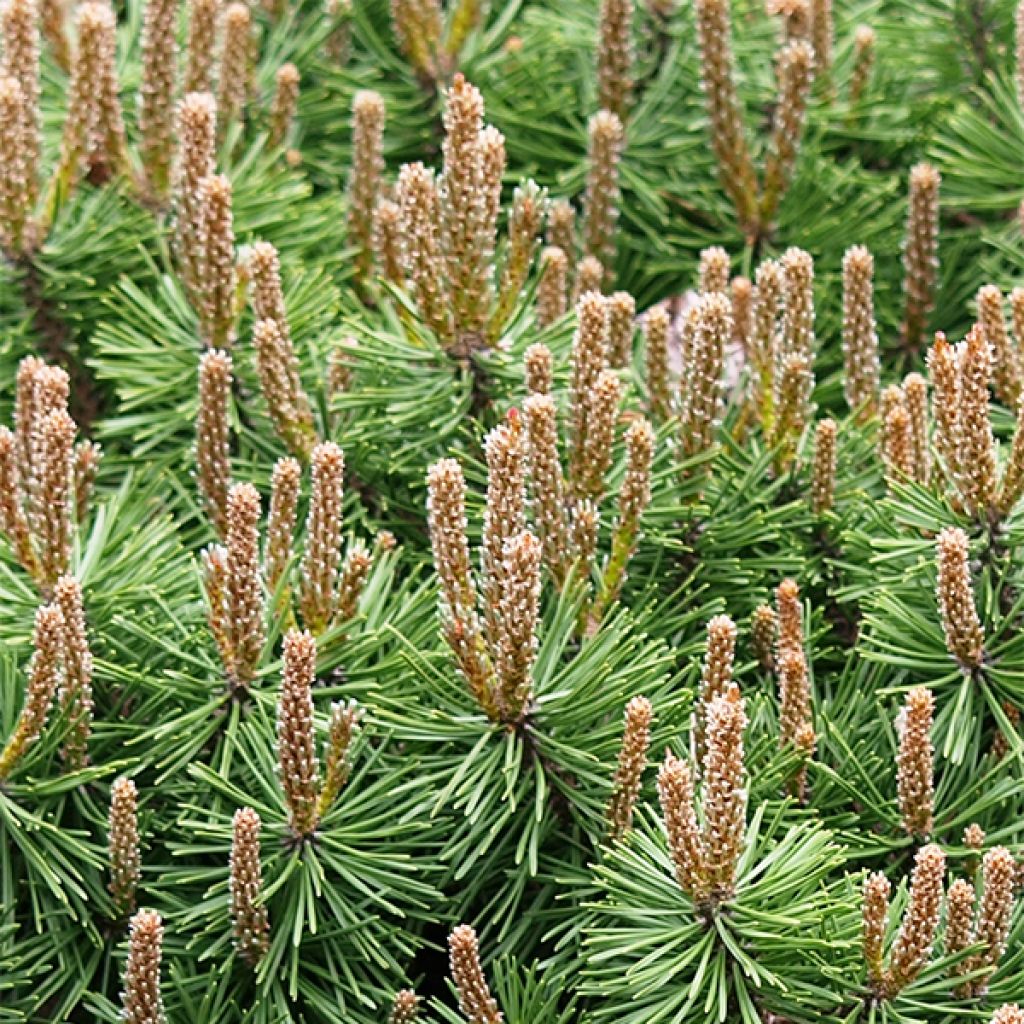
Pinus mugo Mops - Dwarf Mountain Pine
Pinus mugo Mops - Dwarf Mountain Pine
Pinus mugo Mops
Dwarf Mountain Pine, Swiss Mountain Pine, Mugo Pine
I am very satisfied with my purchase. I planted this little pine in a large pot and it is developing very well. It looks absolutely beautiful with its branches tipped with blue pom-poms.
Claudie, 03/08/2025
Back-to-school special offer!
Get €10 off for every €50 you spend! And get up to €40 off on a single order.
How does it work?
1. Shop your favourites
Add your favourite plants to your basket. For every €50 you spend (excluding delivery charges, store credit and the plastic-free option), you’ll receive a €10 voucher.
€50 spent = €10 voucher
€100 spent = €20 voucher
€150 spent = €30 voucher
€200 spent = €40 voucher
2. Place your order
Once your basket reaches one of the spending thresholds, place your order. You can even choose your delivery date!
3. Receive your voucher
As soon as your order has been shipped, you’ll receive an email containing your personal voucher code and its value.
4. Use it on your next order
Your voucher is valid for 90 days from the date you receive it. It can be used once only, on a new order worth at least the value of the voucher, excluding delivery charges.
Please note: Vouchers can be combined with other offers, but cannot be split or refunded.
Home or relay delivery (depending on size and destination)
Important: You may be charged customs duties by your country’s customs authorities upon delivery.
Schedule delivery date,
and select date in basket
This plant carries a 24 months recovery warranty
More information
We guarantee the quality of our plants for a full growing cycle, and will replace at our expense any plant that fails to recover under normal climatic and planting conditions.


Would this plant suit my garden?
Set up your Plantfit profile →
Description
Pinus mugo 'Mops' is a small mountain pine, with an almost spherical and compact habit when young, which over time forms a very dense, more spreading mass, with a fluffy and somewhat irregular texture. Its ascending and very tight branches are covered with fairly short, intense green needles. Due to its reduced development and slow growth, it is well-suited for a small garden, where it can liven up a rockery, or make a statement in a container on the terrace. It is an extremely hardy conifer and truly undemanding, which does not require pruning. It thrives in ordinary soil and a sunny exposure.
Pinus mugo, also known as Mountain Pine or Mountain Pine Tree, is an evergreen conifer of the pine family endemic to the mountains of Europe. It is found at the subalpine level, avoiding the summer heat, from the Spanish sierras, through the high alpine and Pyrenees massifs, to the Balkans. It only descends to an altitude of 200 m (656 ft 2 in) in Central Europe. In the wild, it slowly reaches 3 to 4 m (9 ft 10 in to 13 ft 1 ft) in all directions, adopting a windswept silhouette that reflects its habitat. It is a very hardy species, well adapted to the mountain climate.
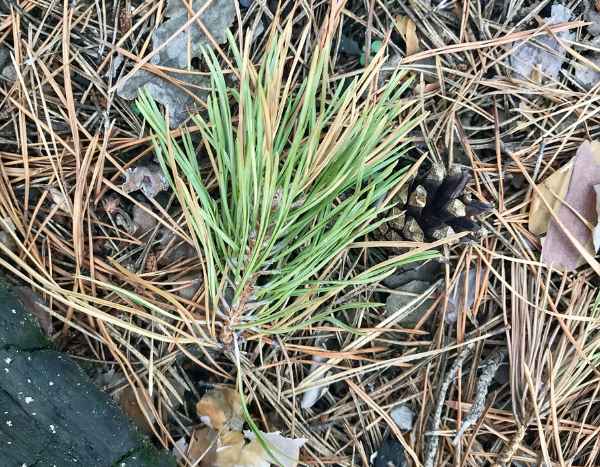
The 'Mops' variety is distinguished from the wild species by its small size, short needles and very compact habit, which is initially spherical and then spreading and bushy. Its growth is slow, so a 25-year-old specimen will not exceed 80 cm (31.5 in) in height and 1 m (3 ft 4 in) in width. Over time, this small shrub widens out, eventually forming a rounded pine, wider than it is tall, measuring 1 m (3 ft 4 in) in height and 1.2 m (3 ft 11 in) in diameter. Its small, tightly packed branches are covered with fine needles, not exceeding 6 cm (2.4 in) in length, grouped in pairs and arranged in brushes around the branches. The young shoots emerge in spring from light brown and resinous buds. On its trunk, the bark is brown-grey, while it shows a green and shiny hue, turning to black, on the branches.
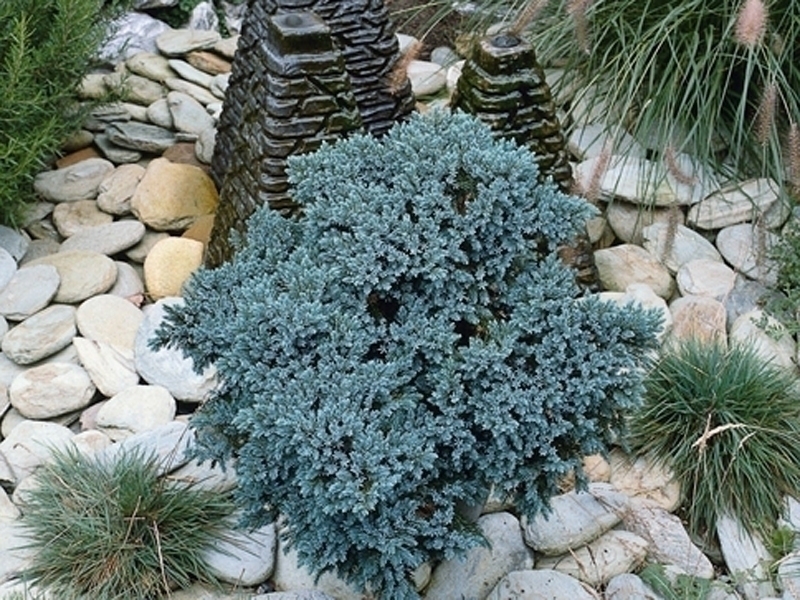
The 'Mops' dwarf mountain pine will find its place in all gardens, even the smallest ones. It can be planted as a standalone specimen, in a massif or in a rockery. It can also be grown in a large pot on the terrace or balcony. It works wonders in a Japanese garden and pairs well with large stones, the geometric lines of swimming pools, and masonry works. It can be combined with complementary grasses or dwarf conifers with a prostrate habit (Juniperus horizontalis Blue Chip), globose (Picea abies Little Gem), or columnar (Juniperus communis 'Sentinel'). The true graphic qualities of conifers naturally impose themselves in the design of a contemporary garden, which prefers the aesthetics of shapes, silhouettes, and textures over the dance of flowers. These plants, with their reassuring permanence, structurally define a flower bed, mark pathways and border the terrace, easily replacing the strong presence of trimmed boxwood or holly. The key is to play with volumes and colours.

Pinus mugo Mops - Dwarf Mountain Pine in pictures
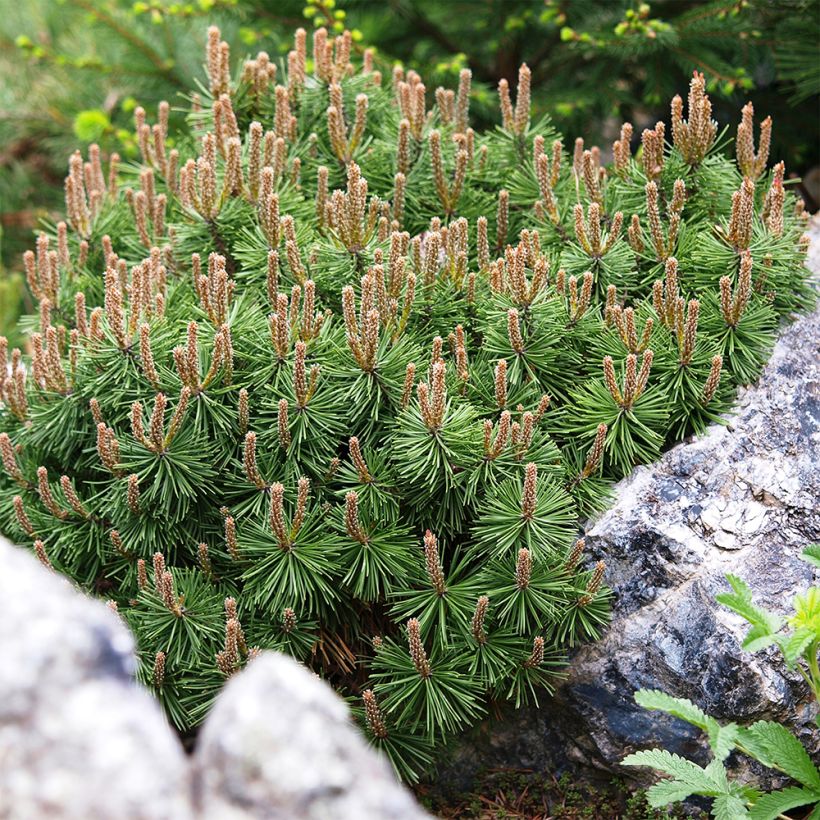
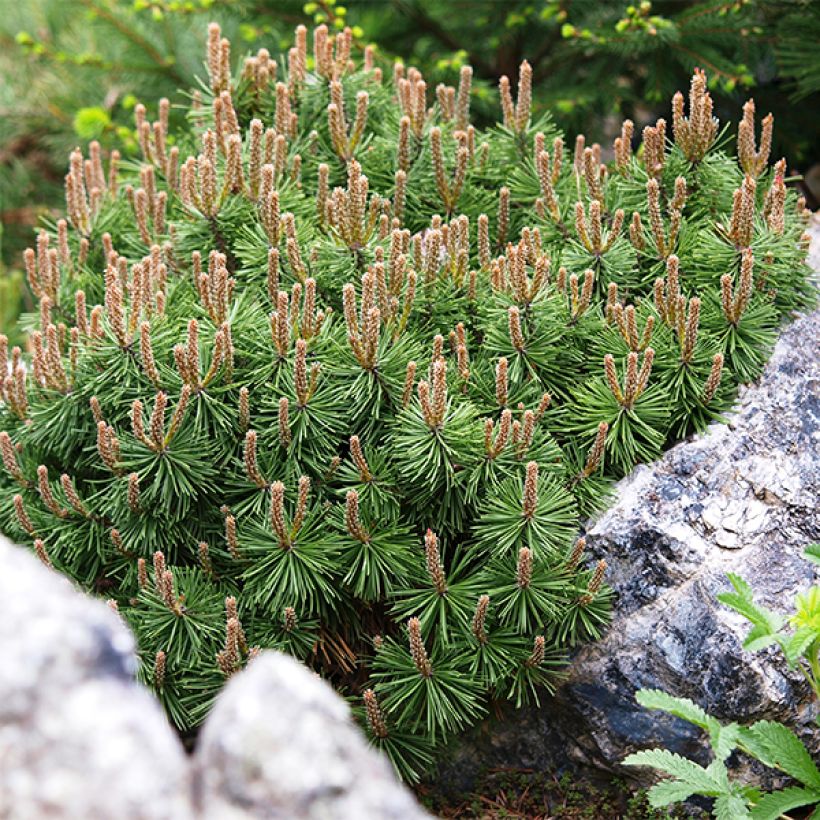
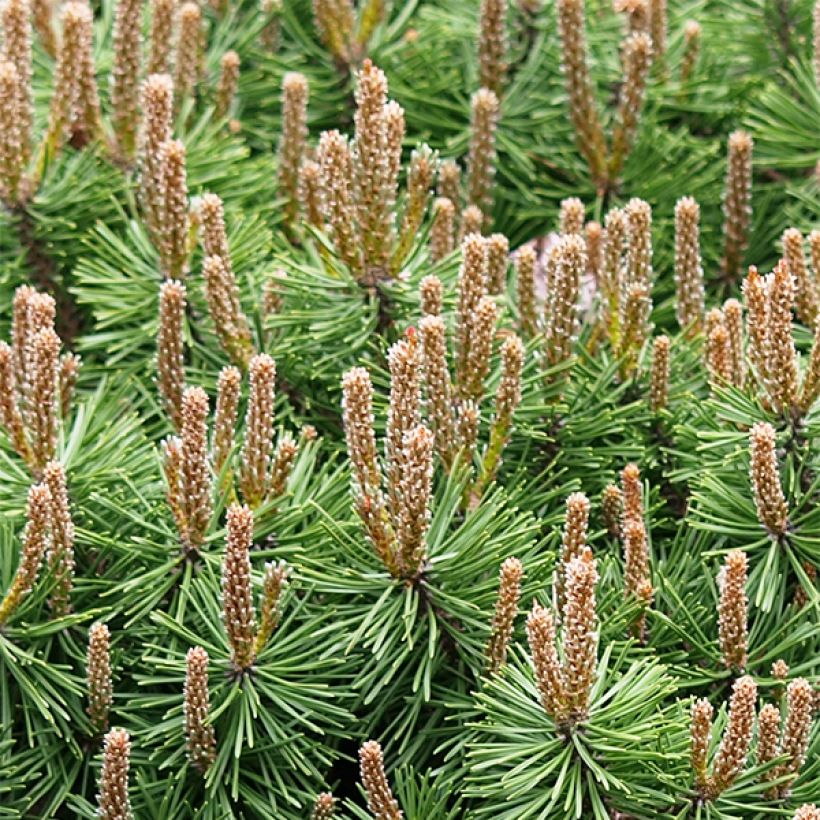
Plant habit
Foliage
Botanical data
Pinus
mugo
Mops
Pinaceae
Dwarf Mountain Pine, Swiss Mountain Pine, Mugo Pine
Cultivar or hybrid
Planting and care
Pinus mugo 'Mops' can be planted from September to November and from February to June in well-drained soil, which should be moist to dry, even poor, whether it is limestone or, alternatively, peaty and acidic. It only fears extremely hot temperatures. Choose a sunny location or, at worst, a partially shaded position in a warm climate. Soak the root balls well before planting. Optionally, add organic compost at planting and water generously in the first years, and in case of prolonged drought. You can apply a special conifer fertiliser every year in April and cultivate the soil in summer. This very hardy conifer (down to at least -30 °C (22 °F)) does not need to be pruned. However, you can enhance its compact habit or keep it in very small proportions by annually pruning the branches by half their size, from September to November.
Planting period
Intended location
Care
Planting & care advice
-
-

-

-

-
-

-
-
-
, onOrder confirmed
Reply from on Promesse de fleurs
Recently viewed products
Haven't found what you were looking for?
Hardiness is the lowest winter temperature a plant can endure without suffering serious damage or even dying. However, hardiness is affected by location (a sheltered area, such as a patio), protection (winter cover) and soil type (hardiness is improved by well-drained soil).

The flowering period indicated on our website applies to countries and regions located in USDA zone 8 (France, the United Kingdom, Ireland, the Netherlands, etc.)
It will vary according to where you live:- In zones 9 to 10 (Italy, Spain, Greece, etc.), flowering will occur about 2 to 4 weeks earlier.
- In zones 6 to 7 (Germany, Poland, Slovenia, and lower mountainous regions), flowering will be delayed by 2 to 3 weeks.
- In zone 5 (Central Europe, Scandinavia), blooming will be delayed by 3 to 5 weeks.
In temperate climates, pruning of spring-flowering shrubs (forsythia, spireas, etc.) should be done just after flowering.
Pruning of summer-flowering shrubs (Indian Lilac, Perovskia, etc.) can be done in winter or spring.
In cold regions as well as with frost-sensitive plants, avoid pruning too early when severe frosts may still occur.
The planting period indicated on our website applies to countries and regions located in USDA zone 8 (France, United Kingdom, Ireland, Netherlands).
It will vary according to where you live:
- In Mediterranean zones (Marseille, Madrid, Milan, etc.), autumn and winter are the best planting periods.
- In continental zones (Strasbourg, Munich, Vienna, etc.), delay planting by 2 to 3 weeks in spring and bring it forward by 2 to 4 weeks in autumn.
- In mountainous regions (the Alps, Pyrenees, Carpathians, etc.), it is best to plant in late spring (May-June) or late summer (August-September).
The harvesting period indicated on our website applies to countries and regions in USDA zone 8 (France, England, Ireland, the Netherlands).
In colder areas (Scandinavia, Poland, Austria...) fruit and vegetable harvests are likely to be delayed by 3-4 weeks.
In warmer areas (Italy, Spain, Greece, etc.), harvesting will probably take place earlier, depending on weather conditions.
The sowing periods indicated on our website apply to countries and regions within USDA Zone 8 (France, UK, Ireland, Netherlands).
In colder areas (Scandinavia, Poland, Austria...), delay any outdoor sowing by 3-4 weeks, or sow under glass.
In warmer climes (Italy, Spain, Greece, etc.), bring outdoor sowing forward by a few weeks.
Shipping country and language
Your country of residence may be:
Your country of residence is:
For a better user experience on our website, you can select:
Your shipping country:
-
 Austria
-
 Belgium
-
 Bosnia & Herzegovina
-
 Bulgaria
-
 Croatia
-
 Cyprus
-
 Czechia
-
 Denmark
-
 Estonia
-
 Finland
-
 France
-
 Germany
-
 Greece
-
 Hungary
-
 Iceland
-
 Ireland
-
 Italy
Italy
-
 Latvia
-
 Liechtenstein
-
 Lithuania
-
 Luxembourg
-
 Malta
Malta
-
 Netherlands
-
 Poland
-
 Portugal
-
 Romania
-
 Serbia
-
 Slovakia
-
 Slovenia
-
 Spain
Spain
-
 Sweden
-
 Switzerland
Language:
-
French
-
 English
-
Spanish
-
Italian
-
German
-
Portuguese
-
Dutch
-
Finnish
My Account
Hello
My wish lists
My cart
Log in / Register
Existing customer?
This form is protected by reCAPTCHA - the Google Privacy Policy and Terms of Service apply.
New customer?
Create an account to track your orders, access our customer service and, if you wish, make the most of our upcoming offers.