
Pinus parviflora Azumi Goye - Japanese White Pine

Pinus parviflora Azumi Goye - Japanese White Pine
Pinus parviflora Azumi Goye - Japanese White Pine
Pinus parviflora Azumi Goye
Japanese White Pine, Five-needle Pine, East Asian White Pine
Just like in the picture. Short and bluish needle white pine. Impeccable and fast packaging. Highly recommended.
JUAN PABLO MORENO, 19/08/2016
Back-to-school special offer!
Get €10 off for every €50 you spend! And get up to €40 off on a single order.
How does it work?
1. Shop your favourites
Add your favourite plants to your basket. For every €50 you spend (excluding delivery charges, store credit and the plastic-free option), you’ll receive a €10 voucher.
€50 spent = €10 voucher
€100 spent = €20 voucher
€150 spent = €30 voucher
€200 spent = €40 voucher
2. Place your order
Once your basket reaches one of the spending thresholds, place your order. You can even choose your delivery date!
3. Receive your voucher
As soon as your order has been shipped, you’ll receive an email containing your personal voucher code and its value.
4. Use it on your next order
Your voucher is valid for 90 days from the date you receive it. It can be used once only, on a new order worth at least the value of the voucher, excluding delivery charges.
Please note: Vouchers can be combined with other offers, but cannot be split or refunded.
Why not try an alternative variety in stock?
View all →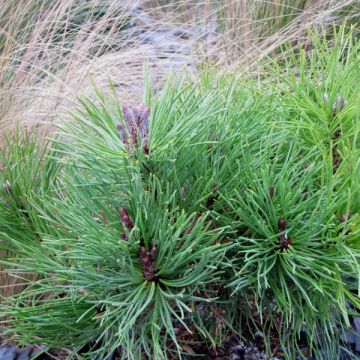
Available in 2 sizes
Available in 1 sizes
Available in 2 sizes
Available in 2 sizes
Available in 2 sizes
Available in 1 sizes
Available in 2 sizes
Available in 2 sizes
Available in 2 sizes
Available in 1 sizes
This plant carries a 24 months recovery warranty
More information
We guarantee the quality of our plants for a full growing cycle, and will replace at our expense any plant that fails to recover under normal climatic and planting conditions.

Would this plant suit my garden?
Set up your Plantfit profile →
Description
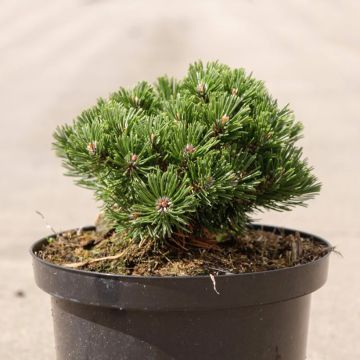
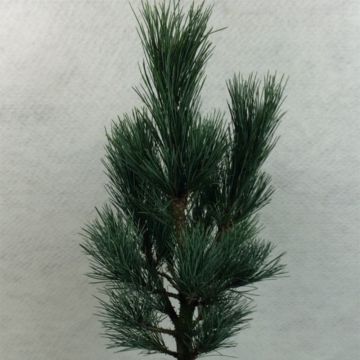
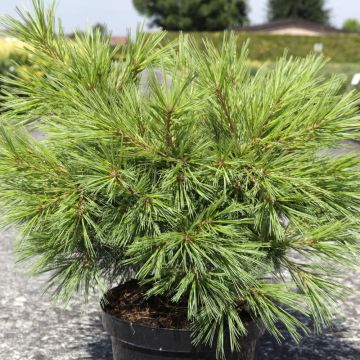
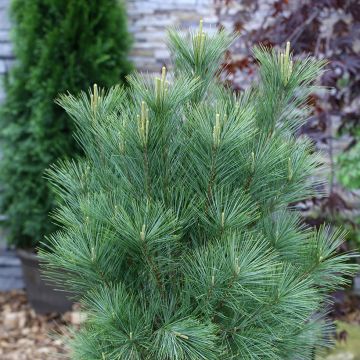
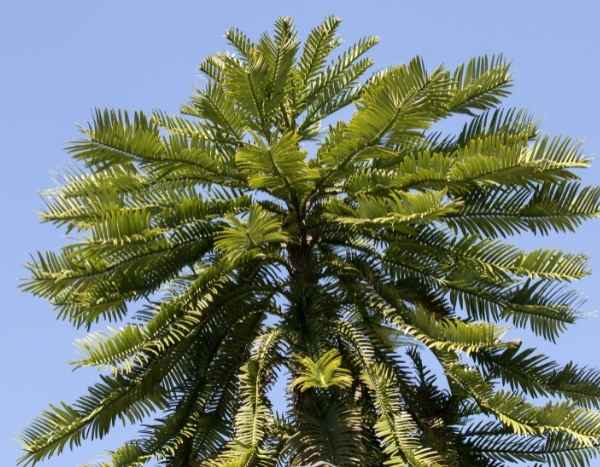
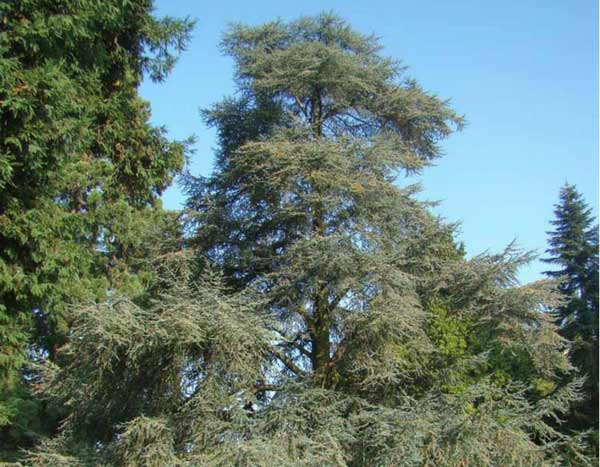
Pinus parviflora 'Azumi Goye' is a smaller and elegant form of the Japanese white pine, with a conical habit, and quite wide spread. Its somewhat irregular vegetation is composed of ascending branches covered with short and delicate needles, with grey-blue hues, giving the bush a very nuanced dark green shade. Like all Japanese pines, it tolerates pruning very well, which allows it to be shaped into a living sculpture for many years. It is an ideal variety for pots and particularly suitable for the art of bonsai. Not demanding, this small conifer prefers sunlight and well-drained soils and tolerates drought quite well.
Pinus parviflora, also known as Japanese white pine or five-needle pine, is a plant of the pine family native to forests located at altitudes between 1300 and 1800 m (4265 and 5905ft), in the Japanese islands. In its natural environment, this species can exceed 20 m (66ft) in height and has a pyramidal habit, often as wide as it is tall, bearing a dense conical crown. Appreciated for its wood in Japan, this elegant species has given rise to very beautiful forms, often grown as bonsai.
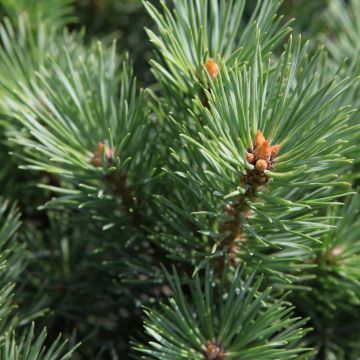
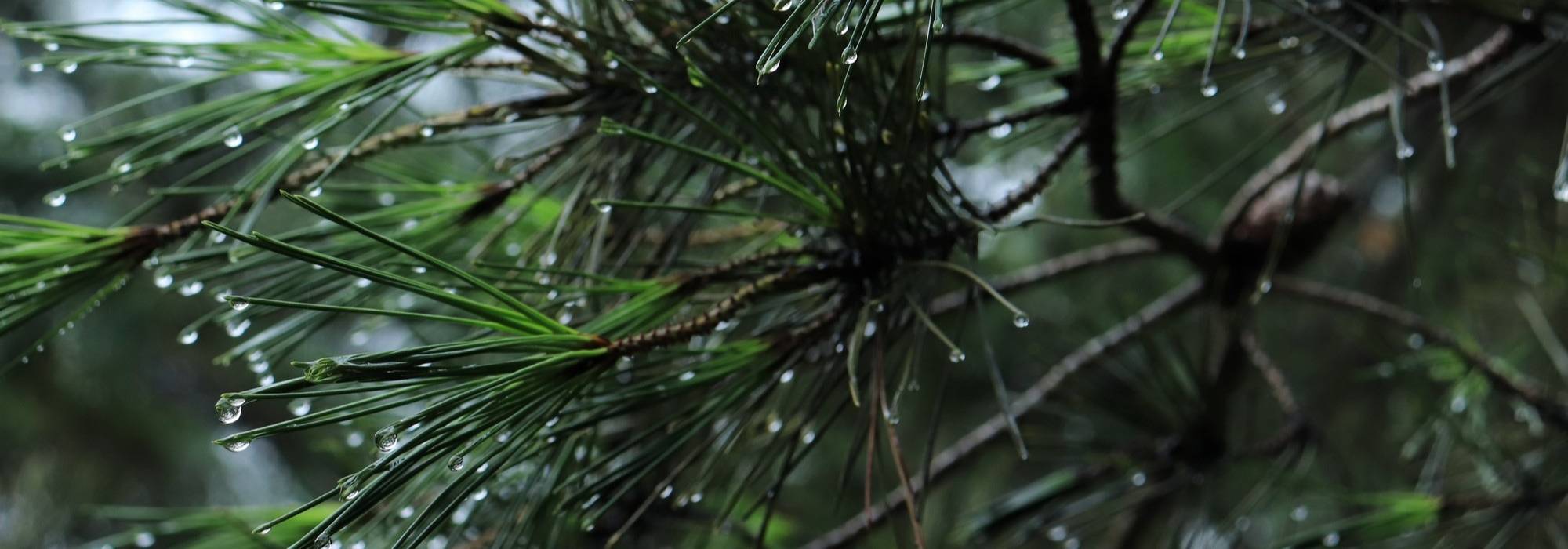
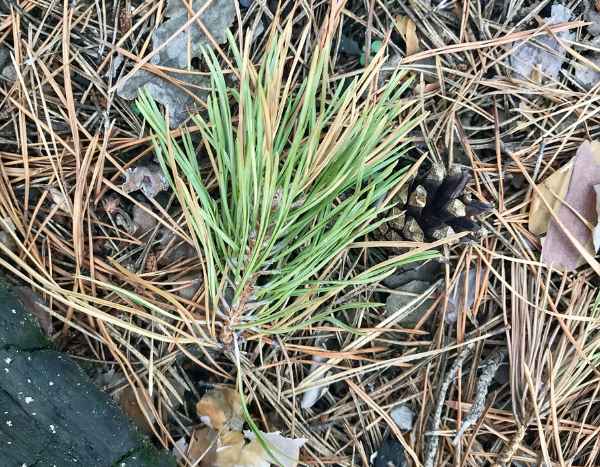
Still little known, the 'Azumi Goye' variety, derived from this species, stands out for its modest size and its particular conical habit, which can be further accentuated by autumn pruning. Its growth is slow, so at maturity, it will not exceed 3 to 4 m (10 to 13ft) in height and 2 m (7ft) in width. Its branches are rigid and ascending, covered with a dark brown bark and with short and slightly twisted needles, which measure from 4 to 6 cm (2in) long. These are even shorter when the pine is grown as bonsai. They are grouped in fives and arranged in dense clusters along the branches. Their glaucous grey-blue appearance is due to the presence of blue and silver lines on a dark green background. The bark of this small tree peels off in scaly patches over time.
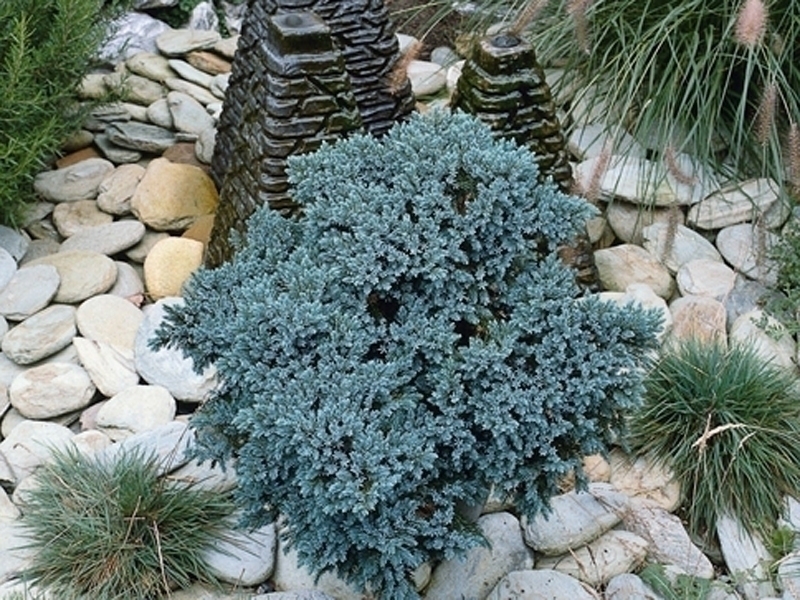
The Japanese white pine 'Azumi Goye' will find its place in all gardens, as its Japanese origins do not prevent it from thriving in very different climates. In small spaces, it will stand out when grown as a specimen, especially when shaped by pruning. It will also bring splendor to a rock garden or a flower bed. Of course, it will make a magnificent feature that will enhance a balcony or patio, and will work wonders in a Japanese garden. It pairs well with large stones, the geometric lines of swimming pools, architectural walls. It can be associated with complementary grasses or with dwarf conifers with a prostrate habit (Juniperus horizontalis Blue Chip) or a globose habit (Picea abies Little Gem). The true geometric qualities of conifers naturally work well in the design of a contemporary garden, which prefers the aesthetics of shapes, silhouettes, and textures over many flowers. These plants, with their reassuring permanence, can structure a flower bed for a long time, mark paths, and line a terrace, easily substituting pruned boxwood or holly. The key is to play with volumes and colours.
Pinus parviflora Azumi Goye - Japanese White Pine in pictures


Plant habit
Foliage
Botanical data
Pinus
parviflora
Azumi Goye
Pinaceae
Japanese White Pine, Five-needle Pine, East Asian White Pine
Cultivar or hybrid
Planting and care
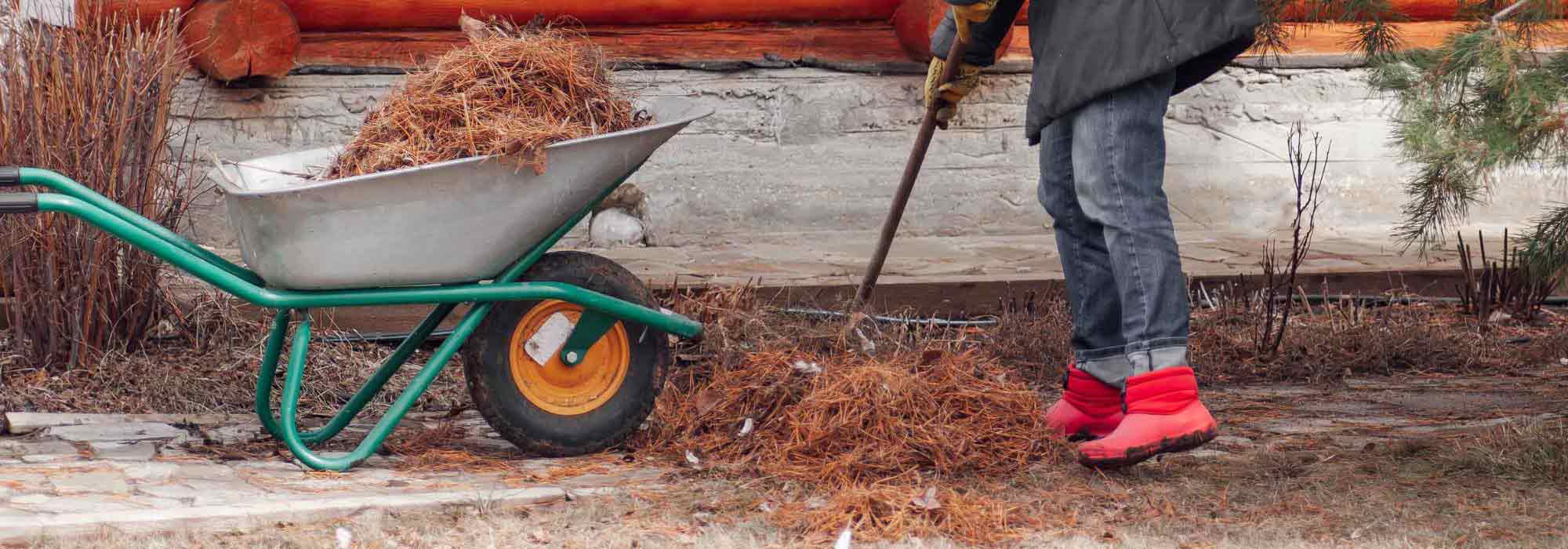
Pinus parviflora 'Azumi Goye' is planted from September to November and from February to June in ordinary, well drained soil, even poor clay or limestone. Choose a sunny position or partially shade in hot climates, as this small tree is sensitive to hot and humid weather. Soak the roots well before planting. Add organic matter at planting and water generously for the first two years, and in case of prolonged drought. Apply a special conifer fertilizer every year in April and cultivate the soil in summer. This very hardy conifer ,tolerating temperatures as low as -20°C (1°F), is not afraid of wind, but it dislikes waterlogged soils in winter. To shape the habit of this conifer, an annual pruning can be carried out from September to November, by shortening the shoots that are considered unsightly, to achieve the desired shape over the years.
Planting period
Intended location
Care
Planting & care advice
-
-

-
-
-
-

-
-
-
, onOrder confirmed
Reply from on Promesse de fleurs
Recently viewed products
Haven't found what you were looking for?
Hardiness is the lowest winter temperature a plant can endure without suffering serious damage or even dying. However, hardiness is affected by location (a sheltered area, such as a patio), protection (winter cover) and soil type (hardiness is improved by well-drained soil).

The flowering period indicated on our website applies to countries and regions located in USDA zone 8 (France, the United Kingdom, Ireland, the Netherlands, etc.)
It will vary according to where you live:- In zones 9 to 10 (Italy, Spain, Greece, etc.), flowering will occur about 2 to 4 weeks earlier.
- In zones 6 to 7 (Germany, Poland, Slovenia, and lower mountainous regions), flowering will be delayed by 2 to 3 weeks.
- In zone 5 (Central Europe, Scandinavia), blooming will be delayed by 3 to 5 weeks.
In temperate climates, pruning of spring-flowering shrubs (forsythia, spireas, etc.) should be done just after flowering.
Pruning of summer-flowering shrubs (Indian Lilac, Perovskia, etc.) can be done in winter or spring.
In cold regions as well as with frost-sensitive plants, avoid pruning too early when severe frosts may still occur.
The planting period indicated on our website applies to countries and regions located in USDA zone 8 (France, United Kingdom, Ireland, Netherlands).
It will vary according to where you live:
- In Mediterranean zones (Marseille, Madrid, Milan, etc.), autumn and winter are the best planting periods.
- In continental zones (Strasbourg, Munich, Vienna, etc.), delay planting by 2 to 3 weeks in spring and bring it forward by 2 to 4 weeks in autumn.
- In mountainous regions (the Alps, Pyrenees, Carpathians, etc.), it is best to plant in late spring (May-June) or late summer (August-September).
The harvesting period indicated on our website applies to countries and regions in USDA zone 8 (France, England, Ireland, the Netherlands).
In colder areas (Scandinavia, Poland, Austria...) fruit and vegetable harvests are likely to be delayed by 3-4 weeks.
In warmer areas (Italy, Spain, Greece, etc.), harvesting will probably take place earlier, depending on weather conditions.
The sowing periods indicated on our website apply to countries and regions within USDA Zone 8 (France, UK, Ireland, Netherlands).
In colder areas (Scandinavia, Poland, Austria...), delay any outdoor sowing by 3-4 weeks, or sow under glass.
In warmer climes (Italy, Spain, Greece, etc.), bring outdoor sowing forward by a few weeks.
Shipping country and language
Your country of residence may be:
Your country of residence is:
For a better user experience on our website, you can select:
Your shipping country:
-
 Austria
-
 Belgium
-
 Bosnia & Herzegovina
-
 Bulgaria
-
 Croatia
-
 Cyprus
-
 Czechia
-
 Denmark
-
 Estonia
-
 Finland
-
 France
-
 Germany
-
 Greece
-
 Hungary
-
 Iceland
-
 Ireland
-
 Italy
Italy
-
 Latvia
-
 Liechtenstein
-
 Lithuania
-
 Luxembourg
-
 Malta
Malta
-
 Netherlands
-
 Poland
-
 Portugal
-
 Romania
-
 Serbia
-
 Slovakia
-
 Slovenia
-
 Spain
Spain
-
 Sweden
-
 Switzerland
Language:
-
French
-
 English
-
Spanish
-
Italian
-
German
-
Portuguese
-
Dutch
-
Finnish
My Account
Hello
My wish lists
My cart
Log in / Register
Existing customer?
This form is protected by reCAPTCHA - the Google Privacy Policy and Terms of Service apply.
New customer?
Create an account to track your orders, access our customer service and, if you wish, make the most of our upcoming offers.