
Erica x darleyensis Winter Belles Katia - Winter Heath
Erica x darleyensis Winter Belles Katia - Winter Heath
Erica x darleyensis Winter Belles Katia
Winter Heath
Beautiful heather with already lots of flowers to come... happy with my order.
Isabelle, 02/10/2025
Back-to-school special offer!
Get €10 off for every €50 you spend! And get up to €40 off on a single order.
How does it work?
1. Shop your favourites
Add your favourite plants to your basket. For every €50 you spend (excluding delivery charges, store credit and the plastic-free option), you’ll receive a €10 voucher.
€50 spent = €10 voucher
€100 spent = €20 voucher
€150 spent = €30 voucher
€200 spent = €40 voucher
2. Place your order
Once your basket reaches one of the spending thresholds, place your order. You can even choose your delivery date!
3. Receive your voucher
As soon as your order has been shipped, you’ll receive an email containing your personal voucher code and its value.
4. Use it on your next order
Your voucher is valid for 90 days from the date you receive it. It can be used once only, on a new order worth at least the value of the voucher, excluding delivery charges.
Please note: Vouchers can be combined with other offers, but cannot be split or refunded.
Home or relay delivery (depending on size and destination)
Important: You may be charged customs duties by your country’s customs authorities upon delivery.
Schedule delivery date,
and select date in basket
This plant carries a 24 months recovery warranty
More information
We guarantee the quality of our plants for a full growing cycle, and will replace at our expense any plant that fails to recover under normal climatic and planting conditions.

Would this plant suit my garden?
Set up your Plantfit profile →
Description
Winter heath Erica x darleyensis Winter Belles® 'Katia' is a remarkable hybrid horticultural variety, notable for its flowers, which are larger than those of the classic species. This compact shrub forms a 50 cm mound in height and spread, with evergreen foliage in a medium to dark green. This foliage provides the perfect backdrop for the bright white flowers, which bloom from November to March. Very hardy and thriving in sun, this heather will also appreciate light shade in hot climates. It prefers neutral to acidic soils, although it tolerates a little lime. A fairly rich, moisture-retentive soil with plenty of organic matter, while remaining well drained, will suit it perfectly.
Heathers (a general term covering the genera Erica, Calluna and Daboecia) belong to the Ericaceae family, which is rich in ornamental plants, including popular genera such as Rhododendrons, as well as lesser-known plants such as Zenobia, or dusty zenobia, also known as the lily-of-the-valley tree. Within the heathers, the single genus Erica already includes more than 800 species, distributed mainly across Africa and Europe. As indicated by the "x", Erica x darleyensis is an interspecific hybrid. Its parents are Erica carnea, snow heather, native to the Alps and other European mountains, and Erica erigena, or Irish heath, originating from Ireland and other parts of western Europe. Several dozen cultivars of E. x darleyensis are known. They have inherited a long winter flowering period, evergreen foliage, good resistance to cold and a wide diversity of flower colours.
Erica x darleyensis Winter Belles® 'Katia' is a selection made by the Swiss grower Henri Brégeon in 2005. It is an improvement on the famous 'Silberschmelze', a highly regarded and much older variety, having been introduced to the market shortly before the Second World War. Part of the Winter Belles horticultural range, which includes four varieties in 2026, 'Katia' is the white-flowered selection in the group. This moderately growing plant gradually forms a rounded to irregular cushion, reaching 40 to 50 cm in height, with a spread of 50 to 60 cm. Very dense, it develops numerous upright branches bearing small, narrow leaves that are lanceolate to needle-shaped, usually measuring just 3 to 10 mm in length. They are fairly dark in colour and evergreen, making this an attractive plant all year round, and particularly valuable in winter displays because of its flowering. Flowering generally begins around the start of November and continues until March, or from December to April depending on the region. The heather then produces clusters 3 to 10 cm long, made up of bell-shaped flowers. Measuring approximately 8 mm in length, the corollas, formed of fused petals, open slightly at the tip, revealing a cluster of brown stamens from which the white pistil protrudes. This contrast with the immaculate white of the corolla further enhances the beauty of these flowers, produced abundantly throughout the winter.
Winter heath 'Katia' is invaluable in the garden for bringing it to life in midwinter, when flowering is scarce. Nectar-rich, it also helps pollinating insects, which can feed on it during fine weather when they are active. This excellent groundcover can be planted in a not-too-dry rockery, along a border or as part of a winter-interest bed. Plant it alongside dwarf conifers, focusing on contrasts in foliage. The Thuja occidentalis 'Fire Chief', with its rounded habit and colour changing from yellow to green and then coppery red, will allow you to create superb contrasts. Also make use of ornamental bark by planting your heather at the foot of birches such as the magnificent Betula utilis var. jacquemontii 'Doorenbos', whose bright white bark will combine beautifully with 'Katia's flowers while contrasting with its foliage. Finally, scatter a few bulbs throughout your bed, such as those of Narcissus poeticus Actaea, whose white flowers with yellow-orange central cups will take over from those of your heather.

Erica x darleyensis Winter Belles Katia - Winter Heath in pictures
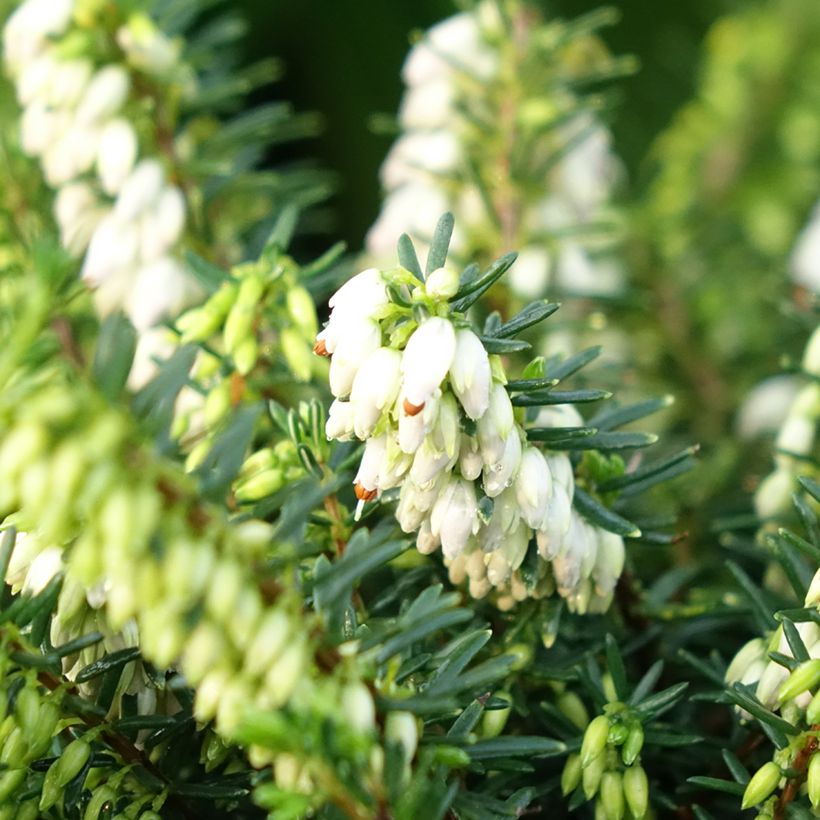

Plant habit
Flowering
Foliage
Botanical data
Erica
x darleyensis
Winter Belles Katia
Ericaceae
Winter Heath
Cultivar or hybrid
Planting and care
Erica Winter Belles Katia prefers full sun in soil with a good supply of organic matter. The soil should remain moist but well drained, as it dislikes both drought and waterlogging. It grows in neutral to acidic soils, although it tolerates a little chalk, mainly in alkaline soils with little active lime. In hot, sunny regions of southern France, place it in the light shade of taller plants. Water your heather once or twice a week, depending on the ambient temperature. Once well established, it can tolerate short dry spells, but it still prefers moist conditions. Each year after flowering, cut back the faded shoots to 2 cm from the previous year's growth. Erica can be affected by phytophthora (root rot), phythium and rhizoctonia during hot, damp periods.
Planting period
Intended location
Care
Planting & care advice

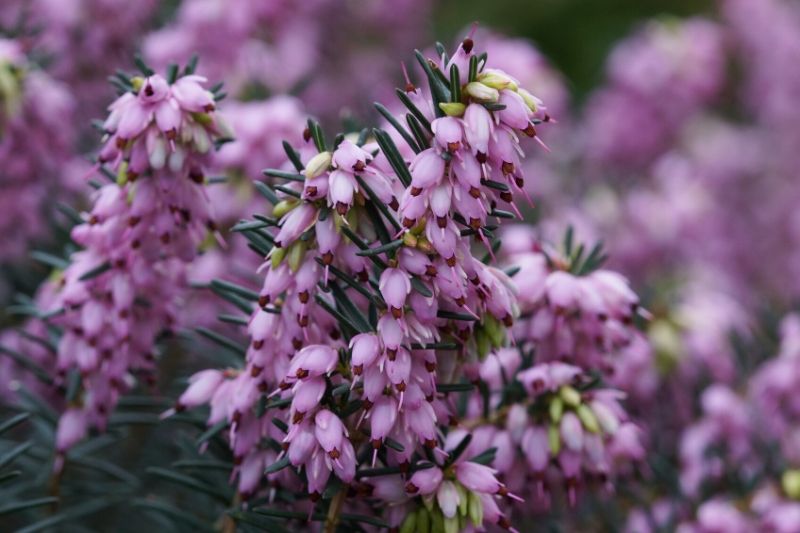
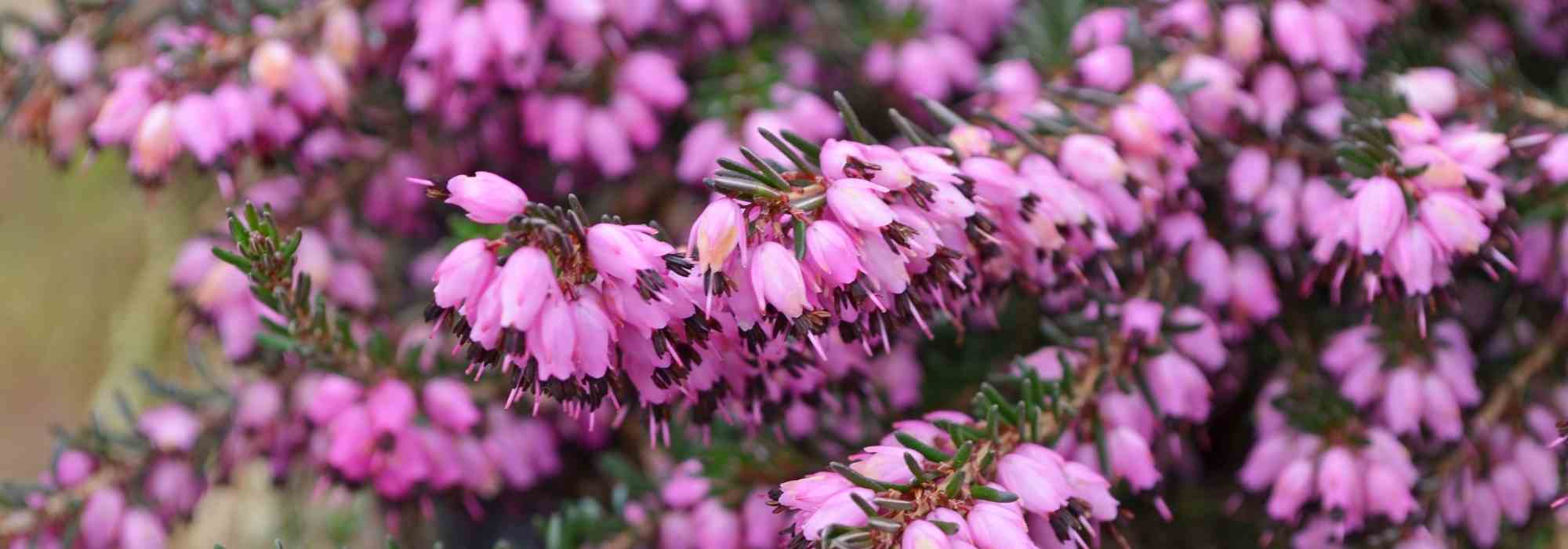





-
, onOrder confirmed
Reply from on Promesse de fleurs
Recently viewed products
Haven't found what you were looking for?
Hardiness is the lowest winter temperature a plant can endure without suffering serious damage or even dying. However, hardiness is affected by location (a sheltered area, such as a patio), protection (winter cover) and soil type (hardiness is improved by well-drained soil).

The flowering period indicated on our website applies to countries and regions located in USDA zone 8 (France, the United Kingdom, Ireland, the Netherlands, etc.)
It will vary according to where you live:- In zones 9 to 10 (Italy, Spain, Greece, etc.), flowering will occur about 2 to 4 weeks earlier.
- In zones 6 to 7 (Germany, Poland, Slovenia, and lower mountainous regions), flowering will be delayed by 2 to 3 weeks.
- In zone 5 (Central Europe, Scandinavia), blooming will be delayed by 3 to 5 weeks.
In temperate climates, pruning of spring-flowering shrubs (forsythia, spireas, etc.) should be done just after flowering.
Pruning of summer-flowering shrubs (Indian Lilac, Perovskia, etc.) can be done in winter or spring.
In cold regions as well as with frost-sensitive plants, avoid pruning too early when severe frosts may still occur.
The planting period indicated on our website applies to countries and regions located in USDA zone 8 (France, United Kingdom, Ireland, Netherlands).
It will vary according to where you live:
- In Mediterranean zones (Marseille, Madrid, Milan, etc.), autumn and winter are the best planting periods.
- In continental zones (Strasbourg, Munich, Vienna, etc.), delay planting by 2 to 3 weeks in spring and bring it forward by 2 to 4 weeks in autumn.
- In mountainous regions (the Alps, Pyrenees, Carpathians, etc.), it is best to plant in late spring (May-June) or late summer (August-September).
The harvesting period indicated on our website applies to countries and regions in USDA zone 8 (France, England, Ireland, the Netherlands).
In colder areas (Scandinavia, Poland, Austria...) fruit and vegetable harvests are likely to be delayed by 3-4 weeks.
In warmer areas (Italy, Spain, Greece, etc.), harvesting will probably take place earlier, depending on weather conditions.
The sowing periods indicated on our website apply to countries and regions within USDA Zone 8 (France, UK, Ireland, Netherlands).
In colder areas (Scandinavia, Poland, Austria...), delay any outdoor sowing by 3-4 weeks, or sow under glass.
In warmer climes (Italy, Spain, Greece, etc.), bring outdoor sowing forward by a few weeks.
Shipping country and language
Your country of residence may be:
Your country of residence is:
For a better user experience on our website, you can select:
Your shipping country:
-
 Austria
-
 Belgium
-
 Bosnia & Herzegovina
-
 Bulgaria
-
 Croatia
-
 Cyprus
-
 Czechia
-
 Denmark
-
 Estonia
-
 Finland
-
 France
-
 Germany
-
 Greece
-
 Hungary
-
 Iceland
-
 Ireland
-
 Italy
Italy
-
 Latvia
-
 Liechtenstein
-
 Lithuania
-
 Luxembourg
-
 Malta
Malta
-
 Netherlands
-
 Poland
-
 Portugal
-
 Romania
-
 Serbia
-
 Slovakia
-
 Slovenia
-
 Spain
Spain
-
 Sweden
-
 Switzerland
Language:
-
French
-
 English
-
Spanish
-
Italian
-
German
-
Portuguese
-
Dutch
-
Finnish
My Account
Hello
My wish lists
My cart
Log in / Register
Existing customer?
This form is protected by reCAPTCHA - the Google Privacy Policy and Terms of Service apply.
New customer?
Create an account to track your orders, access our customer service and, if you wish, make the most of our upcoming offers.