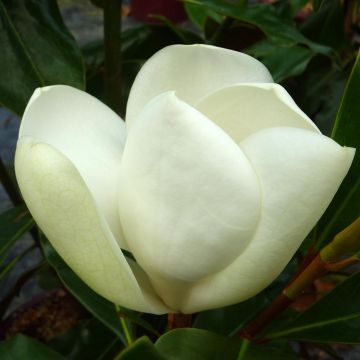
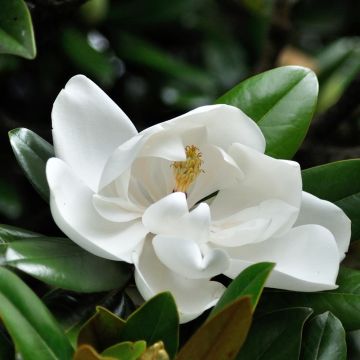


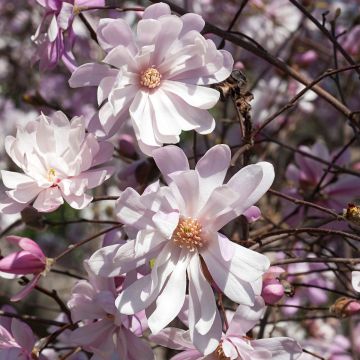

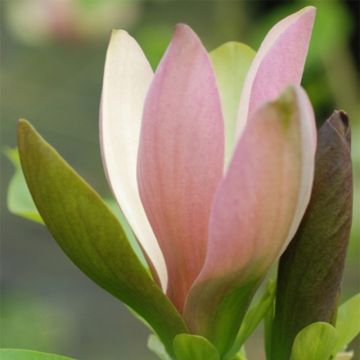
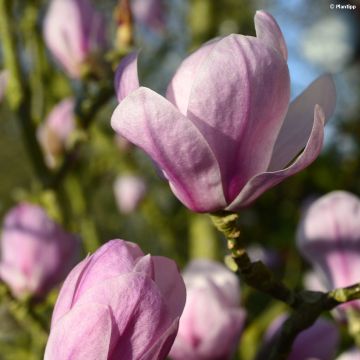
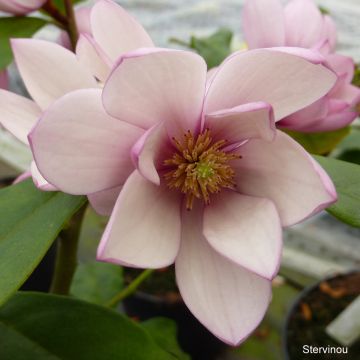

Magnolia ‘Longblomma’ belongs to the Magnoliaceae family. This hybrid cultivar is a recent selection whose parentage is unknown. Its appearance and behaviour suggest a relationship with Magnolia × soulangeana and M. liliflora 'Nigra'.
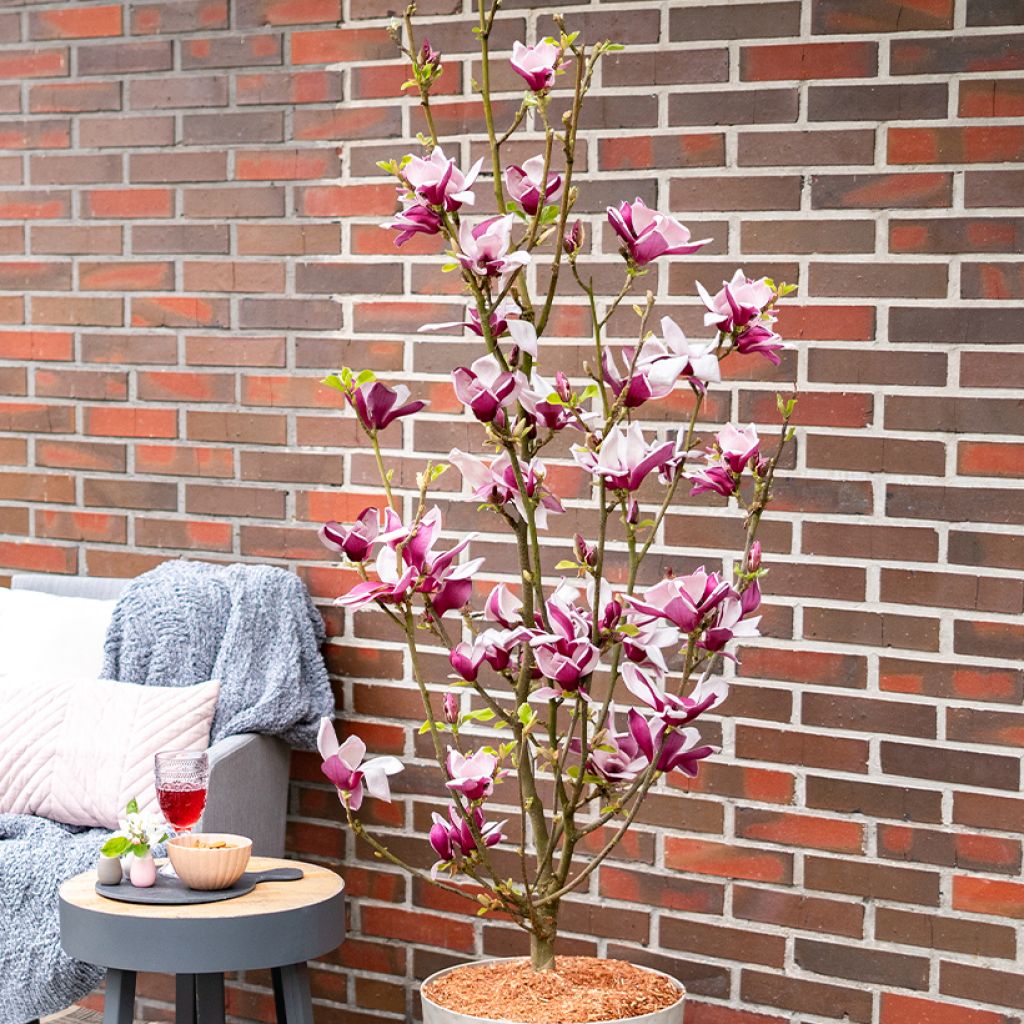
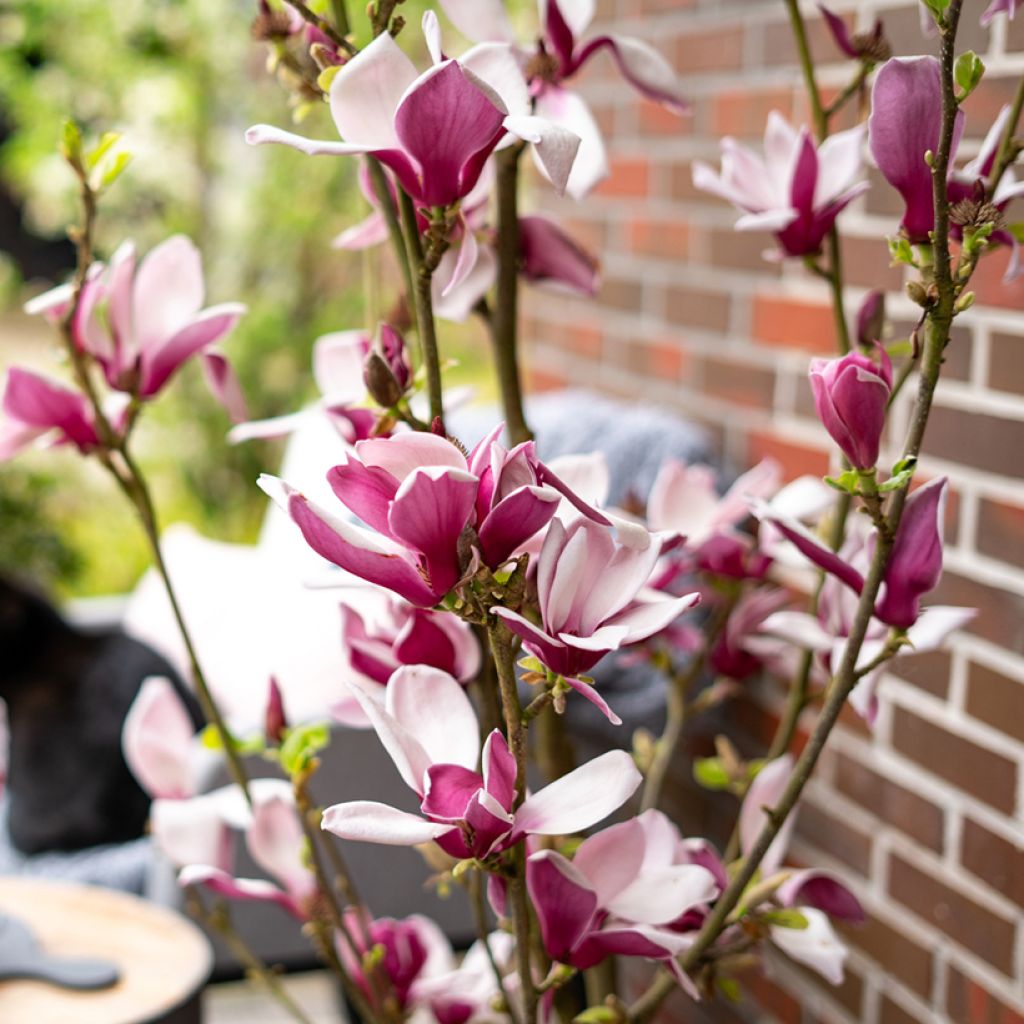
‘Longblomma’ has a slender, narrow habit, the shrub reaches about 3m in height and 1.50m in spread at maturity in open ground. Its growth is moderate, its silhouette naturally balanced. The large, solitary flowers are tulip-shaped, composed of 6 to 9 tepals of a dark purplish pink. Each flower measures 8-10 cm in diameter. The deciduous foliage consists of simple, alternate leaves with entire margins, measuring between 10 and 15cm long. They appear after the first flowering. They are bright green throughout the season, and then they fall in autumn. The branches are erect and slender, covered with smooth, greyish bark.
Magnolia Longblomma
Magnolia Longblomma
Magnolia Longblomma
Magnolia Longblomma
Back-to-school special offer!
Get €10 off for every €50 you spend! And get up to €40 off on a single order.
How does it work?
1. Shop your favourites
Add your favourite plants to your basket. For every €50 you spend (excluding delivery charges, store credit and the plastic-free option), you’ll receive a €10 voucher.
€50 spent = €10 voucher
€100 spent = €20 voucher
€150 spent = €30 voucher
€200 spent = €40 voucher
2. Place your order
Once your basket reaches one of the spending thresholds, place your order. You can even choose your delivery date!
3. Receive your voucher
As soon as your order has been shipped, you’ll receive an email containing your personal voucher code and its value.
4. Use it on your next order
Your voucher is valid for 90 days from the date you receive it. It can be used once only, on a new order worth at least the value of the voucher, excluding delivery charges.
Please note: Vouchers can be combined with other offers, but cannot be split or refunded.
Why not try an alternative variety in stock?
View all →Available in 1 sizes
Available in 1 sizes
Available in 2 sizes
Available in 1 sizes
Available in 3 sizes
Available in 2 sizes
Available in 2 sizes
Available in 2 sizes
Available in 1 sizes
Available in 1 sizes
This plant carries a 24 months recovery warranty
More information
We guarantee the quality of our plants for a full growing cycle, and will replace at our expense any plant that fails to recover under normal climatic and planting conditions.
Would this plant suit my garden?
Set up your Plantfit profile →
Description
Magnolia ‘Longblomma’ is a quite fantastic cultivar which flowers from March to November. This deciduous shrub produces very beautiful tulip-shaped flowers in a deep purplish pink. They first appear on the bare branches in late winter, then return in waves until the end of the season. Compact, elegant, and upright, it easily finds a place in gardens of all sizes and adapts very well to container growing.
Magnolia ‘Longblomma’ is an excellent choice for a small garden or a large terrace. As a specimen, in the centre of a lawn or in a large container, this shrub is decorative from spring through to autumn. It can also be integrated into a bed of acid-loving shrubs with complementary flowering. It can be associated with large Rhododendrons, wild Camellias or large hydrangeas such as Hydrangea aspera 'Bellevue', for example. It also finds a place in a Japanese garden style, mixed with maples, Fothergilla or sweetshrub (Calycanthus).
Magnolias are ancient trees with fossils dating back over 20 million years. Their magnificent flowering is considered one of the most primitive: their flowers are, from an evolutionary standpoint, close to the first existing flowers. Magnolia bark has medicinal properties and is used in cosmetics. Their wood is considered precious.

Magnolia Longblomma in pictures
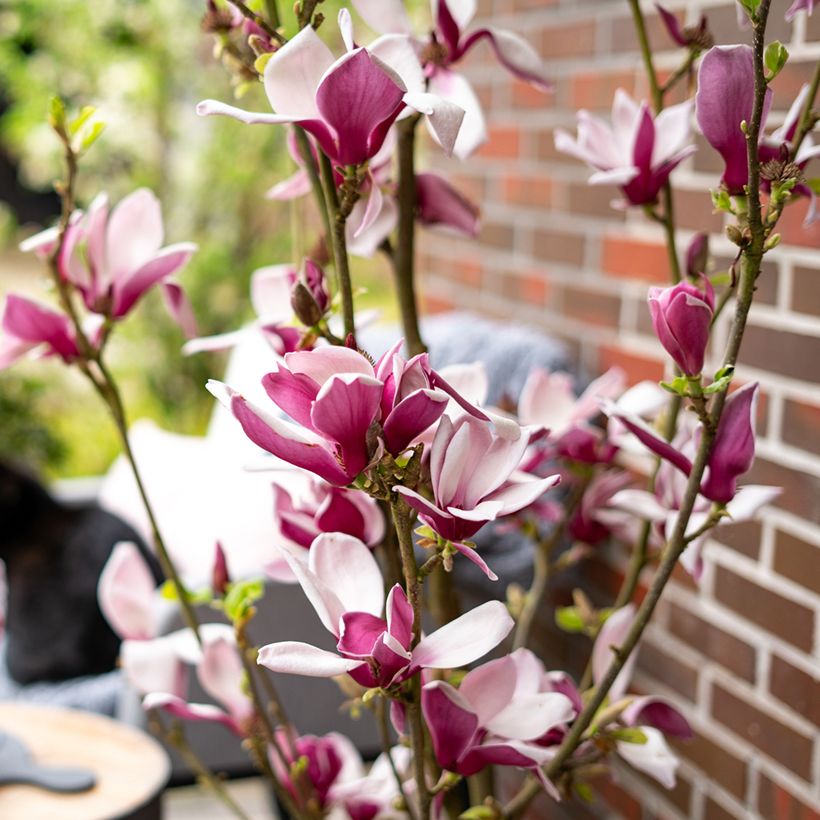
Plant habit
Flowering
Foliage
Botanical data
Magnolia
Longblomma
Magnoliaceae
Cultivar or hybrid
Planting and care
Magnolia 'Longblomma' prefers sheltered positions, sunny to partially shaded exposures, moist, well-drained, rich soil with low lime content, either neutral or acid. It dislikes both overly dry and overly wet soils, as well as windy positions and root competition, because its root system is shallow. It is fairly hardy (down to -20°C); it is nevertheless advisable to protect young specimens from frost for the first few years after planting. Note that late frosts and cold winds can damage flower buds and young leaves.
Magnolia can be planted in spring or autumn, outside frost periods. Prepare a hole 80cm square and equally deep, with a generous addition of ericaceous soil and compost. Take care to handle it gently when placing it in the hole, to avoid breaking the roots, which are fleshy but rather delicate. Immediate watering, with non-lime water if possible (rainwater), helps settle the soil around the roots. During the first year after planting, Magnolia needs one watering can per week. It will appreciate a fertiliser application once a year in spring. It is recommended to mulch its base to retain moisture, enrich the soil, and protect it from cold in winter. As its roots are fragile, transplanting should be avoided. The only enemies of the Magnolia are pests such as scale insects, snails and slugs which attack young plants, and cryptogamous diseases like root rot (in overly waterlogged soil), coral spot and Pestalozzia. Magnolias are ornamental trees that tolerate air pollution well.
Planting period
Intended location
Care
Planting & care advice
-

-

-
-

-

-
-
-

This item has not been reviewed yet - be the first to leave a review about it.
Recently viewed products
Haven't found what you were looking for?
Hardiness is the lowest winter temperature a plant can endure without suffering serious damage or even dying. However, hardiness is affected by location (a sheltered area, such as a patio), protection (winter cover) and soil type (hardiness is improved by well-drained soil).

The flowering period indicated on our website applies to countries and regions located in USDA zone 8 (France, the United Kingdom, Ireland, the Netherlands, etc.)
It will vary according to where you live:- In zones 9 to 10 (Italy, Spain, Greece, etc.), flowering will occur about 2 to 4 weeks earlier.
- In zones 6 to 7 (Germany, Poland, Slovenia, and lower mountainous regions), flowering will be delayed by 2 to 3 weeks.
- In zone 5 (Central Europe, Scandinavia), blooming will be delayed by 3 to 5 weeks.
In temperate climates, pruning of spring-flowering shrubs (forsythia, spireas, etc.) should be done just after flowering.
Pruning of summer-flowering shrubs (Indian Lilac, Perovskia, etc.) can be done in winter or spring.
In cold regions as well as with frost-sensitive plants, avoid pruning too early when severe frosts may still occur.
The planting period indicated on our website applies to countries and regions located in USDA zone 8 (France, United Kingdom, Ireland, Netherlands).
It will vary according to where you live:
- In Mediterranean zones (Marseille, Madrid, Milan, etc.), autumn and winter are the best planting periods.
- In continental zones (Strasbourg, Munich, Vienna, etc.), delay planting by 2 to 3 weeks in spring and bring it forward by 2 to 4 weeks in autumn.
- In mountainous regions (the Alps, Pyrenees, Carpathians, etc.), it is best to plant in late spring (May-June) or late summer (August-September).
The harvesting period indicated on our website applies to countries and regions in USDA zone 8 (France, England, Ireland, the Netherlands).
In colder areas (Scandinavia, Poland, Austria...) fruit and vegetable harvests are likely to be delayed by 3-4 weeks.
In warmer areas (Italy, Spain, Greece, etc.), harvesting will probably take place earlier, depending on weather conditions.
The sowing periods indicated on our website apply to countries and regions within USDA Zone 8 (France, UK, Ireland, Netherlands).
In colder areas (Scandinavia, Poland, Austria...), delay any outdoor sowing by 3-4 weeks, or sow under glass.
In warmer climes (Italy, Spain, Greece, etc.), bring outdoor sowing forward by a few weeks.
Shipping country and language
Your country of residence may be:
Your country of residence is:
For a better user experience on our website, you can select:
Your shipping country:
-
 Austria
-
 Belgium
-
 Bosnia & Herzegovina
-
 Bulgaria
-
 Croatia
-
 Cyprus
-
 Czechia
-
 Denmark
-
 Estonia
-
 Finland
-
 France
-
 Germany
-
 Greece
-
 Hungary
-
 Iceland
-
 Ireland
-
 Italy
Italy
-
 Latvia
-
 Liechtenstein
-
 Lithuania
-
 Luxembourg
-
 Malta
Malta
-
 Netherlands
-
 Poland
-
 Portugal
-
 Romania
-
 Serbia
-
 Slovakia
-
 Slovenia
-
 Spain
Spain
-
 Sweden
-
 Switzerland
Language:
-
French
-
 English
-
Spanish
-
Italian
-
German
-
Portuguese
-
Dutch
-
Finnish
My Account
Hello
My wish lists
My cart
Log in / Register
Existing customer?
This form is protected by reCAPTCHA - the Google Privacy Policy and Terms of Service apply.
New customer?
Create an account to track your orders, access our customer service and, if you wish, make the most of our upcoming offers.