
Azalea mollis Demoiselles de Boutiguery Callista
Azalea mollis Demoiselles de Boutiguery Callista
Rhododendron (Azalea) x mollis Demoiselles de Boutiguery ® Callista
Chinese Azalea, Soft Rhododendron
Back-to-school special offer!
Get €10 off for every €50 you spend! And get up to €40 off on a single order.
How does it work?
1. Shop your favourites
Add your favourite plants to your basket. For every €50 you spend (excluding delivery charges, store credit and the plastic-free option), you’ll receive a €10 voucher.
€50 spent = €10 voucher
€100 spent = €20 voucher
€150 spent = €30 voucher
€200 spent = €40 voucher
2. Place your order
Once your basket reaches one of the spending thresholds, place your order. You can even choose your delivery date!
3. Receive your voucher
As soon as your order has been shipped, you’ll receive an email containing your personal voucher code and its value.
4. Use it on your next order
Your voucher is valid for 90 days from the date you receive it. It can be used once only, on a new order worth at least the value of the voucher, excluding delivery charges.
Please note: Vouchers can be combined with other offers, but cannot be split or refunded.
Why not try an alternative variety in stock?
View all →
Available in 1 sizes

Available in 1 sizes

Available in 1 sizes

Available in 1 sizes
Available in 1 sizes
Available in 1 sizes
Available in 1 sizes

Available in 1 sizes

Available in 1 sizes
Available in 1 sizes
This plant carries a 24 months recovery warranty
More information
We guarantee the quality of our plants for a full growing cycle, and will replace at our expense any plant that fails to recover under normal climatic and planting conditions.
Would this plant suit my garden?
Set up your Plantfit profile →
Description
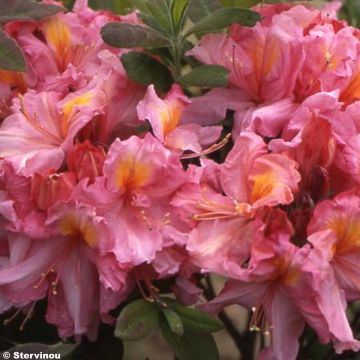
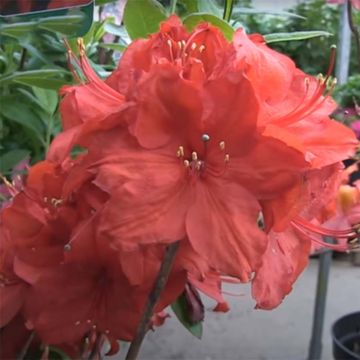
The Chinese Azalea 'Demoiselles de Boutiguery Callista' undoubtedly has some of the most beautiful spring flowers. In May, the shrub is covered with clusters of soft pink flowers with peach highlights. A French creation from a family of plant enthusiasts and nurserymen in Brittany, this Azalea is very distinctive in the garden and can also be easily grown in containers, thanks to its compact growth. Unlike Japanese Azaleas, this plant is deciduous and very hardy. Even young plants are very floriferous, so you can enjoy its beauty from very early on. It can be grown in full sun or partial shade, in moist, lime-free soil.
Azalea is a horticultural term still commonly used, but in botanical terms, they are actually Rhododendrons, whose flowers have 5 stamens instead of 10. Plants from the Ericaceae family, just like heathers, strawberry trees or blueberries, they mostly prefer lime-free, acid soil and damp climates. The deciduous Chinese Azaleas, have fewer requirements than the evergreen Japanese Azaleas: they are very hardy, tolerate the sun and heat better, and even occasionally dry soil, depending on the hybrids. Nevertheless, they will be at their best in cool climates, with distinct winters, planted in humus-rich, fertile, lime-free soil.
The 'Demoiselles de Boutiguery' series is the work of a Breton family, settled on the Domaine de Boutiguery, whose park was designed by the Bühler brothers, renowned landscape designers (they are responsible for the layout of the Tête d'Or park in Lyon, the Thabor park in Rennes and the Courson Castle park in Essonne). Christian de la Sablière and his daughter Virginie work there, constantly hybridising Rhododendrons in search of new flower colours.
'Callista' is one of their recent creations, named after the most beautiful of women. There is no doubt that it was inspired by the sumptuous blooms, which exude a certain charm. In May, clusters of flowers with large corollas of about 6 cm (2.4 in) in diameter open at the ends of the branches. A pretty soft pink varying in intensity and with darker veins, they consist of 5 star-shaped petals that overlap at the edges. The upper petal has a diffuse peach-coloured blotch, perfectly in harmony with the surrounding shades of pink, which brightens up the flower and gives it depth, just like the stamens that spring from the centre, tracing a graceful curve upwards.
Its compact habit accentuates the abundance of flowers. This Azalea measures less than a metre in height and width. The deciduous foliage is made up of simple, oval-lanceolate, smooth-edged leaves arranged alternately on the branches, ranging from 5 to 10 cm (2 to 3.9 inches) in length. The lovely, bright green colour, is a perfect backdrop for the flowers, which stand out clearly against the foliage.
Azaleas and Rhododendrons have a shallow root system that always needs to be kept moist, but they also dislike waterlogged soil which would suffocate the roots.
This Chinese Azalea 'Callista' will be the focal point of a spring border. You can plant it alongside the Rhododendron lindleyi, a botanical species with large, fragrant white flowers. Kalmia latifolia Elf, a small mountain laurel with cute little white flowers, will also be an ideal companion. It is a good idea to play with the timing of the different blooms to make your border shine throughout the season. By planting different varieties of Camellias, especially Autumn Camellias (C. sasanqua), you can easily complement the flowers of the 'Callista' Azalea. Also consider Witch Hazels, like the Hamamelis x intermedia 'Diane', which produces its spidery red flowers from December to February with brilliantly coloured foliage in autumn. In a different style, small Sarcococcas are also excellent winter-flowering shrubs.
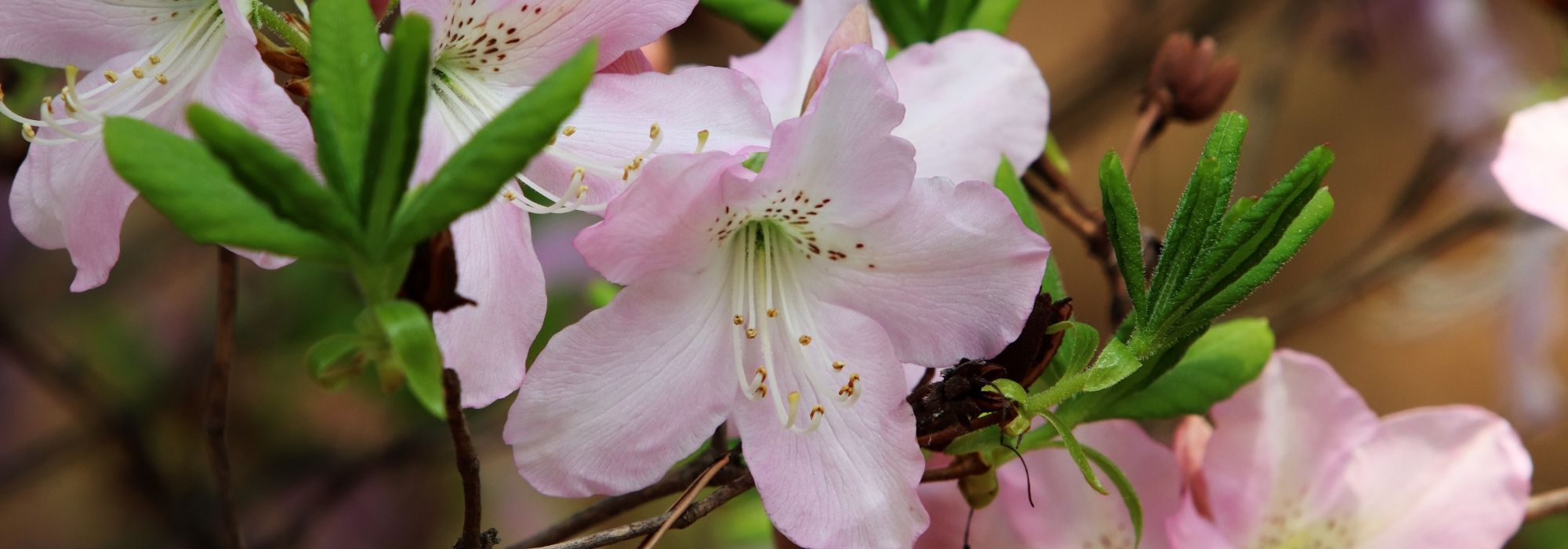
Azalea mollis Demoiselles de Boutiguery Callista in pictures

Plant habit
Flowering
Foliage
Planting and care
The Chinese Azalea Demoiselles de Boutiguery Idylla thrives a sunny location, unlike the Japanese Azalea, but its favourite position is in partial shade, or east-facing for the morning sun, especially in very sunny or hot regions. Plant it in an ericaceous or humus-rich, well-drained, lime-free soil that does not dry out in summer.
Make sure not to plant the root ball too deep, it should be level with the surface of the soil. Water copiously with alkaline-free water during dry periods, at least once a week in the first year. In spring, apply a fertilizer for ericaceous plants. Pruning is not essential but it is a good idea to prune lightly after flowering to keep the plant looking neat. Remove spent flowers to encourage new growth. The Azalea suffers from very few diseases when well-established outdoors. It can be attacked by weevils that eat the edges of the leaves and rootlets, and by the famous "Rhododendron lace bug", though not often causing significant damage. If the soil is chalky or poorly drained, or if the rootball is planted too deep, the leaves may turn yellow and eventually die.
Planting period
Intended location
Care
Planting & care advice
-

-

-

-
-

-

-
-

This item has not been reviewed yet - be the first to leave a review about it.
Recently viewed products
Haven't found what you were looking for?
Hardiness is the lowest winter temperature a plant can endure without suffering serious damage or even dying. However, hardiness is affected by location (a sheltered area, such as a patio), protection (winter cover) and soil type (hardiness is improved by well-drained soil).

The flowering period indicated on our website applies to countries and regions located in USDA zone 8 (France, the United Kingdom, Ireland, the Netherlands, etc.)
It will vary according to where you live:- In zones 9 to 10 (Italy, Spain, Greece, etc.), flowering will occur about 2 to 4 weeks earlier.
- In zones 6 to 7 (Germany, Poland, Slovenia, and lower mountainous regions), flowering will be delayed by 2 to 3 weeks.
- In zone 5 (Central Europe, Scandinavia), blooming will be delayed by 3 to 5 weeks.
In temperate climates, pruning of spring-flowering shrubs (forsythia, spireas, etc.) should be done just after flowering.
Pruning of summer-flowering shrubs (Indian Lilac, Perovskia, etc.) can be done in winter or spring.
In cold regions as well as with frost-sensitive plants, avoid pruning too early when severe frosts may still occur.
The planting period indicated on our website applies to countries and regions located in USDA zone 8 (France, United Kingdom, Ireland, Netherlands).
It will vary according to where you live:
- In Mediterranean zones (Marseille, Madrid, Milan, etc.), autumn and winter are the best planting periods.
- In continental zones (Strasbourg, Munich, Vienna, etc.), delay planting by 2 to 3 weeks in spring and bring it forward by 2 to 4 weeks in autumn.
- In mountainous regions (the Alps, Pyrenees, Carpathians, etc.), it is best to plant in late spring (May-June) or late summer (August-September).
The harvesting period indicated on our website applies to countries and regions in USDA zone 8 (France, England, Ireland, the Netherlands).
In colder areas (Scandinavia, Poland, Austria...) fruit and vegetable harvests are likely to be delayed by 3-4 weeks.
In warmer areas (Italy, Spain, Greece, etc.), harvesting will probably take place earlier, depending on weather conditions.
The sowing periods indicated on our website apply to countries and regions within USDA Zone 8 (France, UK, Ireland, Netherlands).
In colder areas (Scandinavia, Poland, Austria...), delay any outdoor sowing by 3-4 weeks, or sow under glass.
In warmer climes (Italy, Spain, Greece, etc.), bring outdoor sowing forward by a few weeks.
Shipping country and language
Your country of residence may be:
Your country of residence is:
For a better user experience on our website, you can select:
Your shipping country:
-
 Austria
-
 Belgium
-
 Bosnia & Herzegovina
-
 Bulgaria
-
 Croatia
-
 Cyprus
-
 Czechia
-
 Denmark
-
 Estonia
-
 Finland
-
 France
-
 Germany
-
 Greece
-
 Hungary
-
 Iceland
-
 Ireland
-
 Italy
Italy
-
 Latvia
-
 Liechtenstein
-
 Lithuania
-
 Luxembourg
-
 Malta
Malta
-
 Netherlands
-
 Poland
-
 Portugal
-
 Romania
-
 Serbia
-
 Slovakia
-
 Slovenia
-
 Spain
Spain
-
 Sweden
-
 Switzerland
Language:
-
French
-
 English
-
Spanish
-
Italian
-
German
-
Portuguese
-
Dutch
-
Finnish
My Account
Hello
My wish lists
My cart
Log in / Register
Existing customer?
This form is protected by reCAPTCHA - the Google Privacy Policy and Terms of Service apply.
New customer?
Create an account to track your orders, access our customer service and, if you wish, make the most of our upcoming offers.