Cookies help us to offer you a personalised browsing experience and to measure our audience. You can configure them at any time and consult our privacy policy.
This website uses cookies to improve your experience when browsing the website. Of these, cookies classified as necessary are stored on your browser because they are essential for the basic functionality of the website to work. We also use third-party cookies to help us analyse and understand how you use this website. These cookies will only be stored on your browser with your consent. You also have the option of refusing these cookies. However, deactivating some of these cookies may have an effect on your browsing experience.
Marketing
These cookies may be used by third-party companies to establish a profile of your interests and offer you relevant advertising on other websites. They do not directly store personal data but are based on the unique identification of your browser and your Internet device. Rejecting these cookies will not necessarily mean you are less targeted by advertisements, only that they will be less targeted.
Name
Description
Lifetime
Essentials
These cookies are essential for the sound operation of our site and will make it unusable if deactivated. They do not store any personal identification information.
Name
Description
Lifetime
Analysis & Performance
These cookies enable us to monitor the number of visits and the source of enquiries in order to measure and improve the performance of our site. They also help us identify the most and least visited pages in order to improve our content. The data linked to these cookies is collated and anonymised.
Would this plant suit my garden?
Set up your Plantfit profile →
Filter
Sort by:
Display
2results
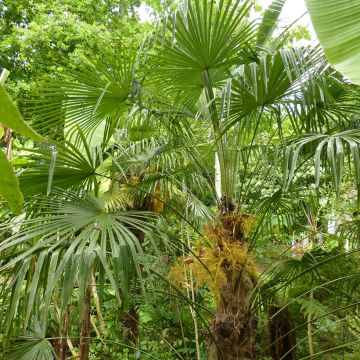
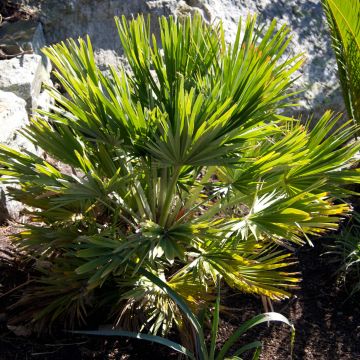
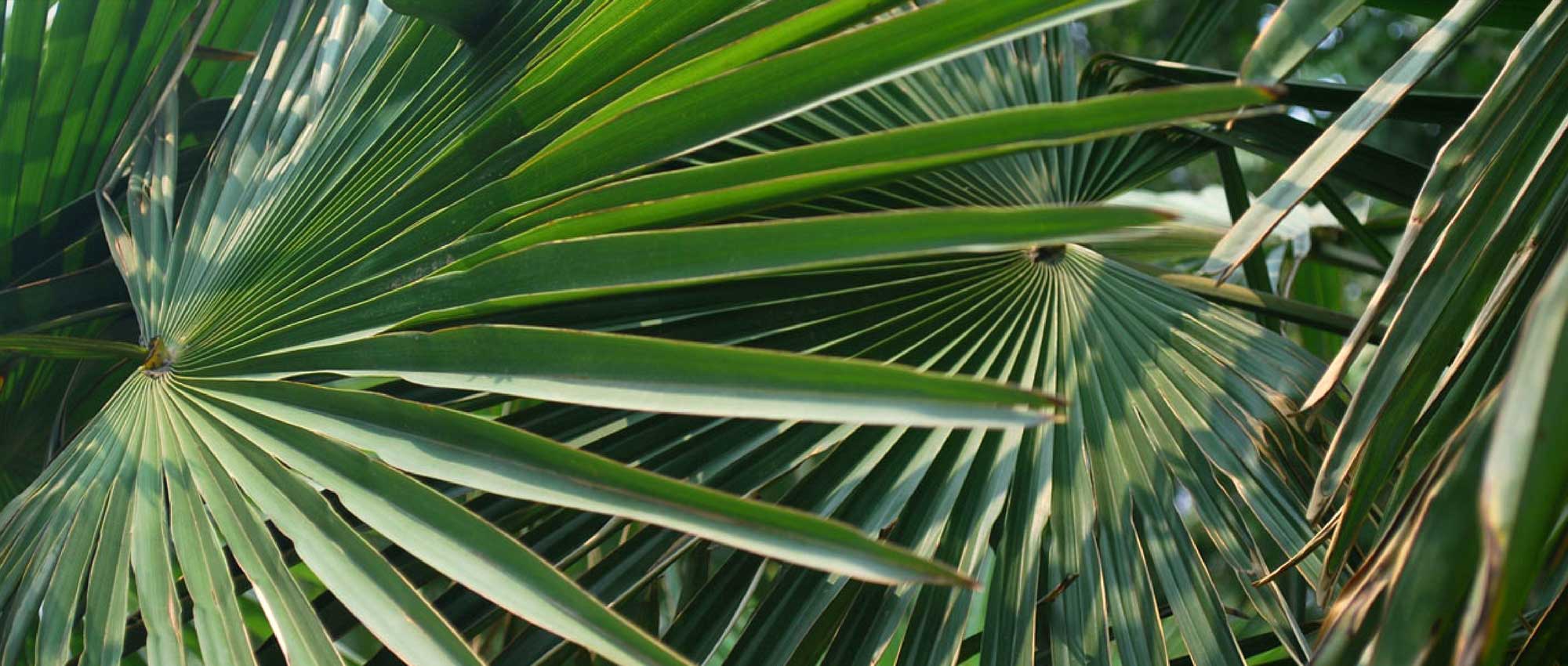
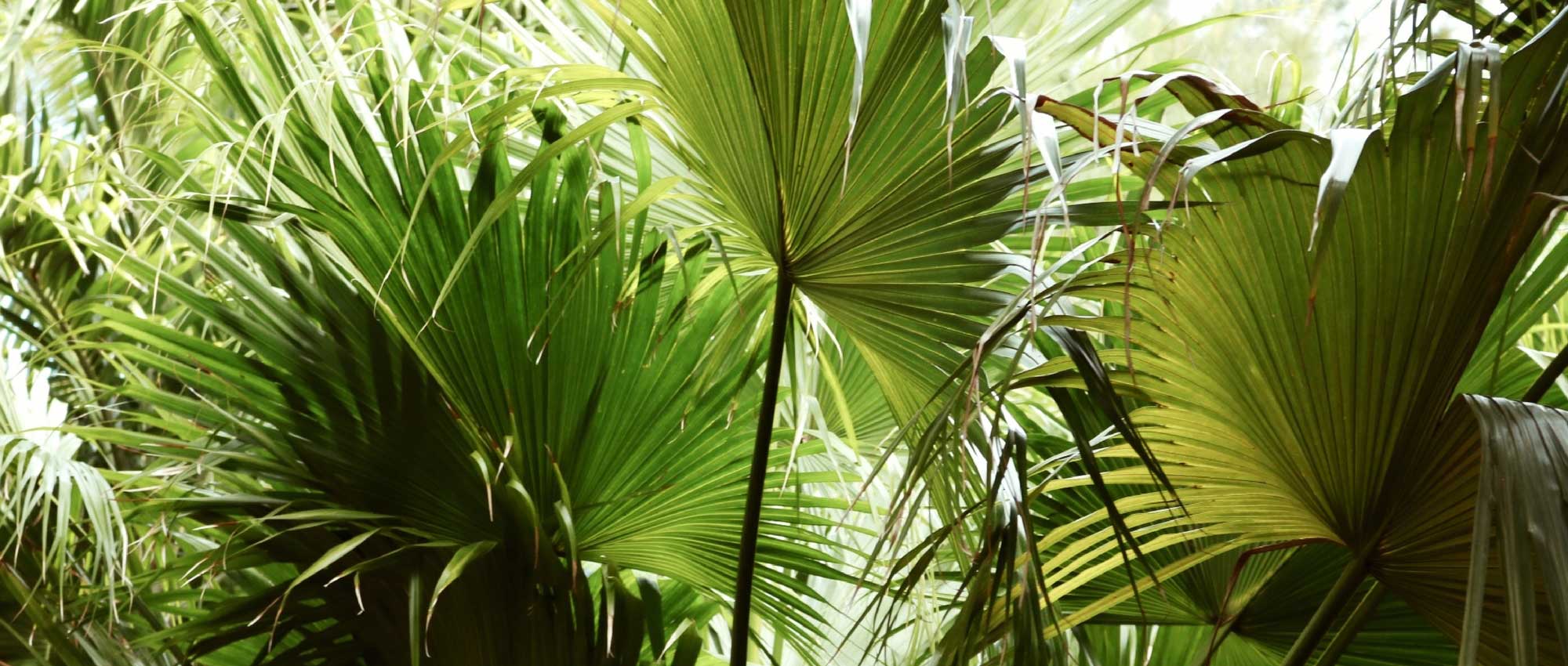
Which hardy palm tree should you choose for your garden? These plants, symbols of exoticism, belong to the family of Arecaceae, rich in more than 2500 species, among which several dozen, often originating from North America, are capable of withstanding our cold winters in open ground, even in northerly regions, as well as drought. The most well-known are called Trachycarpus, Chamaerops or Sabal. Did you know that Jubaea chilensis and the amazing Nannorrhops can withstand temperatures as low as -15°C, and that Brahea armata, a magnificent Blue Palm from Mexico, can endure -12°C? Enter the fascinating world of hardy palm trees! There is definitely one that will thrive in your garden, whether you live near the Mediterranean, on the shores of the North Sea, in the mountains, on a dry limestone plateau, in Brittany, or even in the Île-de-France region. Once you have made your choice, simply ensure that your young palm tree benefits from careful care during planting and effective winter protection during the first few years to ensure a good start.
The flowering period indicated on our website applies to countries and regions located in USDA zone 8 (France, the United Kingdom, Ireland, the Netherlands, etc.)
It will vary according to where you live:
In zones 9 to 10 (Italy, Spain, Greece, etc.), flowering will occur about 2 to 4 weeks earlier.
In zones 6 to 7 (Germany, Poland, Slovenia, and lower mountainous regions), flowering will be delayed by 2 to 3 weeks.
In zone 5 (Central Europe, Scandinavia), blooming will be delayed by 3 to 5 weeks.
In temperate climates, pruning of spring-flowering shrubs (forsythia, spireas, etc.) should be done just after flowering.
Pruning of summer-flowering shrubs (Indian Lilac, Perovskia, etc.) can be done in winter or spring.
In cold regions as well as with frost-sensitive plants, avoid pruning too early when severe frosts may still occur.
The planting period indicated on our website applies to countries and regions located in USDA zone 8 (France, United Kingdom, Ireland, Netherlands).
It will vary according to where you live:
In Mediterranean zones (Marseille, Madrid, Milan, etc.), autumn and winter are the best planting periods.
In continental zones (Strasbourg, Munich, Vienna, etc.), delay planting by 2 to 3 weeks in spring and bring it forward by 2 to 4 weeks in autumn.
In mountainous regions (the Alps, Pyrenees, Carpathians, etc.), it is best to plant in late spring (May-June) or late summer (August-September).
The harvesting period indicated on our website applies to countries and regions in USDA zone 8 (France, England, Ireland, the Netherlands).
In colder areas (Scandinavia, Poland, Austria...) fruit and vegetable harvests are likely to be delayed by 3-4 weeks.
In warmer areas (Italy, Spain, Greece, etc.), harvesting will probably take place earlier, depending on weather conditions.
The sowing periods indicated on our website apply to countries and regions within USDA Zone 8 (France, UK, Ireland, Netherlands).
In colder areas (Scandinavia, Poland, Austria...), delay any outdoor sowing by 3-4 weeks, or sow under glass.
In warmer climes (Italy, Spain, Greece, etc.), bring outdoor sowing forward by a few weeks.
Shipping country and language
Your country of residence may be:
Your country of residence is:
For a better user experience on our website, you can select: