Dahlia Yellow Perception
Dahlia Yellow Perception
Dahlia Yellow Perception
Dahlia
Back-to-school special offer!
Get €10 off for every €50 you spend! And get up to €40 off on a single order.
How does it work?
1. Shop your favourites
Add your favourite plants to your basket. For every €50 you spend (excluding delivery charges, store credit and the plastic-free option), you’ll receive a €10 voucher.
€50 spent = €10 voucher
€100 spent = €20 voucher
€150 spent = €30 voucher
€200 spent = €40 voucher
2. Place your order
Once your basket reaches one of the spending thresholds, place your order. You can even choose your delivery date!
3. Receive your voucher
As soon as your order has been shipped, you’ll receive an email containing your personal voucher code and its value.
4. Use it on your next order
Your voucher is valid for 90 days from the date you receive it. It can be used once only, on a new order worth at least the value of the voucher, excluding delivery charges.
Please note: Vouchers can be combined with other offers, but cannot be split or refunded.
This plant carries a 6 months recovery warranty
More information
We guarantee the quality of our plants for a full growing cycle, and will replace at our expense any plant that fails to recover under normal climatic and planting conditions.
Would this plant suit my garden?
Set up your Plantfit profile →
Description
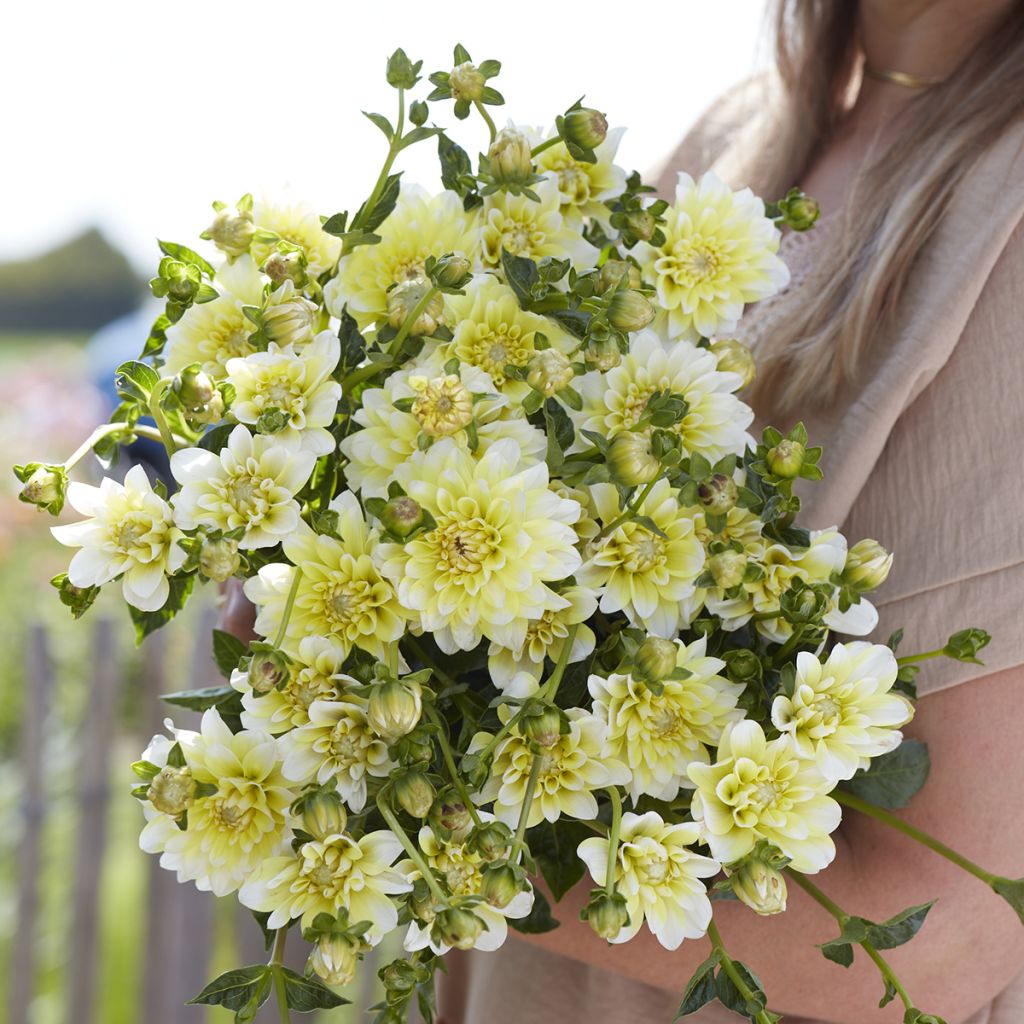
Dahlia 'Yellow Perception' is distinguished by its waterlily-like open flowers. They measure 10cm (4in) in diameter. They are pale-yellow with a darker heart, slightly tinged with green. It flowers from July to the first frosts. It is a marvel for flower beds and bouquets.
Dahlias belong to the Asteraceae family and are originally from the high plateaus of Mexico. There are currently thousands of horticultural varieties that have conquered gardens worldwide. They are tender perennials with fleshy tubers.
'Yellow Perception' is a waterlily dahlia. The inflorescences are approximately 10cm (4in) wide, composed of numerous ligules, which are broadly ovate and almost flat on the periphery and more curved towards the centre. It flowers throughout summer, bearing pale-yellow blooms enhanced with darker yellow-green heart.
Remove faded flowers to encourage new blooms. You can use cut flowers to make colourful bouquets, combining them with other varieties.
Create a bed of dahlias or plant several varieties in the vegetable garden. Combine 'Yellow Perception' with the bright yellow of Dahlia 'Kennemerland' or the purple of D. 'Arabian Night'.
Decorative dahlias go well with gauras and cleomes with their light appearance. Also consider echinaceas and perennial sunflowers like 'Lemon Queen' with their pale-yellow flowers.
Dahlias are stars of borders and ornamental gardens, confidently accompanying the most beautiful flowers. However, they are also appreciated alongside vegetable plants. In Mexico, this tuberous plant was first cultivated as a root vegetable for consumption. Its poor taste qualities quickly saw it categorised as an ornamental plant. Since then, the interest in their beautiful exuberance has never waned.
Plant habit
Flowering
Foliage
Botanical data
Dahlia
Yellow Perception
Asteraceae
Dahlia
Cultivar or hybrid
Planting and care
Plant in spring as soon as the last frost has passed. For abundant flowering, plant the tubers in full sun in rich, moist but well-drained soil. Stagnant moisture causes tuber rot. Amend the soil with compost and sand, if necessary. Work the soil deeply and enrich it, for example, with crushed horn or dehydrated blood. Place your tuber and crumble the soil well to fill without air pockets. Cover with about 6cm (2in) of soil. At the end of planting, water once abundantly and then repeat this watering regularly during the first 6 weeks to help with rooting.
Dahlias are sensitive to cold, so they need to be overwintered. Dig the tubers up when the first frost has blackened the foliage. Carefully remove the tubers. Remove as much soil as possible. Let the foliage dry so that the tubers can replenish their reserves. Then cut the stems to 10cm (4in). Spread your bulbs in a box lined with newspaper. Store them in a frost-free, dry, cool, and dark place, such as a garage or attic. In mild regions without frost, or those close to the coast, it is possible to leave them in place. In this case, simply cover the ground with a carpet of leaves or straw for protection.
Pinch the stems early (from the 3rd or 4th week after planting) to make your dahlia more compact and branched, and therefore more resistant to bad weather (wind, rain). To do this, use your nails to cut the terminal shoots just above the leaves. If you choose not to pinch out, there is always the option of staking, but the aesthetic result may not be the best.
Watch out for slugs and snails. They are very fond of these young shoots.
Planting period
Intended location
Care
Planting & care advice






This item has not been reviewed yet - be the first to leave a review about it.
Recently viewed products
Haven't found what you were looking for?
Hardiness is the lowest winter temperature a plant can endure without suffering serious damage or even dying. However, hardiness is affected by location (a sheltered area, such as a patio), protection (winter cover) and soil type (hardiness is improved by well-drained soil).

The flowering period indicated on our website applies to countries and regions located in USDA zone 8 (France, the United Kingdom, Ireland, the Netherlands, etc.)
It will vary according to where you live:- In zones 9 to 10 (Italy, Spain, Greece, etc.), flowering will occur about 2 to 4 weeks earlier.
- In zones 6 to 7 (Germany, Poland, Slovenia, and lower mountainous regions), flowering will be delayed by 2 to 3 weeks.
- In zone 5 (Central Europe, Scandinavia), blooming will be delayed by 3 to 5 weeks.
In temperate climates, pruning of spring-flowering shrubs (forsythia, spireas, etc.) should be done just after flowering.
Pruning of summer-flowering shrubs (Indian Lilac, Perovskia, etc.) can be done in winter or spring.
In cold regions as well as with frost-sensitive plants, avoid pruning too early when severe frosts may still occur.
The planting period indicated on our website applies to countries and regions located in USDA zone 8 (France, United Kingdom, Ireland, Netherlands).
It will vary according to where you live:
- In Mediterranean zones (Marseille, Madrid, Milan, etc.), autumn and winter are the best planting periods.
- In continental zones (Strasbourg, Munich, Vienna, etc.), delay planting by 2 to 3 weeks in spring and bring it forward by 2 to 4 weeks in autumn.
- In mountainous regions (the Alps, Pyrenees, Carpathians, etc.), it is best to plant in late spring (May-June) or late summer (August-September).
The harvesting period indicated on our website applies to countries and regions in USDA zone 8 (France, England, Ireland, the Netherlands).
In colder areas (Scandinavia, Poland, Austria...) fruit and vegetable harvests are likely to be delayed by 3-4 weeks.
In warmer areas (Italy, Spain, Greece, etc.), harvesting will probably take place earlier, depending on weather conditions.
The sowing periods indicated on our website apply to countries and regions within USDA Zone 8 (France, UK, Ireland, Netherlands).
In colder areas (Scandinavia, Poland, Austria...), delay any outdoor sowing by 3-4 weeks, or sow under glass.
In warmer climes (Italy, Spain, Greece, etc.), bring outdoor sowing forward by a few weeks.
Shipping country and language
Your country of residence may be:
Your country of residence is:
For a better user experience on our website, you can select:
Your shipping country:
-
 Austria
-
 Belgium
-
 Bosnia & Herzegovina
-
 Bulgaria
-
 Croatia
-
 Cyprus
-
 Czechia
-
 Denmark
-
 Estonia
-
 Finland
-
 France
-
 Germany
-
 Greece
-
 Hungary
-
 Iceland
-
 Ireland
-
 Italy
Italy
-
 Latvia
-
 Liechtenstein
-
 Lithuania
-
 Luxembourg
-
 Malta
Malta
-
 Netherlands
-
 Poland
-
 Portugal
-
 Romania
-
 Serbia
-
 Slovakia
-
 Slovenia
-
 Spain
Spain
-
 Sweden
-
 Switzerland
Language:
-
French
-
 English
-
Spanish
-
Italian
-
German
-
Portuguese
-
Dutch
-
Finnish
My Account
Hello
My wish lists
My cart
Log in / Register
Existing customer?
This form is protected by reCAPTCHA - the Google Privacy Policy and Terms of Service apply.
New customer?
Create an account to track your orders, access our customer service and, if you wish, make the most of our upcoming offers.