
































If there's one subject that raises questions and sparks passion, it's permaculture. Consider this: in France, on average, that word is typed into Google 49,500 times a month, while the term "Potager" only prompts 14,800 queries.
How to explain that enthusiasm? Is permaculture genuinely revolutionary and going to save the world? Or is it rather because the question “What is permaculture?” has a multitude of answers, more or less precise?
I must admit I'm regretting volunteering to tackle this nebulous topic this morning. But since we're here, let's dive in... 😉
Permaculture: what is it?
Ask Wikipedia and it will answer: “Permaculture is a systemic and holistic method that aims to design systems (for example human habitats and agricultural systems but it can be applied to any system) by drawing inspiration from natural ecology (biomimicry) and tradition ”
That doesn't exactly make things clearer, does it?
To keep things simple, I suggest remembering the definition used by the Ferme du Bec Hellouin, a model of the kind: permaculture, or “permanent agriculture”, is about taking inspiration from nature to meet our needs without degrading the planet.
Ethics and main principles
Ethics have an important place in permaculture and rest on three main principles defined by its founders, Bill Mollison and David Holmgren: care for earth, care for people and fair share.
The method involves viewing the garden as a whole, taking account of what already exists and of the interactions between all its elements: plants, animals, people. It aims towards autonomy by growing edible plants almost anywhere while conserving natural resources and saving time.
In practice, what does permaculture look like?
In permaculture, the range of practices is wide because thinking is in terms of systems where everything is closely linked and techniques must constantly adapt to the garden's evolution. Among the many practices, three seem essential to me:
Design
To make a permaculture system work, the design stage is vital. It organises and connects spaces, takes the dwelling into account and is based on careful observation of what already exists, of nature… It is a starting point that is not intended to freeze the garden; it will evolve as it grows and as experiments are carried out.
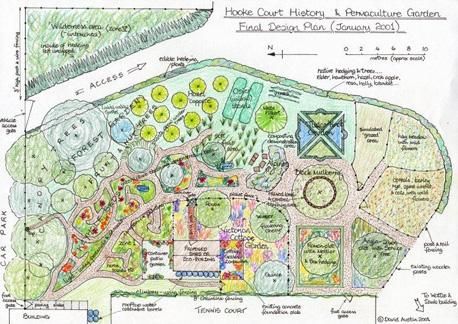
Example of design - source: permaculture.org.uk via Pinterest
Soil care
Traditional deep cultivation is almost absent in permaculture. No deep ploughing with a tractor, but special attention to the living organisms that inhabit the soil, which create humus. As in organic gardening, mulching plays a crucial role in permaculture. It reduces weeding and watering, protects the soil and maintains its fertility. The notion of waste does not really exist: everything is a resource!
Cultivation on mounds
Among the best-known techniques, the mound is emblematic (and there are many recipes: forest-style mound “fourrée”, sandwich mounds and even lasagne beds!). They are appreciated for their ergonomics and allow abundant harvests on a small surface. Reputed to be self-fertile and low-maintenance, they are durable. Once built, they no longer require soil work. Not necessarily useful everywhere, these mounds are nevertheless a godsend in degraded areas and wherever soil depth is insufficient.
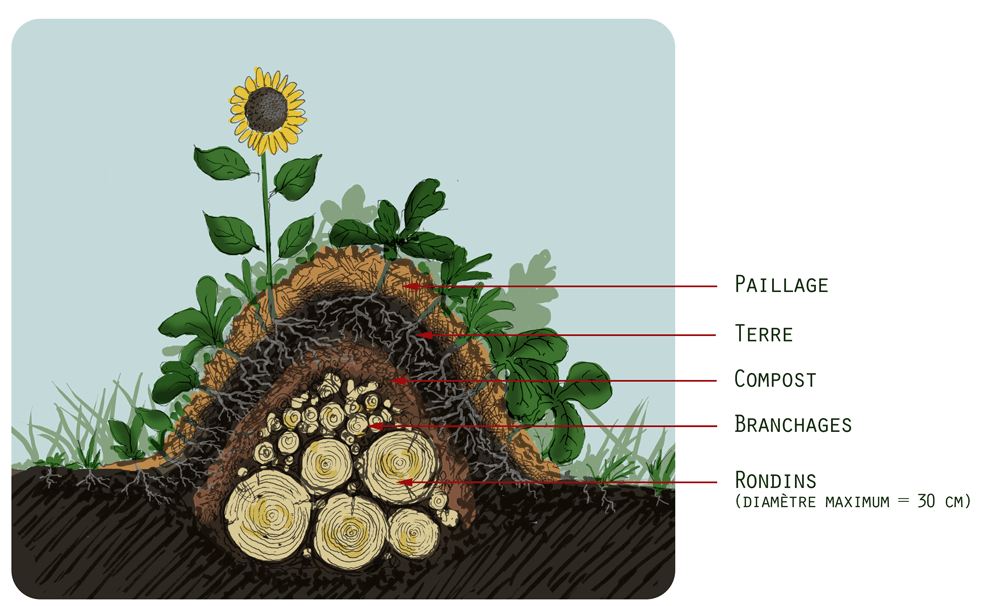
A "hugelkultur" mound model - Source: Fermes d'Avenir
Among the many examples of successful permaculture experiments, I suggest looking up the works of Joseph CHAUFFREY, who harvests nearly 300 kilos of fruit and vegetables per year in Normandy from his 150 m2 garden, of which only 25 m2 are dedicated to the vegetable patch.
Permaculture pitfalls: beware of gurus!
Far more than a gardening or market-gardening method, permaculture is sometimes presented as a philosophy and this is where problems can arise. From philosophy to religion, there is sometimes only a small step… which can be quickly crossed, bringing with it a host of occasionally fanciful, more or less open-minded positions.
Similarly, permaculture does not seem immune to supply-and-demand dynamics. While natural or organic gardening courses are rather rare, the supply of permaculture courses has literally exploded in recent years. Alongside serious centres, numerous e-book offers and online trainings of questionable quality have sprung up. And, as you might expect, this knowledge is not shared for free. Prices can easily reach several hundred euros. Don't be fooled: you don't become a permaculturist in a few hours!
I hope this has given you a brief overview of permaculture… If you have experimented with techniques or are already convinced, please share your experiences!
To find out more :
- "The Permaculture Guide for the Garden" - Carine Mayo - Editions Terre Vivante
- "Essence of Permaculture" - a summary of David Holmgren's concepts and principles (free PDF)
- "Permaculture - Heal the Earth, Feed People" by Perrine and Charles HERVE-GRUYER - Editions Actes Sud
Sites to visit, related to permaculture :

Comments