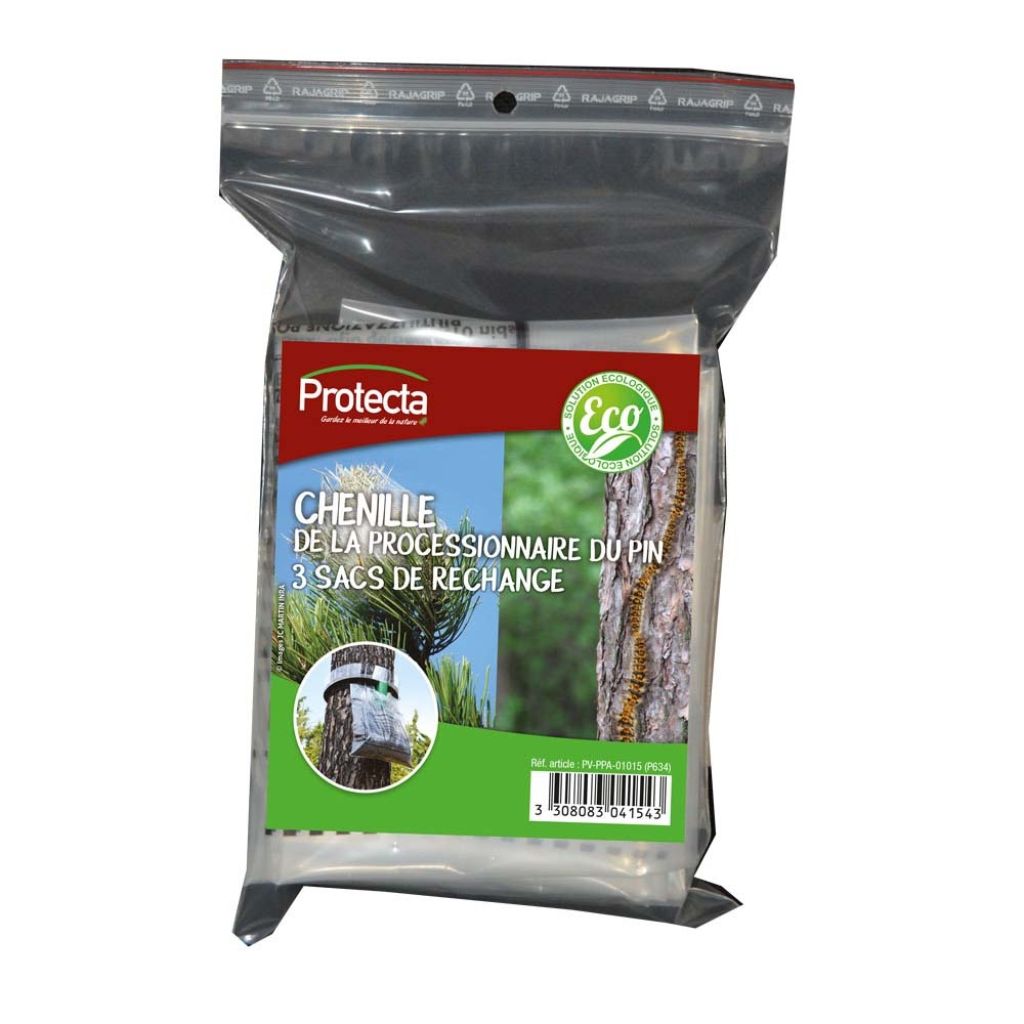
Protecta pack of 3 replacement bags for Pine Processionary Caterpillar Traps
Protecta pack of 3 replacement bags for Pine Processionary Caterpillar Traps
Back-to-school special offer!
Get €10 off for every €50 you spend! And get up to €40 off on a single order.
How does it work?
1. Shop your favourites
Add your favourite plants to your basket. For every €50 you spend (excluding delivery charges, store credit and the plastic-free option), you’ll receive a €10 voucher.
€50 spent = €10 voucher
€100 spent = €20 voucher
€150 spent = €30 voucher
€200 spent = €40 voucher
2. Place your order
Once your basket reaches one of the spending thresholds, place your order. You can even choose your delivery date!
3. Receive your voucher
As soon as your order has been shipped, you’ll receive an email containing your personal voucher code and its value.
4. Use it on your next order
Your voucher is valid for 90 days from the date you receive it. It can be used once only, on a new order worth at least the value of the voucher, excluding delivery charges.
Please note: Vouchers can be combined with other offers, but cannot be split or refunded.
Home or relay delivery (depending on size and destination)
Important: You may be charged customs duties by your country’s customs authorities upon delivery.
Schedule delivery date,
and select date in basket
We guarantee the quality of our plants for a full growing cycle, and will replace at our expense any plant that fails to recover under normal climatic and planting conditions.
A set of 3 replacement bags for the Protecta collar trap kit, an alternative control device that effectively and naturally combats the pine processionary caterpillar. Place the collection bag, where the caterpillars are trapped, beneath the chute positioned at the collar level, which blocks the caterpillars' passage during their descent.
For instructions on how to assemble your processionary caterpillar trap, you can watch the following video: https://www.youtube.com/watch?v=FbfmG6ilsEU&t=5s.
Remove the collection bag at the end of May, for destruction at the chrysalis stage. In case of heavy infestation (more than 10 nests per tree), it is advisable to install 2 collection bags/traps to avoid any risk of caterpillar overflow. When dismantling, wear gloves and a mask to avoid any irritation caused by bristles that may still be present around the trunk. Caution: stinging hairs are also very prevalent in the final nests and they can retain their urticating power for several years if kept dry.
The life cycle of the pine processionary caterpillar:
The pine processionary caterpillar is dangerous to humans and domestic animals. It is the larva of a moth whose Latin name is Thaumetopoea pityocampa, which feeds exclusively on pine needles, causing significant weakening of the trees. It is brown with orange patches and covered in hairs that secrete a fine, stinging dust to deter potential predators. Its adult form hatches during the summer, between June and September, depending on the climate. This moth is grey, with black patterns and whitish spots. Once fertilised, the female begins searching for a pine or cedar to lay her eggs. The most affected species are the Austrian black pine, Corsican laricio, Salzman pine, Monterey pine, maritime pine, Scots pine and Aleppo pine. The eggs are laid in parallel rows, their cluster forming a silvery-grey sheath covered in scales, visible on the twigs or pine needles. Hatching occurs 5 to 6 weeks after laying, releasing caterpillars that moult three times before winter. The young caterpillars weave temporary nests where they spend the day. The larvae begin to eat the pine needles, initially quite discreetly, manifesting as the yellowing of a few tufts of needles here and there. The caterpillars then migrate in stages towards the top of the vegetation, always in search of food, rebuilding a new nest each time. These migrations are easily observable in fine weather, in the form of long processions that can gather several hundred individuals. At this stage, the young caterpillars are not yet urticating. At the fourth larval stage, they build a definitive, voluminous nest, invariably facing south to store heat, where they will spend the winter. At this stage, the processions are nocturnal. In spring, the caterpillars leave the tree in procession to bury themselves in the soil in a sunny spot; they can travel up to 40 m to find the ideal spot where they will pupate before transforming into a moth when temperatures are sufficiently high. And the cycle begins again. Note that any plant growing near infested trees is likely to harbour pupae in its roots and contribute to their dispersal, as soon as it is transplanted or even moved during weeding.
To reinforce the control of the pine processionary caterpillar, you can also apply a treatment with an organic insecticide based on Bacillus thuringiensis (BT kurtstaki, serotype 3a3b), or install pheromone traps that will neutralise the male moths. Also consider encouraging the establishment of predators. The cuckoo is the only bird that attacks the caterpillars, sometimes even fetching them from their nest. The tit, on the other hand, hunts the first larval form. The greatest predator of the processionary caterpillar is the larva of a beetle called the great calosoma. The adult, which lives on the ground, has wings with metallic green highlights. It is sometimes seen climbing up tree trunks to seek its prey.
Uses and advantages
Tips
Tips
This item has not been reviewed yet - be the first to leave a review about it.
Recently viewed products
Haven't found what you were looking for?
Hardiness is the lowest winter temperature a plant can endure without suffering serious damage or even dying. However, hardiness is affected by location (a sheltered area, such as a patio), protection (winter cover) and soil type (hardiness is improved by well-drained soil).

The flowering period indicated on our website applies to countries and regions located in USDA zone 8 (France, the United Kingdom, Ireland, the Netherlands, etc.)
It will vary according to where you live:- In zones 9 to 10 (Italy, Spain, Greece, etc.), flowering will occur about 2 to 4 weeks earlier.
- In zones 6 to 7 (Germany, Poland, Slovenia, and lower mountainous regions), flowering will be delayed by 2 to 3 weeks.
- In zone 5 (Central Europe, Scandinavia), blooming will be delayed by 3 to 5 weeks.
In temperate climates, pruning of spring-flowering shrubs (forsythia, spireas, etc.) should be done just after flowering.
Pruning of summer-flowering shrubs (Indian Lilac, Perovskia, etc.) can be done in winter or spring.
In cold regions as well as with frost-sensitive plants, avoid pruning too early when severe frosts may still occur.
The planting period indicated on our website applies to countries and regions located in USDA zone 8 (France, United Kingdom, Ireland, Netherlands).
It will vary according to where you live:
- In Mediterranean zones (Marseille, Madrid, Milan, etc.), autumn and winter are the best planting periods.
- In continental zones (Strasbourg, Munich, Vienna, etc.), delay planting by 2 to 3 weeks in spring and bring it forward by 2 to 4 weeks in autumn.
- In mountainous regions (the Alps, Pyrenees, Carpathians, etc.), it is best to plant in late spring (May-June) or late summer (August-September).
The harvesting period indicated on our website applies to countries and regions in USDA zone 8 (France, England, Ireland, the Netherlands).
In colder areas (Scandinavia, Poland, Austria...) fruit and vegetable harvests are likely to be delayed by 3-4 weeks.
In warmer areas (Italy, Spain, Greece, etc.), harvesting will probably take place earlier, depending on weather conditions.
The sowing periods indicated on our website apply to countries and regions within USDA Zone 8 (France, UK, Ireland, Netherlands).
In colder areas (Scandinavia, Poland, Austria...), delay any outdoor sowing by 3-4 weeks, or sow under glass.
In warmer climes (Italy, Spain, Greece, etc.), bring outdoor sowing forward by a few weeks.
Shipping country and language
Your country of residence may be:
Your country of residence is:
For a better user experience on our website, you can select:
Your shipping country:
-
 Austria
-
 Belgium
-
 Bosnia & Herzegovina
-
 Bulgaria
-
 Croatia
-
 Cyprus
-
 Czechia
-
 Denmark
-
 Estonia
-
 Finland
-
 France
-
 Germany
-
 Greece
-
 Hungary
-
 Iceland
-
 Ireland
-
 Italy
Italy
-
 Latvia
-
 Liechtenstein
-
 Lithuania
-
 Luxembourg
-
 Malta
Malta
-
 Netherlands
-
 Poland
-
 Portugal
-
 Romania
-
 Serbia
-
 Slovakia
-
 Slovenia
-
 Spain
Spain
-
 Sweden
-
 Switzerland
Language:
-
French
-
 English
-
Spanish
-
Italian
-
German
-
Portuguese
-
Dutch
-
Finnish
My Account
Hello
My wish lists
My cart
Log in / Register
Existing customer?
This form is protected by reCAPTCHA - the Google Privacy Policy and Terms of Service apply.
New customer?
Create an account to track your orders, access our customer service and, if you wish, make the most of our upcoming offers.