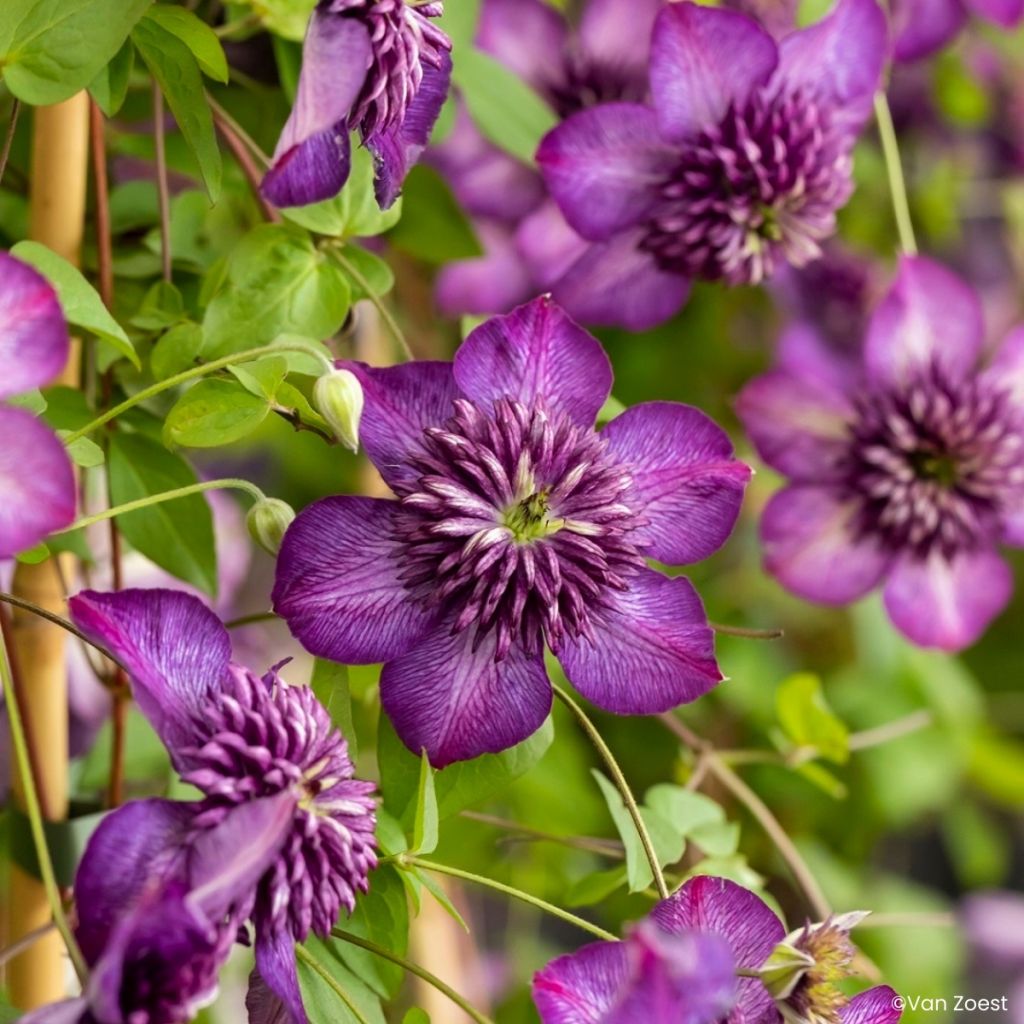
Clematis viticella Welcome Home
Clematis viticella Welcome Home
Clematis x viticella ‘Zo24025’ Welcome Home
Italian Leather Flower, Purple Clematis, Virgin's Bower
Packaging was very well prepared: the pots didn't move at all. The clematis was very small but it soon recovered. Can't wait to see the flowering.
Muriel, 11/06/2026
Back-to-school special offer!
Get €10 off for every €50 you spend! And get up to €40 off on a single order.
How does it work?
1. Shop your favourites
Add your favourite plants to your basket. For every €50 you spend (excluding delivery charges, store credit and the plastic-free option), you’ll receive a €10 voucher.
€50 spent = €10 voucher
€100 spent = €20 voucher
€150 spent = €30 voucher
€200 spent = €40 voucher
2. Place your order
Once your basket reaches one of the spending thresholds, place your order. You can even choose your delivery date!
3. Receive your voucher
As soon as your order has been shipped, you’ll receive an email containing your personal voucher code and its value.
4. Use it on your next order
Your voucher is valid for 90 days from the date you receive it. It can be used once only, on a new order worth at least the value of the voucher, excluding delivery charges.
Please note: Vouchers can be combined with other offers, but cannot be split or refunded.
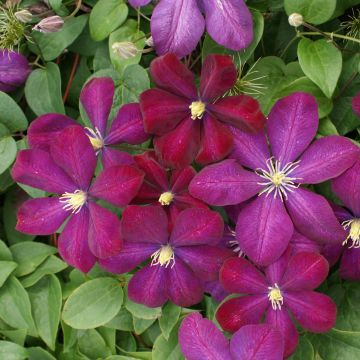
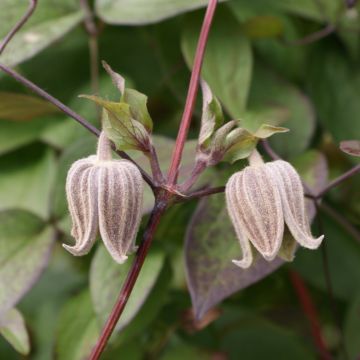
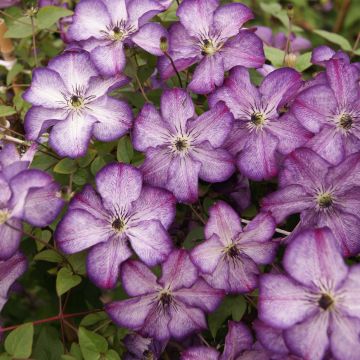
Why not try an alternative variety in stock?
View all →
Available in 1 sizes
Available in 1 sizes

Available in 1 sizes
Available in 1 sizes
Available in 1 sizes

Available in 1 sizes
Available in 1 sizes

Available in 1 sizes

Available in 2 sizes

Available in 1 sizes
This plant carries a 12 months recovery warranty
More information
We guarantee the quality of our plants for a full growing cycle, and will replace at our expense any plant that fails to recover under normal climatic and planting conditions.

Would this plant suit my garden?
Set up your Plantfit profile →
Description
A robust and reliable viticella clematis, Welcome Home (‘Zo24025’) produces dark violet, anemone-centred flowers all summer long, which are more robust than those of many large-flowered varieties. They bloom from June to September on the current year's shoots, which simplifies their care: a short pruning in late winter is sufficient. Vigorous without being invasive, it climbs trellises, arches, and fences and also adapts well to container cultivation. Derived from the Italian Clematis, it is perfectly hardy, undemanding with regard to soil, and disease-resistant.
Belonging to the Ranunculaceae family, this Welcome Home variety is part of the viticella clematis group. The protected cultivar ‘Zo24025’, marketed as Welcome Home, was developed by Dutch nurseryman J. van Zoest (Boskoop) and presented among the 2024 novelties. It is distinguished by its fleshy flowers, whose dark violet tepals surround a densely packed centre of light-coloured petaloids or staminodia; this structure, combined with reported male and female sterility by the breeder, prolongs the flower's display and limits fruit set.
This is a flexible, climbing plant that attaches itself via its leaf petioles. In the ground, it reaches between 2 m and 3 m in height; in a pot 40 cm in diameter or larger, expect 1.50 m to 2 m with support.
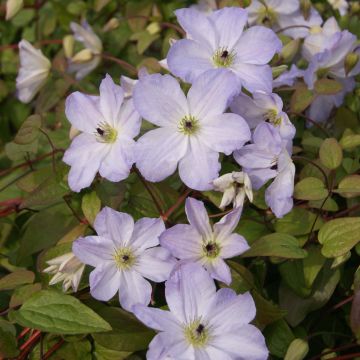
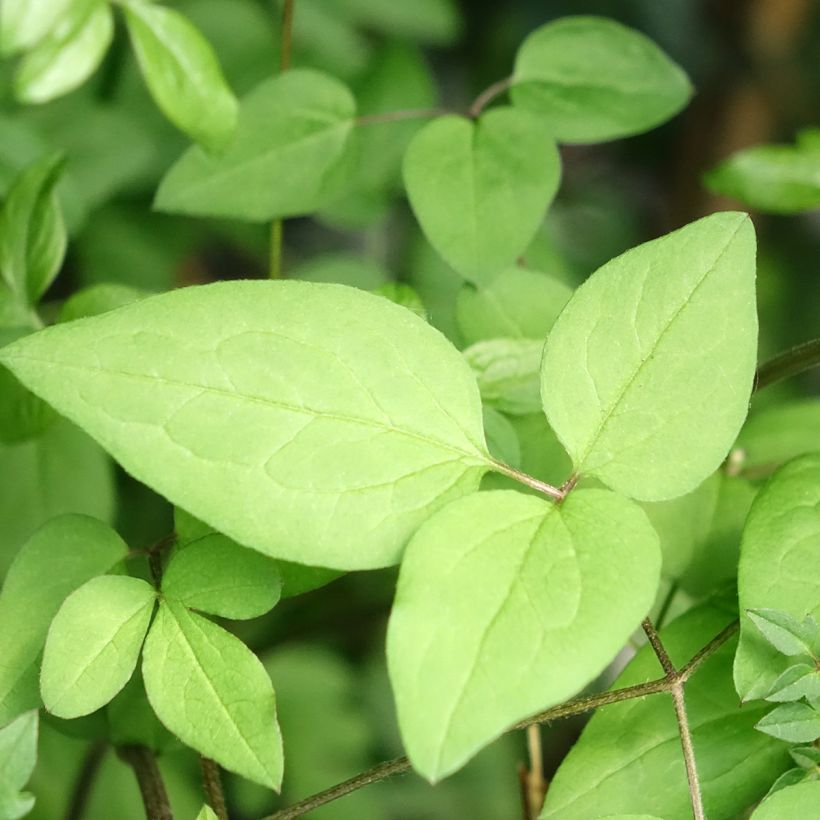
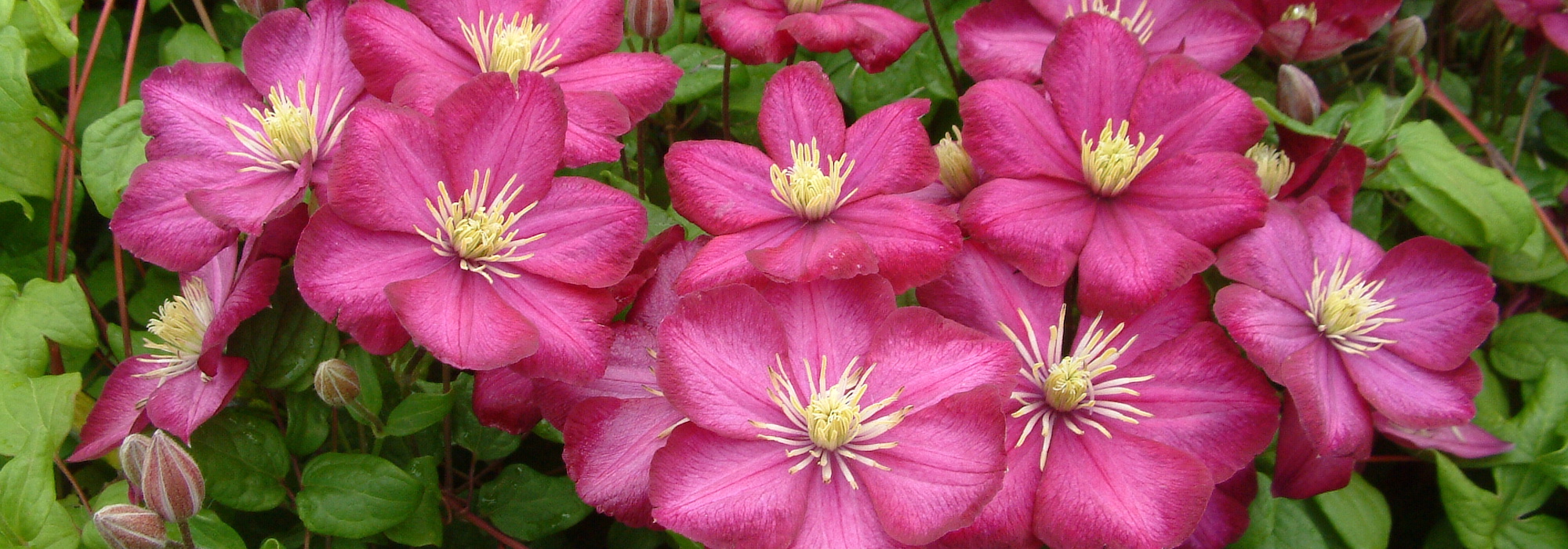
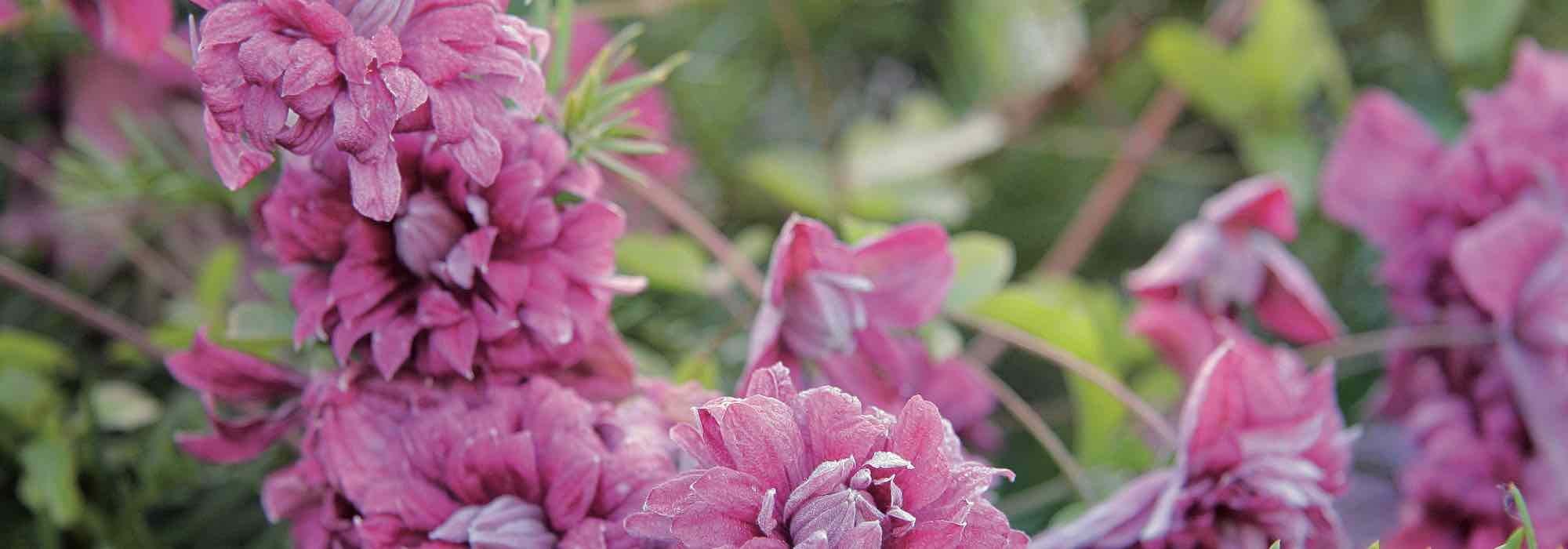
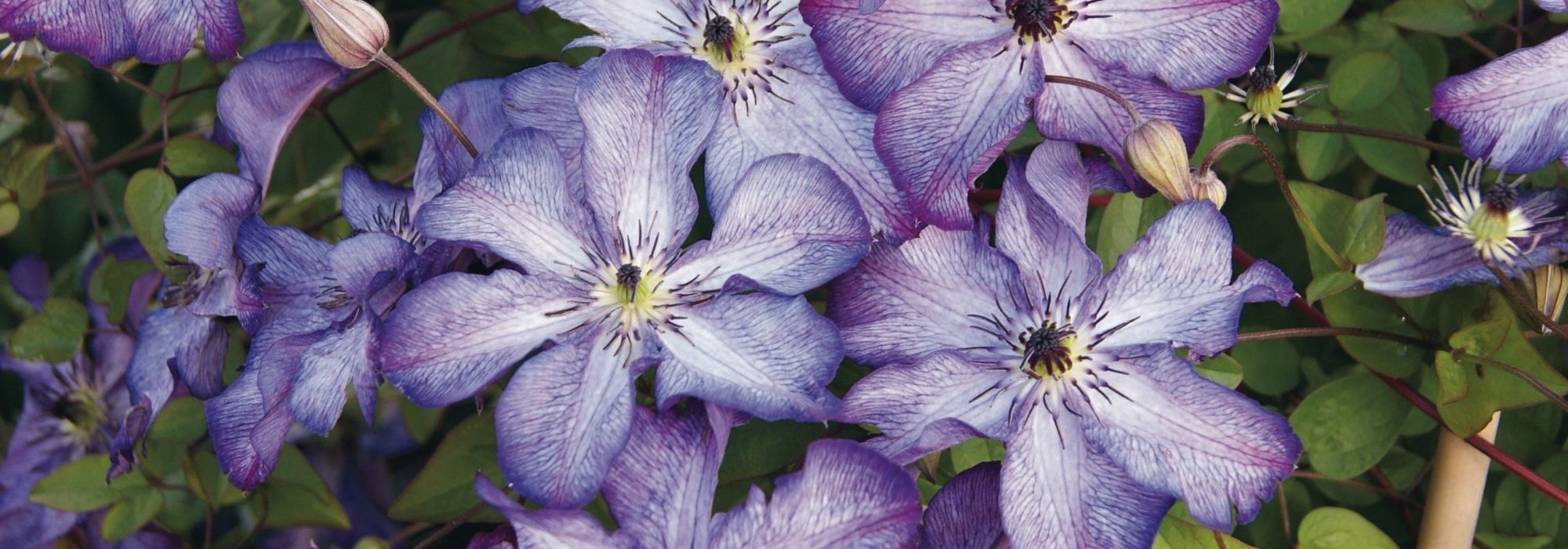
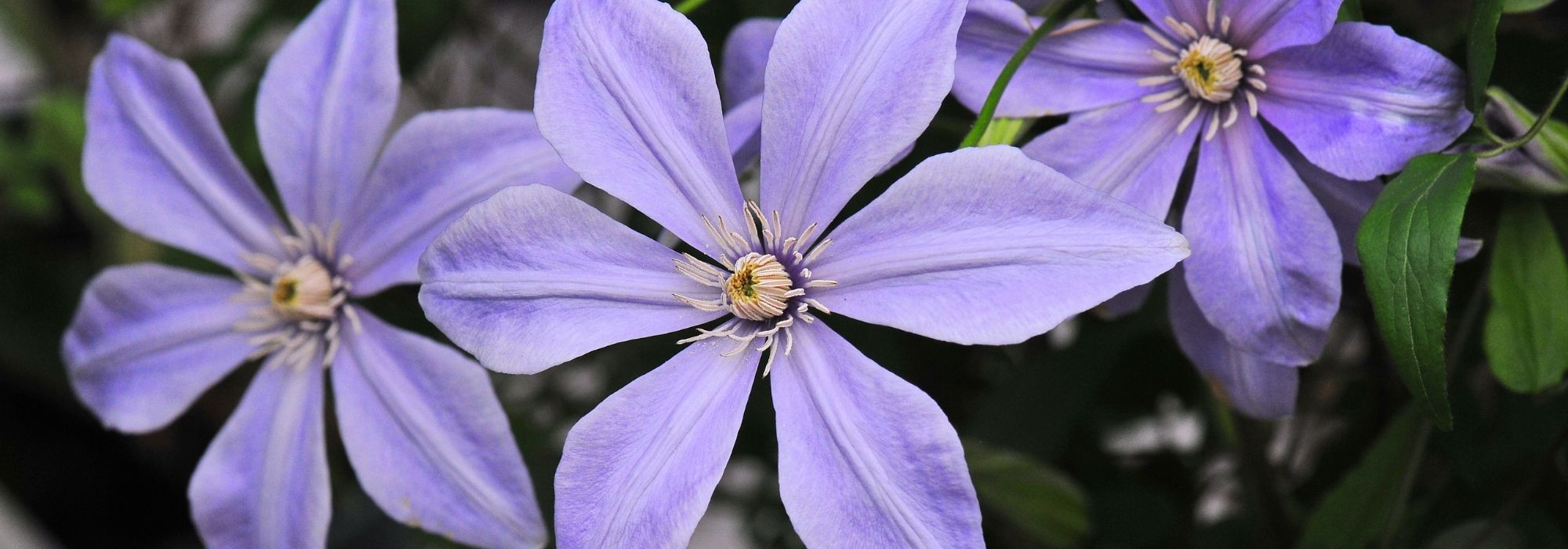
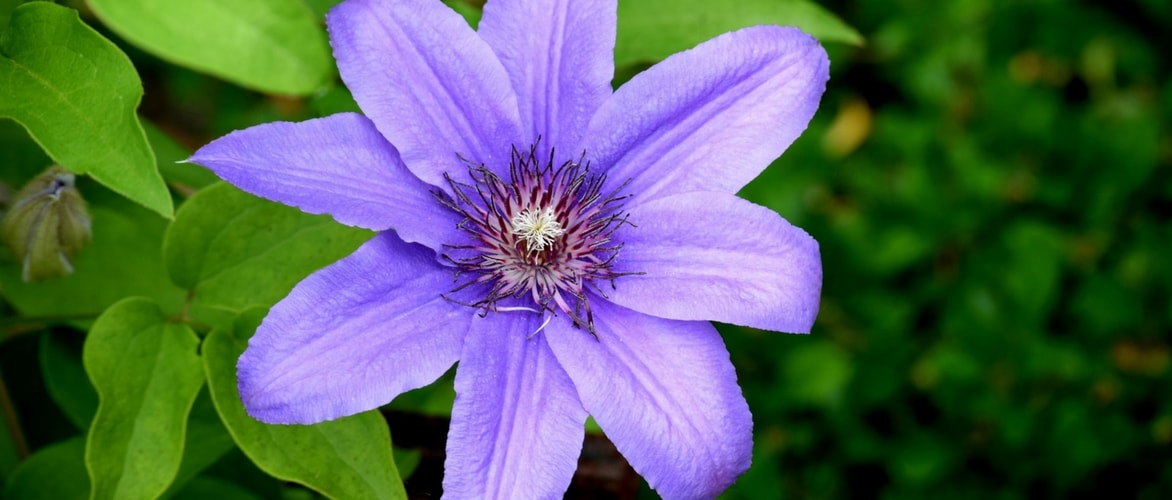
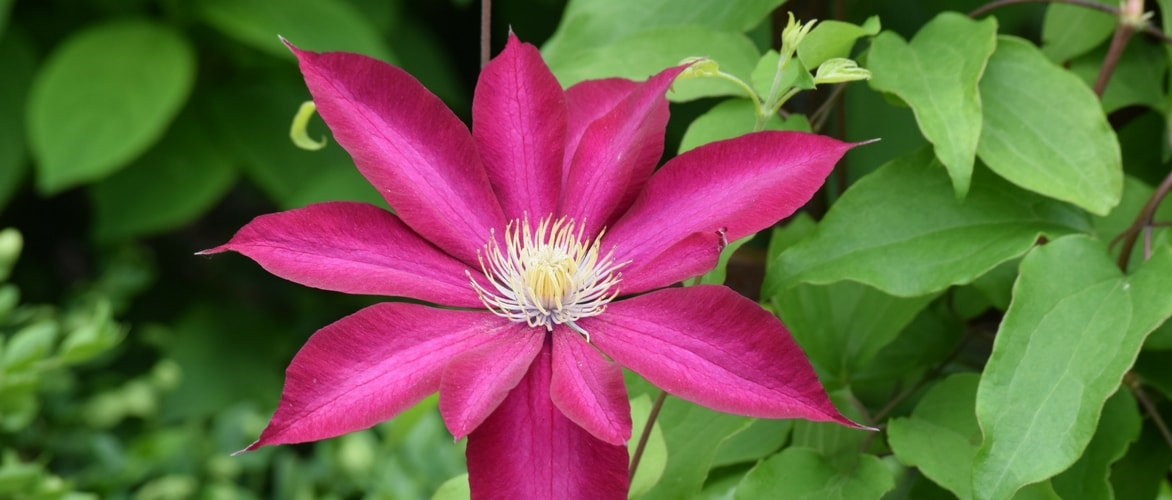
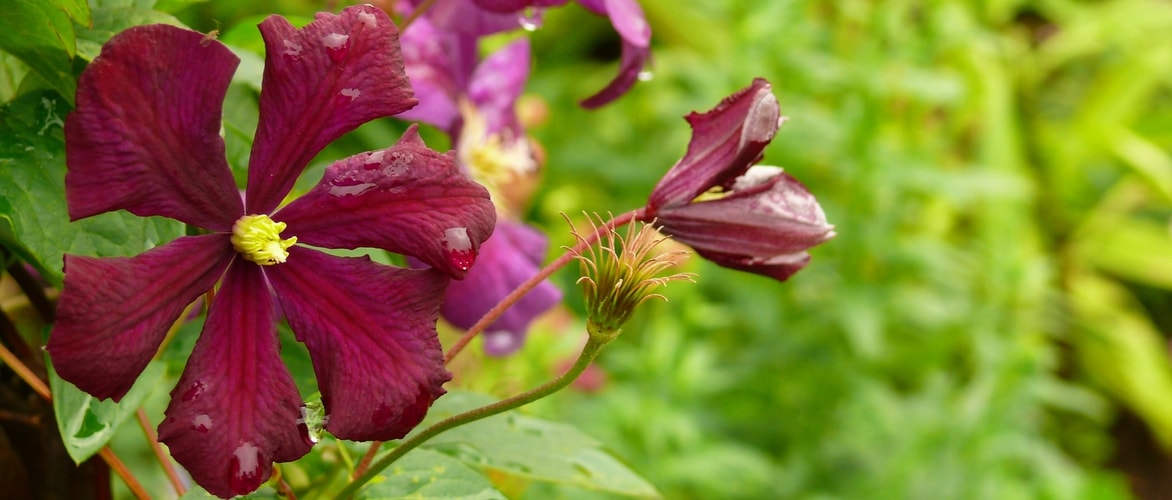
The flowers measure 5 to 8 cm in diameter, opening into a flattened cup composed of 6 to 8 thick, velvety, purple-violet tepals with a slightly lighter reverse; the centre is formed of numerous paler staminodia, sometimes tinged with cream, surrounding reduced stamens. Flowering occurs from June to September, peaking in July, on the current year's shoots. The foliage is deciduous, absent in winter; the leaves are compound with 3 ovate to lanceolate, 5 to 10 cm long, bright green leaflets, with a fairly fine texture. The plant tolerates −20 °C in well-drained soil.
Train this Welcome Home variety on a trellis, an arch or through a spring-flowering shrub, exposing its vegetation to the sun but shading its base. It will cover a fence or a climbing rose within two seasons; in a pot, provide a deep container, sturdy support, and regular watering and feeding. Pair it with the variety Purpurea Plena Elegans; both will climb the vigorous shrub rose ‘Sally Holmes’ and mingle with the purple foliage of Cotinus coggygria ‘Royal Purple’. A few clumps of hardy geraniums will protect its base from the sun.
The species, C. viticella, is native to southern Europe and western Asia, from the Italian Peninsula and the Balkans to Turkey, the Caucasus, and northern Iran, where it climbs in open thickets and woodland edges. The species name viticella derives from the Latin vitis ("vine") with a diminutive meaning "little vine", alluding to its climbing stems equipped with twining petioles. This wildling was one of the first clematis cultivated in Northern Europe during the Renaissance; introduced to England as early as the 16th century, it has served as a parent for many modern hybrids renowned for being less susceptible to wilting.
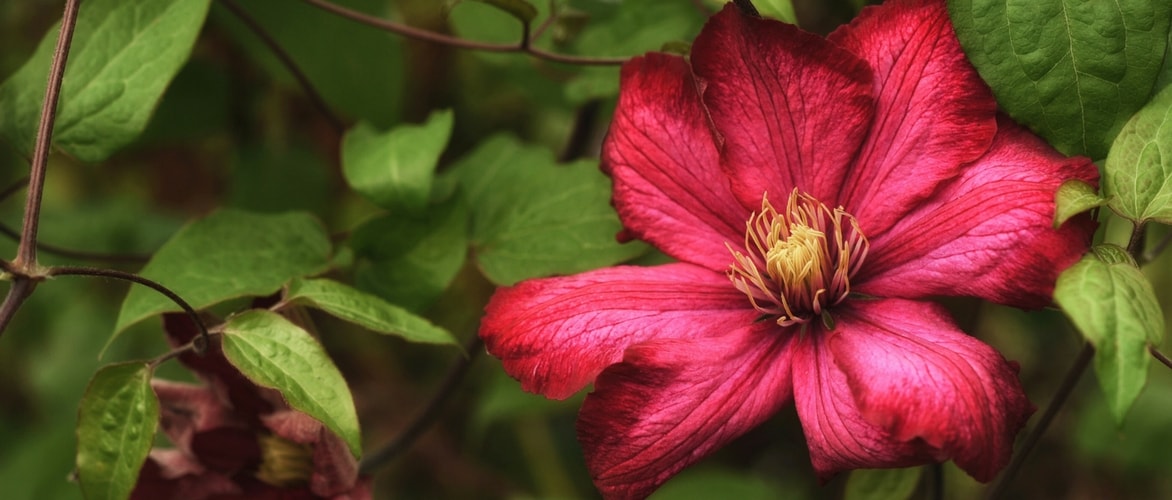
Clematis viticella Welcome Home in pictures
Plant habit
Flowering
Foliage
Botanical data
Clematis
x viticella
‘Zo24025’ Welcome Home
Ranunculaceae
Italian Leather Flower, Purple Clematis, Virgin's Bower
Cultivar or hybrid
Planting and care
Clematis Welcome Home will appreciate a position in sun or light shade near a tree. Plant it in fairly fertile soil, enriched with leaf mould, especially well-drained, shading the roots and the base of the stem (with a flat tile, for example). Generally, clematis wilt in overly moist soil, but varieties derived from C. viticella seem less sensitive and are generally very easy to grow in ordinary, well-loosened soil. Plant covering the slanted root ball with 3 cm of soil, in soil worked to a depth of 20 cm, lightened with good compost and coarse sand. After planting, cut back the stems of the clematis to about 30 cm from the base, above a nice pair of buds. For the first few weeks, water regularly. However, be careful not to let water stagnate, as this can cause fungus development at the collar. Mulch all clematis in February with garden compost or well-rotted manure, avoiding direct contact with the stems. Train the stems, without tying them tightly, until the plant clings by itself. Clematis also like to grow freely on neighbouring plants. Prune in February-March to 30 cm from the soil, above a pair of nice buds.
After a few years, cover the base of your climbing clematis with a small mound of soil to reduce the risk of wilting, while encouraging new vigorous shoots from the base. Voles and cutworms can attack clematis and devour the stems. Aphids and greenhouse whiteflies are also potential parasites.
Planting period
Intended location
Care
Planting & care advice
-
-
-
-
-

-
-
-
-
, onOrder confirmed
Reply from on Promesse de fleurs
Recently viewed products
Haven't found what you were looking for?
Hardiness is the lowest winter temperature a plant can endure without suffering serious damage or even dying. However, hardiness is affected by location (a sheltered area, such as a patio), protection (winter cover) and soil type (hardiness is improved by well-drained soil).

The flowering period indicated on our website applies to countries and regions located in USDA zone 8 (France, the United Kingdom, Ireland, the Netherlands, etc.)
It will vary according to where you live:- In zones 9 to 10 (Italy, Spain, Greece, etc.), flowering will occur about 2 to 4 weeks earlier.
- In zones 6 to 7 (Germany, Poland, Slovenia, and lower mountainous regions), flowering will be delayed by 2 to 3 weeks.
- In zone 5 (Central Europe, Scandinavia), blooming will be delayed by 3 to 5 weeks.
In temperate climates, pruning of spring-flowering shrubs (forsythia, spireas, etc.) should be done just after flowering.
Pruning of summer-flowering shrubs (Indian Lilac, Perovskia, etc.) can be done in winter or spring.
In cold regions as well as with frost-sensitive plants, avoid pruning too early when severe frosts may still occur.
The planting period indicated on our website applies to countries and regions located in USDA zone 8 (France, United Kingdom, Ireland, Netherlands).
It will vary according to where you live:
- In Mediterranean zones (Marseille, Madrid, Milan, etc.), autumn and winter are the best planting periods.
- In continental zones (Strasbourg, Munich, Vienna, etc.), delay planting by 2 to 3 weeks in spring and bring it forward by 2 to 4 weeks in autumn.
- In mountainous regions (the Alps, Pyrenees, Carpathians, etc.), it is best to plant in late spring (May-June) or late summer (August-September).
The harvesting period indicated on our website applies to countries and regions in USDA zone 8 (France, England, Ireland, the Netherlands).
In colder areas (Scandinavia, Poland, Austria...) fruit and vegetable harvests are likely to be delayed by 3-4 weeks.
In warmer areas (Italy, Spain, Greece, etc.), harvesting will probably take place earlier, depending on weather conditions.
The sowing periods indicated on our website apply to countries and regions within USDA Zone 8 (France, UK, Ireland, Netherlands).
In colder areas (Scandinavia, Poland, Austria...), delay any outdoor sowing by 3-4 weeks, or sow under glass.
In warmer climes (Italy, Spain, Greece, etc.), bring outdoor sowing forward by a few weeks.
Shipping country and language
Your country of residence may be:
Your country of residence is:
For a better user experience on our website, you can select:
Your shipping country:
-
 Austria
-
 Belgium
-
 Bosnia & Herzegovina
-
 Bulgaria
-
 Croatia
-
 Cyprus
-
 Czechia
-
 Denmark
-
 Estonia
-
 Finland
-
 France
-
 Germany
-
 Greece
-
 Hungary
-
 Iceland
-
 Ireland
-
 Italy
Italy
-
 Latvia
-
 Liechtenstein
-
 Lithuania
-
 Luxembourg
-
 Malta
Malta
-
 Netherlands
-
 Poland
-
 Portugal
-
 Romania
-
 Serbia
-
 Slovakia
-
 Slovenia
-
 Spain
Spain
-
 Sweden
-
 Switzerland
Language:
-
French
-
 English
-
Spanish
-
Italian
-
German
-
Portuguese
-
Dutch
-
Finnish
My Account
Hello
My wish lists
My cart
Log in / Register
Existing customer?
This form is protected by reCAPTCHA - the Google Privacy Policy and Terms of Service apply.
New customer?
Create an account to track your orders, access our customer service and, if you wish, make the most of our upcoming offers.