Rosa 'Max Bajazzo' - Climbing Rose
Rosa 'Max Bajazzo' - Climbing Rose
Rosa 'Max Bajazzo' - Climbing Rose
Rosa 'Max Bajazzo' - Climbing Rose
Rosa Climbing Max Bajazzo® KORteheba
KORteheba
Rose bushes very well protected; the roots are small, but in good soil they will develop. I am pleased with my purchase.
Nicole , 18/03/2025
Back-to-school special offer!
Get €10 off for every €50 you spend! And get up to €40 off on a single order.
How does it work?
1. Shop your favourites
Add your favourite plants to your basket. For every €50 you spend (excluding delivery charges, store credit and the plastic-free option), you’ll receive a €10 voucher.
€50 spent = €10 voucher
€100 spent = €20 voucher
€150 spent = €30 voucher
€200 spent = €40 voucher
2. Place your order
Once your basket reaches one of the spending thresholds, place your order. You can even choose your delivery date!
3. Receive your voucher
As soon as your order has been shipped, you’ll receive an email containing your personal voucher code and its value.
4. Use it on your next order
Your voucher is valid for 90 days from the date you receive it. It can be used once only, on a new order worth at least the value of the voucher, excluding delivery charges.
Please note: Vouchers can be combined with other offers, but cannot be split or refunded.
Home or relay delivery (depending on size and destination)
Important: You may be charged customs duties by your country’s customs authorities upon delivery.
Schedule delivery date,
and select date in basket
This plant carries a 24 months recovery warranty
More information
We guarantee the quality of our plants for a full growing cycle, and will replace at our expense any plant that fails to recover under normal climatic and planting conditions.

Description
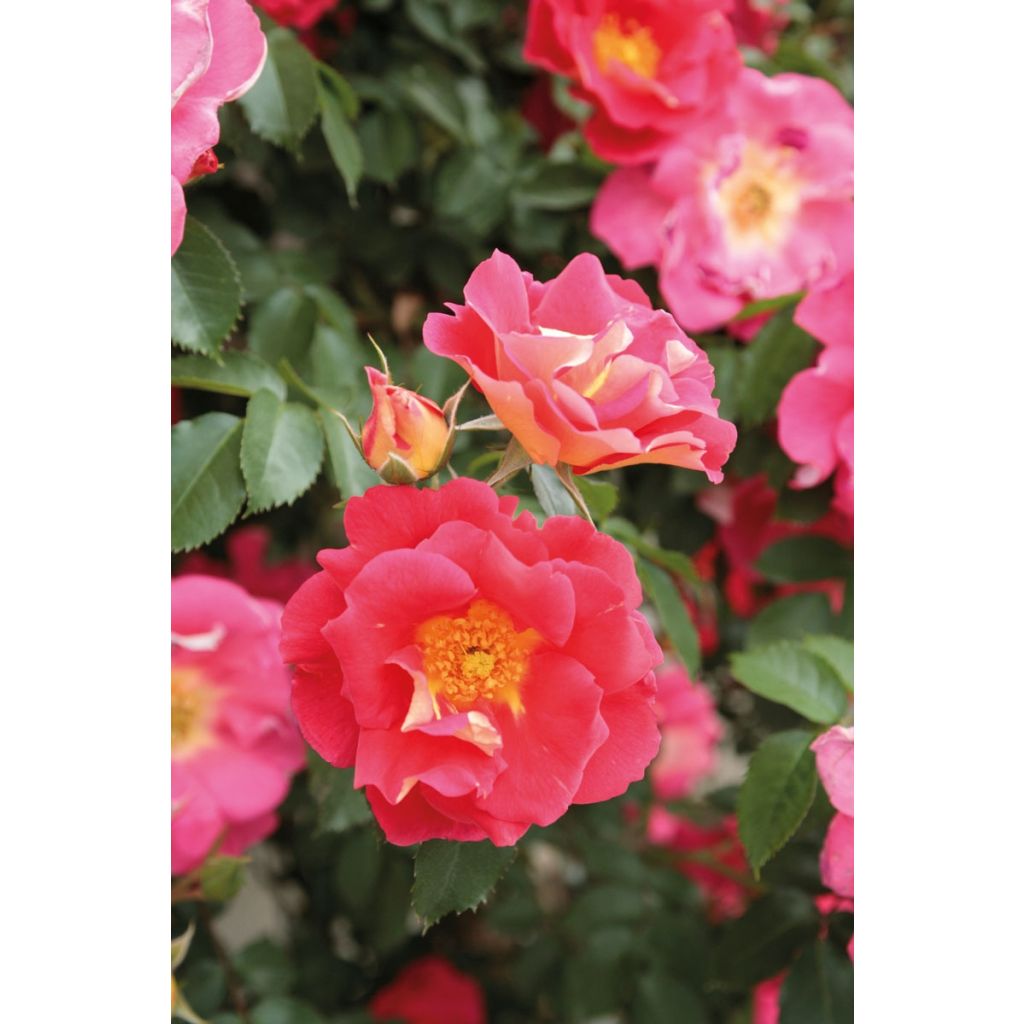
The Climbing 'Max Bajazzo' rose bush is a beautiful novelty belonging to the Climbing Max series, developed in Germany by the rose breeder Kordes. This rose has more than one advantage: an exceptional colour, a flowering that continues throughout the summer, and excellent disease resistance, established by the highly selective A.D.R label in 2010. Adopt this worry-free rose for its generosity, vigour, and variegated semi-double corollas. It will climb arches and trellises in just a few years or fill out a large flowering hedge.
This Climbing Max Bajazzo rose is an introduction to the European market 2011. This wonderful modern hybrid is a testament to the patient work and soulless selection of the Kordes house, renowned for its particularly hardy, floriferous, and disease-resistant creations. Climbing Max roses transform the garden into a fabulous flower parade. With their fantastic colours, these versatile climbers look their best when the majority of their long stems are trained horizontally.
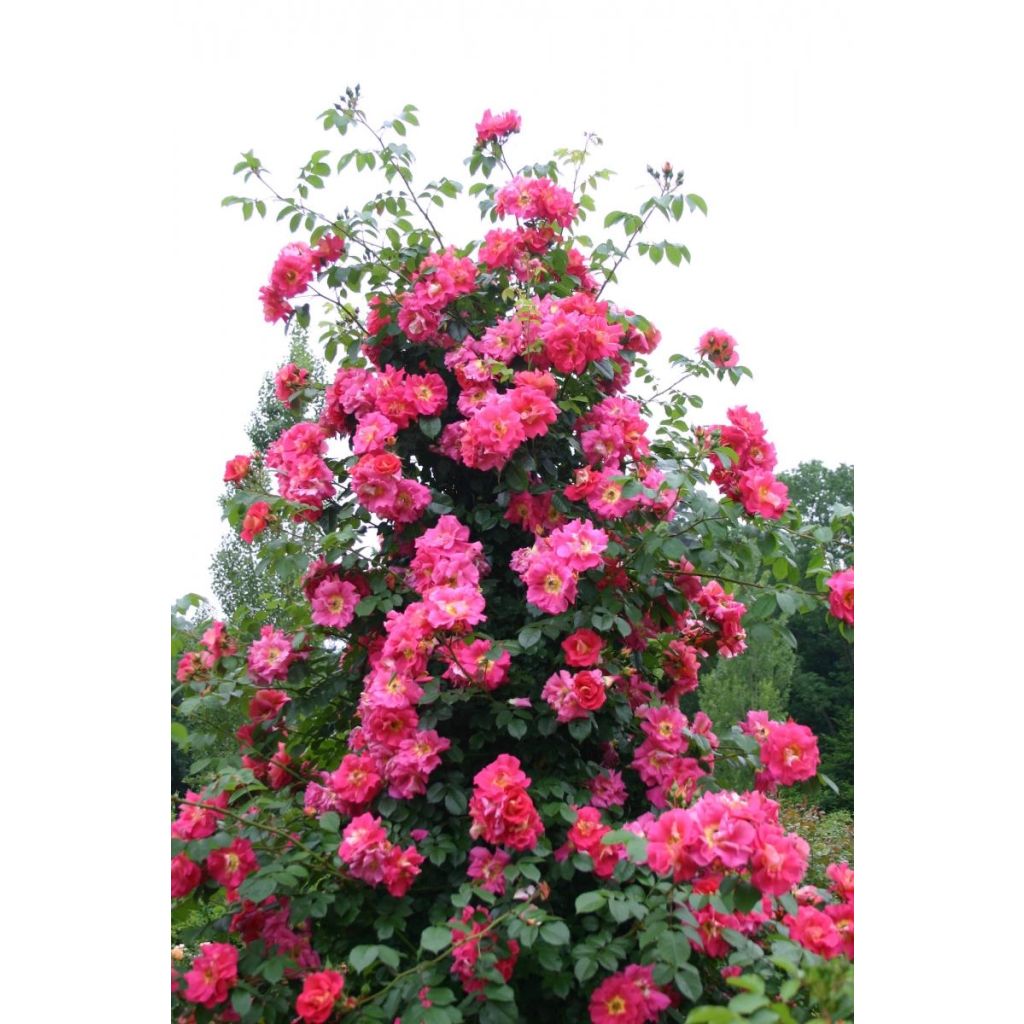
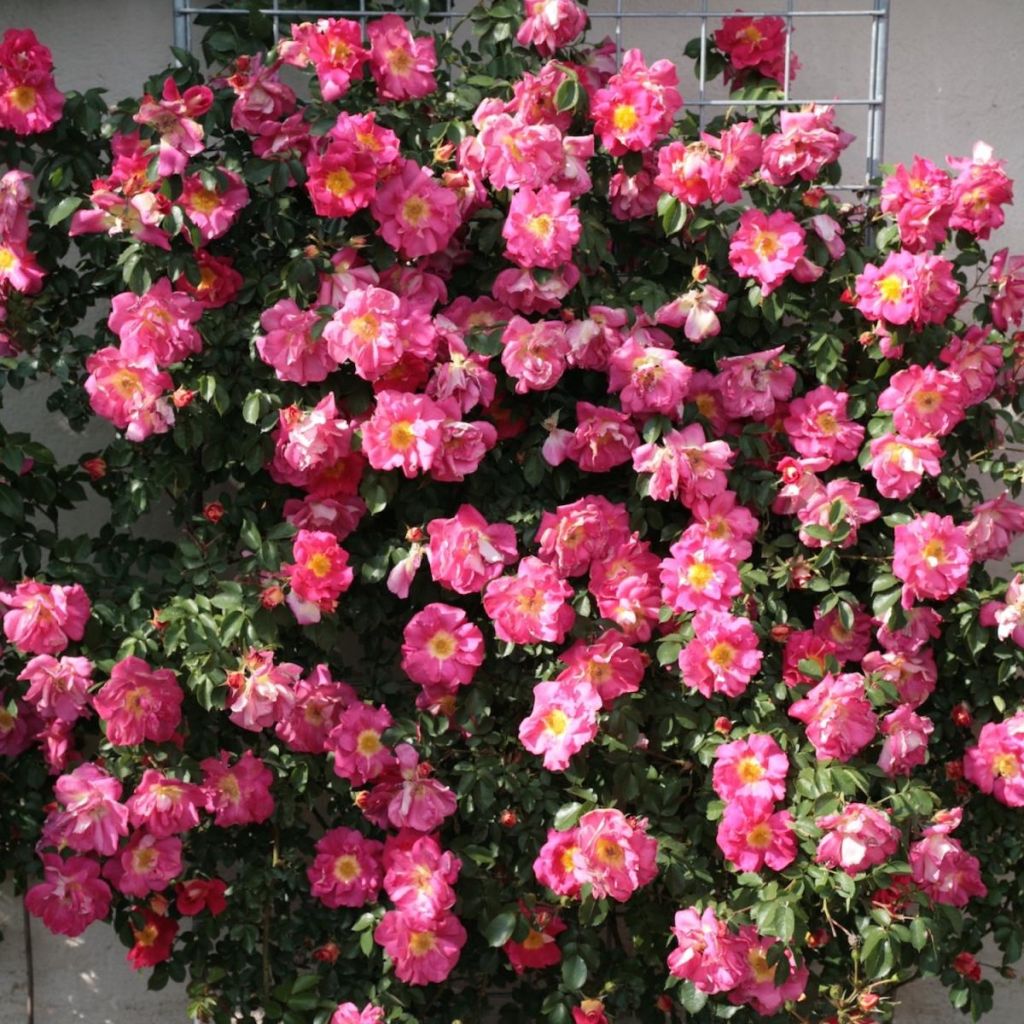
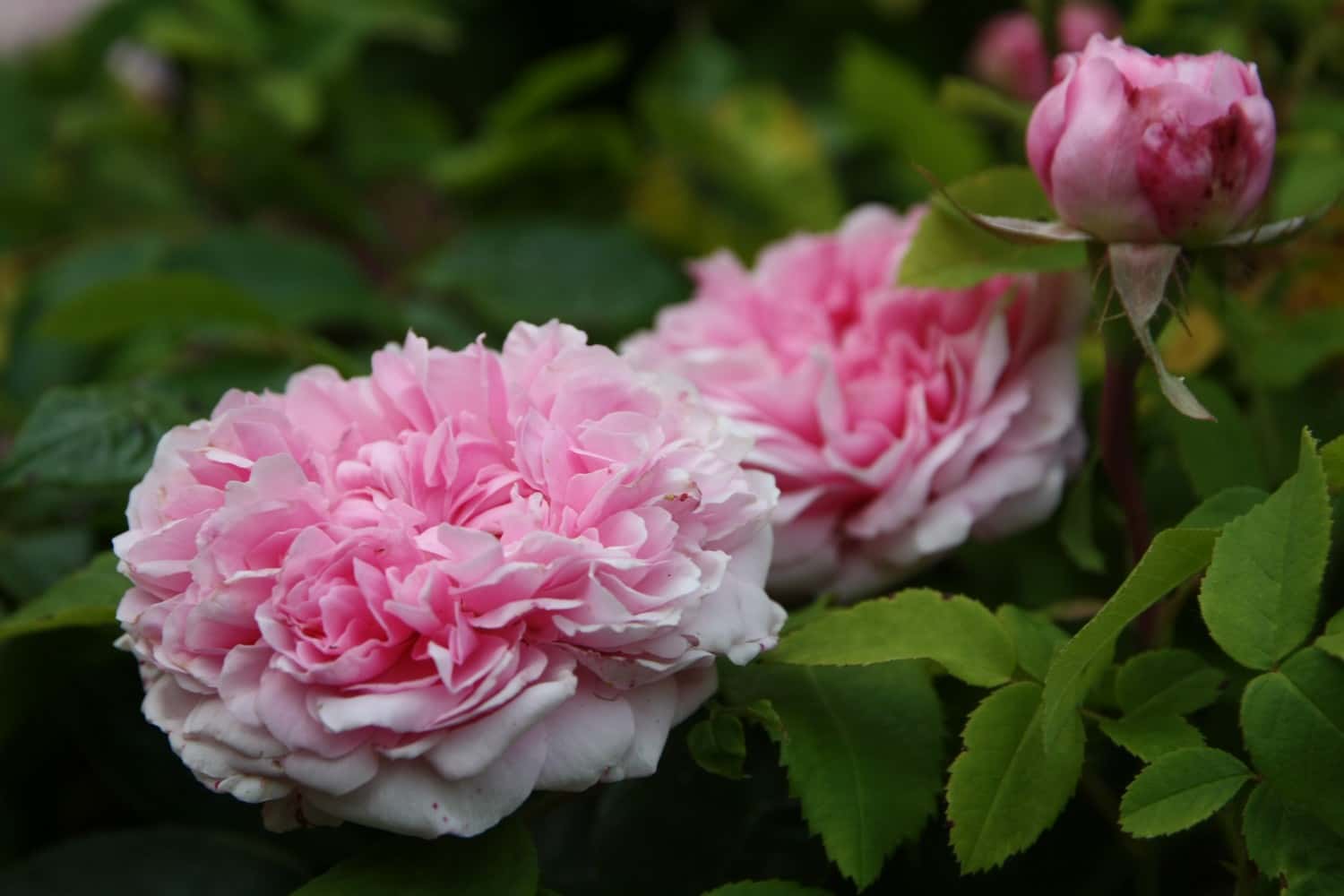
'Bajazzo', with its climbing habit, will quickly reach a height of up to 2.50 m (8ft) and have a spread of 80 cm (32in), depending on the growing conditions. Its long stems are covered with numerous prickles, have glossy foliage, a fairly dark green colour, and are particularly healthy. This deciduous foliage, dense and abundant, appears in spring and falls in autumn. The flowers form in June-July, then in successive waves until October. They emerge on short shoots in the second year. They are semi-double corollas measuring 7-8 cm (3in) in diameter, with slightly undulated petals that open almost flat. Their colour ranges from almost red to pink, with orange undersides. The throat, clearly visible, is golden yellow. All these radiant colours mingle on the plant, creating a beautiful, flamboyant effect. The flowers are gathered in generous bouquets and are very popular with bees. This variety produces fruits at the end of the season.
'Climbing Max Bajazzo' is a rose that will please lovers of easy and colourful flowers. It is an ideal subject to dress up a pillar, a brick garage, a trellis, or a wire fence. Trained on an arch near the terrace, it will make a magnificent sight. When allowed to grow freely, without being pruned or trained on a support, it forms a very beautiful bush that can be placed, for example, at the back of a perennial bed or in a large flowering hedge. Roses in this colour range go well with white lilacs, blue-flowered clematis (C.jackmanii, Arabella, Blue Light) and blue and mauve morning glories.

Rosa 'Max Bajazzo' - Climbing Rose in pictures

Plant habit
Flowering
Foliage
Botanical data
Rosa
Climbing Max Bajazzo® KORteheba
Rosaceae
KORteheba
Cultivar or hybrid
Planting and care
Plant your Climbing Max Bajazzo Rose in a rather sunny location. Climbing Max roses are tolerant but won't like excessive limestone and prefer fertile and loose soil. They will adapt to any garden if the soil is well-worked and rich. To plant your rose, work the soil by crumbling it well and put an amendment at the bottom of the planting hole, such as blood, fish and bone. Water generously after planting to remove air pockets. Water regularly for a few weeks to facilitate rooting. Pruning modern climbing roses is essential for flowering. At the end of winter, shorten the branches to 3-5 buds above the ground (at the lowest), and choose an outward-facing bud for a more elegant habit. Take advantage of this pruning to remove dead wood and unsightly branches. Pruning is done at an angle above an bud. As the flowers bloom, remove faded flowers, stimulating the development of other buds.
If you plant a climbing or rambling rose next to a living tree, the rose's root system will compete with that of the already well-established tree. To control watering, here's a trick: plant the rose in a large container with drainage holes at the base of the tree. The tree's roots will not penetrate the container for at least a year. Remove the container after 1 year, for example, by cutting one side without disturbing the rose's root system. The rose will have had time to develop its root system deeply and will be more resistant.
Planting period
Intended location
Care
Planting & care advice
-
-

-

-

-

-
-
-

-
, onOrder confirmed
Reply from on Promesse de fleurs
Recently viewed products
Haven't found what you were looking for?
Hardiness is the lowest winter temperature a plant can endure without suffering serious damage or even dying. However, hardiness is affected by location (a sheltered area, such as a patio), protection (winter cover) and soil type (hardiness is improved by well-drained soil).

The flowering period indicated on our website applies to countries and regions located in USDA zone 8 (France, the United Kingdom, Ireland, the Netherlands, etc.)
It will vary according to where you live:- In zones 9 to 10 (Italy, Spain, Greece, etc.), flowering will occur about 2 to 4 weeks earlier.
- In zones 6 to 7 (Germany, Poland, Slovenia, and lower mountainous regions), flowering will be delayed by 2 to 3 weeks.
- In zone 5 (Central Europe, Scandinavia), blooming will be delayed by 3 to 5 weeks.
In temperate climates, pruning of spring-flowering shrubs (forsythia, spireas, etc.) should be done just after flowering.
Pruning of summer-flowering shrubs (Indian Lilac, Perovskia, etc.) can be done in winter or spring.
In cold regions as well as with frost-sensitive plants, avoid pruning too early when severe frosts may still occur.
The planting period indicated on our website applies to countries and regions located in USDA zone 8 (France, United Kingdom, Ireland, Netherlands).
It will vary according to where you live:
- In Mediterranean zones (Marseille, Madrid, Milan, etc.), autumn and winter are the best planting periods.
- In continental zones (Strasbourg, Munich, Vienna, etc.), delay planting by 2 to 3 weeks in spring and bring it forward by 2 to 4 weeks in autumn.
- In mountainous regions (the Alps, Pyrenees, Carpathians, etc.), it is best to plant in late spring (May-June) or late summer (August-September).
The harvesting period indicated on our website applies to countries and regions in USDA zone 8 (France, England, Ireland, the Netherlands).
In colder areas (Scandinavia, Poland, Austria...) fruit and vegetable harvests are likely to be delayed by 3-4 weeks.
In warmer areas (Italy, Spain, Greece, etc.), harvesting will probably take place earlier, depending on weather conditions.
The sowing periods indicated on our website apply to countries and regions within USDA Zone 8 (France, UK, Ireland, Netherlands).
In colder areas (Scandinavia, Poland, Austria...), delay any outdoor sowing by 3-4 weeks, or sow under glass.
In warmer climes (Italy, Spain, Greece, etc.), bring outdoor sowing forward by a few weeks.
Shipping country and language
Your country of residence may be:
Your country of residence is:
For a better user experience on our website, you can select:
Your shipping country:
-
 Austria
-
 Belgium
-
 Bosnia & Herzegovina
-
 Bulgaria
-
 Croatia
-
 Cyprus
-
 Czechia
-
 Denmark
-
 Estonia
-
 Finland
-
 France
-
 Germany
-
 Greece
-
 Hungary
-
 Iceland
-
 Ireland
-
 Italy
Italy
-
 Latvia
-
 Liechtenstein
-
 Lithuania
-
 Luxembourg
-
 Malta
Malta
-
 Netherlands
-
 Poland
-
 Portugal
-
 Romania
-
 Serbia
-
 Slovakia
-
 Slovenia
-
 Spain
Spain
-
 Sweden
-
 Switzerland
Language:
-
French
-
 English
-
Spanish
-
Italian
-
German
-
Portuguese
-
Dutch
-
Finnish
My Account
Hello
My wish lists
My cart
Log in / Register
Existing customer?
This form is protected by reCAPTCHA - the Google Privacy Policy and Terms of Service apply.
New customer?
Create an account to track your orders, access our customer service and, if you wish, make the most of our upcoming offers.