Cookies help us to offer you a personalised browsing experience and to measure our audience. You can configure them at any time and consult our privacy policy.
This website uses cookies to improve your experience when browsing the website. Of these, cookies classified as necessary are stored on your browser because they are essential for the basic functionality of the website to work. We also use third-party cookies to help us analyse and understand how you use this website. These cookies will only be stored on your browser with your consent. You also have the option of refusing these cookies. However, deactivating some of these cookies may have an effect on your browsing experience.
Essentials
These cookies are essential for the sound operation of our site and will make it unusable if deactivated. They do not store any personal identification information.
Name
Description
Lifetime
Name: CART
Description: The association with your shopping cart.
Lifetime: 1 Year
Name: CATEGORY_INFO
Description: Allows pages to be displayed more quickly.
Lifetime: 1 Year
Name: COMPARE
Description: The items that you have in the Compare Products list.
Lifetime: 1 Year
Name: CUSTOMER
Description: An encrypted version of your customer id.
Lifetime: 1 Year
Name: CUSTOMER_AUTH
Description: An indicator if you are signed into the store.
Lifetime: 1 Year
Name: CUSTOMER_INFO
Description: An encrypted version of the customer group you belong to.
Lifetime: 1 Year
Name: toky_state
Description:
Lifetime: 20 Days
Name: user_allowed_save_cookie
Description: Enregistre les préférences de l'utilisateur concernant les cookies sur le site.
Lifetime: 41 Days
Name: intercom-device-id-cv6ld8kq
Description: Identifiant unique utilisé pour suivre les interactions de l'utilisateur avec le site via Intercom.
Lifetime: 63 Days
Name: __cf_bm
Description: Identifie de manière unique les clients individuels derrière une adresse IP partagée et applique des paramètres de sécurité par client.
Lifetime: 154 Days
Name: intercom-id-cv6ld8kq
Description:
Lifetime: 56 Days
Name: private_content_version
Description:
Lifetime: 55 Days
Name: visitor_country
Description: Choix du volet pays
Lifetime: 17 Days
Name: form_key
Description:
Lifetime: 0
Name: PHPSESSID
Description:
Lifetime: 41 Days
Name: last_visited_store
Description:
Lifetime: 25 Days
Name: CONSENT
Description: Stocke le statut du consentement des cookies de l'utilisateur pour le domaine actuel.
Lifetime: 18 Days
Name: section_data_ids
Description:
Lifetime: 1 Year
Marketing
These cookies may be used by third-party companies to establish a profile of your interests and offer you relevant advertising on other websites. They do not directly store personal data but are based on the unique identification of your browser and your Internet device. Rejecting these cookies will not necessarily mean you are less targeted by advertisements, only that they will be less targeted.
Name
Description
Lifetime
Name: CUSTOMER_SEGMENT_IDS
Description: Stores your Customer Segment ID
Lifetime: 1 Year
Name: EXTERNAL_NO_CACHE
Description: A flag that, indicates whether caching is on or off.
Lifetime: 1 Year
Name: FRONTEND
Description: Your session ID on the server.
Lifetime: 1 Year
Name: GUEST-VIEW
Description: Allows guests to edit their orders.
Lifetime: 1 Year
Name: LAST_CATEGORY
Description: The last category you visited.
Lifetime: 1 Year
Name: LAST_PRODUCT
Description: The last product you looked at.
Lifetime: 1 Year
Name: NEWMESSAGE
Description: Indicates whether a new message has been received.
Lifetime: 1 Year
Name: NO_CACHE
Description: Indicates whether it is allowed to use cache.
Lifetime: 1 Year
Name: PERSISTENT_SHOPPING_CART
Description: A link to information about your cart and viewing history if you have asked the site.
Lifetime: 1 Year
Name: 1P_JAR
Description: Service 'Google Ads Optimization' pour la délivrance de publicités ciblées
Lifetime: 18 Days
Name: __Secure-3PSIDCC
Description: Stocke des informations sur l'utilisation du site pour les annonces Google.
Lifetime: 90 Days
Name: SIDCC
Description: Identifiant de session Google utilisé pour maintenir l'intégrité et la sécurité de votre session lors de l'utilisation des services Google.
Lifetime: 81 Days
Name: __Secure-1PAPISID
Description: Utilisé pour livrer des annonces plus pertinentes et pour améliorer les rapports de performance des campagnes publicitaires.
Lifetime: 51 Days
Name: SAPISID
Description: Identifiant unique utilisé pour suivre les préférences de l'utilisateur et fournir des recommandations de contenu personnalisé.
Lifetime: 41 Days
Name: SSID
Description: Stocke des informations telles que la langue préférée de l'utilisateur afin de personnaliser l'expérience de navigation.
Lifetime: 21 Days
Name: __Secure-3PSIDD
Description: Utilisé pour collecter des informations sur l'interaction de l'utilisateur avec le site Web, telles que les publicités qu'il a vues et les actions qu'il a entreprises.
Lifetime: 167 Days
Name: __Secure-1PSIDD
Description: Identifiant de session utilisé pour maintenir l'état de la session de l'utilisateur entre les demandes de page.
Lifetime: 167 Days
Name: __Secure-1PSIDTS
Description: Utilisé pour mesurer les performances du site et analyser les modèles de trafic des utilisateurs.
Lifetime: 93 Days
Name: HSID
Description: Identifiant de session utilisé pour maintenir l'état de la session de l'utilisateur.
Lifetime: 21 Days
Name: APISID
Description: Identifie de manière unique votre navigateur pour fournir des publicités et des services personnalisés sur Google.
Lifetime: 40 Days
Name: __Secure-1PSIDCC
Description:
Lifetime: 0
Name: __Secure-3PSIDTS
Description: Utilisé pour collecter des informations sur l'interaction de l'utilisateur avec le site Web
Lifetime: 93 Days
Name: __Secure-3PAPISID
Description:
Lifetime: 51 Days
Name: SID
Description: Identifiant de session.
Lifetime: 156 Days
Name: _ga
Description: Identifiant de suivi unique utilisé pour collecter des données sur le comportement des utilisateurs sur le site.
Lifetime: 30 Days
Name: SOCS
Description: Stocke des informations sur les préférences de l'utilisateur et aide à personnaliser l'expérience de navigation.
Lifetime: 58 Days
Analysis & Performance
These cookies enable us to monitor the number of visits and the source of enquiries in order to measure and improve the performance of our site. They also help us identify the most and least visited pages in order to improve our content. The data linked to these cookies is collated and anonymised.
Name
Description
Lifetime
Name: RECENTLYCOMPARED
Description: The items you recently compared.
Lifetime: 1 Year
Name: STF
Description: Information on products you emailed to friends.
Lifetime: 1 Year
Name: STORE
Description: The store view or language you have selected.
Lifetime: 1 Year
Name: USER_ALLOWED_SAVE_COOKIE
Description: Indicates whether a customer authorized cookies.
Lifetime: 1 Year
Name: VIEWED_PRODUCT_IDS
Description: The products that you recently looked at.
Lifetime: 1 Year
Name: WISHLIST
Description: An encrypted list of products added to your wish list.
Lifetime: 1 Year
Name: WISHLIST_CNT
Description: The number of items in your wish list.
Lifetime: 1 Year
Name: _ga_RQXSGJFQ59
Description: Identifiant de suivi unique utilisé pour recueillir des données sur la façon dont les visiteurs interagissent avec le site.
Lifetime: 52 Days
Name: _ga_GJH9RGDDP5
Description: Identifiant de suivi unique utilisé pour recueillir des données sur la façon dont les visiteurs interagissent avec le site.
Lifetime: 52 Days
Name: _ga_X6LMX9VR0Y
Description: Identifiant de suivi unique utilisé pour recueillir des données sur la façon dont les visiteurs interagissent avec le site.
Lifetime: 60 Days
Name: _gid
Description: Identifiant de suivi unique utilisé pour recueillir des données sur la façon dont les visiteurs interagissent avec le site.
Lifetime: 30 Days
Name: _ga_4BXXKZJZTZ
Description: Identifiant de suivi unique utilisé pour recueillir des données sur la façon dont les visiteurs interagissent avec le site.
Lifetime: 52 Days
Name: _gcl_au
Description: Utilisé par Google AdSense pour expérimenter l'efficacité de la publicité sur les sites Web utilisant leurs services.
Lifetime: 31 Days
Name: SEARCH_SAMESITE
Description: Stocke des informations sur les paramètres de même site pour garantir le bon fonctionnement des fonctionnalités du site.
Lifetime: 23 Days
Name: _ga_1LGNSX0EVM
Description: Identifiant de suivi unique utilisé pour recueillir des données sur la façon dont les visiteurs interagissent avec le site.
Lifetime: 52 Days
Name: _ga_B8SKQ9HHPZ
Description: Identifiant de suivi unique utilisé pour recueillir des données sur la façon dont les visiteurs interagissent avec le site.
Lifetime: 52 Days
Name: _ga_Z574RD7GDB
Description: Identifiant de suivi unique utilisé pour recueillir des données sur le comportement des utilisateurs sur le site.
Would this plant suit my garden?
Set up your Plantfit profile →
Filter
Sort by:
Display
4results
Our Range of Tea Plants - Camellia sinensis. The tea plant is the bush whose leaves are used to produce all types of tea: green, black, or white. The variety 'Théojardin', selected for its hardiness (-10°C), is increasingly planted in gardens across Europe. The Camellia sinensis var. assamica originates from the tropical regions of Assam in India. Adapted to warm and humid climates, this variety is mainly used for producing robust and full-bodied black tea. In contrast, the Camellia sinensis 'Benifuuki', a Japanese hybrid variety, is widely used for making health teas in Japan. Another notable cultivar is 'Yabukita', which dominates tea production in Japan and is used for most green teas, such as Sencha.
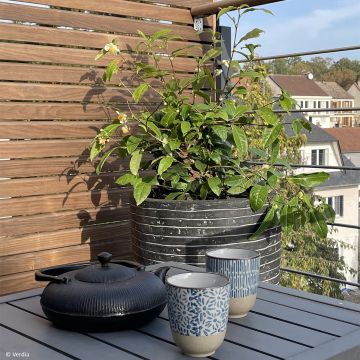
The tea plant is an evergreen bush with a bushy habit, reaching about 2 meters in height and producing small white flowers with yellow stamens. It thrives in acidic, well-drained soil and prefers a mild, humid climate with partial shade. It can be grown in pots on a terrace or directly in the ground in a flower bed. The harvest of young shoots takes place in May, with the most tender leaves being the most aromatic.
To learn more about growing tea plants, check out our article "Growing Tea in France—Is It Possible?"
Our Range of Tea Plants - Camellia sinensis. The tea plant is the bush whose leaves are used to produce all types of tea: green, black, or white. The variety 'Théojardin', selected for its hardiness (-10°C), is increasingly planted in gardens across Europe. The Camellia sinensis var. assamica originates from the tropical regions of Assam in India. Adapted to warm and humid climates, this variety is mainly used for producing robust and full-bodied black tea. In contrast, the Camellia sinensis 'Benifuuki', a Japanese hybrid variety, is widely used for making health teas in Japan. Another notable cultivar is 'Yabukita', which dominates tea production in Japan and is used for most green teas, such as Sencha.
The tea plant is an evergreen bush with a bushy habit, reaching about 2 meters in height and producing small white flowers with yellow stamens. It thrives in acidic, well-drained soil and prefers a mild, humid climate with partial shade. It can be grown in pots on a terrace or directly in the ground in a flower bed. The harvest of young shoots takes place in May, with the most tender leaves being the most aromatic.
To learn more about growing tea plants, check out our article "Growing Tea in France—Is It Possible?"
The flowering period indicated on our website applies to countries and regions located in USDA zone 8 (France, the United Kingdom, Ireland, the Netherlands, etc.)
It will vary according to where you live:
In zones 9 to 10 (Italy, Spain, Greece, etc.), flowering will occur about 2 to 4 weeks earlier.
In zones 6 to 7 (Germany, Poland, Slovenia, and lower mountainous regions), flowering will be delayed by 2 to 3 weeks.
In zone 5 (Central Europe, Scandinavia), blooming will be delayed by 3 to 5 weeks.
In temperate climates, pruning of spring-flowering shrubs (forsythia, spireas, etc.) should be done just after flowering.
Pruning of summer-flowering shrubs (Indian Lilac, Perovskia, etc.) can be done in winter or spring.
In cold regions as well as with frost-sensitive plants, avoid pruning too early when severe frosts may still occur.
The planting period indicated on our website applies to countries and regions located in USDA zone 8 (France, United Kingdom, Ireland, Netherlands).
It will vary according to where you live:
In Mediterranean zones (Marseille, Madrid, Milan, etc.), autumn and winter are the best planting periods.
In continental zones (Strasbourg, Munich, Vienna, etc.), delay planting by 2 to 3 weeks in spring and bring it forward by 2 to 4 weeks in autumn.
In mountainous regions (the Alps, Pyrenees, Carpathians, etc.), it is best to plant in late spring (May-June) or late summer (August-September).
The harvesting period indicated on our website applies to countries and regions in USDA zone 8 (France, England, Ireland, the Netherlands).
In colder areas (Scandinavia, Poland, Austria...) fruit and vegetable harvests are likely to be delayed by 3-4 weeks.
In warmer areas (Italy, Spain, Greece, etc.), harvesting will probably take place earlier, depending on weather conditions.
The sowing periods indicated on our website apply to countries and regions within USDA Zone 8 (France, UK, Ireland, Netherlands).
In colder areas (Scandinavia, Poland, Austria...), delay any outdoor sowing by 3-4 weeks, or sow under glass.
In warmer climes (Italy, Spain, Greece, etc.), bring outdoor sowing forward by a few weeks.
Shipping country and language
Your country of residence may be:
Your country of residence is:
For a better user experience on our website, you can select: