





























Do you know a more original and delicious dessert than a meringued rhubarb tart? But it is not always easy to find stalks of rhubarb (Rheum rhabarbarum) at markets. So the best solution is to plant in your garden this generous, imposing perennial plant, both ornamental and productive, which can provide harvests for more than ten years — provided it is planted in good growing conditions.
Discover the different steps to plant rhubarb to secure long-term harvests.
Why plant rhubarb in your garden?
Rhubarb is already an attractive garden vegetable whose cooked stalks are eaten and have a tart flavour. But it is also very decorative with its large crinkled leaves.
As a reminder, rhubarb is a perennial plant that remains in place for 10 to 15 years. And it takes up quite a bit of room! That is why, when planting, you should think carefully about its location. Very hardy to cold, down to -20 °C, rhubarb is also easy to grow and requires little maintenance.
Note that only the petioles are edible. The leaves are toxic due to their high oxalic acid content. Never eat them, but use them as mulch or to make an insecticidal manure!
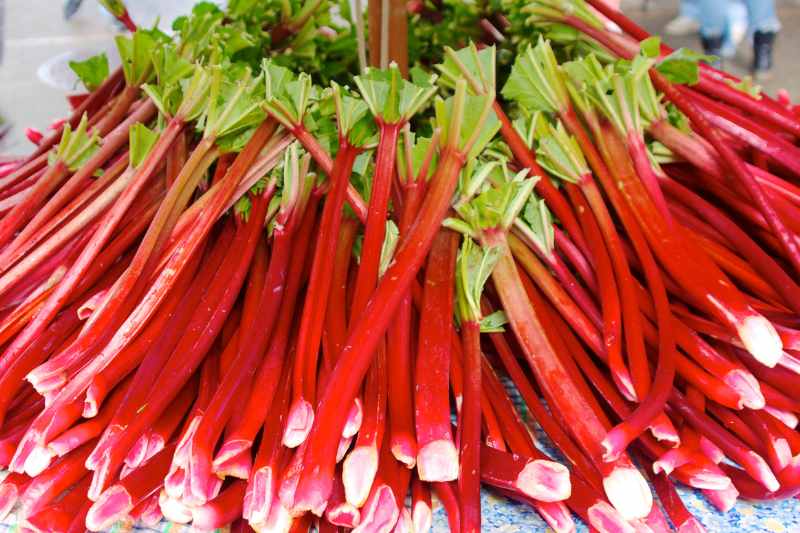
Which rhubarb should you choose?
Not all rhubarbs are the same. Some are redder, others more productive. Here are the most popular varieties:
- ‘Victoria’: a large-growing, very productive variety that produces green and red stalks.
- ‘Valentine’: a late variety that yields deep-red stalks with a mild flavour, ideal for tarts.
- ‘Frambozen Rood’: a variety with very red stalks and a raspberry-like flavour, very pleasant to the palate.
- ‘Goliath’: a variety suited to large gardens, fast-growing and producing very large stalks.
- ‘Paragon rouge’: a variety with tender, fleshy red petioles.
When to plant rhubarb?
Rhubarb is ideally planted in autumn, between October and November, because soil is still warm and autumn rains are plentiful. It will have time to take root.
That said, rhubarb can also be planted in spring, between March and April, just before growth starts.
Where to plant rhubarb?
Rhubarb is a large, nutrient-hungry plant, so it needs space and nourishment.
- It prefers full sun in northern regions, but will appreciate partial shade in the south to prevent its large leaves from scorching.
- Allow a radius of at least 1 metre around each plant. Rhubarb spreads enormously.
- Soil must be deep, rich in organic matter and, above all, well drained. Rhubarb hates having its roots in water during winter, which would rot its crown.
How to prepare soil for rhubarb?
As the plant will remain in place for a long time, preparing the planting hole is an important step:
- Dig a hole about 50 cm deep and 50 cm wide.
- Mix the excavated soil with two good shovelfuls of compost or well-rotted manure.
- If your soil is heavy and clayey, place a bed of gravel or clay pebbles at the bottom of the hole to improve water drainage.
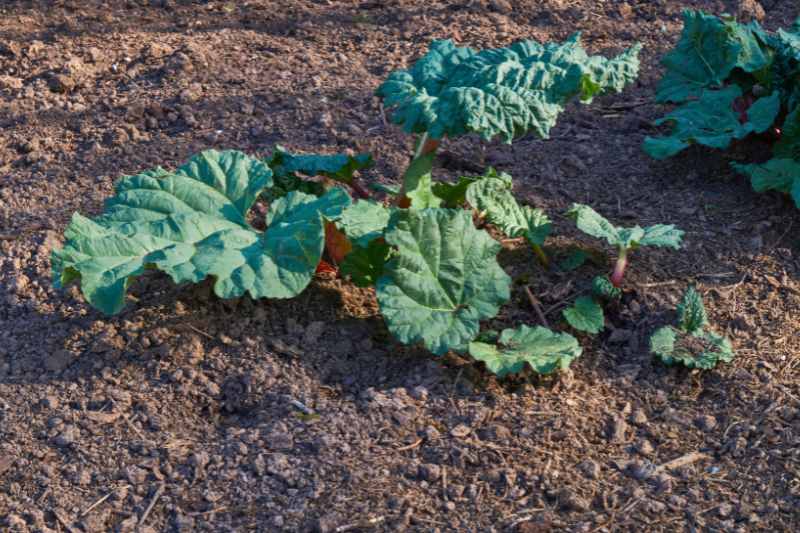
Planting, step by step
Rhubarb is generally planted as root divisions, that is pieces of root with at least one visible bud.
- Preparing the stump: if you buy a potted plant, remove it gently. If you use a root division, check that the root is firm and healthy.
- Planting: place the plant in the centre of the hole, with the bud about 2–3 cm below the soil surface.
- Backfilling the hole: fill with your soil/compost mix, firm gently with your hands. Avoid treading to prevent damaging fragile roots.
- Watering: water generously, even if it is raining, to remove air pockets around the roots.
What maintenance after planting?
- Watering: rhubarb has large leaves that evaporate a lot of water. During the first year, water regularly to keep soil cool. Once established, it will withstand drought better, but a thirsty plant will produce stringy stalks.
- Mulching: apply a thick layer of mulch (straw, dry grass clippings or fallen leaves) at the base of the plant to retain moisture and limit weed growth.
- Feeding: each autumn or each spring, add a fresh layer of compost on the soil surface around the plant to nourish it for the following season.
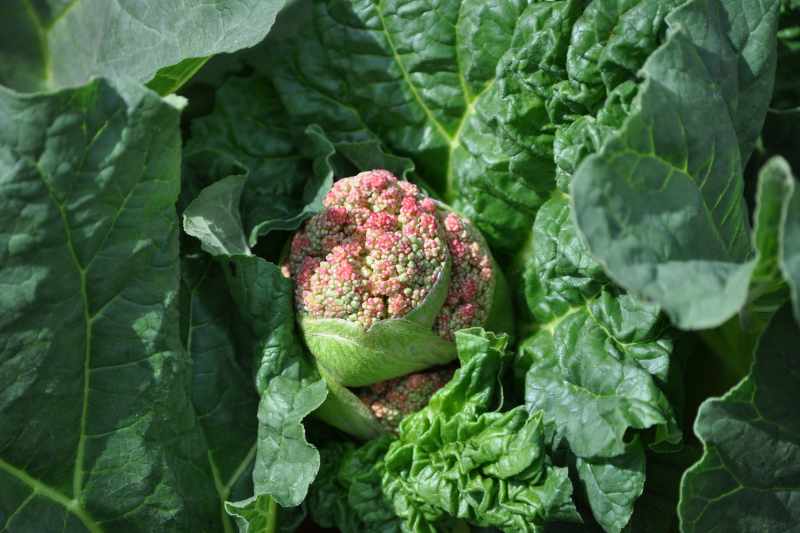
- Removing flowers: in summer, rhubarb may produce a tall flowering stem which should be cut as soon as it appears so the plant is not exhausted at the expense of stalk production.
- Division: after 5–6 years, stalks may become thin. Rhubarb can be divided in winter. Simply dig up the stump and cut it into several pieces, making sure each piece has at least one healthy bud.
When to harvest?
Do not harvest anything the first year to allow roots and foliage to develop. In the second year, two to three stalks per plant may be taken, but no more! In the third year, the harvest can be more substantial.
When harvesting, do not use a knife. It is preferable to grasp the stalk and give it a sideways twist to detach it from the base.

Comments