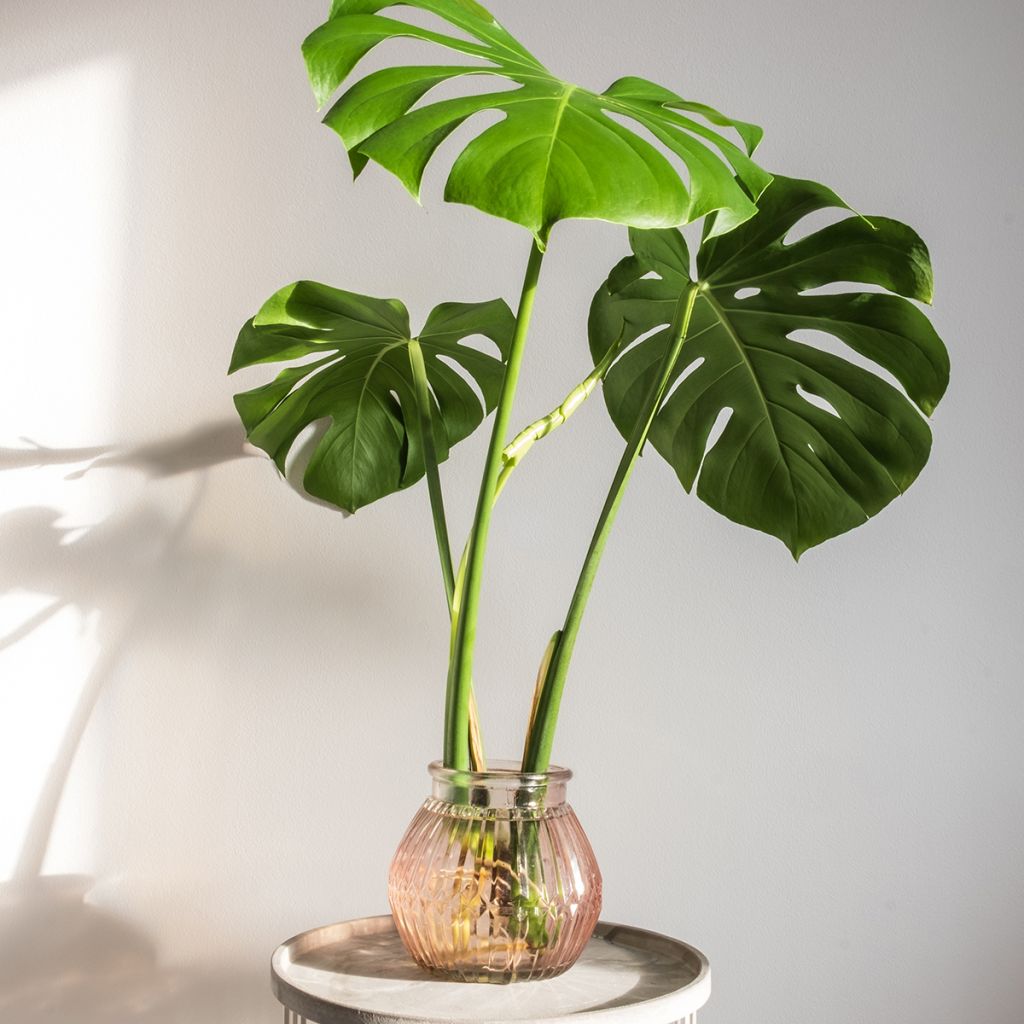
Monstera deliciosa - Swiss cheese plant

Monstera deliciosa - Swiss cheese plant

Monstera deliciosa - Swiss cheese plant

Monstera deliciosa - Swiss cheese plant

Monstera deliciosa - Swiss cheese plant
Monstera deliciosa - Swiss cheese plant
Monstera deliciosa
Swiss cheese plant, cheese plant
Back-to-school special offer!
Get €10 off for every €50 you spend! And get up to €40 off on a single order.
How does it work?
1. Shop your favourites
Add your favourite plants to your basket. For every €50 you spend (excluding delivery charges, store credit and the plastic-free option), you’ll receive a €10 voucher.
€50 spent = €10 voucher
€100 spent = €20 voucher
€150 spent = €30 voucher
€200 spent = €40 voucher
2. Place your order
Once your basket reaches one of the spending thresholds, place your order. You can even choose your delivery date!
3. Receive your voucher
As soon as your order has been shipped, you’ll receive an email containing your personal voucher code and its value.
4. Use it on your next order
Your voucher is valid for 90 days from the date you receive it. It can be used once only, on a new order worth at least the value of the voucher, excluding delivery charges.
Please note: Vouchers can be combined with other offers, but cannot be split or refunded.
Why not try an alternative variety in stock?
View all →
Available in 1 sizes
This plant carries a 30 days recovery warranty
More information
We guarantee the quality of our plants for a full growing cycle, and will replace at our expense any plant that fails to recover under normal climatic and planting conditions.
Description
With its large, glossy and "holey" leaves, Monstera deliciosa, also known as the Swiss cheese plant or cheese plant, is a classic houseplant. This tropical climber with an exuberant character adds style to a living room, entrance hall or office bathed in light. Placed in a large pot and guided onto a sturdy stake, it fits into all styles of decor. A decorative, robust, XXL green plant, suitable for beginners.
This species from the Araceae family is a semi-epiphytic plant that grows in the tropical forests from southern Mexico to Panama. Today, it is widely cultivated in many tropical and subtropical gardens around the world. In nature, it establishes itself at the base of trees before climbing up trunks using its numerous aerial roots. In an apartment, placed in a large pot, Monstera deliciosa forms a climbing plant that commonly reaches 2 to 3 m in height and 1 to 2 m in spread. Its growth is quite rapid in the first few years.
The young leaves are a bright, shiny green, entire, heart-shaped and modest in size. With age, the plant develops large leaves that can measure up to 50 cm long, deeply lobed, with numerous perforations, all different. Borne on long, fleshy petioles, they emerge from thick stems equipped with aerial roots that serve both as an attachment system and a water reserve. Flowering is very rare indoors and is only observed on mature specimens if conditions are optimal. It takes the form of a creamy-white spike surrounded by a large ivory bract (spathe). When conditions are favourable, the inflorescence produces an elongated fruit called a ceriman, which is edible when fully ripe.
Like many aroids, the plant contains calcium oxalate crystals in its leaves, stems and unripe fruit: it is therefore toxic if ingested by humans or pets.
Indoors, the Swiss cheese plant thrives in bright light, but without direct sunlight, never behind a sunny windowpane. It prefers temperatures between 18 and 28 °C in an atmosphere containing 50 to 60% relative humidity, which is found in most living spaces. It is one of the most accommodating houseplants: very easy to care for, it is suitable for beginners, provided very dark places and overly dry atmospheres are avoided.
It can be placed in the living room, a temperate conservatory, a bright stairwell or a sufficiently spacious office.
In the home, you can choose to make Monstera deliciosa the focal point of a group of green plants. Place it in a large pot with a coco coir stake, slightly set back from a glazed bay window fitted with a sheer curtain, and position lower plants in front of it, such as Epipremnum N'joy, a small Syngonium 'Neon Robusta', a Vriesea 'Christiane' and a Begonia Rex 'Escargot' placed close to the ground. On a mature specimen, you can also hang a basket of rabbit's foot fern (Humata or Davallia tyermanii).
Report an error about the product description
Monstera deliciosa - Swiss cheese plant in pictures


Foliage
Plant habit
Botanical data
Monstera
deliciosa
Araceae
Swiss cheese plant, cheese plant
South America
Safety measures
Location
Location
Maintenance & care
Watering tips
Potting advice, substrates and fertilisers
Houseplant care
Disease and pest advice
Maintenance & care
This item has not been reviewed yet - be the first to leave a review about it.
Recently viewed products
Haven't found what you were looking for?
Hardiness is the lowest winter temperature a plant can endure without suffering serious damage or even dying. However, hardiness is affected by location (a sheltered area, such as a patio), protection (winter cover) and soil type (hardiness is improved by well-drained soil).

The flowering period indicated on our website applies to countries and regions located in USDA zone 8 (France, the United Kingdom, Ireland, the Netherlands, etc.)
It will vary according to where you live:- In zones 9 to 10 (Italy, Spain, Greece, etc.), flowering will occur about 2 to 4 weeks earlier.
- In zones 6 to 7 (Germany, Poland, Slovenia, and lower mountainous regions), flowering will be delayed by 2 to 3 weeks.
- In zone 5 (Central Europe, Scandinavia), blooming will be delayed by 3 to 5 weeks.
In temperate climates, pruning of spring-flowering shrubs (forsythia, spireas, etc.) should be done just after flowering.
Pruning of summer-flowering shrubs (Indian Lilac, Perovskia, etc.) can be done in winter or spring.
In cold regions as well as with frost-sensitive plants, avoid pruning too early when severe frosts may still occur.
The planting period indicated on our website applies to countries and regions located in USDA zone 8 (France, United Kingdom, Ireland, Netherlands).
It will vary according to where you live:
- In Mediterranean zones (Marseille, Madrid, Milan, etc.), autumn and winter are the best planting periods.
- In continental zones (Strasbourg, Munich, Vienna, etc.), delay planting by 2 to 3 weeks in spring and bring it forward by 2 to 4 weeks in autumn.
- In mountainous regions (the Alps, Pyrenees, Carpathians, etc.), it is best to plant in late spring (May-June) or late summer (August-September).
The harvesting period indicated on our website applies to countries and regions in USDA zone 8 (France, England, Ireland, the Netherlands).
In colder areas (Scandinavia, Poland, Austria...) fruit and vegetable harvests are likely to be delayed by 3-4 weeks.
In warmer areas (Italy, Spain, Greece, etc.), harvesting will probably take place earlier, depending on weather conditions.
The sowing periods indicated on our website apply to countries and regions within USDA Zone 8 (France, UK, Ireland, Netherlands).
In colder areas (Scandinavia, Poland, Austria...), delay any outdoor sowing by 3-4 weeks, or sow under glass.
In warmer climes (Italy, Spain, Greece, etc.), bring outdoor sowing forward by a few weeks.
Shipping country and language
Your country of residence may be:
Your country of residence is:
For a better user experience on our website, you can select:
Your shipping country:
-
 Austria
-
 Belgium
-
 Bosnia & Herzegovina
-
 Bulgaria
-
 Croatia
-
 Cyprus
-
 Czechia
-
 Denmark
-
 Estonia
-
 Finland
-
 France
-
 Germany
-
 Greece
-
 Hungary
-
 Iceland
-
 Ireland
-
 Italy
Italy
-
 Latvia
-
 Liechtenstein
-
 Lithuania
-
 Luxembourg
-
 Malta
Malta
-
 Netherlands
-
 Poland
-
 Portugal
-
 Romania
-
 Serbia
-
 Slovakia
-
 Slovenia
-
 Spain
Spain
-
 Sweden
-
 Switzerland
Language:
-
French
-
 English
-
Spanish
-
Italian
-
German
-
Portuguese
-
Dutch
-
Finnish
My Account
Hello
My wish lists
My cart
Log in / Register
Existing customer?
This form is protected by reCAPTCHA - the Google Privacy Policy and Terms of Service apply.
New customer?
Create an account to track your orders, access our customer service and, if you wish, make the most of our upcoming offers.