Muhlenbergia reverchonii Rosy - Pink muhly grass
Muhlenbergia reverchonii Rosy - Pink muhly grass
Muhlenbergia reverchonii Rosy - Pink muhly grass
Muhlenbergia reverchonii Rosy
Pink Muhly Grass, Hairy Awn Muhly, Gulf Muhly
Back-to-school special offer!
Get €10 off for every €50 you spend! And get up to €40 off on a single order.
How does it work?
1. Shop your favourites
Add your favourite plants to your basket. For every €50 you spend (excluding delivery charges, store credit and the plastic-free option), you’ll receive a €10 voucher.
€50 spent = €10 voucher
€100 spent = €20 voucher
€150 spent = €30 voucher
€200 spent = €40 voucher
2. Place your order
Once your basket reaches one of the spending thresholds, place your order. You can even choose your delivery date!
3. Receive your voucher
As soon as your order has been shipped, you’ll receive an email containing your personal voucher code and its value.
4. Use it on your next order
Your voucher is valid for 90 days from the date you receive it. It can be used once only, on a new order worth at least the value of the voucher, excluding delivery charges.
Please note: Vouchers can be combined with other offers, but cannot be split or refunded.
Home or relay delivery (depending on size and destination)
Important: You may be charged customs duties by your country’s customs authorities upon delivery.
Schedule delivery date
and select date in basket
This plant carries a 6 months recovery warranty
More information
We guarantee the quality of our plants for a full growing cycle, and will replace at our expense any plant that fails to recover under normal climatic and planting conditions.
Would this plant suit my garden?
Set up your Plantfit profile →
Description
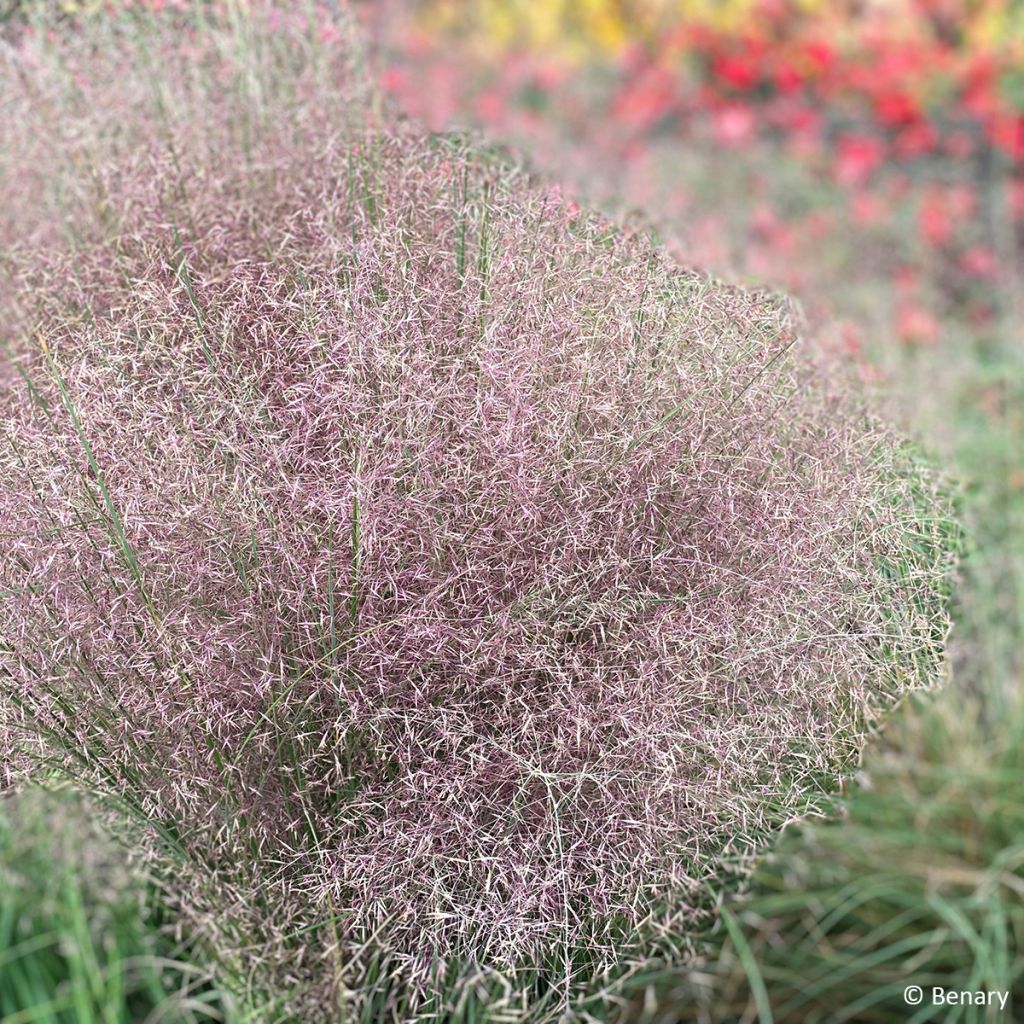
Growing Muhlenbergia reverchonii ‘Rosy’ from seed allows you to grow this ornamental grass at a lower cost, prized for being compact and graceful and for its autumn flowering in soft pink clouds that dance atop flexible stems. With a rounded and dense habit, it forms a regular clump, ideal for gently structuring borders or enlivening a terrace in a pot. Flowering later than Muhlenbergia capillaris, it displays remarkable hardiness down to –28 °C.
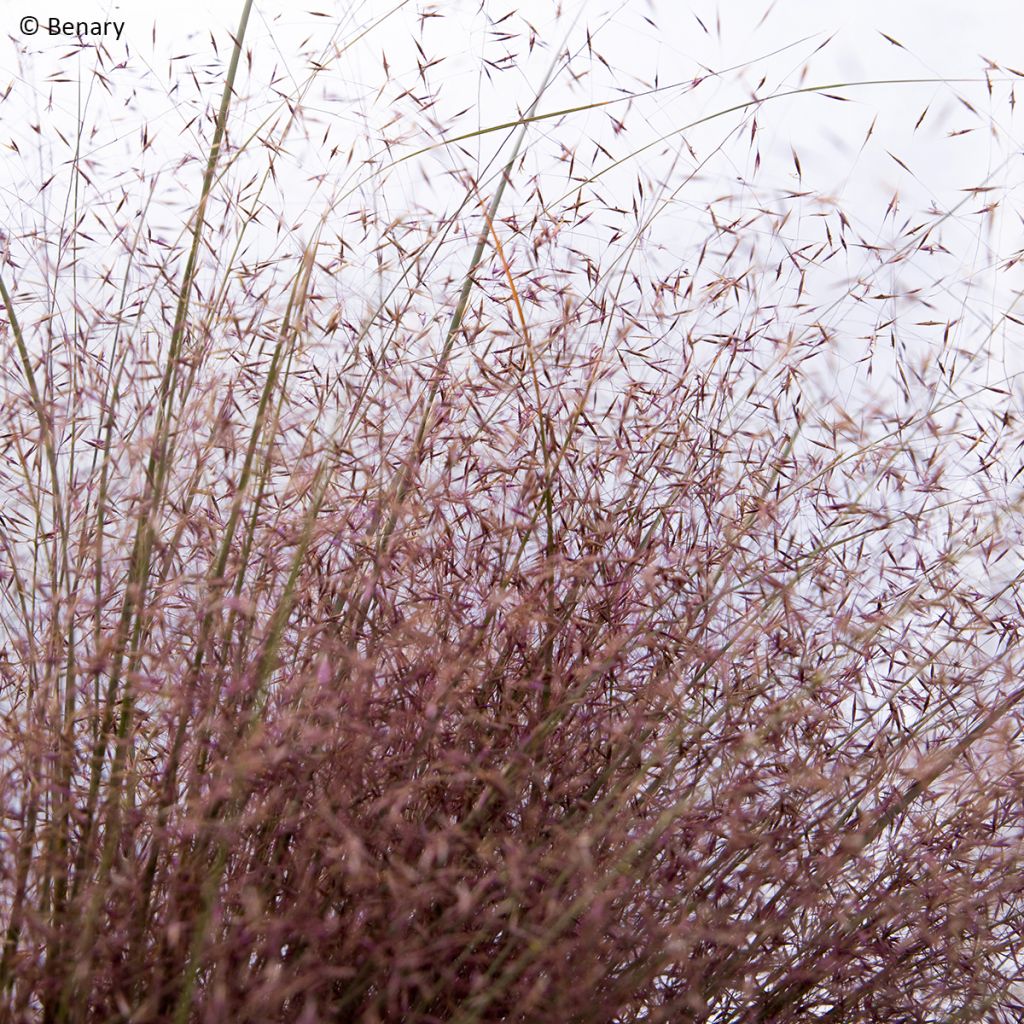
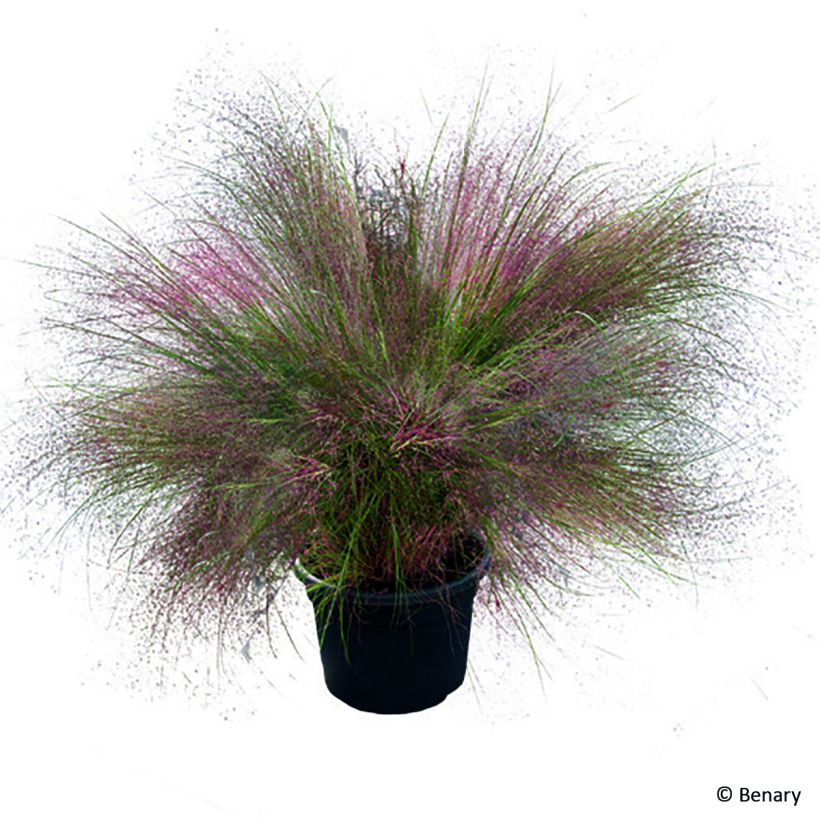
Muhlenbergia reverchonii or Reverchon's Muhly belongs to the Poaceae family and is also found under the botanical name Podosemum reverchonii. The species is endemic to the semi-arid limestone areas of Oklahoma, Texas and into central Mexico. The cultivar ‘Rosy’ is a recent horticultural selection, chosen for its floral panicles of a soft pink to rosy pink, more delicate and slightly more compact than the species. This grass forms a dense, mat-like clump with a rounded habit, reaching 50–60 cm in height and up to 80 cm when in flower, with a similar spread. Its growth rate is medium to fast. The fine, thread-like (2–3 mm wide), glossy green foliage turns beige or brown in winter and may curl up, forming a dense mat on the ground. The rigid and smooth flowering stems bear open panicles 20–30 cm long in late summer to autumn, consisting of hundreds of soft pink spikelets that capture the light. Flowering extends from August to November. The root system is shallow, fasciculate, typical of mat-forming grasses, without deep roots or stolons. The species name honours Julien Reverchon (1837–1905), a French botanist who extensively collected Texan flora.
In a garden designed around light and the rhythm of the seasons, Muhlenbergia reverchonii ‘Rosy’ creates a coloured mist in autumn that dances at the slightest breeze, weaving between the warm stones of a low wall or along a gravel path. It fits well in understated scenes, where the soft, rosy hue of its inflorescences rises above matt foliage and sculptural perennials. Plant it en masse or as a punctuation with the bronze tones of Pennisetum alopecuroides ‘Hameln’, with asters or with the upright spikes of Panicum virgatum ‘Shenandoah’.
Report an error about the product description
Muhlenbergia reverchonii Rosy - Pink muhly grass in pictures
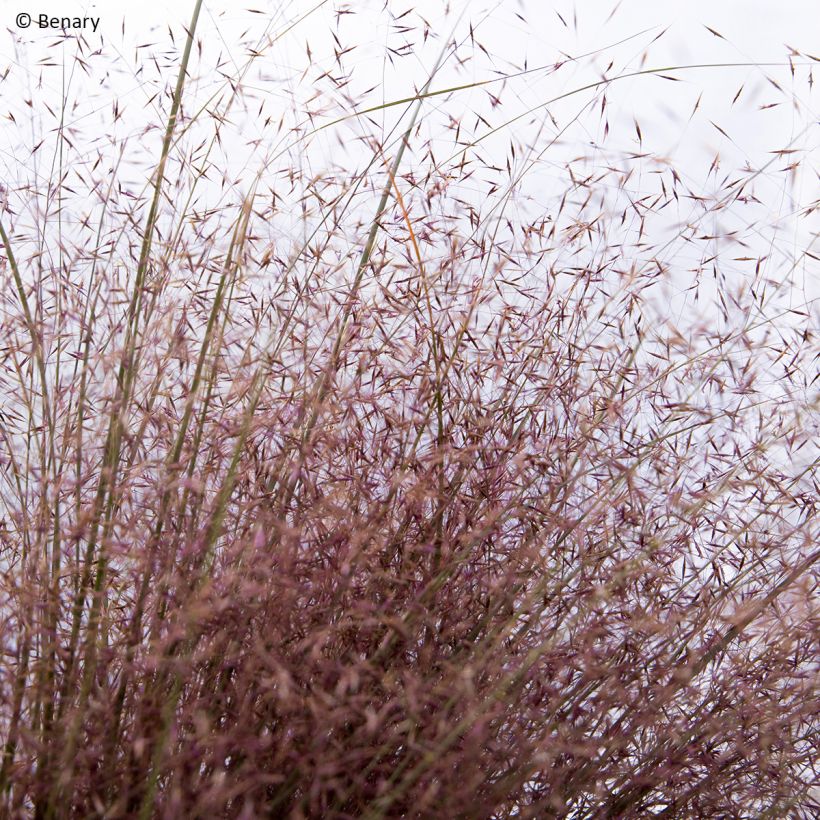
Flowering
Foliage
Plant habit
Botanical data
Muhlenbergia
reverchonii
Rosy
Poaceae
Pink Muhly Grass, Hairy Awn Muhly, Gulf Muhly
Podosemum reverchonii
Cultivar or hybrid
Planting and care
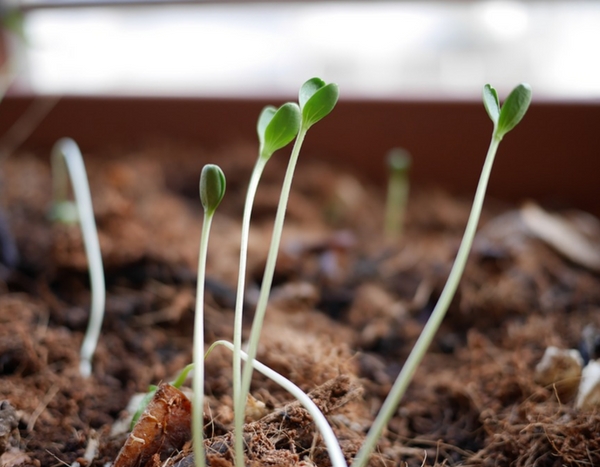
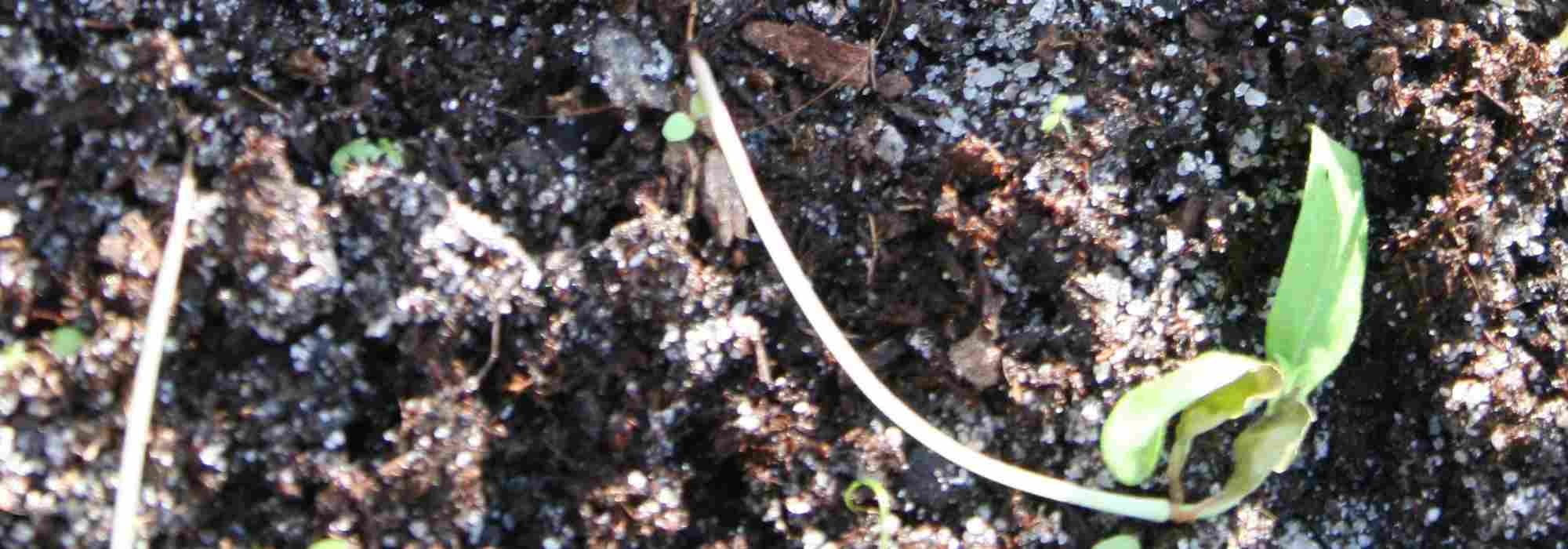
Sowing: in spring or autumn, directly in the ground or in a seed tray, using seed compost.
A period of cold stratification can be beneficial: place Muhlenbergia reverchonii Rosy seeds in a plastic bag with a little moist substrate and place them in the refrigerator for about 4 to 6 weeks. This mimics the winter conditions necessary to induce germination.
Sowing in the ground or in pots: seeds can be sown directly in the ground in spring or autumn. Scatter the seeds over well-prepared and finely raked soil, lightly cover them with soil. You can also sow them in seed trays or pots filled with seed compost and keep them indoors until conditions are more favourable outside.
The sowings should be placed in a sunny spot. Water regularly to keep the soil slightly moist, but avoid excess moisture. Watering by soaking the pot in a saucer and/or by misting prevents the seeds from being displaced. In the ground, use a watering can with a very fine rose to avoid displacing the seeds. Germination can take 2 to 4 weeks and occurs between 13 and 18.5 °C.
Transplant the young plants when they are large enough to handle, placing them in individual 7.5 cm diameter pots. Acclimatise the young plants outdoors before planting them out, in the ground or in pots, spacing them 45 to 60 cm apart.
Cultivation:
Plant Muhlenbergia reverchonii Rosy in full sun, in light, well-drained soil, even quite poor, and even stony or sandy, if possible not too chalky. This grass grows in damp, dry or even very dry soil. It thrives easily, without problems and without maintenance. Do not prune the foliage in winter; simply comb it with your hand.
Sowing period
Intended location
Planting & care advice
-

-
-
-

-

-

-

-

This item has not been reviewed yet - be the first to leave a review about it.
Recently viewed products
Haven't found what you were looking for?
Hardiness is the lowest winter temperature a plant can endure without suffering serious damage or even dying. However, hardiness is affected by location (a sheltered area, such as a patio), protection (winter cover) and soil type (hardiness is improved by well-drained soil).

The flowering period indicated on our website applies to countries and regions located in USDA zone 8 (France, the United Kingdom, Ireland, the Netherlands, etc.)
It will vary according to where you live:- In zones 9 to 10 (Italy, Spain, Greece, etc.), flowering will occur about 2 to 4 weeks earlier.
- In zones 6 to 7 (Germany, Poland, Slovenia, and lower mountainous regions), flowering will be delayed by 2 to 3 weeks.
- In zone 5 (Central Europe, Scandinavia), blooming will be delayed by 3 to 5 weeks.
In temperate climates, pruning of spring-flowering shrubs (forsythia, spireas, etc.) should be done just after flowering.
Pruning of summer-flowering shrubs (Indian Lilac, Perovskia, etc.) can be done in winter or spring.
In cold regions as well as with frost-sensitive plants, avoid pruning too early when severe frosts may still occur.
The planting period indicated on our website applies to countries and regions located in USDA zone 8 (France, United Kingdom, Ireland, Netherlands).
It will vary according to where you live:
- In Mediterranean zones (Marseille, Madrid, Milan, etc.), autumn and winter are the best planting periods.
- In continental zones (Strasbourg, Munich, Vienna, etc.), delay planting by 2 to 3 weeks in spring and bring it forward by 2 to 4 weeks in autumn.
- In mountainous regions (the Alps, Pyrenees, Carpathians, etc.), it is best to plant in late spring (May-June) or late summer (August-September).
The harvesting period indicated on our website applies to countries and regions in USDA zone 8 (France, England, Ireland, the Netherlands).
In colder areas (Scandinavia, Poland, Austria...) fruit and vegetable harvests are likely to be delayed by 3-4 weeks.
In warmer areas (Italy, Spain, Greece, etc.), harvesting will probably take place earlier, depending on weather conditions.
The sowing periods indicated on our website apply to countries and regions within USDA Zone 8 (France, UK, Ireland, Netherlands).
In colder areas (Scandinavia, Poland, Austria...), delay any outdoor sowing by 3-4 weeks, or sow under glass.
In warmer climes (Italy, Spain, Greece, etc.), bring outdoor sowing forward by a few weeks.
Shipping country and language
Your country of residence may be:
Your country of residence is:
For a better user experience on our website, you can select:
Your shipping country:
-
 Austria
-
 Belgium
-
 Bosnia & Herzegovina
-
 Bulgaria
-
 Croatia
-
 Cyprus
-
 Czechia
-
 Denmark
-
 Estonia
-
 Finland
-
 France
-
 Germany
-
 Greece
-
 Hungary
-
 Iceland
-
 Ireland
-
 Italy
Italy
-
 Latvia
-
 Liechtenstein
-
 Lithuania
-
 Luxembourg
-
 Malta
Malta
-
 Netherlands
-
 Poland
-
 Portugal
-
 Romania
-
 Serbia
-
 Slovakia
-
 Slovenia
-
 Spain
Spain
-
 Sweden
-
 Switzerland
Language:
-
French
-
 English
-
Spanish
-
Italian
-
German
-
Portuguese
-
Dutch
-
Finnish
My Account
Hello
My wish lists
My cart
Log in / Register
Existing customer?
This form is protected by reCAPTCHA - the Google Privacy Policy and Terms of Service apply.
New customer?
Create an account to track your orders, access our customer service and, if you wish, make the most of our upcoming offers.