Wisteria brachybotrys 'Shiro-Beni' - Glycine soyeuse Shiro-Beni, Glycine japonaise Shiro-Beni
Wisteria brachybotrys 'Shiro-Beni' - Glycine soyeuse Shiro-Beni, Glycine japonaise Shiro-Beni
Wisteria brachybotrys 'Shiro-Beni'
Back-to-school special offer!
Get €10 off for every €50 you spend! And get up to €40 off on a single order.
How does it work?
1. Shop your favourites
Add your favourite plants to your basket. For every €50 you spend (excluding delivery charges, store credit and the plastic-free option), you’ll receive a €10 voucher.
€50 spent = €10 voucher
€100 spent = €20 voucher
€150 spent = €30 voucher
€200 spent = €40 voucher
2. Place your order
Once your basket reaches one of the spending thresholds, place your order. You can even choose your delivery date!
3. Receive your voucher
As soon as your order has been shipped, you’ll receive an email containing your personal voucher code and its value.
4. Use it on your next order
Your voucher is valid for 90 days from the date you receive it. It can be used once only, on a new order worth at least the value of the voucher, excluding delivery charges.
Please note: Vouchers can be combined with other offers, but cannot be split or refunded.
Home or relay delivery (depending on size and destination)
Important: You may be charged customs duties by your country’s customs authorities upon delivery.
Schedule delivery date,
and select date in basket
This plant carries a 12 months recovery warranty
More information
We guarantee the quality of our plants for a full growing cycle, and will replace at our expense any plant that fails to recover under normal climatic and planting conditions.
Would this plant suit my garden?
Set up your Plantfit profile →
Description
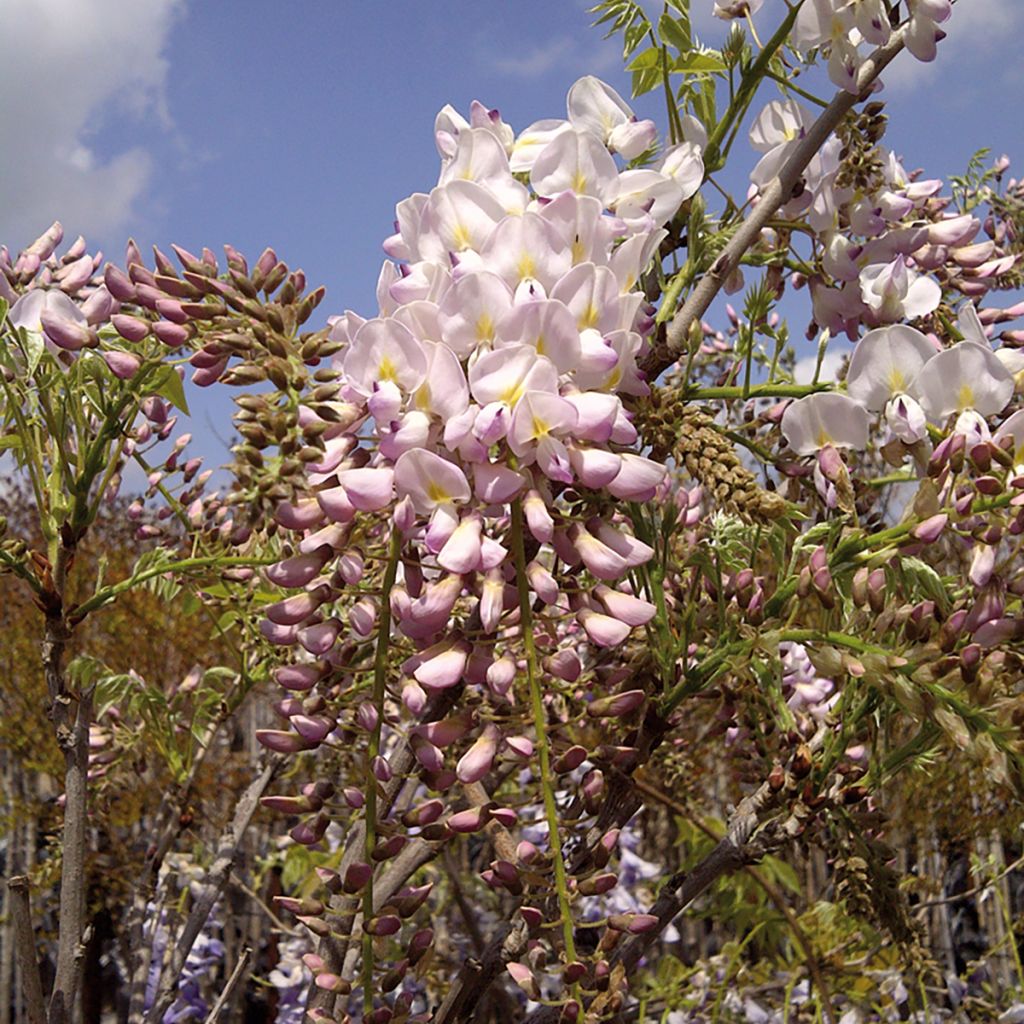
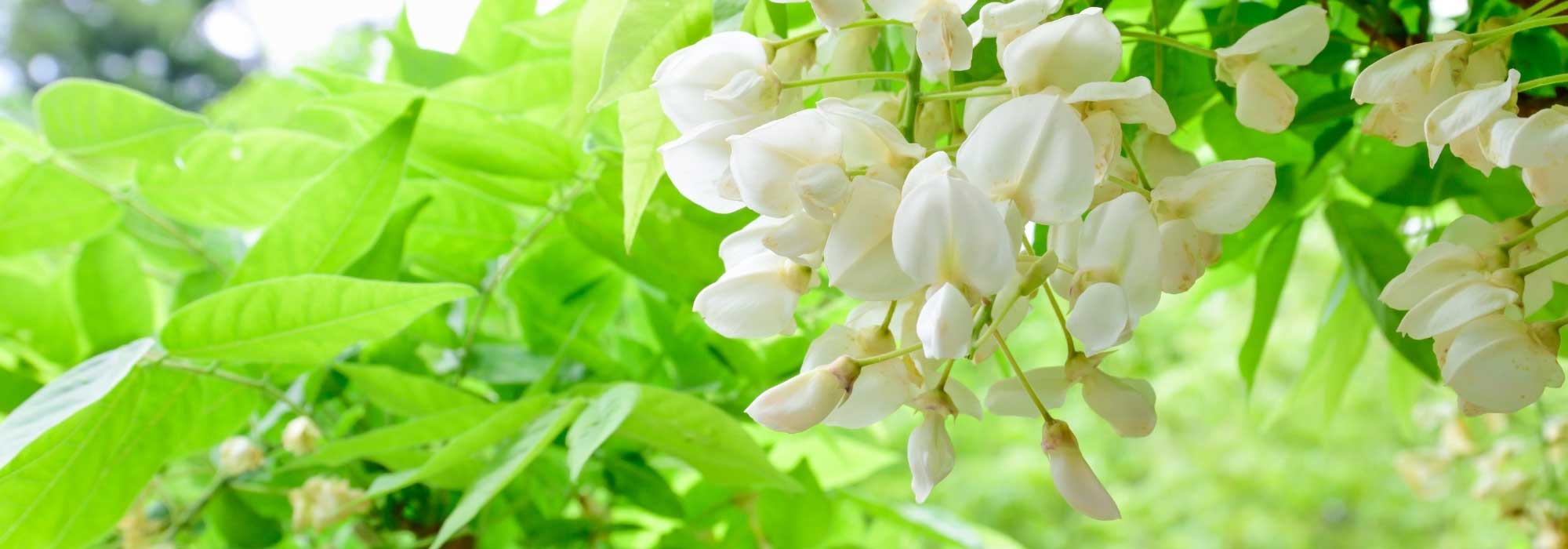
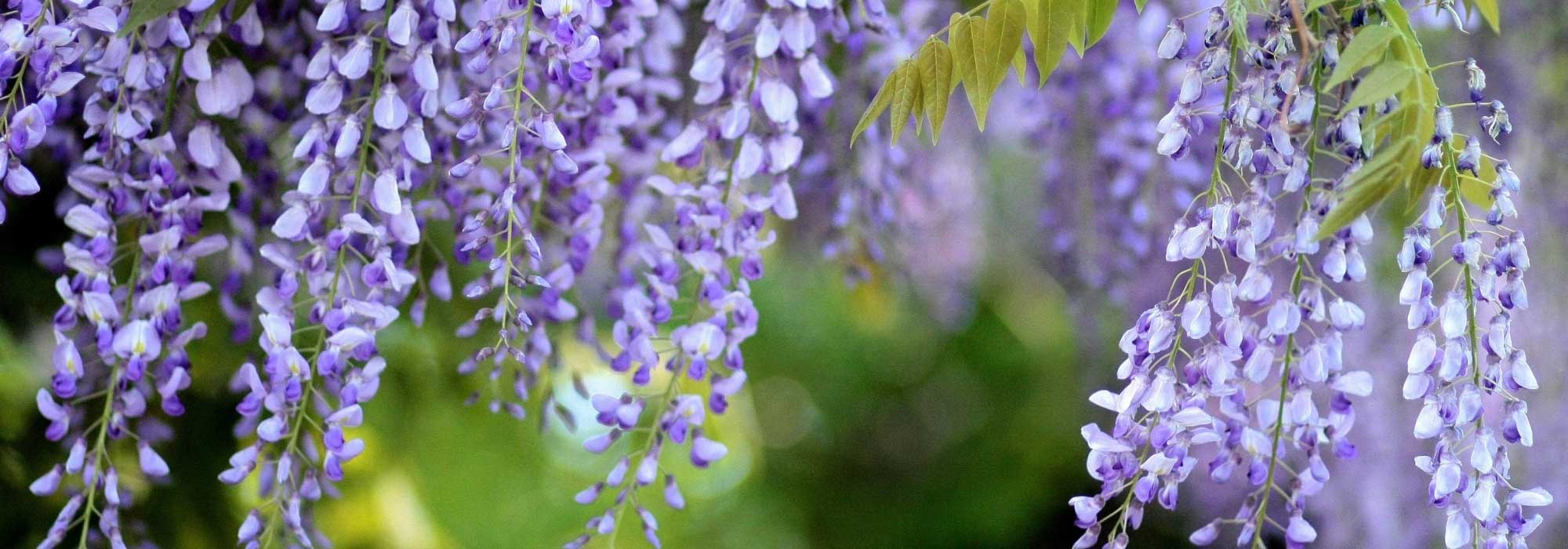
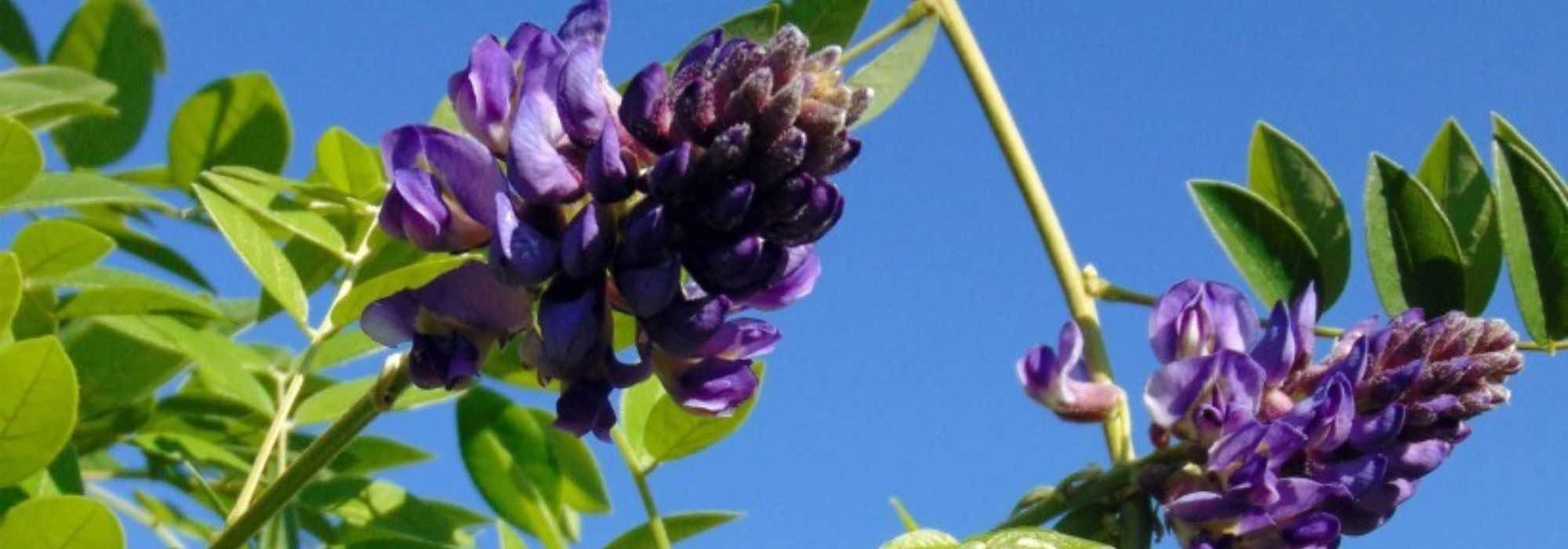
The Wisteria brachybotrys ‘Shiro-Beni’, or Silky Wisteria ‘Shiro-Beni’, is distinguished by its short clusters of very fragrant pale pink flowers in late spring. More compact than the large Japanese and Chinese wisterias, it is better suited to small gardens. It is trained to climb over pergolas, arches, or large pillars. This variety can be grown in a large container if pruned regularly. Its late flowering extends the wisteria season in the garden.
Belonging to the Fabaceae family, this ‘Shiro-Beni’ cultivar belongs to the species Wisteria brachybotrys (synonymous with Wisteria venusta in the broad sense), a deciduous liana native to Japan; its species name, from Greek, brachybotrys means "short clusters".
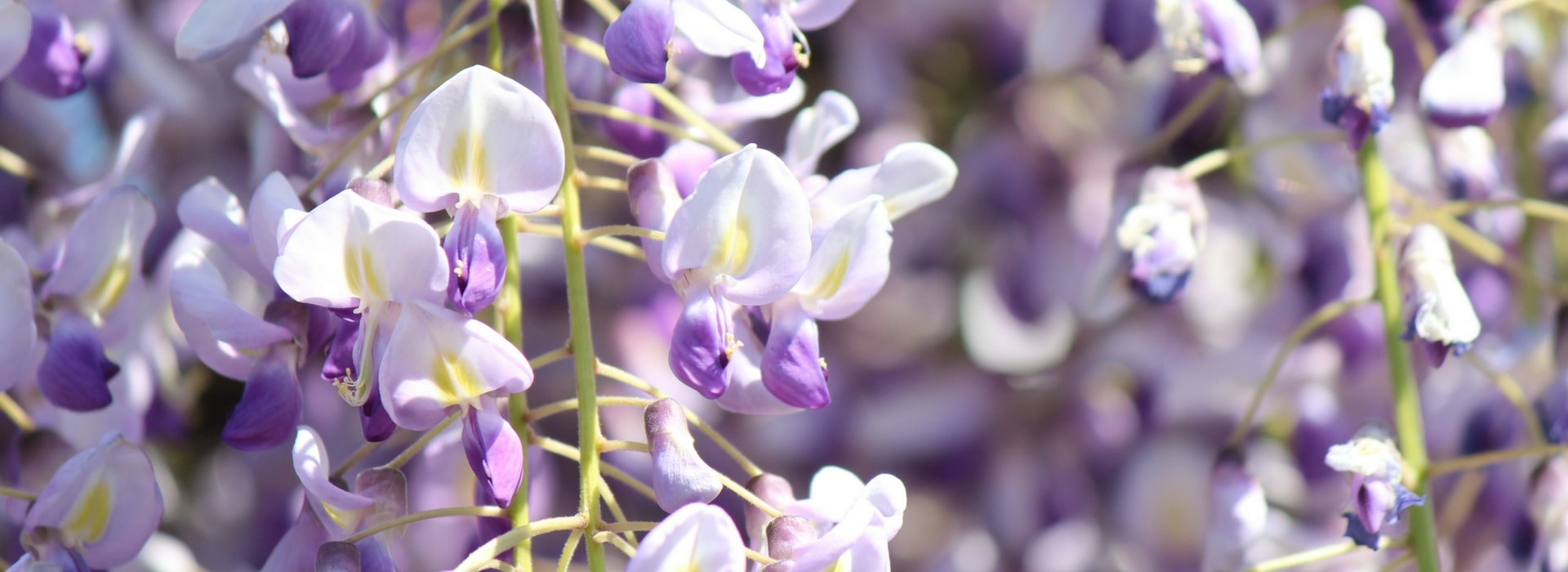
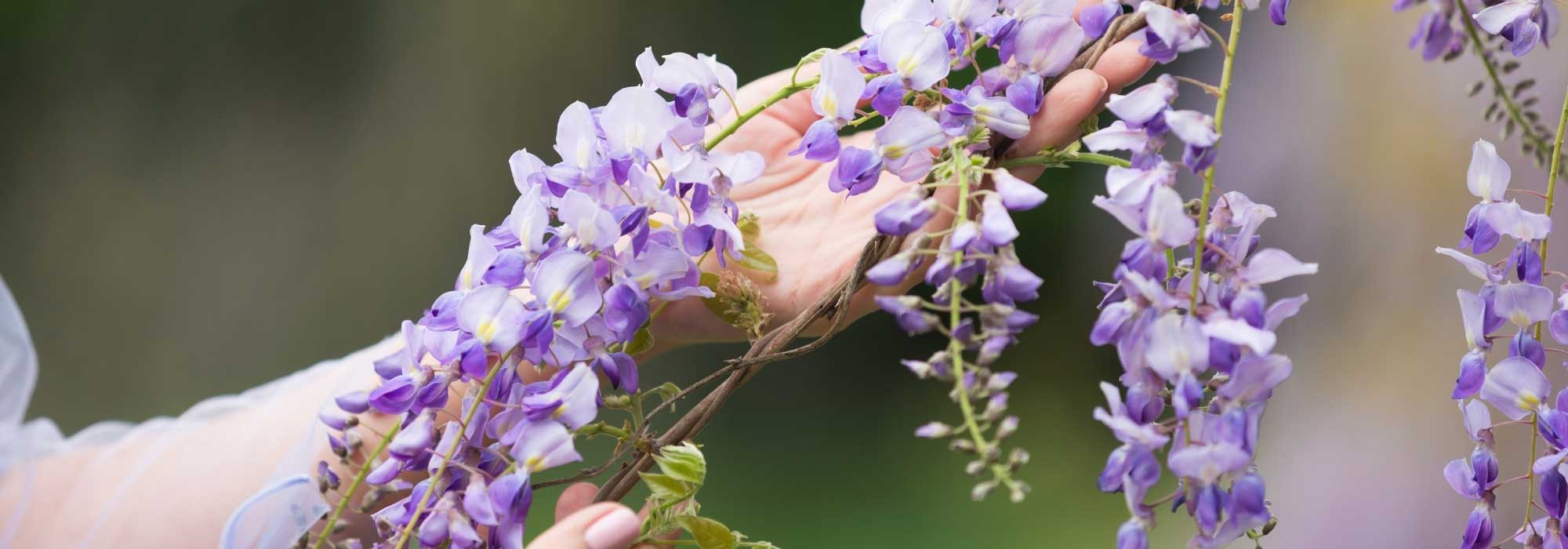
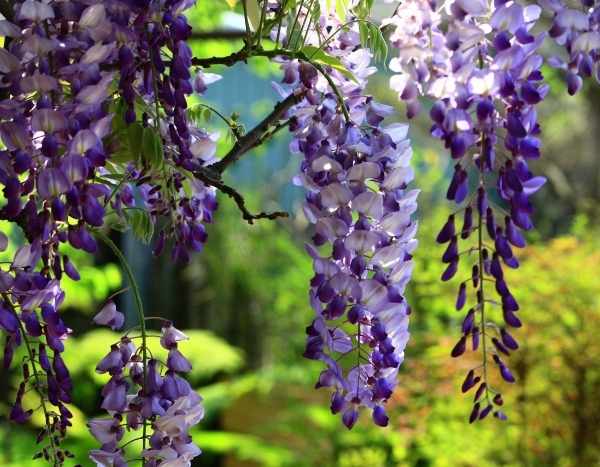
‘Shiro-Beni’ is a horticultural selection of Japanese origin. Compared to the type, it is characterised by shorter clusters, a soft pink hue, and a well-pronounced fragrance. It is a voluble plant, which stems twine in an anticlockwise direction. Its growth is rapid in the first years; in open ground, it climbs to 5–6 m and spreads to 3–4 m; you can expect 4–5 m by the age of 10 years in favourable conditions. The inflorescences are pendulous clusters or racemes measuring 10 to 14 cm long and 7 to 10 cm wide. The dark pink buds open into papilionaceous flowers of pale pink with a yellow eye, very fragrant, especially in the evening. Almost all the flowers open at the same time on the cluster. Flowering occurs from late May to June, with a slight secondary flush sometimes occurring in late summer depending on the climate. Fruiting produces velvety pods of 15–18 cm that ripen in autumn and may persist into winter; the seeds are toxic if ingested.
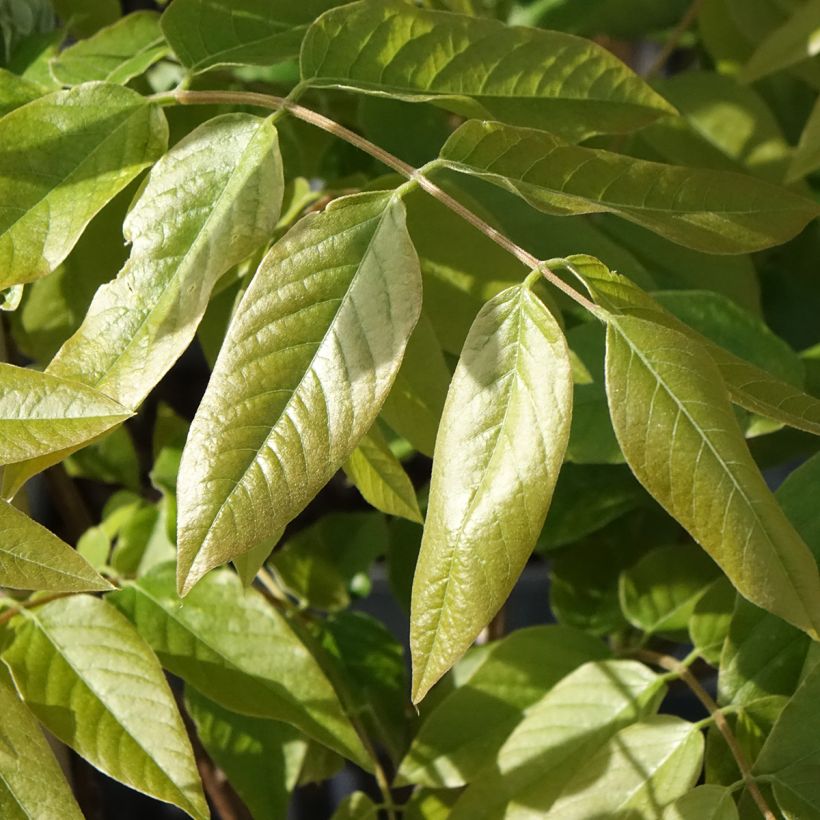
The leaves, 20–35 cm long, composed of 9 to 13 ovate to lanceolate leaflets, are downy on both sides when young; the lamina, of a bright green, turns yellow in autumn before falling. The young stems are silky, the bark becomes grey-brown with age. The root system is powerful and running, capable of exploring deeply and laterally; suckers may develop from the stump; avoid planting the wisteria near pipes and fragile masonry. The hardiness of this variety reaches −20°C; it requires a cool but well-drained soil, tolerates some drought once established, and flowers better in the sun.
Install the Wisteria ‘Shiro-Beni’ on a sturdy pergola, railing, or a strong wall cable, sheltered from prevailing winds. In a medium-sized garden, pair its clusters of soft pink flowers with white or purple blooms: Wisteria venusta with white flowers, the wisteria 'Honbeni' (or 'Rosea') for a deeper pink, a Clematis viticella ‘Etoile Violette’ or a climbing rose 'The Generous Gardener' to spread out the flowering season. In a large container, provide it with a robust structure and prune it fairly hard.
Wisteria brachybotrys 'Shiro-Beni' - Glycine soyeuse Shiro-Beni, Glycine japonaise Shiro-Beni in pictures
Plant habit
Flowering
Foliage
Botanical data
Wisteria
brachybotrys
'Shiro-Beni'
Fabaceae
Wisteria venusta 'Shiro-Beni'
Cultivar or hybrid
Planting and care
Wisteria 'Shiro-Beni' is best planted in autumn or early spring. Plant it in a sunny spot, in deep, well-drained soil that is not too chalky. Loosen the garden soil to a depth of 60 to 80 cm, mix in some well-rotted compost, add a layer of gravel at the bottom for drainage if clay predominates, and set the collar at soil level. Install a very sturdy support at the time of planting. Water generously in the first year, then reduce watering once the plant is well-established; mulch to retain moisture, avoid nitrogen-rich fertilisers which promote wood growth at the expense of flowers, and instead apply a light, potash-rich feed in spring. Keep the stump at least 1 m away from fragile masonry.
In containers, choose a pot with a minimum capacity of 40 to 60 L with drainage holes and install a robust stake, such as a very thick bamboo cane. Use a fertile, free-draining growing medium (potting compost + sieved compost + pumice), water regularly from spring to autumn without letting water sit in the saucer, apply a low-nitrogen 'rose or tomato' fertiliser from May to July, and repot or top-dress every 2–3 years. Protect the pot from severe frost in winter and tie in young shoots to form a good framework.
Planting period
Intended location
Care
Planting & care advice


This item has not been reviewed yet - be the first to leave a review about it.
Recently viewed products
Haven't found what you were looking for?
Hardiness is the lowest winter temperature a plant can endure without suffering serious damage or even dying. However, hardiness is affected by location (a sheltered area, such as a patio), protection (winter cover) and soil type (hardiness is improved by well-drained soil).

The flowering period indicated on our website applies to countries and regions located in USDA zone 8 (France, the United Kingdom, Ireland, the Netherlands, etc.)
It will vary according to where you live:- In zones 9 to 10 (Italy, Spain, Greece, etc.), flowering will occur about 2 to 4 weeks earlier.
- In zones 6 to 7 (Germany, Poland, Slovenia, and lower mountainous regions), flowering will be delayed by 2 to 3 weeks.
- In zone 5 (Central Europe, Scandinavia), blooming will be delayed by 3 to 5 weeks.
In temperate climates, pruning of spring-flowering shrubs (forsythia, spireas, etc.) should be done just after flowering.
Pruning of summer-flowering shrubs (Indian Lilac, Perovskia, etc.) can be done in winter or spring.
In cold regions as well as with frost-sensitive plants, avoid pruning too early when severe frosts may still occur.
The planting period indicated on our website applies to countries and regions located in USDA zone 8 (France, United Kingdom, Ireland, Netherlands).
It will vary according to where you live:
- In Mediterranean zones (Marseille, Madrid, Milan, etc.), autumn and winter are the best planting periods.
- In continental zones (Strasbourg, Munich, Vienna, etc.), delay planting by 2 to 3 weeks in spring and bring it forward by 2 to 4 weeks in autumn.
- In mountainous regions (the Alps, Pyrenees, Carpathians, etc.), it is best to plant in late spring (May-June) or late summer (August-September).
The harvesting period indicated on our website applies to countries and regions in USDA zone 8 (France, England, Ireland, the Netherlands).
In colder areas (Scandinavia, Poland, Austria...) fruit and vegetable harvests are likely to be delayed by 3-4 weeks.
In warmer areas (Italy, Spain, Greece, etc.), harvesting will probably take place earlier, depending on weather conditions.
The sowing periods indicated on our website apply to countries and regions within USDA Zone 8 (France, UK, Ireland, Netherlands).
In colder areas (Scandinavia, Poland, Austria...), delay any outdoor sowing by 3-4 weeks, or sow under glass.
In warmer climes (Italy, Spain, Greece, etc.), bring outdoor sowing forward by a few weeks.
Shipping country and language
Your country of residence may be:
Your country of residence is:
For a better user experience on our website, you can select:
Your shipping country:
-
 Austria
-
 Belgium
-
 Bosnia & Herzegovina
-
 Bulgaria
-
 Croatia
-
 Cyprus
-
 Czechia
-
 Denmark
-
 Estonia
-
 Finland
-
 France
-
 Germany
-
 Greece
-
 Hungary
-
 Iceland
-
 Ireland
-
 Italy
Italy
-
 Latvia
-
 Liechtenstein
-
 Lithuania
-
 Luxembourg
-
 Malta
Malta
-
 Netherlands
-
 Poland
-
 Portugal
-
 Romania
-
 Serbia
-
 Slovakia
-
 Slovenia
-
 Spain
Spain
-
 Sweden
-
 Switzerland
Language:
-
French
-
 English
-
Spanish
-
Italian
-
German
-
Portuguese
-
Dutch
-
Finnish
My Account
Hello
My wish lists
My cart
Log in / Register
Existing customer?
This form is protected by reCAPTCHA - the Google Privacy Policy and Terms of Service apply.
New customer?
Create an account to track your orders, access our customer service and, if you wish, make the most of our upcoming offers.