





























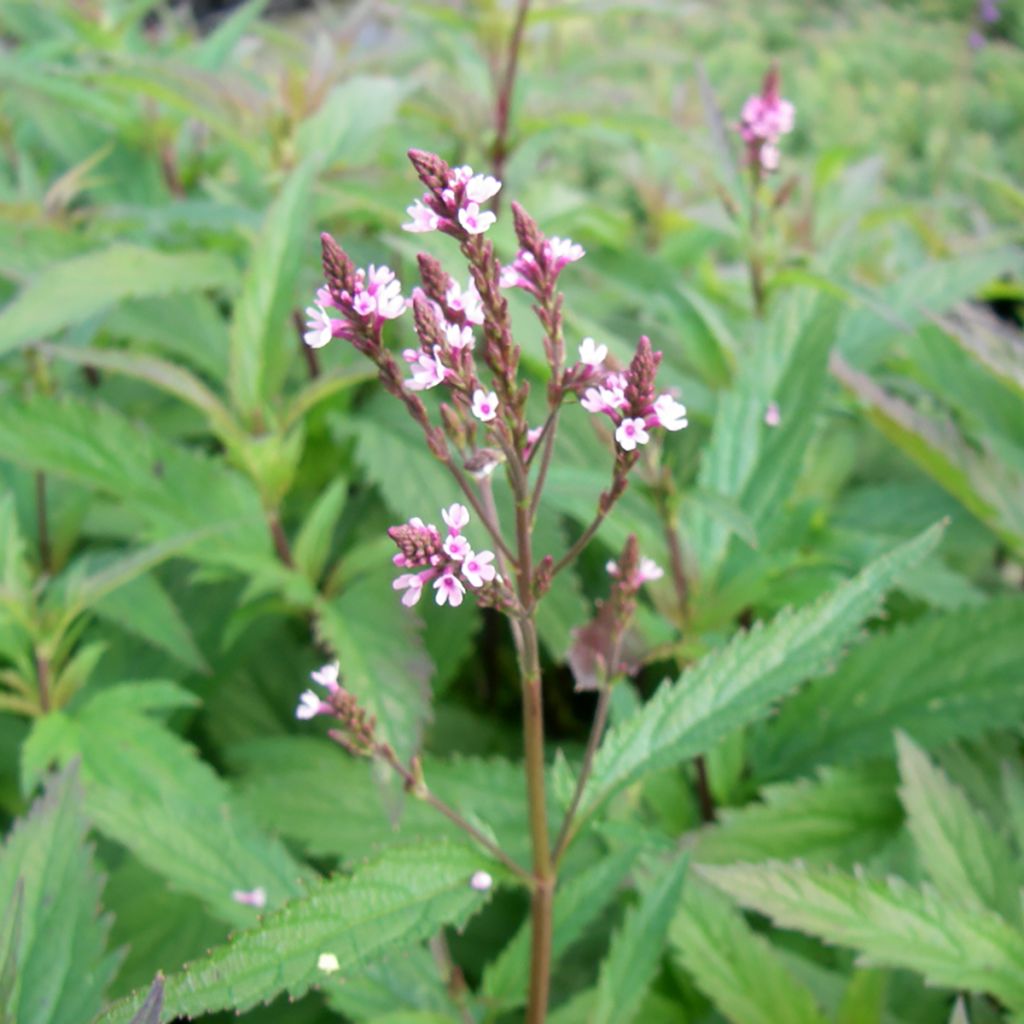
Verbena hastata Pink Spires ervain
Verbena hastata Pink Spires ervain
Verbena hastata Pink Spires
Blue Vervain, Ironweed, Wild Hyssop
Special offer!
Receive a €20 voucher for any order over €90 (excluding delivery costs, credit notes, and plastic-free options)!
1- Add your favorite plants to your cart.
2- Once you have reached €90, confirm your order (you can even choose the delivery date!).
3- As soon as your order is shipped, you will receive an email containing your voucher code, valid for 3 months (90 days).
Your voucher is unique and can only be used once, for any order with a minimum value of €20, excluding delivery costs.
Can be combined with other current offers, non-divisible and non-refundable.
Home or relay delivery (depending on size and destination)
Schedule delivery date,
and select date in basket
This plant carries a 12 months recovery warranty
More information
We guarantee the quality of our plants for a full growing cycle, and will replace at our expense any plant that fails to recover under normal climatic and planting conditions.
Would this plant suit my garden?
Set up your Plantfit profile →
Description
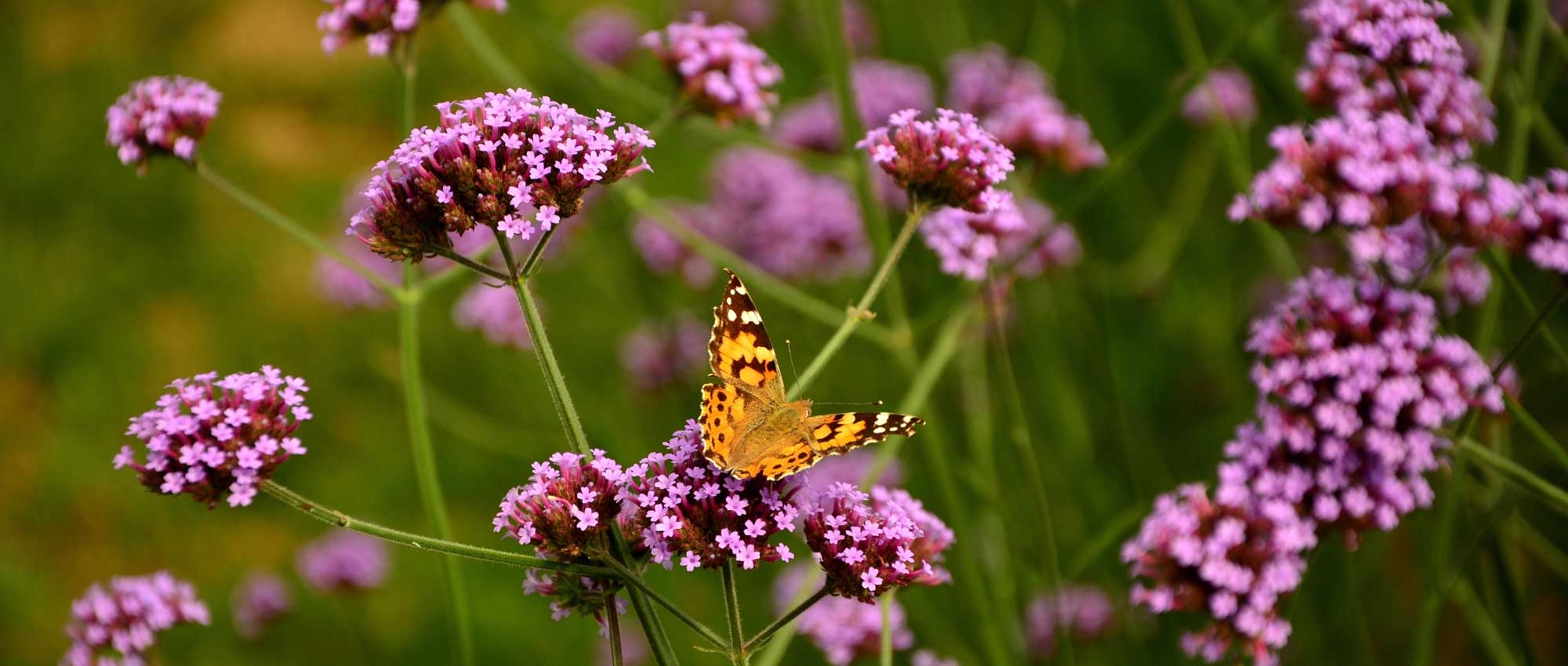
Verbena hastata 'Pink Spires' is a pink horticultural variety of Blue Vervain, a wild North American plant with blue-violet flowers. Its long flowering period, which begins in late spring and stretches into early autumn, is particularly striking. Its pink spikes stand like candelabras above the beautiful, deep, glossy green foliage. Perfect for adding a vertical accent within a flower bed, it delights butterflies and other pollinators, thus promoting biodiversity in the garden. Well-suited to moist to wet soils, even at the water's edge, it thrives in full sun and is absolutely unfazed by the cold.
Vervain (Verbena) is a member of the Verbenaceae family, from which it gets its name, and which is notably represented in southern gardens by the delightful Lantana, also used as annuals elsewhere, or Duranta with its magnificent violet flowering followed by decorative yellow fruits. The Verbena genus comprises approximately 125 species, from annuals to perennials, with habits that can be carpeting (Verbena tenuisecta), more or less mounded, or distinctly upright, as in V. hastata, and hardiness that is equally variable, ranging from intolerance to frost to resistance to cold of around -30°C!
Native to Canada and the United States, Blue Vervain colonises moist soils and all damp environments, such as riverbanks or floodplain forests in its natural habitat, earning it the English name Swamp Verbena.
Verbena hastata 'Pink Spires' quickly forms a beautiful, dense clump with erect, quadrangular stems, reaching 90 cm to over 1.20 m in height when in flower, with a spread of 40 to 50 cm. As its species name indicates, it bears hastate leaves, that is, shaped like a spearhead, with a very elongated lanceolate leaf blade with two small divergent lobes at its base. The deep to dark green, opposite leaves are coarsely toothed with prominent veins. They measure 10 to 13 cm in length and about 2.5 cm in width. This mass of foliage is dominated from June by flowering stems that branch to give about a dozen 10 to 15 cm long spikes. They bear very numerous small pink flowers, with 5 petals, which bloom from the bottom upwards, giving a very characteristic appearance to the plant. The open flowers are topped by closed buds, giving this tall perennial a wild and graceful look. Flowering continues until September, attracting bees and butterflies, and promoting a dynamic, living ecosystem. It is followed by the formation of small, hard, elongated fruits; the plant self-seeds easily when the seeds are released. Furthermore, the original plant spreads along the ground by its rootstocks, potentially forming small colonies under favourable conditions.
Blue Vervain Pink Spires is a perfect plant for naturalistic gardens that favour plants with a wild appearance over very "cultivated" ones. It is particularly suited to moist soils, even at the water's edge. You can plant it alongside Carex flacca 'Blue Zinger', a variety of Sedge with glaucous foliage that also has a very natural look. Filipendula purpurea 'Alba', a purple Meadowsweet with an airy, white, barely pink flowering, will be equally at home in this rustic setting. Eupatorium cannabinum 'Plenum', whose tall stems are crowned with floral corymbs in an old rose colour, will complete your scene and please wild pollinators as much as your Vervain.
Flowering
Foliage
Plant habit
Botanical data
Verbena
hastata
Pink Spires
Verbenaceae
Blue Vervain, Ironweed, Wild Hyssop
Cultivar or hybrid
Planting and care
Plant Verbena hastata 'Pink Spires' in any ordinary, neutral, acidic, or calcareous soil, as it is not very sensitive to pH. However, it prefers damp to moist, loamy, and fertile ground. If your soil is sometimes dry in summer, or if you plant it in a container, you will need to water it regularly during the growing season. In this case, you can also apply a mulch at its base to maintain some moisture in summer. Choose a sunny location; it will tolerate light shade in very hot regions. Remove faded flowers to limit self-seeding.
Planting period
Intended location
Care
Planting & care advice
-
-
-
-
-
-
-
-

This item has not been reviewed yet - be the first to leave a review about it.
Similar products
Available in 2 sizes
Available in 3 sizes

Available in 1 sizes

Available in 0 sizes
Available in 2 sizes
Available in 3 sizes
Available in 1 sizes
Available in 1 sizes
Available in 2 sizes

Available in 1 sizes
Haven't found what you were looking for?
Hardiness is the lowest winter temperature a plant can endure without suffering serious damage or even dying. However, hardiness is affected by location (a sheltered area, such as a patio), protection (winter cover) and soil type (hardiness is improved by well-drained soil).

Photo Sharing Terms & Conditions
In order to encourage gardeners to interact and share their experiences, Promesse de fleurs offers various media enabling content to be uploaded onto its Site - in particular via the ‘Photo sharing’ module.
The User agrees to refrain from:
- Posting any content that is illegal, prejudicial, insulting, racist, inciteful to hatred, revisionist, contrary to public decency, that infringes on privacy or on the privacy rights of third parties, in particular the publicity rights of persons and goods, intellectual property rights, or the right to privacy.
- Submitting content on behalf of a third party;
- Impersonate the identity of a third party and/or publish any personal information about a third party;
In general, the User undertakes to refrain from any unethical behaviour.
All Content (in particular text, comments, files, images, photos, videos, creative works, etc.), which may be subject to property or intellectual property rights, image or other private rights, shall remain the property of the User, subject to the limited rights granted by the terms of the licence granted by Promesse de fleurs as stated below. Users are at liberty to publish or not to publish such Content on the Site, notably via the ‘Photo Sharing’ facility, and accept that this Content shall be made public and freely accessible, notably on the Internet.
Users further acknowledge, undertake to have ,and guarantee that they hold all necessary rights and permissions to publish such material on the Site, in particular with regard to the legislation in force pertaining to any privacy, property, intellectual property, image, or contractual rights, or rights of any other nature. By publishing such Content on the Site, Users acknowledge accepting full liability as publishers of the Content within the meaning of the law, and grant Promesse de fleurs, free of charge, an inclusive, worldwide licence for the said Content for the entire duration of its publication, including all reproduction, representation, up/downloading, displaying, performing, transmission, and storage rights.
Users also grant permission for their name to be linked to the Content and accept that this link may not always be made available.
By engaging in posting material, Users consent to their Content becoming automatically accessible on the Internet, in particular on other sites and/or blogs and/or web pages of the Promesse de fleurs site, including in particular social pages and the Promesse de fleurs catalogue.
Users may secure the removal of entrusted content free of charge by issuing a simple request via our contact form.
The flowering period indicated on our website applies to countries and regions located in USDA zone 8 (France, the United Kingdom, Ireland, the Netherlands, etc.)
It will vary according to where you live:
- In zones 9 to 10 (Italy, Spain, Greece, etc.), flowering will occur about 2 to 4 weeks earlier.
- In zones 6 to 7 (Germany, Poland, Slovenia, and lower mountainous regions), flowering will be delayed by 2 to 3 weeks.
- In zone 5 (Central Europe, Scandinavia), blooming will be delayed by 3 to 5 weeks.
In temperate climates, pruning of spring-flowering shrubs (forsythia, spireas, etc.) should be done just after flowering.
Pruning of summer-flowering shrubs (Indian Lilac, Perovskia, etc.) can be done in winter or spring.
In cold regions as well as with frost-sensitive plants, avoid pruning too early when severe frosts may still occur.
The planting period indicated on our website applies to countries and regions located in USDA zone 8 (France, United Kingdom, Ireland, Netherlands).
It will vary according to where you live:
- In Mediterranean zones (Marseille, Madrid, Milan, etc.), autumn and winter are the best planting periods.
- In continental zones (Strasbourg, Munich, Vienna, etc.), delay planting by 2 to 3 weeks in spring and bring it forward by 2 to 4 weeks in autumn.
- In mountainous regions (the Alps, Pyrenees, Carpathians, etc.), it is best to plant in late spring (May-June) or late summer (August-September).
The harvesting period indicated on our website applies to countries and regions in USDA zone 8 (France, England, Ireland, the Netherlands).
In colder areas (Scandinavia, Poland, Austria...) fruit and vegetable harvests are likely to be delayed by 3-4 weeks.
In warmer areas (Italy, Spain, Greece, etc.), harvesting will probably take place earlier, depending on weather conditions.
The sowing periods indicated on our website apply to countries and regions within USDA Zone 8 (France, UK, Ireland, Netherlands).
In colder areas (Scandinavia, Poland, Austria...), delay any outdoor sowing by 3-4 weeks, or sow under glass.
In warmer climes (Italy, Spain, Greece, etc.), bring outdoor sowing forward by a few weeks.