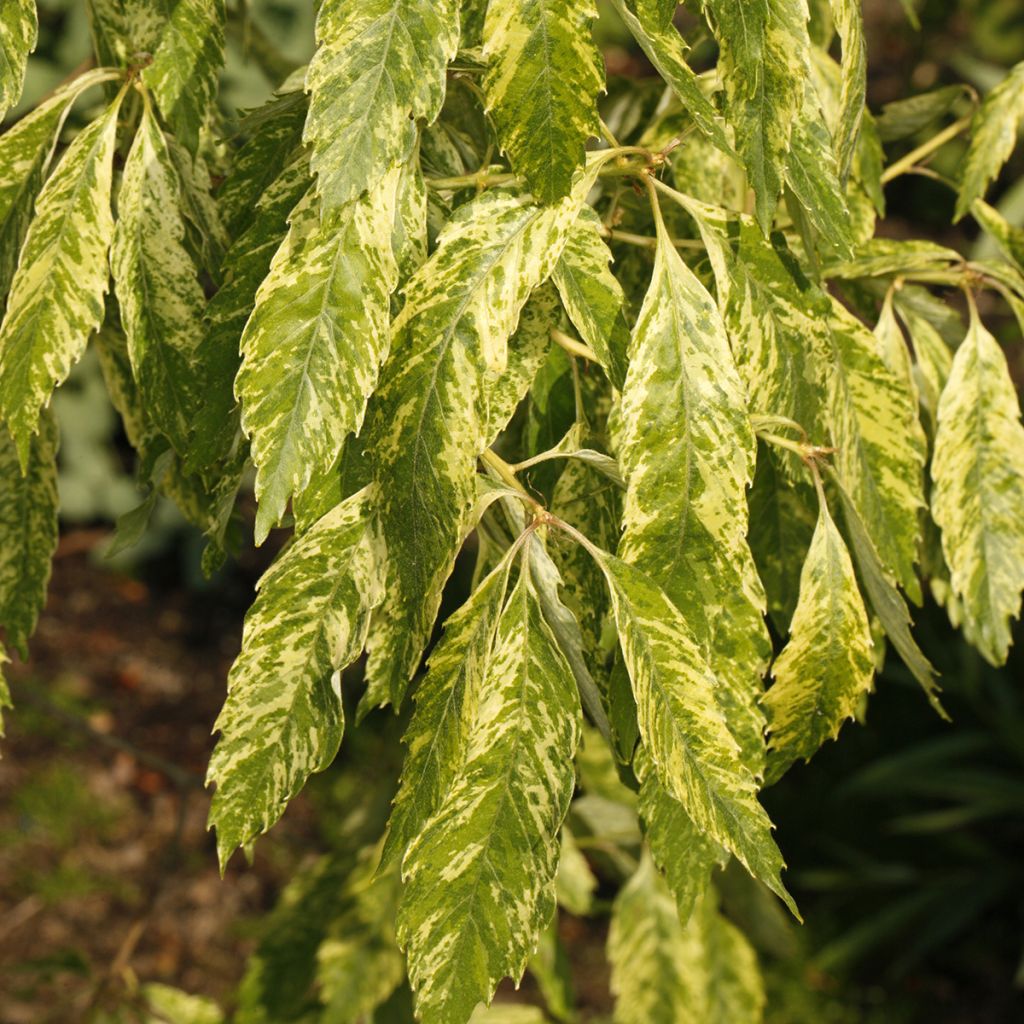
Quercus serrata Ishii
Quercus serrata Ishii
Quercus serrata Ishii
Oak
Back-to-school special offer!
Get €10 off for every €50 you spend! And get up to €40 off on a single order.
How does it work?
1. Shop your favourites
Add your favourite plants to your basket. For every €50 you spend (excluding delivery charges, store credit and the plastic-free option), you’ll receive a €10 voucher.
€50 spent = €10 voucher
€100 spent = €20 voucher
€150 spent = €30 voucher
€200 spent = €40 voucher
2. Place your order
Once your basket reaches one of the spending thresholds, place your order. You can even choose your delivery date!
3. Receive your voucher
As soon as your order has been shipped, you’ll receive an email containing your personal voucher code and its value.
4. Use it on your next order
Your voucher is valid for 90 days from the date you receive it. It can be used once only, on a new order worth at least the value of the voucher, excluding delivery charges.
Please note: Vouchers can be combined with other offers, but cannot be split or refunded.
Why not try an alternative variety in stock?
View all →
Available in 1 sizes
Available in 2 sizes
Available in 3 sizes
Available in 1 sizes
Available in 4 sizes
Available in 1 sizes
Available in 4 sizes
Available in 1 sizes
Available in 1 sizes
Available in 1 sizes
This plant carries a 24 months recovery warranty
More information
We guarantee the quality of our plants for a full growing cycle, and will replace at our expense any plant that fails to recover under normal climatic and planting conditions.
Would this plant suit my garden?
Set up your Plantfit profile →
Description
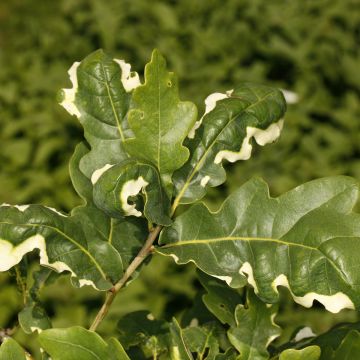
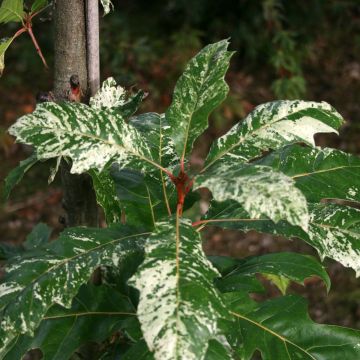
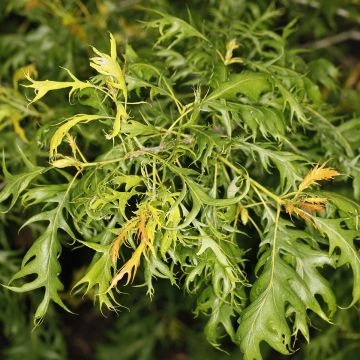
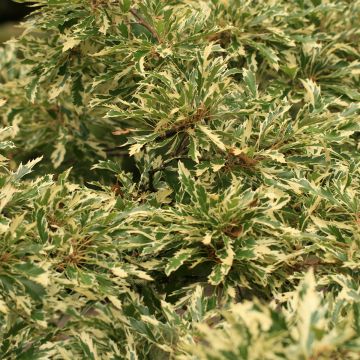
The Quercus serrata 'Ishii' is a rare Japanese selection of the Dentate Oak in cultivation characterised by a small size and variegated foliage of great elegance. In its youth, Pyramidal developed a more spreading crown, similar to some Japanese maples. This small tree has glossy, toothed green leaves, pale yellow, and cream white, which colour beautifully in autumn before falling. Its bark, which cracks over time, is not without interest. Hardy and undemanding in terms of soil, this refined-looking oak will find its place more easily in small gardens.
The Quercus serrata 'Ishii' is derived from a botanical species called the Korean Oak, Jolcham Oak, or Dentate Oak. Like all oaks, it belongs to the fagaceae family. This species, native to China, Japan, and Korea, was introduced to Europe in 1983 by Charles Sargent. In nature, it grows in deciduous forests, on sometimes rocky soils, up to 2000 m altitude. Preferring warmth but perfectly hardy, this tree adapts to any type of deep and well-drained soil, whether acidic, neutral, or alkaline. However, it does not tolerate severe droughts well and does not like to be moved. It is a monoecious oak, meaning there are male and female individuals. The 'Ishii' selection is female. To obtain acorns, a male or hermaphroditic oak nearby is necessary.
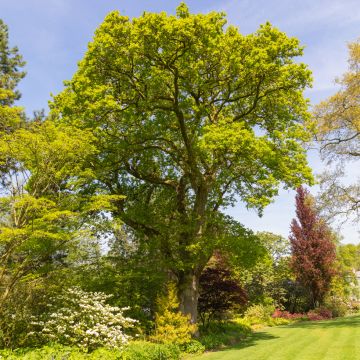
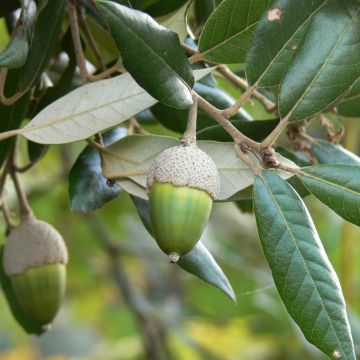
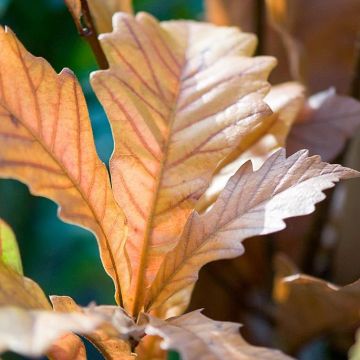
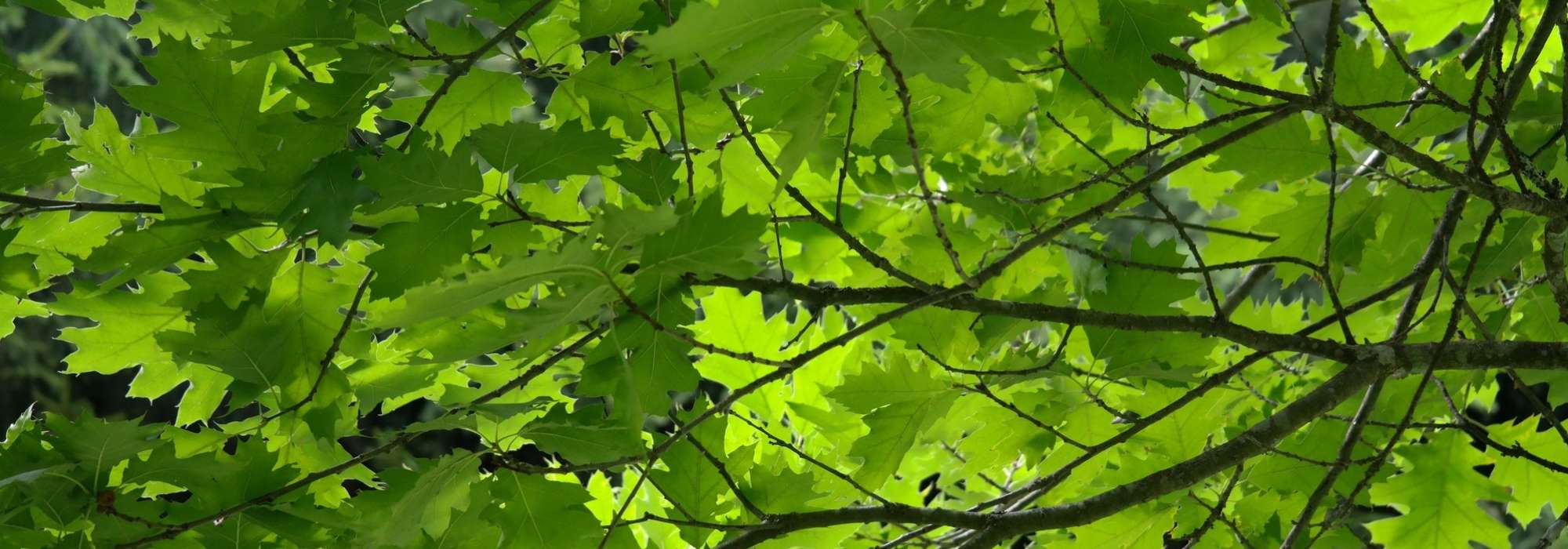
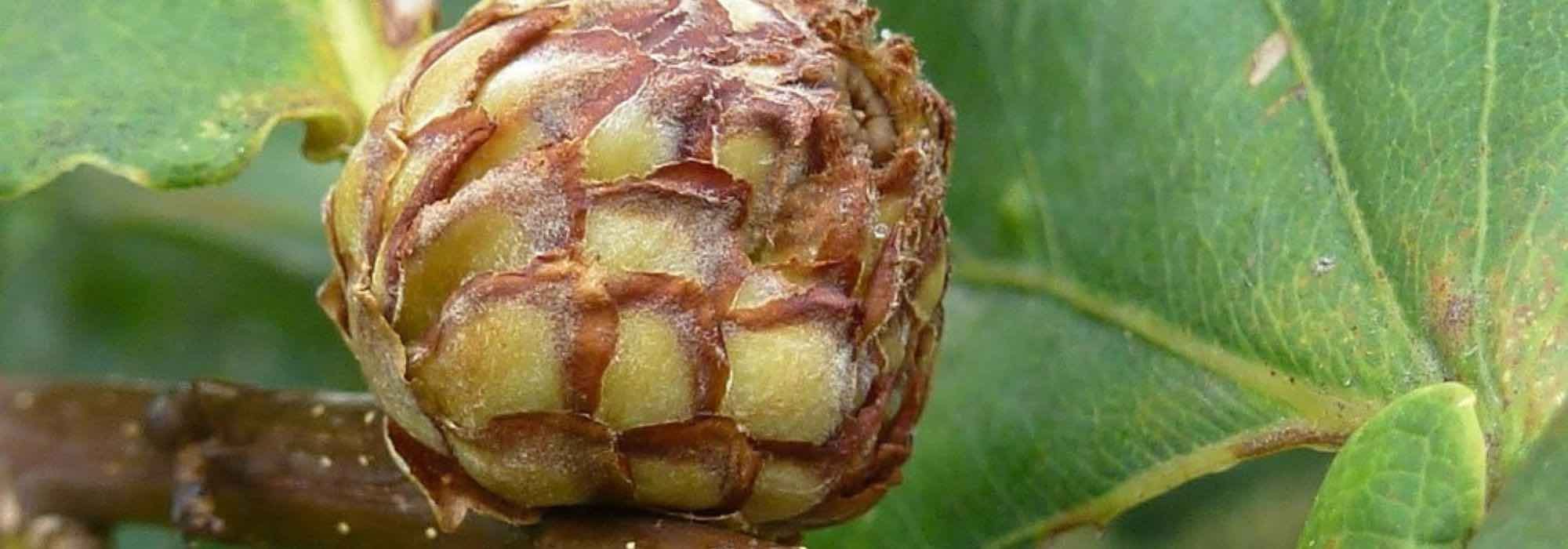
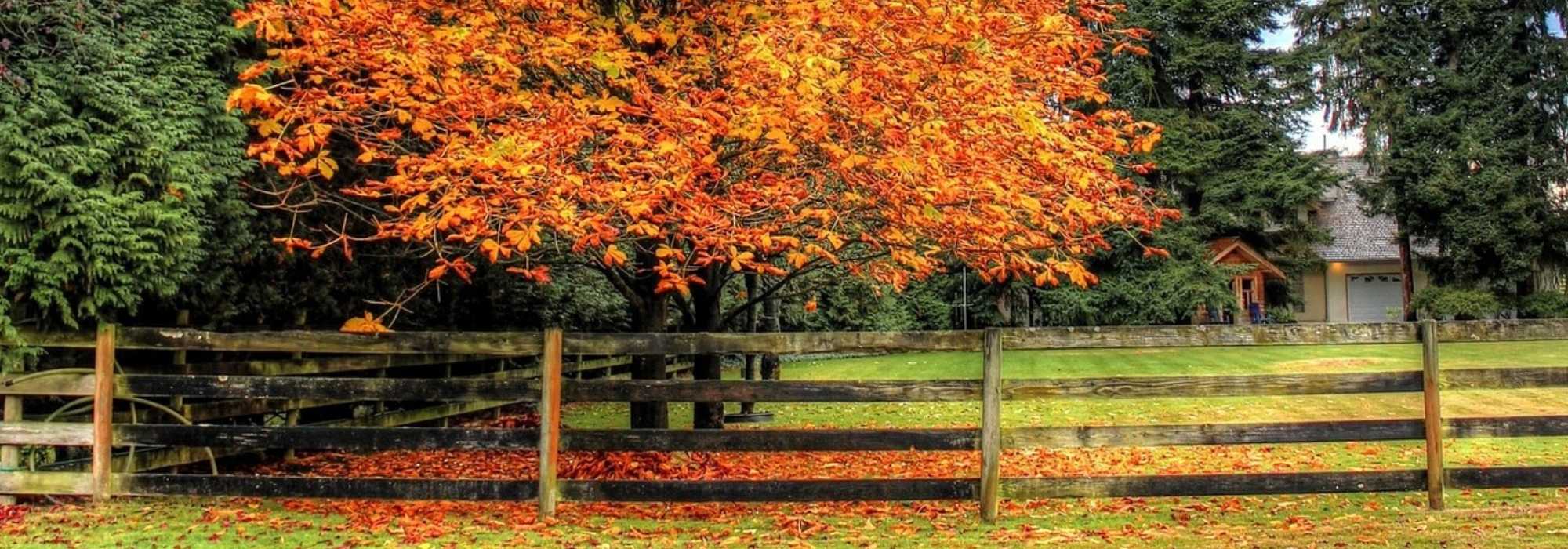
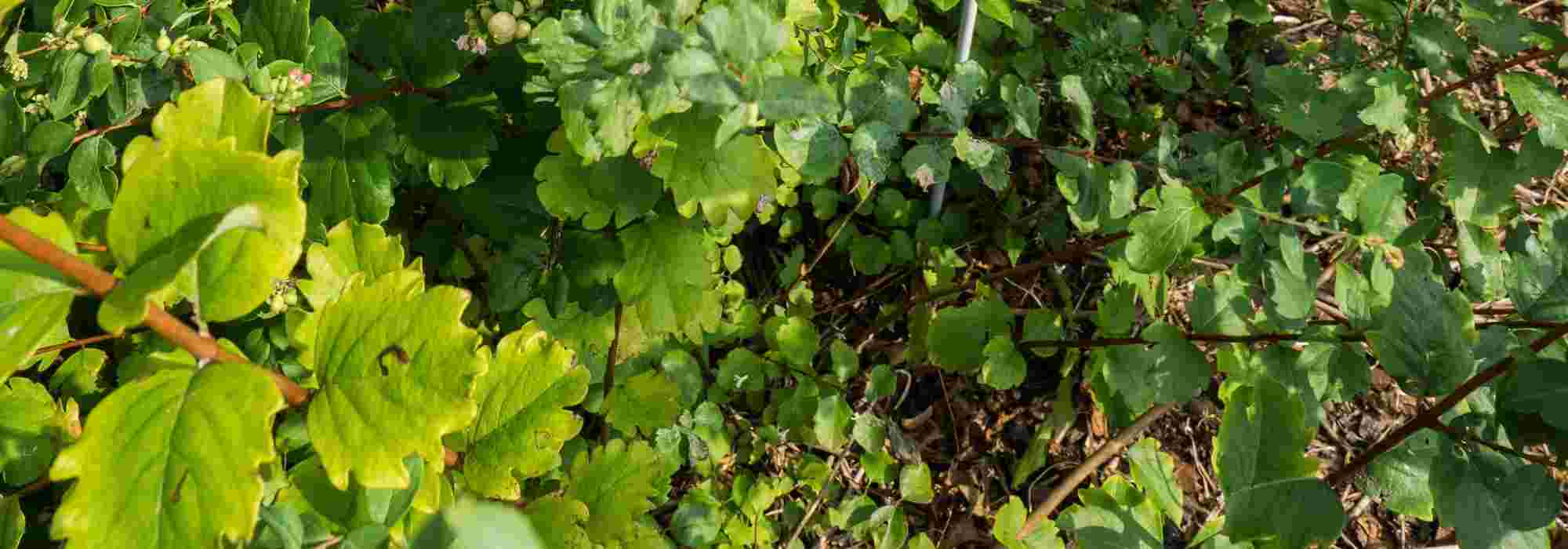
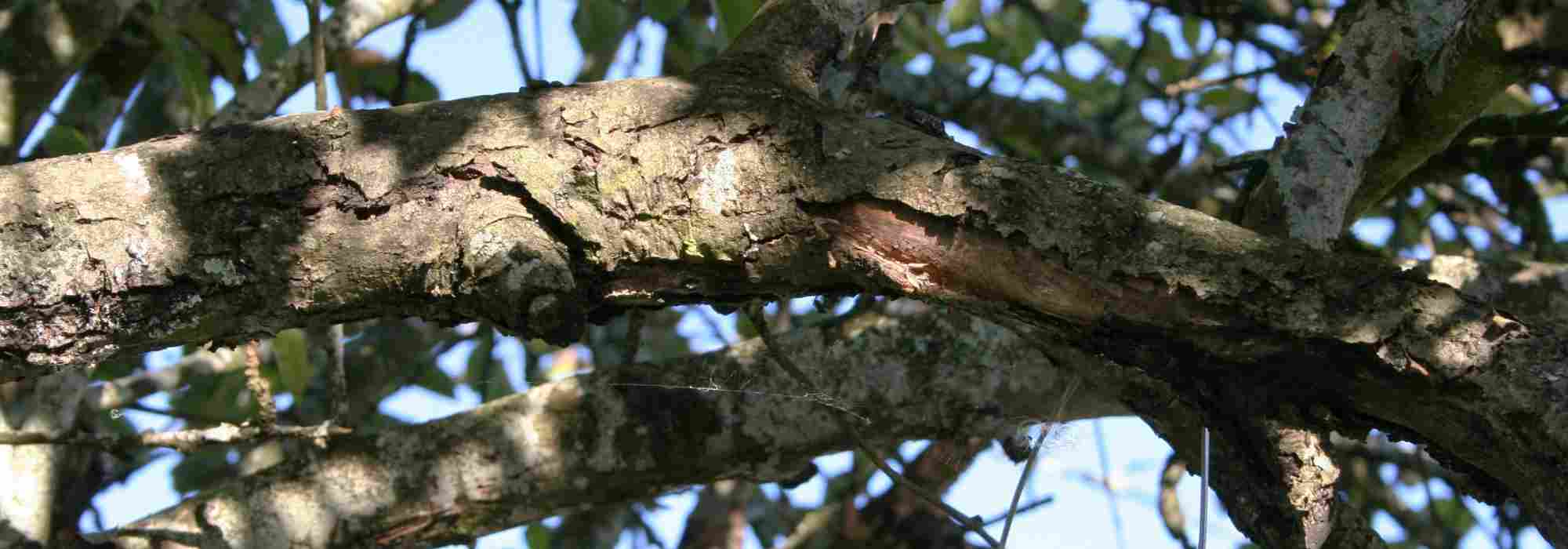
The growth of this 'Ishii' oak is prolonged; it will form a small tree about 4 m tall and 2 m wide on average at the age of 10. Its habit, initially conical in its youth, spreads more over the years. Its bark is grey or reddish-brown and longitudinally fissures with age. Its branches bear clusters of leaves at their ends. Each leaf, lanceolate in shape, narrow, with toothed edges, measures up to 10 cm long. When they emerge in spring, the very young leaves are pubescent and pale orange-brown. As they unfold, they show a beautiful variegation of cream white to pale yellow on a relatively dark green background. The upper surface of the leaves is slightly shiny, while the underside is greyish and somewhat pubescent. In autumn, their colour gradually changes to bronze and then brown. In spring, this oak produces small greenish female flowers grouped in catkins in April-May. Once pollinated, the flowers transform into solitary or paired acorns, which mature in 1 year. Its deep and robust root system, with a taproot type, provides a solid and long-lasting grip in the deep soils it prefers.
The Quercus serrata 'Ishii' deserves a prominent place in the garden, in a not-too-scorching exposure that could damage its beautiful variegated foliage. It should be planted in isolation to showcase it. It naturally fits into a Japanese-style garden in front of a bamboo curtain, accompanied by Nandinas and small conifers (Chamaecyparis Lawsoniana Yellow Spire, Chamaecyparis obtusa Chirimen). To accompany its beautiful foliage from spring to autumn, one can also choose from numerous infinitely refined Asian flowering shrubs, such as Japanese cherry trees and apricots, star magnolias, or autumn camellias, which require the same growing conditions.
Plant habit
Flowering
Foliage
Botanical data
Quercus
serrata
Ishii
Fagaceae
Oak
Southeast Asia
Planting and care
The Quercus serrata 'Ishii' grows in deep, relatively fertile soil, whether acidic, neutral or chalky. Tolerant to the nature of the soil, it does not like prolonged droughts or very clayey soils that are waterlogged in winter. It enjoys hot summers and prefers sunny exposures (4 to 5 hours of sun per day), but does not like scorching exposures that damage its variegated foliage. Protect it during dry summers and in the years following planting by regularly watering it deeply and placing mulch at its base. Once well-rooted, it is a tree that requires very little maintenance.
Planting period
Intended location
Care
Planting & care advice
-
-

-
-
-
-
-
-

This item has not been reviewed yet - be the first to leave a review about it.
Recently viewed products
Haven't found what you were looking for?
Hardiness is the lowest winter temperature a plant can endure without suffering serious damage or even dying. However, hardiness is affected by location (a sheltered area, such as a patio), protection (winter cover) and soil type (hardiness is improved by well-drained soil).

The flowering period indicated on our website applies to countries and regions located in USDA zone 8 (France, the United Kingdom, Ireland, the Netherlands, etc.)
It will vary according to where you live:- In zones 9 to 10 (Italy, Spain, Greece, etc.), flowering will occur about 2 to 4 weeks earlier.
- In zones 6 to 7 (Germany, Poland, Slovenia, and lower mountainous regions), flowering will be delayed by 2 to 3 weeks.
- In zone 5 (Central Europe, Scandinavia), blooming will be delayed by 3 to 5 weeks.
In temperate climates, pruning of spring-flowering shrubs (forsythia, spireas, etc.) should be done just after flowering.
Pruning of summer-flowering shrubs (Indian Lilac, Perovskia, etc.) can be done in winter or spring.
In cold regions as well as with frost-sensitive plants, avoid pruning too early when severe frosts may still occur.
The planting period indicated on our website applies to countries and regions located in USDA zone 8 (France, United Kingdom, Ireland, Netherlands).
It will vary according to where you live:
- In Mediterranean zones (Marseille, Madrid, Milan, etc.), autumn and winter are the best planting periods.
- In continental zones (Strasbourg, Munich, Vienna, etc.), delay planting by 2 to 3 weeks in spring and bring it forward by 2 to 4 weeks in autumn.
- In mountainous regions (the Alps, Pyrenees, Carpathians, etc.), it is best to plant in late spring (May-June) or late summer (August-September).
The harvesting period indicated on our website applies to countries and regions in USDA zone 8 (France, England, Ireland, the Netherlands).
In colder areas (Scandinavia, Poland, Austria...) fruit and vegetable harvests are likely to be delayed by 3-4 weeks.
In warmer areas (Italy, Spain, Greece, etc.), harvesting will probably take place earlier, depending on weather conditions.
The sowing periods indicated on our website apply to countries and regions within USDA Zone 8 (France, UK, Ireland, Netherlands).
In colder areas (Scandinavia, Poland, Austria...), delay any outdoor sowing by 3-4 weeks, or sow under glass.
In warmer climes (Italy, Spain, Greece, etc.), bring outdoor sowing forward by a few weeks.
Shipping country and language
Your country of residence may be:
Your country of residence is:
For a better user experience on our website, you can select:
Your shipping country:
-
 Austria
-
 Belgium
-
 Bosnia & Herzegovina
-
 Bulgaria
-
 Croatia
-
 Cyprus
-
 Czechia
-
 Denmark
-
 Estonia
-
 Finland
-
 France
-
 Germany
-
 Greece
-
 Hungary
-
 Iceland
-
 Ireland
-
 Italy
Italy
-
 Latvia
-
 Liechtenstein
-
 Lithuania
-
 Luxembourg
-
 Malta
Malta
-
 Netherlands
-
 Poland
-
 Portugal
-
 Romania
-
 Serbia
-
 Slovakia
-
 Slovenia
-
 Spain
Spain
-
 Sweden
-
 Switzerland
Language:
-
French
-
 English
-
Spanish
-
Italian
-
German
-
Portuguese
-
Dutch
-
Finnish
My Account
Hello
My wish lists
My cart
Log in / Register
Existing customer?
This form is protected by reCAPTCHA - the Google Privacy Policy and Terms of Service apply.
New customer?
Create an account to track your orders, access our customer service and, if you wish, make the most of our upcoming offers.