
































Unlike regular hedges, which are often monotonous and monochrome, the flowering hedge enlivens the garden and changes colour throughout the seasons and flowering periods. It combines shrubs that can flower in spring, summer, autumn, or even winter. So farewell to dull, impenetrable thuja hedges, and long live the flowering hedge, free, rustic, synonymous with biodiversity, charm, and easy maintenance!
Why choosing a free and flowering hedge?
Firstly, because this type of hedge offers a variety of decorative advantages throughout the seasons, making it interesting to fully integrate into garden design, with effects from both deciduous and evergreen foliage, as well as flowering and fruiting.
Secondly, because the shrubs planted here are less exposed to diseases or pests due to their diversity. If one plant is sick, the neighbours are unlikely to be affected, unlike uniform hedges.
Through its diversity, the mixed hedge helps attract a variety of beneficial wildlife, including birds that come to seek shelter and food, as well as beneficial insects, pollinators, or pest predators.
Finally, because it is not static. You can intervene through pruning to control a species that is a bit too vigorous, decide to replace another that may not thrive or lacks vitality...
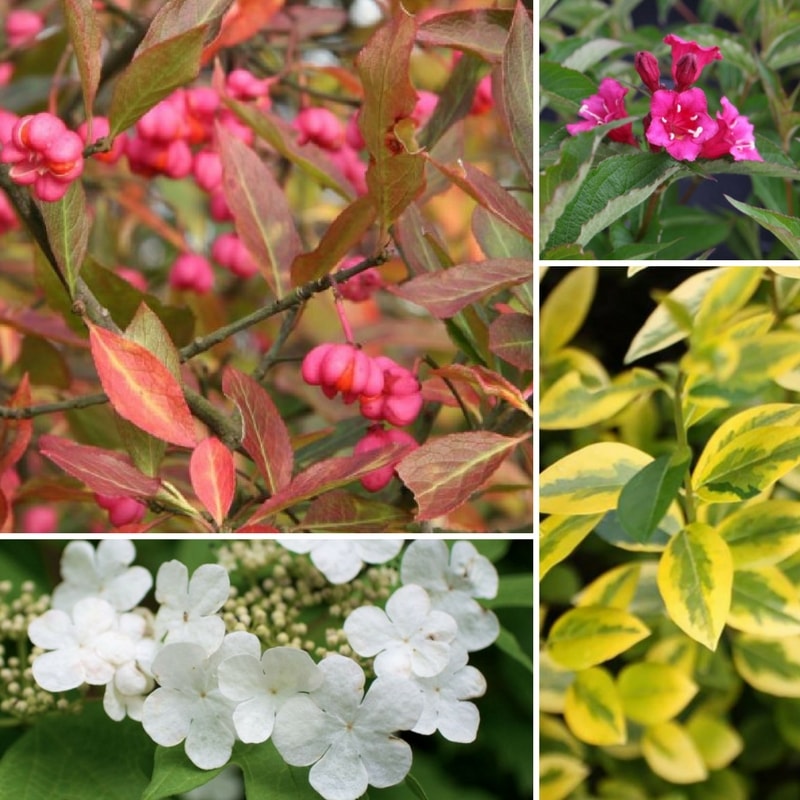 Euonymus europaeus, Weigelia Bristol Ruby, Ligustrum ovalifolium aureum and Viburnum opulus
What to plant to create a beautiful hedge?
A golden rule: only choose robust plants that are suited to the growing conditions of your garden, both in terms of climate and soil. The hedge is not the place to try to acclimatise a rhododendron in chalky soil or a shrub at the edge of hardiness that risks freezing irreparably after the second winter.
Also, consider observing the local wild flora and the hedges of neighbouring gardens: this is an excellent indicator of what will thrive in your area.
Of course, choose according to your tastes and seek a decorative effect that changes with the seasons. To ensure the hedge remains attractive in winter, do not overlook evergreen foliage (a ratio of 1/3 evergreens to 2/3 deciduous is ideal) and also consider Hornbeam (Carpinus betulus), which retains most of its dry leaves throughout winter.
Which species and varieties to plant?
To choose your shrubs for a flowering hedge, consider your climate as well as the exposure and size of your garden...
- In southern France: pittosporum, strawberry tree, choisya, oleander, pomegranate, bay laurel, buddleia, myrtle, laurustinus… select plants for their drought resistance and, of course, their ornamental qualities.
- In northern France: rough rose, barberry, kolkwitzia, spindle, forsythia, mock orange, Japanese quince, hornbeam, pyracantha, palm laurel, cherry laurel, holly, laurustinus, eleagnus, hazel, privet, spiraea, weigela…
- In shade: this may be the case in an urban garden overshadowed by neighbouring buildings, or when large trees cast shade. Remember: barberry, pyracantha, mahonia, aucuba, Japanese cornel, snowberry, sea buckthorn, palm laurel, laurustinus, privet.
- In a small garden: combine the useful with the pleasant and plant a flowering hedge (in a single row, of course) as a shrub bed, choosing your favourite shrubs, simply planted along the property line. To break the alignment effect, lean other plantings here and there against the hedge.
How to associate shrubs in a hedge?
On a short length of hedge, you can place the shrubs as you wish, avoiding as much as possible the regular repetition of a sequence.
On a longer stretch to plant, it is often simpler for both purchasing the plants and planting to design a “sequence” to repeat. Imagine a sequence of at least 5 different shrubs, in an odd number for a more harmonious effect, and when planting, do not hesitate to interchange certain species to break the repetition effect and always favour more freedom!
When and how to plant a flowering hedge, what planting distances?
Regarding the planting period, it all depends on the conditioning: for container-grown subjects, it is possible almost all year round if you take care with watering. Deciduous trees and shrubs with bare roots should be planted between the end of October and the end of March.
Useful resources
- Discover our wide range of shrubs and kits for flowering hedges
- To learn all about the different shrub conditioning options: "Hedge shrubs: bare roots, clumps, pots... What to choose?"
- For how to plant your hedge: "How to plant a hedge"

Comments