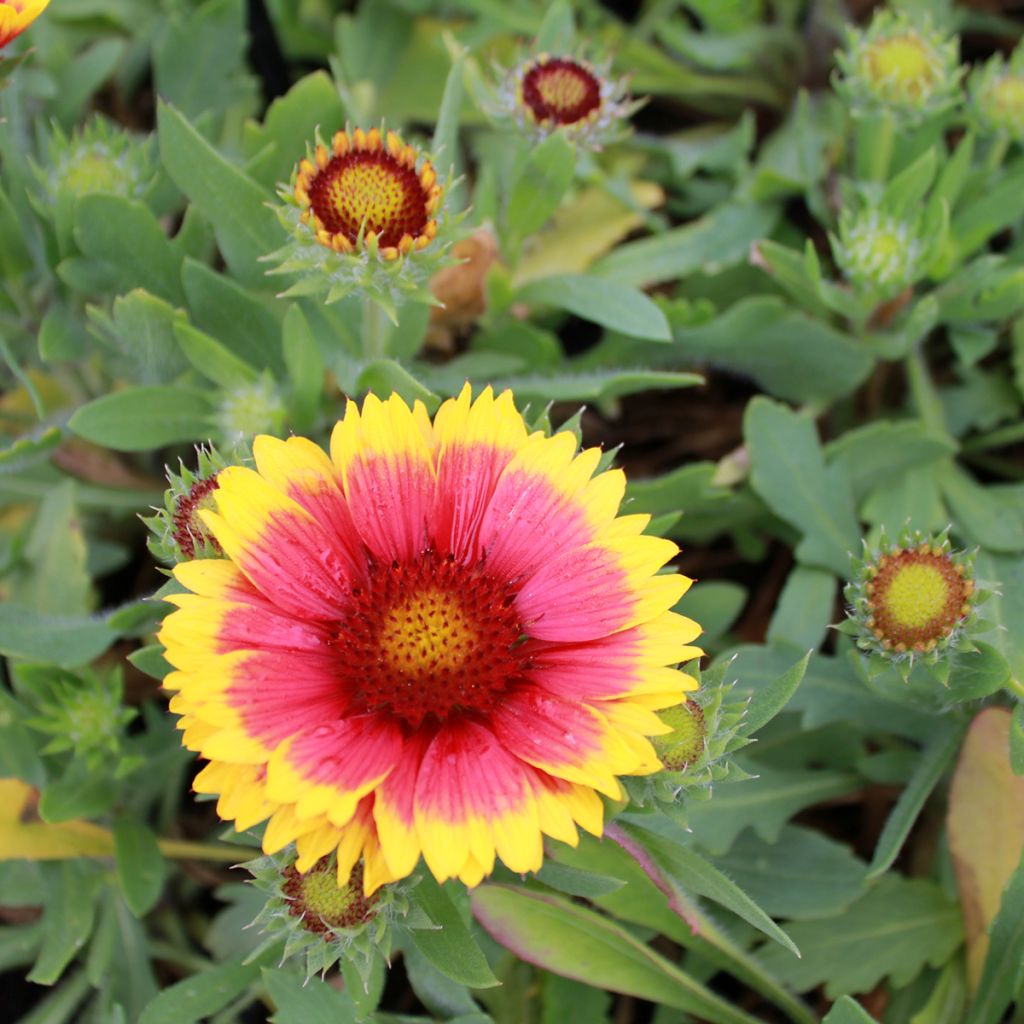
Gaillardia x grandiflora Arizona Sun
Gaillardia x grandiflora Arizona Sun
Gaillardia x grandiflora Arizona Sun
Great Blanket Flower
Back-to-school special offer!
Get €10 off for every €50 you spend! And get up to €40 off on a single order.
How does it work?
1. Shop your favourites
Add your favourite plants to your basket. For every €50 you spend (excluding delivery charges, store credit and the plastic-free option), you’ll receive a €10 voucher.
€50 spent = €10 voucher
€100 spent = €20 voucher
€150 spent = €30 voucher
€200 spent = €40 voucher
2. Place your order
Once your basket reaches one of the spending thresholds, place your order. You can even choose your delivery date!
3. Receive your voucher
As soon as your order has been shipped, you’ll receive an email containing your personal voucher code and its value.
4. Use it on your next order
Your voucher is valid for 90 days from the date you receive it. It can be used once only, on a new order worth at least the value of the voucher, excluding delivery charges.
Please note: Vouchers can be combined with other offers, but cannot be split or refunded.
Home or relay delivery (depending on size and destination)
Important: You may be charged customs duties by your country’s customs authorities upon delivery.
Schedule delivery date
and select date in basket
This plant carries a 12 months recovery warranty
More information
We guarantee the quality of our plants for a full growing cycle, and will replace at our expense any plant that fails to recover under normal climatic and planting conditions.
Would this plant suit my garden?
Set up your Plantfit profile →
Description
Gaillardia x grandiflora 'Arizona Sun' is a perennial blanketflower with both early and long-lasting flowering. Its large scarlet-red inflorescences, edged with bright yellow, renew themselves from May to September, making it one of the best flowering plants for summer. Blooming against relatively dark green foliage, they are perfectly showcased in the garden, as well as in a pot. It is easy to cultivate, thriving in full sun, in well-drained soil, and once established, it copes well with heat or drought. Also very hardy, it can be planted almost anywhere.
The Blanketflower is a representative of the vast botanical family of Asteraceae, formerly known as Compositae. The "flowers" are in fact inflorescences composed of fertile flowers tightly packed in the centre and surrounded by sterile flowers on the periphery (often mistaken for petals). These inflorescences make it easy to identify members of the family, from Dimorphotheca to Bidens, including, of course, Asters. There are about thirty botanical species of Blanketflower, as well as a horticultural hybrid, Gaillardia × grandiflora. It originated from a cross-breeding between Gaillardia aristata, a robust perennial from the Great North American plains, and Gaillardia pulchella, a short-lived species native to northern Mexico and the south and centre of the United States. From this genetic mix, the plant retained the cold resistance and good longevity of the first, while inheriting the vigour, floral profusion, and hardiness of the second.
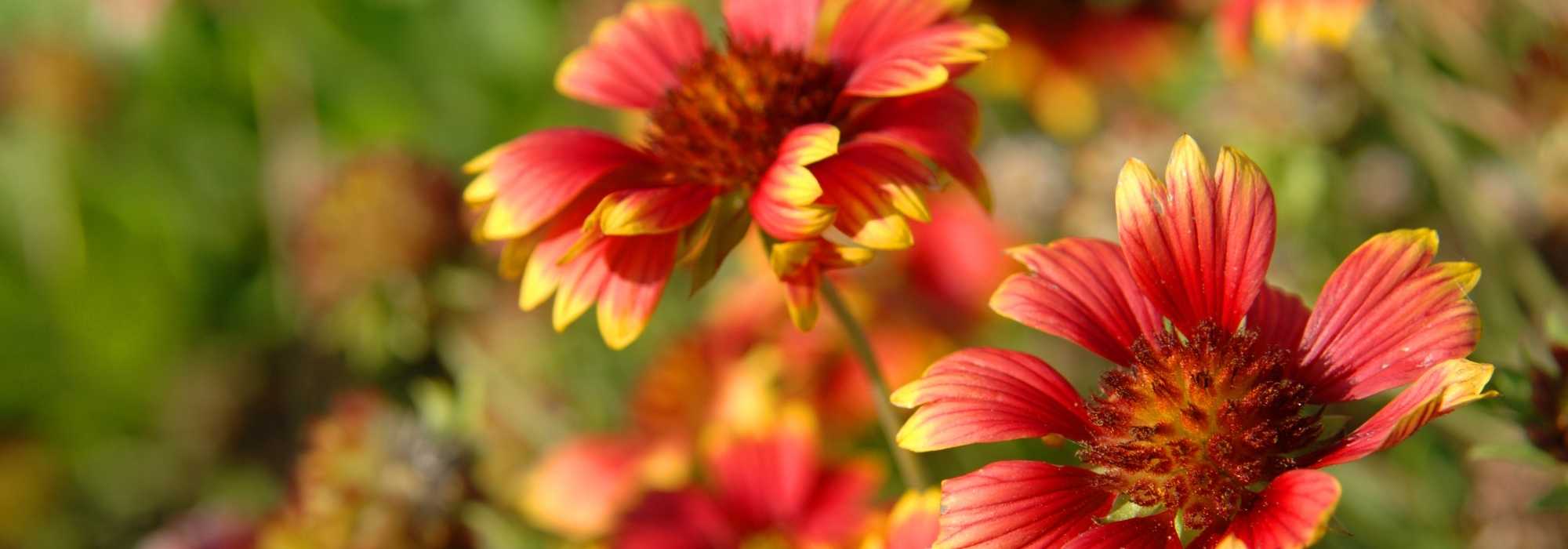
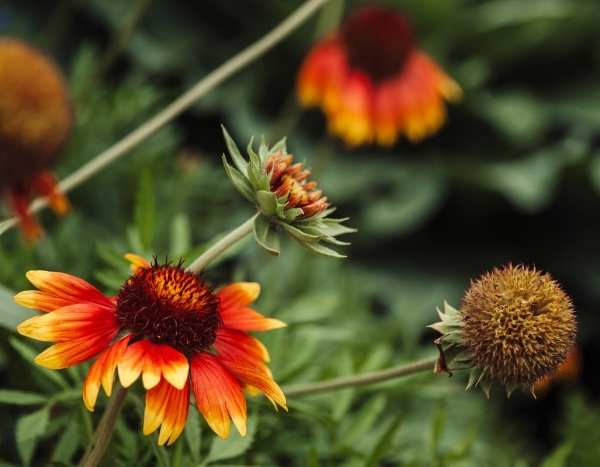
The variety ‘Arizona Sun’ develops rapidly into a dense clump approximately 30 cm in height and 40 cm in width. The hairy, lanceolate leaves are a medium to dark green, sometimes slightly greyish, semi-evergreen, depending on the climate. They are sessile, attached directly to the stems without a petiole. Their texture is somewhat rough to the touch. This fairly dense and matte vegetation serves as a setting for the brightly coloured inflorescences. Flowering begins early, from late spring, often several weeks before other blanketflowers. From May onwards, it has large, 6 to 7 cm in diameter heads, very attractive to pollinating insects. Their centre forms a prominent disc, initially bright yellow, gradually evolving towards purplish-red, then brownish hues as the seeds develop. The peripheral ligulate flowers (which resemble petals) are a brilliant scarlet red, accentuated by a fine, bright yellow edge on the perimeter, creating a vibrant contrast. The inflorescences renew regularly until September, more so if faded flowers are removed to facilitate the formation of new buds. The aerial part of the plant partially disappears during winter before regrowing vigorously in spring.
Despite their connotation as flowers of yesteryear, Blanketflowers retain their usefulness in today's gardens, subject to the vagaries of climate change. Few plants are, like them, capable of withstanding increasingly frequent and intense periods of heat while offering abundant flowering. Pair your Blanketflower 'Arizona Sun' with other summer champions like Gaura with airy, graceful flowers, which will lighten the more substantial appearance of the heads. White cultivars will be easier to integrate alongside the bright red. Charming Nepetas will add a touch of bluish height to your scene, amidst which you can happily integrate a few clumps of ornamental grasses for dry soil for their architectural and dynamic aspect, the slightest breath of air being enough to set them in motion.
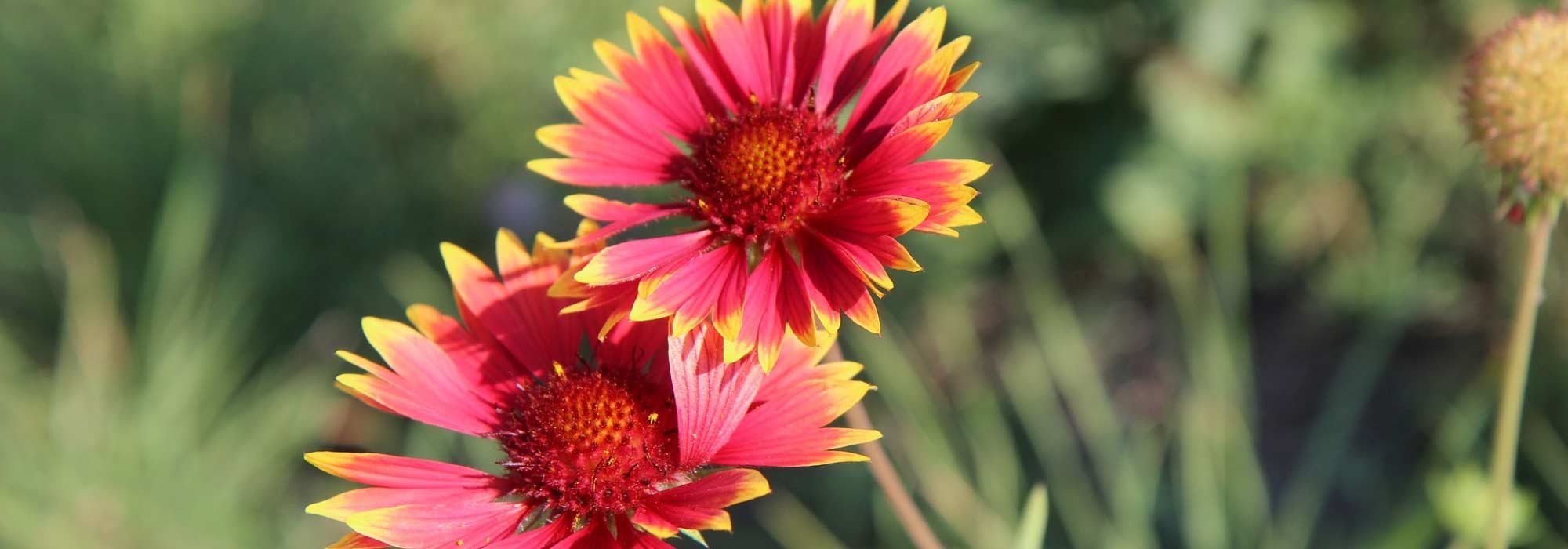
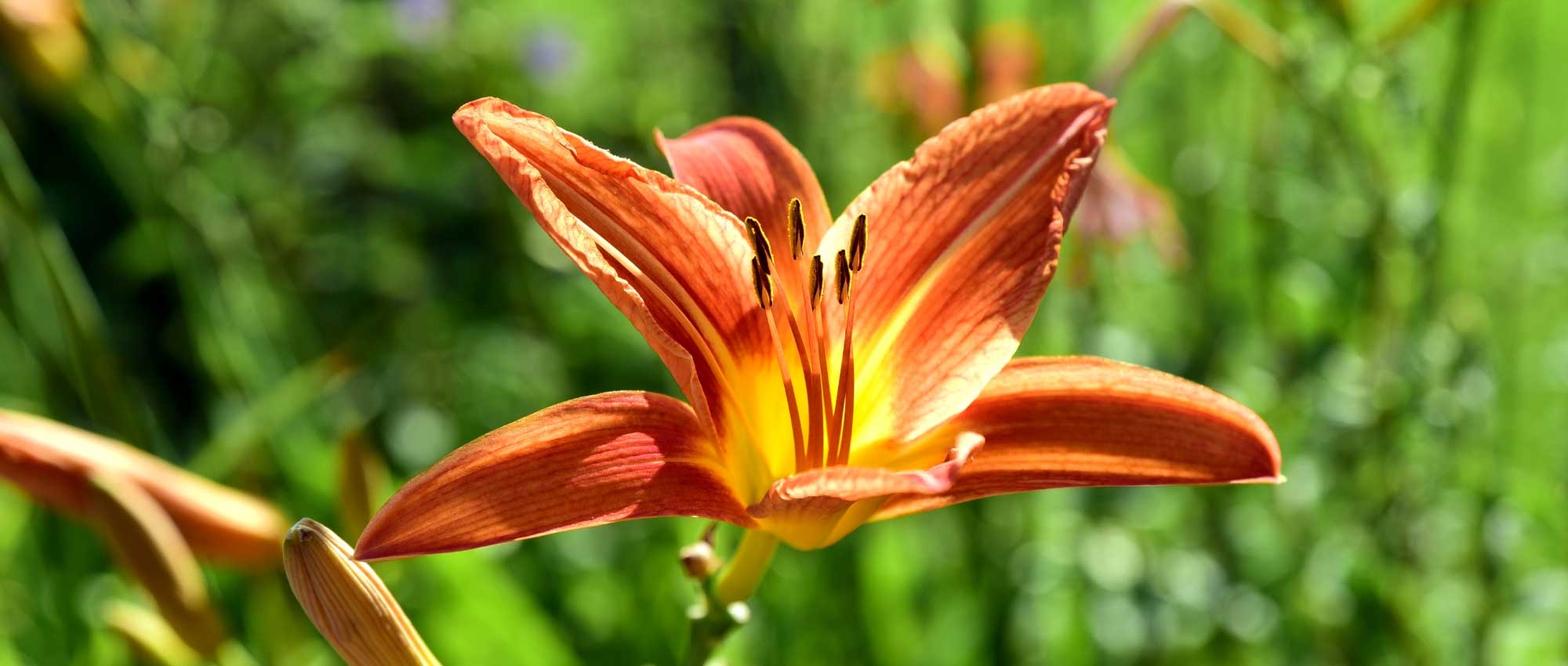
Flowering
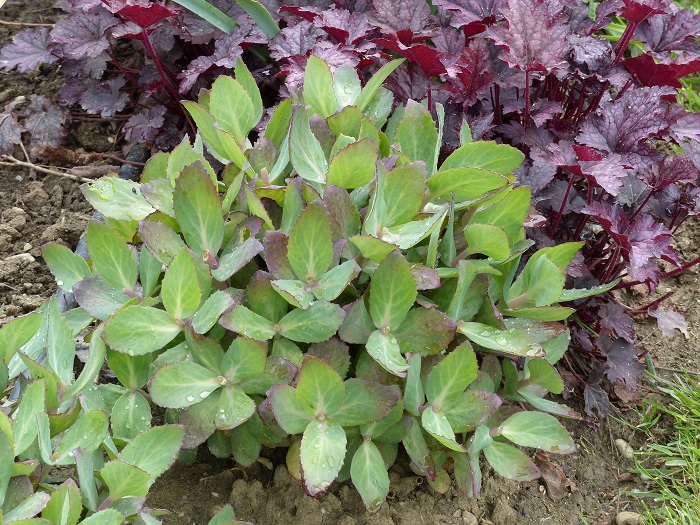
Foliage
Plant habit
Botanical data
Gaillardia
x grandiflora
Arizona Sun
Asteraceae
Great Blanket Flower
Gaillardia x grandiflora 'Arizona Sun' (Arizona series)
Cultivar or hybrid
Planting and care
Hardy and undemanding, Blanketflowers tolerate intense heat, cold, drought, strong winds, and poor soils well. In summer, the slightest rain or a light watering during prolonged drought will restart the flowering. Plant them in well-drained soil, in full sun; they will tolerate light shade in the south. Once well-rooted, they are not too bothered by drought; on the other hand, they dislike overly wet soils. In a cool climate, the plants are more robust with fewer flowers: pruning the flower stems at the end of September, to 10 cm from the soil, helps them overwinter well. Regularly removing spent flowers also encourages further flower production.
Planting period
Intended location
Care
Planting & care advice
-
-
-

-
-
-
-
-

This item has not been reviewed yet - be the first to leave a review about it.
Recently viewed products
Haven't found what you were looking for?
Hardiness is the lowest winter temperature a plant can endure without suffering serious damage or even dying. However, hardiness is affected by location (a sheltered area, such as a patio), protection (winter cover) and soil type (hardiness is improved by well-drained soil).

The flowering period indicated on our website applies to countries and regions located in USDA zone 8 (France, the United Kingdom, Ireland, the Netherlands, etc.)
It will vary according to where you live:- In zones 9 to 10 (Italy, Spain, Greece, etc.), flowering will occur about 2 to 4 weeks earlier.
- In zones 6 to 7 (Germany, Poland, Slovenia, and lower mountainous regions), flowering will be delayed by 2 to 3 weeks.
- In zone 5 (Central Europe, Scandinavia), blooming will be delayed by 3 to 5 weeks.
In temperate climates, pruning of spring-flowering shrubs (forsythia, spireas, etc.) should be done just after flowering.
Pruning of summer-flowering shrubs (Indian Lilac, Perovskia, etc.) can be done in winter or spring.
In cold regions as well as with frost-sensitive plants, avoid pruning too early when severe frosts may still occur.
The planting period indicated on our website applies to countries and regions located in USDA zone 8 (France, United Kingdom, Ireland, Netherlands).
It will vary according to where you live:
- In Mediterranean zones (Marseille, Madrid, Milan, etc.), autumn and winter are the best planting periods.
- In continental zones (Strasbourg, Munich, Vienna, etc.), delay planting by 2 to 3 weeks in spring and bring it forward by 2 to 4 weeks in autumn.
- In mountainous regions (the Alps, Pyrenees, Carpathians, etc.), it is best to plant in late spring (May-June) or late summer (August-September).
The harvesting period indicated on our website applies to countries and regions in USDA zone 8 (France, England, Ireland, the Netherlands).
In colder areas (Scandinavia, Poland, Austria...) fruit and vegetable harvests are likely to be delayed by 3-4 weeks.
In warmer areas (Italy, Spain, Greece, etc.), harvesting will probably take place earlier, depending on weather conditions.
The sowing periods indicated on our website apply to countries and regions within USDA Zone 8 (France, UK, Ireland, Netherlands).
In colder areas (Scandinavia, Poland, Austria...), delay any outdoor sowing by 3-4 weeks, or sow under glass.
In warmer climes (Italy, Spain, Greece, etc.), bring outdoor sowing forward by a few weeks.
Shipping country and language
Your country of residence may be:
Your country of residence is:
For a better user experience on our website, you can select:
Your shipping country:
-
 Austria
-
 Belgium
-
 Bosnia & Herzegovina
-
 Bulgaria
-
 Croatia
-
 Cyprus
-
 Czechia
-
 Denmark
-
 Estonia
-
 Finland
-
 France
-
 Germany
-
 Greece
-
 Hungary
-
 Iceland
-
 Ireland
-
 Italy
Italy
-
 Latvia
-
 Liechtenstein
-
 Lithuania
-
 Luxembourg
-
 Malta
Malta
-
 Netherlands
-
 Poland
-
 Portugal
-
 Romania
-
 Serbia
-
 Slovakia
-
 Slovenia
-
 Spain
Spain
-
 Sweden
-
 Switzerland
Language:
-
French
-
 English
-
Spanish
-
Italian
-
German
-
Portuguese
-
Dutch
-
Finnish
My Account
Hello
My wish lists
My cart
Log in / Register
Existing customer?
This form is protected by reCAPTCHA - the Google Privacy Policy and Terms of Service apply.
New customer?
Create an account to track your orders, access our customer service and, if you wish, make the most of our upcoming offers.