Nelumbo Elite Red - Dwarf lotus
Nelumbo Elite Red - Dwarf lotus
Nelumbo Elite Red
Sacred Lotus, Indian Lotus, Lotus
Back-to-school special offer!
Get €10 off for every €50 you spend! And get up to €40 off on a single order.
How does it work?
1. Shop your favourites
Add your favourite plants to your basket. For every €50 you spend (excluding delivery charges, store credit and the plastic-free option), you’ll receive a €10 voucher.
€50 spent = €10 voucher
€100 spent = €20 voucher
€150 spent = €30 voucher
€200 spent = €40 voucher
2. Place your order
Once your basket reaches one of the spending thresholds, place your order. You can even choose your delivery date!
3. Receive your voucher
As soon as your order has been shipped, you’ll receive an email containing your personal voucher code and its value.
4. Use it on your next order
Your voucher is valid for 90 days from the date you receive it. It can be used once only, on a new order worth at least the value of the voucher, excluding delivery charges.
Please note: Vouchers can be combined with other offers, but cannot be split or refunded.
Why not try an alternative variety in stock?
View all →
Available in 1 sizes
Available in 1 sizes
Available in 1 sizes
This plant carries a 6 months recovery warranty
More information
We guarantee the quality of our plants for a full growing cycle, and will replace at our expense any plant that fails to recover under normal climatic and planting conditions.
Description
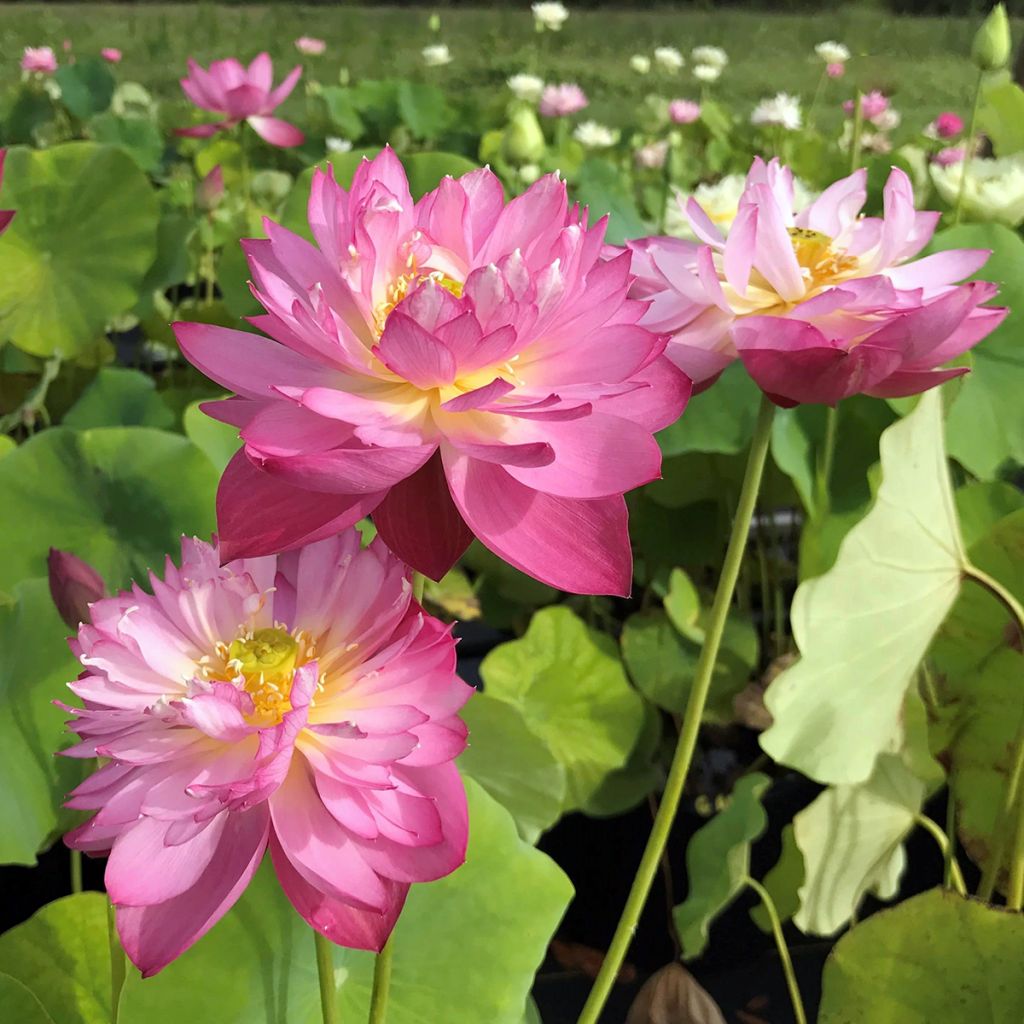
Nelumbo 'Elite Red' is a dwarf lotus distinguished by its double reddish-pink flowering and its delicately spicy fragrance. Well-suited to small ponds and aquatic containers, it possesses all the qualities of the sacred lotus without its exuberant character. It is a delightful variety for adorning a sunny terrace or a modest-sized water feature.
Related to the sacred lotus, Nelumbo nucifera, this cultivar belongs to the Nelumbonaceae family. The species is commonly called the sacred lotus, Oriental lotus, and Indian lotus. Its main botanical synonyms are Nelumbium speciosum, Nelumbo speciosa, Nelumbo indica, and Nymphaea nelumbo. In the wild, the sacred lotus grows in calm or very slow-moving, muddy, and warm waters, from temperate and tropical Asia to northern Australia. It is found notably in China, India, Japan, Korea, Vietnam, Thailand, and even in northern Australia. It is a deciduous, rhizomatous aquatic perennial: all aerial vegetation disappears with the first cold spells.
'Elite Red' is distinguished by its modest growth: the plant forms an emergent clump 60 cm tall, with flowers that can reach 80 cm. Its growth is rapid once the water warms up. The round, peltate leaves, meaning attached at their centre, are a bright, slightly satiny green and measure 25 to 30 cm in diameter. They float at first and then rise above the water. The flowers, also erect, are double, 8 to 12 cm wide, a deep pink when opening, slightly streaked with white, then lighter as they bloom. The numerous petals, arranged in several rows, give the corolla a very full, beautiful profile. The centre shows a yellow-green receptacle surrounded by golden stamens. Flowering runs from July to September, being more generous in late summer. Each flower lives for 3 or 4 days, opening each morning. The watering-can-shaped fruiting heads become decorative when dried.
Install Nelumbo 'Elite Red' in a wide bowl, a half-barrel, or a small, very sunny pond, with heavy, rich soil covered by 10 to 20 cm of water. Give it space: its flowers look best emerging alone above a calm water mirror.
Lotus and water lilies are among the most beautiful pond plants. Most flower from spring until early autumn. The lotus is also very useful for the good balance of a garden pond, as it contributes to water oxygenation. Its leaves will provide shade and shelter for your fish, which, in return, will protect them from predatory insects like aphids.
The entire plant is edible. The seeds can be eaten candied, and the rhizome is a nourishing starch. The yellow stamens are used to flavour tea in Vietnam. The rhizome and seeds are also used in Chinese cosmetics to combat ageing, as well as in medicine and perfumery.
The perfection of the flower and fruit of the sacred lotus (Nelumbo nucifera) makes this aquatic plant a symbol of purity in several religions. In Buddhism, it derives its sacred character from the belief that Buddha appeared floating on its leaf. In Hinduism, it is perceived as the cradle of the universe.
Report an error about the product description
Nelumbo Elite Red - Dwarf lotus in pictures
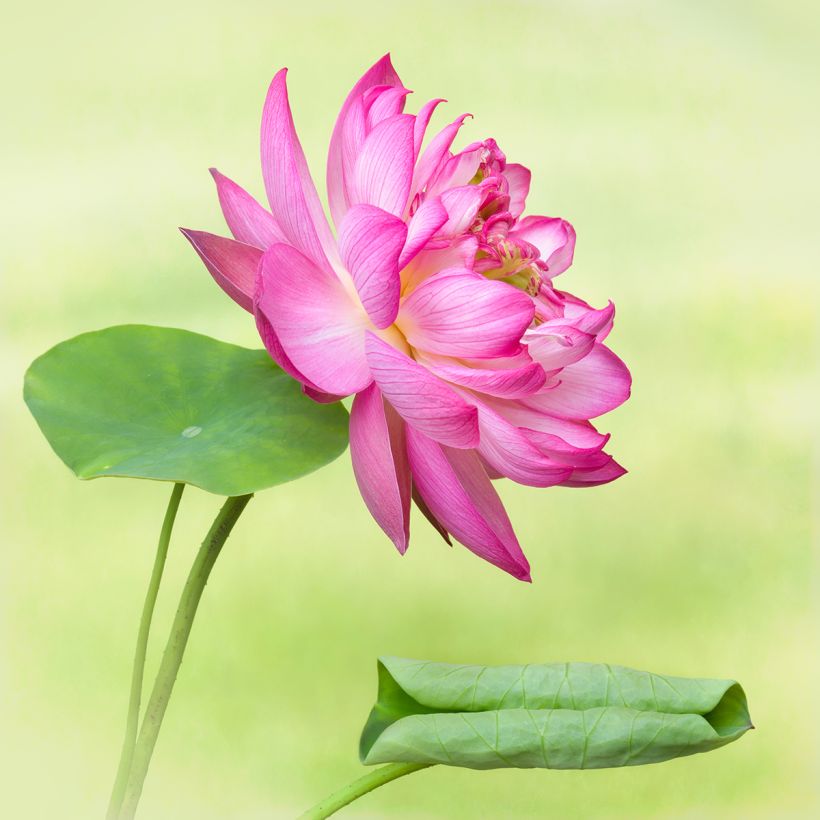
Flowering
Foliage
Plant habit
Botanical data
Nelumbo
Elite Red
Nelumbonaceae
Sacred Lotus, Indian Lotus, Lotus
Cultivar or hybrid
Planting and care
Aside from a few requirements, cultivating the dwarf lotus Elite Red does not require any special arrangements. Dwarf lotus requires a sunny location and enjoys warmth. It can withstand temperatures as low as –12°C, provided it is submerged deeply enough. Plant the rhizome without breaking it, horizontally, in late spring, in a pot or directly in the mud, between 10 and 20 cm below the water surface. Never use horticultural compost, as it would float to the surface and encourage algae growth. In shallow ponds, planting in a container is possible, but it will be essential to overwinter the rhizomes in damp sand, protected from frost. Rhizomes can be planted in a wicker basket or a fine mesh basket, 30-40 cm in diameter (wider than tall), which is sunk in the required spot. Give them the sunniest spot in the water feature. Space each rhizome at least 50 cm apart.
In regions with severe winters, it is preferable to keep the rhizome in a damp pot, protected from frost, from October to May.
Never leave Nelumbo rhizomes exposed to sun or air to prevent them from drying out; plant them immediately upon receipt or purchase. If you have fish in your pond, it is advisable to spread a good layer of coarse gravel on the surface of the planted pot to deter them from digging in the soil and thus fouling the water. The development of nelumbos will be optimal if they are planted in containers suited to their growth. Lotus plants are heavy feeders: apply a balanced, controlled-release fertiliser at planting, then each year at the start of the growing season, with a duration matching the growing period (for example: Osmocote 10-11-18-2 with a 5-6 month duration). During summer, remove excess leaves that emerge at the centre of the clump, keeping only the most vigorous ones. Also, remove those that are yellowed or spotted, as well as any aquatic weeds emerging from the surface. Caution: contact with lotus foliage can cause skin allergies!
Monitor for aphid infestations on the foliage. Introduce ladybird larvae or spray black soap on the foliage. Remove yellowed leaves at the end of summer.
Planting period
Intended location
Care
Planting & care advice
-
-
-
-

-

-
-
-
This item has not been reviewed yet - be the first to leave a review about it.
Recently viewed products
Haven't found what you were looking for?
Hardiness is the lowest winter temperature a plant can endure without suffering serious damage or even dying. However, hardiness is affected by location (a sheltered area, such as a patio), protection (winter cover) and soil type (hardiness is improved by well-drained soil).

The flowering period indicated on our website applies to countries and regions located in USDA zone 8 (France, the United Kingdom, Ireland, the Netherlands, etc.)
It will vary according to where you live:- In zones 9 to 10 (Italy, Spain, Greece, etc.), flowering will occur about 2 to 4 weeks earlier.
- In zones 6 to 7 (Germany, Poland, Slovenia, and lower mountainous regions), flowering will be delayed by 2 to 3 weeks.
- In zone 5 (Central Europe, Scandinavia), blooming will be delayed by 3 to 5 weeks.
In temperate climates, pruning of spring-flowering shrubs (forsythia, spireas, etc.) should be done just after flowering.
Pruning of summer-flowering shrubs (Indian Lilac, Perovskia, etc.) can be done in winter or spring.
In cold regions as well as with frost-sensitive plants, avoid pruning too early when severe frosts may still occur.
The planting period indicated on our website applies to countries and regions located in USDA zone 8 (France, United Kingdom, Ireland, Netherlands).
It will vary according to where you live:
- In Mediterranean zones (Marseille, Madrid, Milan, etc.), autumn and winter are the best planting periods.
- In continental zones (Strasbourg, Munich, Vienna, etc.), delay planting by 2 to 3 weeks in spring and bring it forward by 2 to 4 weeks in autumn.
- In mountainous regions (the Alps, Pyrenees, Carpathians, etc.), it is best to plant in late spring (May-June) or late summer (August-September).
The harvesting period indicated on our website applies to countries and regions in USDA zone 8 (France, England, Ireland, the Netherlands).
In colder areas (Scandinavia, Poland, Austria...) fruit and vegetable harvests are likely to be delayed by 3-4 weeks.
In warmer areas (Italy, Spain, Greece, etc.), harvesting will probably take place earlier, depending on weather conditions.
The sowing periods indicated on our website apply to countries and regions within USDA Zone 8 (France, UK, Ireland, Netherlands).
In colder areas (Scandinavia, Poland, Austria...), delay any outdoor sowing by 3-4 weeks, or sow under glass.
In warmer climes (Italy, Spain, Greece, etc.), bring outdoor sowing forward by a few weeks.
Shipping country and language
Your country of residence may be:
Your country of residence is:
For a better user experience on our website, you can select:
Your shipping country:
-
 Austria
-
 Belgium
-
 Bosnia & Herzegovina
-
 Bulgaria
-
 Croatia
-
 Cyprus
-
 Czechia
-
 Denmark
-
 Estonia
-
 Finland
-
 France
-
 Germany
-
 Greece
-
 Hungary
-
 Iceland
-
 Ireland
-
 Italy
Italy
-
 Latvia
-
 Liechtenstein
-
 Lithuania
-
 Luxembourg
-
 Malta
Malta
-
 Netherlands
-
 Poland
-
 Portugal
-
 Romania
-
 Serbia
-
 Slovakia
-
 Slovenia
-
 Spain
Spain
-
 Sweden
-
 Switzerland
Language:
-
French
-
 English
-
Spanish
-
Italian
-
German
-
Portuguese
-
Dutch
-
Finnish
My Account
Hello
My wish lists
My cart
Log in / Register
Existing customer?
This form is protected by reCAPTCHA - the Google Privacy Policy and Terms of Service apply.
New customer?
Create an account to track your orders, access our customer service and, if you wish, make the most of our upcoming offers.