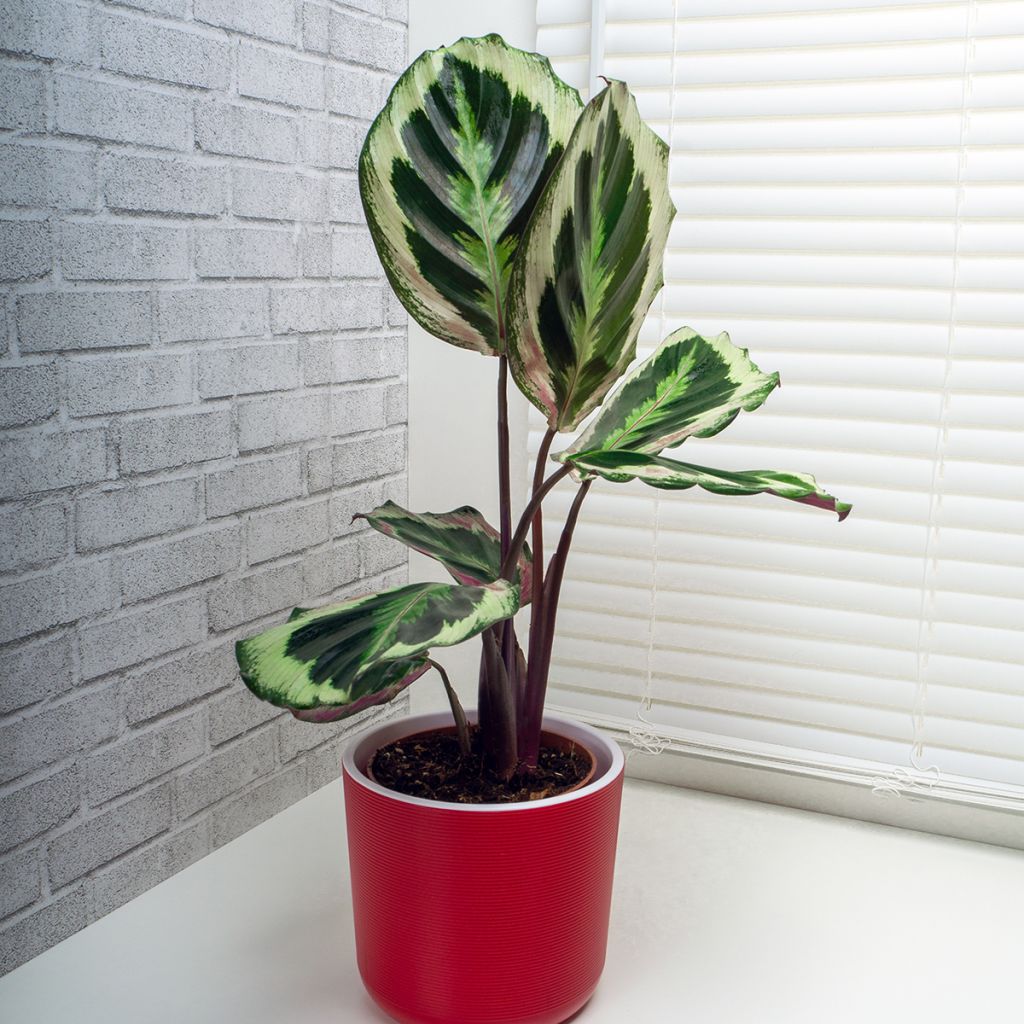
Calathea roseopicta Shinestar - Rose-painted calathea
Calathea roseopicta Shinestar - Rose-painted calathea
Calathea roseopicta Shinestar
Rose-painted calathea
Back-to-school special offer!
Get €10 off for every €50 you spend! And get up to €40 off on a single order.
How does it work?
1. Shop your favourites
Add your favourite plants to your basket. For every €50 you spend (excluding delivery charges, store credit and the plastic-free option), you’ll receive a €10 voucher.
€50 spent = €10 voucher
€100 spent = €20 voucher
€150 spent = €30 voucher
€200 spent = €40 voucher
2. Place your order
Once your basket reaches one of the spending thresholds, place your order. You can even choose your delivery date!
3. Receive your voucher
As soon as your order has been shipped, you’ll receive an email containing your personal voucher code and its value.
4. Use it on your next order
Your voucher is valid for 90 days from the date you receive it. It can be used once only, on a new order worth at least the value of the voucher, excluding delivery charges.
Please note: Vouchers can be combined with other offers, but cannot be split or refunded.
Why not try an alternative variety in stock?
View all →
Available in 1 sizes

Available in 2 sizes

Available in 1 sizes

Available in 1 sizes
This plant carries a 30 days recovery warranty
More information
We guarantee the quality of our plants for a full growing cycle, and will replace at our expense any plant that fails to recover under normal climatic and planting conditions.
Description
Calathea 'Shinestar', or Goeppertia roseopicta ‘Shinestar’, is a houseplant with richly variegated foliage. Its large, deep green leaves, broadly brushed with light green and sometimes tinged with pink, have a very decorative purple underside. Its mobile foliage follows the variations in light in the living room, office, or bathroom.
Native to the humid tropical forests of western South America, particularly the Amazon basin in Brazil, Peru, and Colombia, Goeppertia roseopicta (formerly Calathea roseopicta) grows naturally under the canopy, in constantly moist soil and very humid air.
The cultivar Shinestar™ (also sold as Calathea Shinestar™ PP21978) belongs to the Marantaceae family, famous for its "prayer plants" whose leaves rise in the evening. This tropical perennial forms a dense clump reaching 40 to 60 cm in height and 30 to 50 cm in width. Its broad, teardrop-shaped, wavy and glossy leaves, feature a very dark, almost black, green centre along the midrib, surrounded by a wide, medium green zone, itself bordered by an irregular, very light green edge often tinged with pink. The deep purple-violet underside appears when the leaves rise in the evening. The small, discreet white to violet flowers are rarely seen indoors.
Calathea is generally considered non-toxic to humans and pets.
Indoors, this variety appreciates filtered light, away from direct sunlight, a warm and humid atmosphere, and a location protected from cold draughts. Stable temperatures between 18 and 24 °C, without dropping consistently below 16 °C, suit it very well, especially if the humidity remains high. Overall, it is a plant that requires a bit of attention, as it reacts quickly to air that is too dry, over or under-watering, and hard water.
Calathea 'Shinestar' will look good in a plain-coloured planter placed on a side table or console, a few steps away from an east or north-facing window. It suits both urban jungle atmospheres and more bohemian décors. To create a lush atmosphere, you can pair it with a Calathea ‘Dottie’ and install a Philodendron ‘Brasil’ in a hanging basket right next to it. A Cyrtomium falcatum fern will complete this ensemble.
Report an error about the product description
Foliage
Plant habit
Botanical data
Calathea
roseopicta
Shinestar
Marantaceae
Rose-painted calathea
Cultivar or hybrid
Location
Location
Maintenance & care
Watering tips
Potting advice, substrates and fertilisers
Houseplant care
Disease and pest advice
Maintenance & care
This item has not been reviewed yet - be the first to leave a review about it.
Recently viewed products
Haven't found what you were looking for?
Hardiness is the lowest winter temperature a plant can endure without suffering serious damage or even dying. However, hardiness is affected by location (a sheltered area, such as a patio), protection (winter cover) and soil type (hardiness is improved by well-drained soil).

The flowering period indicated on our website applies to countries and regions located in USDA zone 8 (France, the United Kingdom, Ireland, the Netherlands, etc.)
It will vary according to where you live:- In zones 9 to 10 (Italy, Spain, Greece, etc.), flowering will occur about 2 to 4 weeks earlier.
- In zones 6 to 7 (Germany, Poland, Slovenia, and lower mountainous regions), flowering will be delayed by 2 to 3 weeks.
- In zone 5 (Central Europe, Scandinavia), blooming will be delayed by 3 to 5 weeks.
In temperate climates, pruning of spring-flowering shrubs (forsythia, spireas, etc.) should be done just after flowering.
Pruning of summer-flowering shrubs (Indian Lilac, Perovskia, etc.) can be done in winter or spring.
In cold regions as well as with frost-sensitive plants, avoid pruning too early when severe frosts may still occur.
The planting period indicated on our website applies to countries and regions located in USDA zone 8 (France, United Kingdom, Ireland, Netherlands).
It will vary according to where you live:
- In Mediterranean zones (Marseille, Madrid, Milan, etc.), autumn and winter are the best planting periods.
- In continental zones (Strasbourg, Munich, Vienna, etc.), delay planting by 2 to 3 weeks in spring and bring it forward by 2 to 4 weeks in autumn.
- In mountainous regions (the Alps, Pyrenees, Carpathians, etc.), it is best to plant in late spring (May-June) or late summer (August-September).
The harvesting period indicated on our website applies to countries and regions in USDA zone 8 (France, England, Ireland, the Netherlands).
In colder areas (Scandinavia, Poland, Austria...) fruit and vegetable harvests are likely to be delayed by 3-4 weeks.
In warmer areas (Italy, Spain, Greece, etc.), harvesting will probably take place earlier, depending on weather conditions.
The sowing periods indicated on our website apply to countries and regions within USDA Zone 8 (France, UK, Ireland, Netherlands).
In colder areas (Scandinavia, Poland, Austria...), delay any outdoor sowing by 3-4 weeks, or sow under glass.
In warmer climes (Italy, Spain, Greece, etc.), bring outdoor sowing forward by a few weeks.
Shipping country and language
Your country of residence may be:
Your country of residence is:
For a better user experience on our website, you can select:
Your shipping country:
-
 Austria
-
 Belgium
-
 Bosnia & Herzegovina
-
 Bulgaria
-
 Croatia
-
 Cyprus
-
 Czechia
-
 Denmark
-
 Estonia
-
 Finland
-
 France
-
 Germany
-
 Greece
-
 Hungary
-
 Iceland
-
 Ireland
-
 Italy
Italy
-
 Latvia
-
 Liechtenstein
-
 Lithuania
-
 Luxembourg
-
 Malta
Malta
-
 Netherlands
-
 Poland
-
 Portugal
-
 Romania
-
 Serbia
-
 Slovakia
-
 Slovenia
-
 Spain
Spain
-
 Sweden
-
 Switzerland
Language:
-
French
-
 English
-
Spanish
-
Italian
-
German
-
Portuguese
-
Dutch
-
Finnish
My Account
Hello
My wish lists
My cart
Log in / Register
Existing customer?
This form is protected by reCAPTCHA - the Google Privacy Policy and Terms of Service apply.
New customer?
Create an account to track your orders, access our customer service and, if you wish, make the most of our upcoming offers.