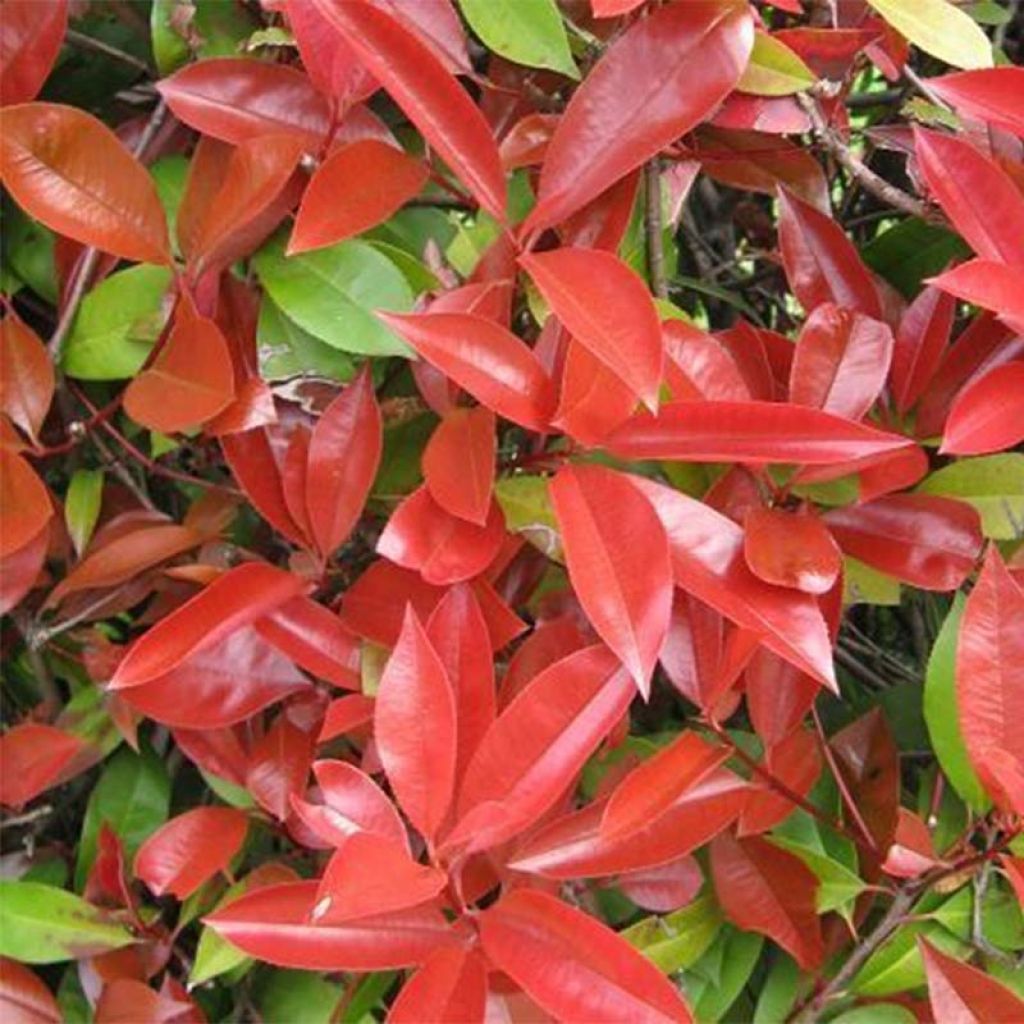
Photinia fraseri Dicker Toni - Christmas Berry
Photinia fraseri Dicker Toni - Christmas Berry
Photinia x fraseri Dicker Toni
Christmas Berry, Redtip Photinia
Very disappointed! Three purchased, three that I am going to throw away because the leaves are eaten by the in... , these famous little creatures whose larvae were present at the time of my purchase!!! So I do not recommend!
ODILE, 29/04/2022
Back-to-school special offer!
Get €10 off for every €50 you spend! And get up to €40 off on a single order.
How does it work?
1. Shop your favourites
Add your favourite plants to your basket. For every €50 you spend (excluding delivery charges, store credit and the plastic-free option), you’ll receive a €10 voucher.
€50 spent = €10 voucher
€100 spent = €20 voucher
€150 spent = €30 voucher
€200 spent = €40 voucher
2. Place your order
Once your basket reaches one of the spending thresholds, place your order. You can even choose your delivery date!
3. Receive your voucher
As soon as your order has been shipped, you’ll receive an email containing your personal voucher code and its value.
4. Use it on your next order
Your voucher is valid for 90 days from the date you receive it. It can be used once only, on a new order worth at least the value of the voucher, excluding delivery charges.
Please note: Vouchers can be combined with other offers, but cannot be split or refunded.
Why not try an alternative variety in stock?
View all →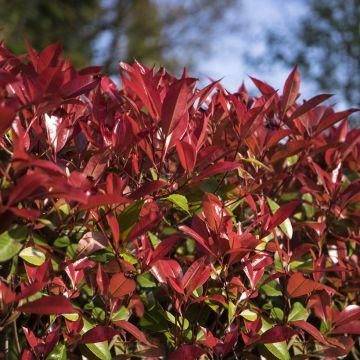
Available in 1 sizes

Available in 1 sizes
Available in 2 sizes
Available in 3 sizes

Available in 4 sizes
Available in 7 sizes

Available in 2 sizes
Available in 1 sizes
Available in 1 sizes

Available in 1 sizes
This plant carries a 24 months recovery warranty
More information
We guarantee the quality of our plants for a full growing cycle, and will replace at our expense any plant that fails to recover under normal climatic and planting conditions.

Would this plant suit my garden?
Set up your Plantfit profile →
Description
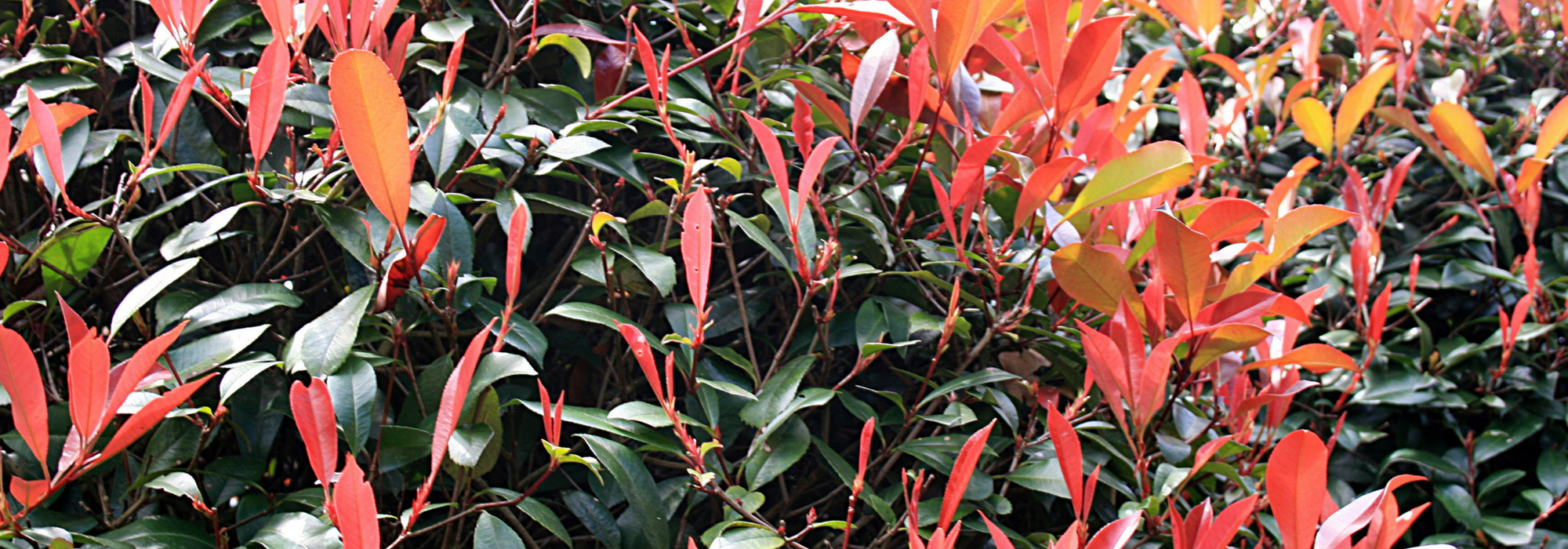
The Photinia Fraseri 'Dicker Toni' is a beautiful new variety resembling the 'Red Robin', but with a more upright habit, more compact and more ramified from the base. It also has the advantage of producing very bright red young shoots throughout the season and after each pruning. Its foliage is finer and more resistant to diseases. In spring, red young leaves, umbels of white flowers and mature leaves of a shiny dark green coexist on this bush that is full of character. Moderate growth and excellent screening power even in winter are other assets sought to create an elegant and sturdy hedge. Comfortable in any good garden soil, even in coastal regions, this new Photinia also adapts very well to container cultivation.
Photinia (x) fraseri or Fraser's Photinia is an old horticultural creation born in 1940 in the United States, resulting from the cross-breeding between Photinia glabra, native to Japan, and Photinia serrulata, native to China. This hybrid has given rise to some famous cultivars, including 'Red Robin', widely planted in our parks and gardens. In recent years, some beautiful improvements have been born, more compact, more colorful and more disease-resistant, such as 'Dicker Toni'.
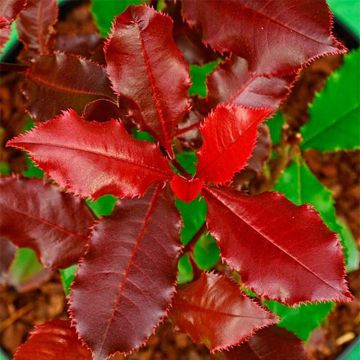
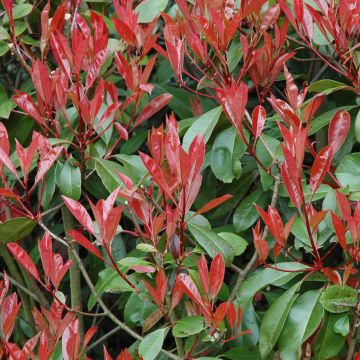
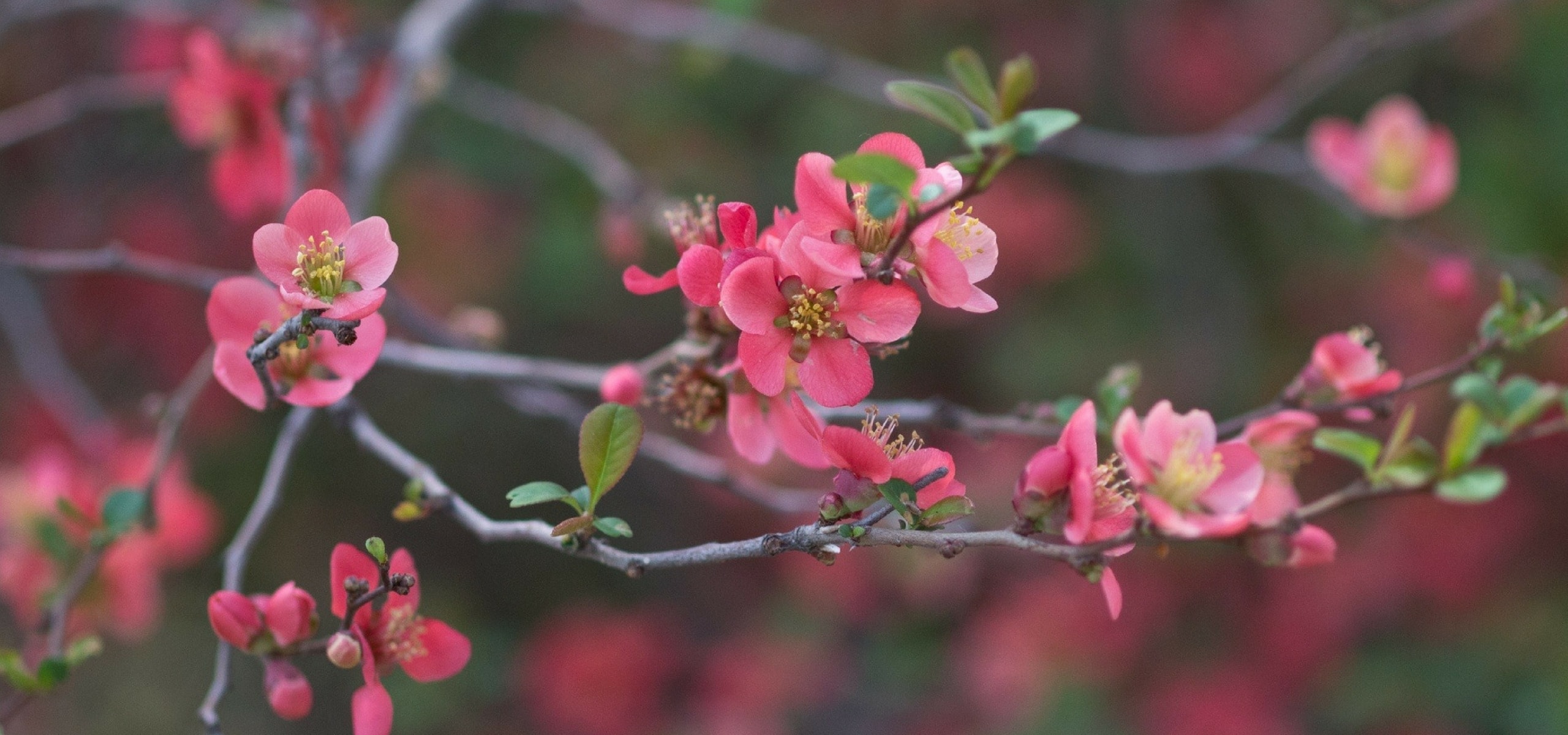
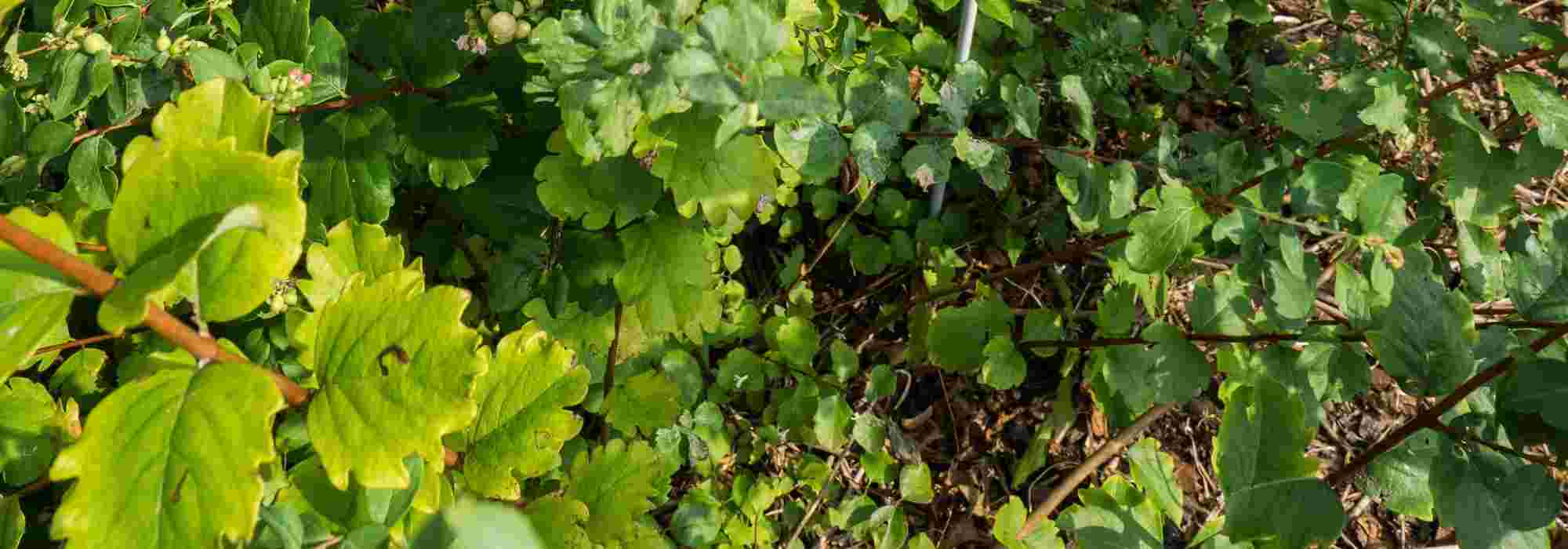
Rarely exceeding 2m (7ft) in height and 1.50m (5ft) in spread, the Photinia Dicker Toni has a very dense habit and shows rapid growth. Its particularly ramified vegetation is adorned with evergreen foliage composed of leaves thinner than those of Red Robin. Arranged alternately on the branches, they are about 6-8cm (2-3in) long, finely toothed on the edges, a bright red-orange when young, then a shiny green when mature. In March or April, clusters of small white flowers appear, reaching up to 10cm (4in) in diameter at the terminal ends of the branches.
In addition to the beautiful coloration of its young foliage, it is also the hardiness and adaptability to any type of soil that have earned Photinia (x) fraseri worldwide success. Like it, 'Dicker Toni' tolerates all types of well-drained soil, from deep and moist to dry, in sunny or semi-shaded positions. It is an easy-to-cultivate and low-maintenance bush that can withstand temperatures down to -18°C (1°F) when exposed to the sun. Of course, it is ideal for creating trimmed or untrimmed hedges, and it also adapts very well to container cultivation and is impressive in flower beds. Very ornamental, it can also be planted as a stand-alone in a small garden. There are numerous possibilities for companion planting depending on the regions and the preferences of each gardener; with other easy-to-grow evergreen bushes like Elaeagnus ebbingei Compacta, laurels, Rhamnus alaternus, Berberis, Olearia, Lonicera nitida or Lonicera xylosteum Clavate's Dwarf for example. It will also accompany other bushes with white spring flowering such as Spireas or Mock Orange.
Photinia fraseri Dicker Toni - Christmas Berry in pictures
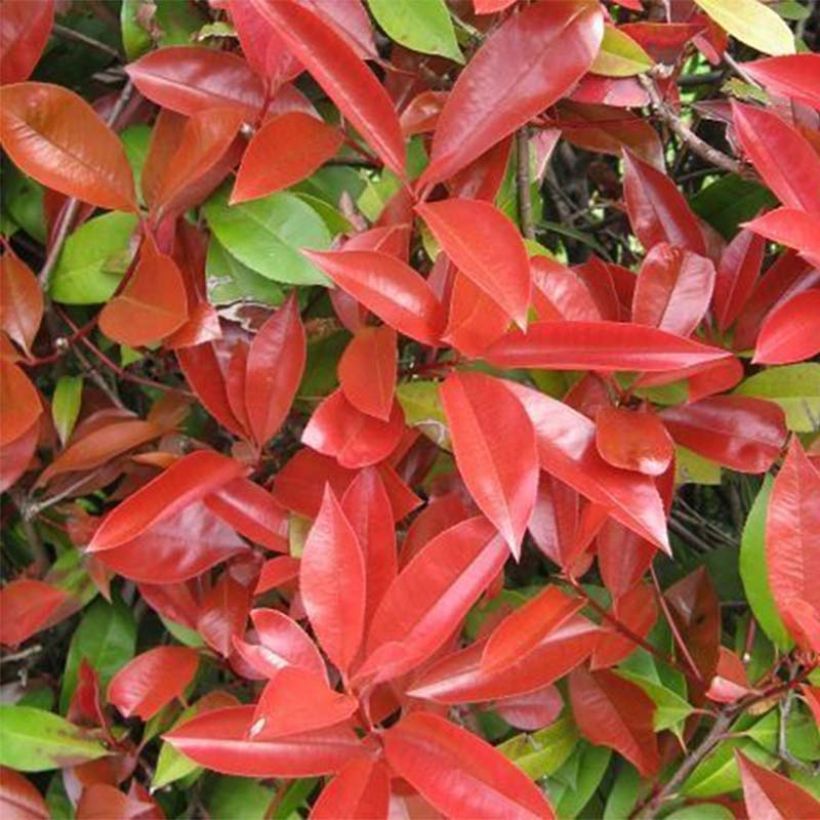
Plant habit
Flowering
Foliage
Botanical data
Photinia
x fraseri
Dicker Toni
Rosaceae
Christmas Berry, Redtip Photinia
Cultivar or hybrid
Planting and care
Photinia Fraseri Dicker Toni can be planted in spring or autumn in any deep, occasionally dry, fertile and well-drained soil. It appreciates a sunny or partially shaded exposure, sheltered from cold and brisk winds. It also tolerates shaded exposures, although at the expense of flowering and the intensity of young foliage coloration. Water well for the first two years, once or twice a week, especially in hot and dry weather during summer. Mulch the soil to keep it cool in summer in warm regions and protect the base in winter in cold regions. Note that once well established, the Photinia fraseri tolerates summer drought quite well. Prune in summer to balance the habit, cutting back all branches by half. This will promote the regrowth of young red leaves in autumn. Note that climates with mild, humid, and cool seasons promote the growth of photinias and the renewal of young red shoots, which can then be produced throughout the year.
Photinia is generally a robust plant however, in humid weather or, conversely, in certain dry and poor soils, photinias can be affected by a fungus (entomosporiosis). Watch out for black and red spots appearing on the leaves, treat with Bordeaux mixture. Weevils can also nibble on the edges of leaves at night, while their larvae can attack the roots; treat the soil with nematodes that parasitize the larvae.
Planting period
Intended location
Care
Planting & care advice
-
-

-
-
-

-
-
-

-
, onOrder confirmed
Reply from on Promesse de fleurs
Recently viewed products
Haven't found what you were looking for?
Hardiness is the lowest winter temperature a plant can endure without suffering serious damage or even dying. However, hardiness is affected by location (a sheltered area, such as a patio), protection (winter cover) and soil type (hardiness is improved by well-drained soil).

The flowering period indicated on our website applies to countries and regions located in USDA zone 8 (France, the United Kingdom, Ireland, the Netherlands, etc.)
It will vary according to where you live:- In zones 9 to 10 (Italy, Spain, Greece, etc.), flowering will occur about 2 to 4 weeks earlier.
- In zones 6 to 7 (Germany, Poland, Slovenia, and lower mountainous regions), flowering will be delayed by 2 to 3 weeks.
- In zone 5 (Central Europe, Scandinavia), blooming will be delayed by 3 to 5 weeks.
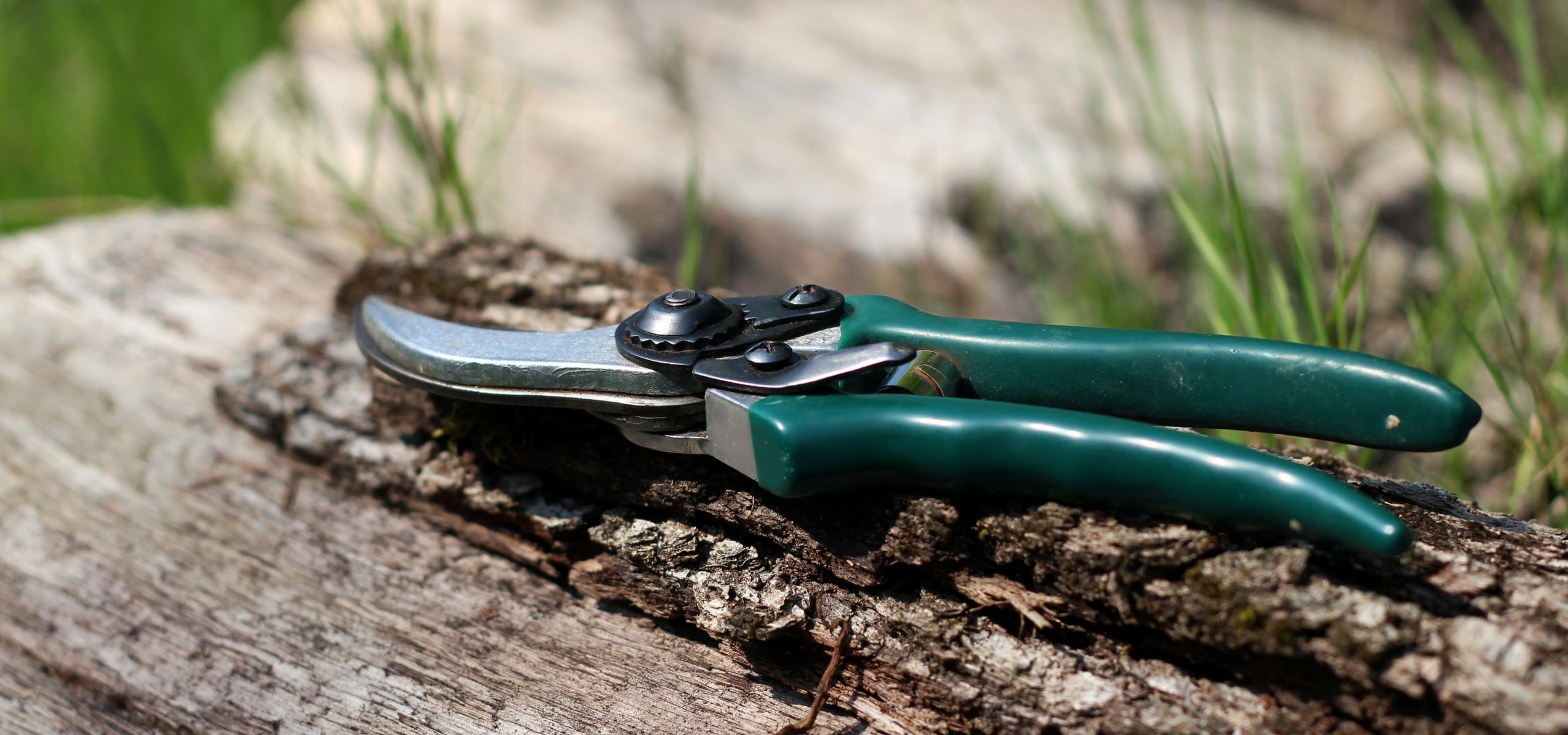
In temperate climates, pruning of spring-flowering shrubs (forsythia, spireas, etc.) should be done just after flowering.
Pruning of summer-flowering shrubs (Indian Lilac, Perovskia, etc.) can be done in winter or spring.
In cold regions as well as with frost-sensitive plants, avoid pruning too early when severe frosts may still occur.
The planting period indicated on our website applies to countries and regions located in USDA zone 8 (France, United Kingdom, Ireland, Netherlands).
It will vary according to where you live:
- In Mediterranean zones (Marseille, Madrid, Milan, etc.), autumn and winter are the best planting periods.
- In continental zones (Strasbourg, Munich, Vienna, etc.), delay planting by 2 to 3 weeks in spring and bring it forward by 2 to 4 weeks in autumn.
- In mountainous regions (the Alps, Pyrenees, Carpathians, etc.), it is best to plant in late spring (May-June) or late summer (August-September).
The harvesting period indicated on our website applies to countries and regions in USDA zone 8 (France, England, Ireland, the Netherlands).
In colder areas (Scandinavia, Poland, Austria...) fruit and vegetable harvests are likely to be delayed by 3-4 weeks.
In warmer areas (Italy, Spain, Greece, etc.), harvesting will probably take place earlier, depending on weather conditions.
The sowing periods indicated on our website apply to countries and regions within USDA Zone 8 (France, UK, Ireland, Netherlands).
In colder areas (Scandinavia, Poland, Austria...), delay any outdoor sowing by 3-4 weeks, or sow under glass.
In warmer climes (Italy, Spain, Greece, etc.), bring outdoor sowing forward by a few weeks.
Shipping country and language
Your country of residence may be:
Your country of residence is:
For a better user experience on our website, you can select:
Your shipping country:
-
 Austria
-
 Belgium
-
 Bosnia & Herzegovina
-
 Bulgaria
-
 Croatia
-
 Cyprus
-
 Czechia
-
 Denmark
-
 Estonia
-
 Finland
-
 France
-
 Germany
-
 Greece
-
 Hungary
-
 Iceland
-
 Ireland
-
 Italy
Italy
-
 Latvia
-
 Liechtenstein
-
 Lithuania
-
 Luxembourg
-
 Malta
Malta
-
 Netherlands
-
 Poland
-
 Portugal
-
 Romania
-
 Serbia
-
 Slovakia
-
 Slovenia
-
 Spain
Spain
-
 Sweden
-
 Switzerland
Language:
-
French
-
 English
-
Spanish
-
Italian
-
German
-
Portuguese
-
Dutch
-
Finnish
My Account
Hello
My wish lists
My cart
Log in / Register
Existing customer?
This form is protected by reCAPTCHA - the Google Privacy Policy and Terms of Service apply.
New customer?
Create an account to track your orders, access our customer service and, if you wish, make the most of our upcoming offers.