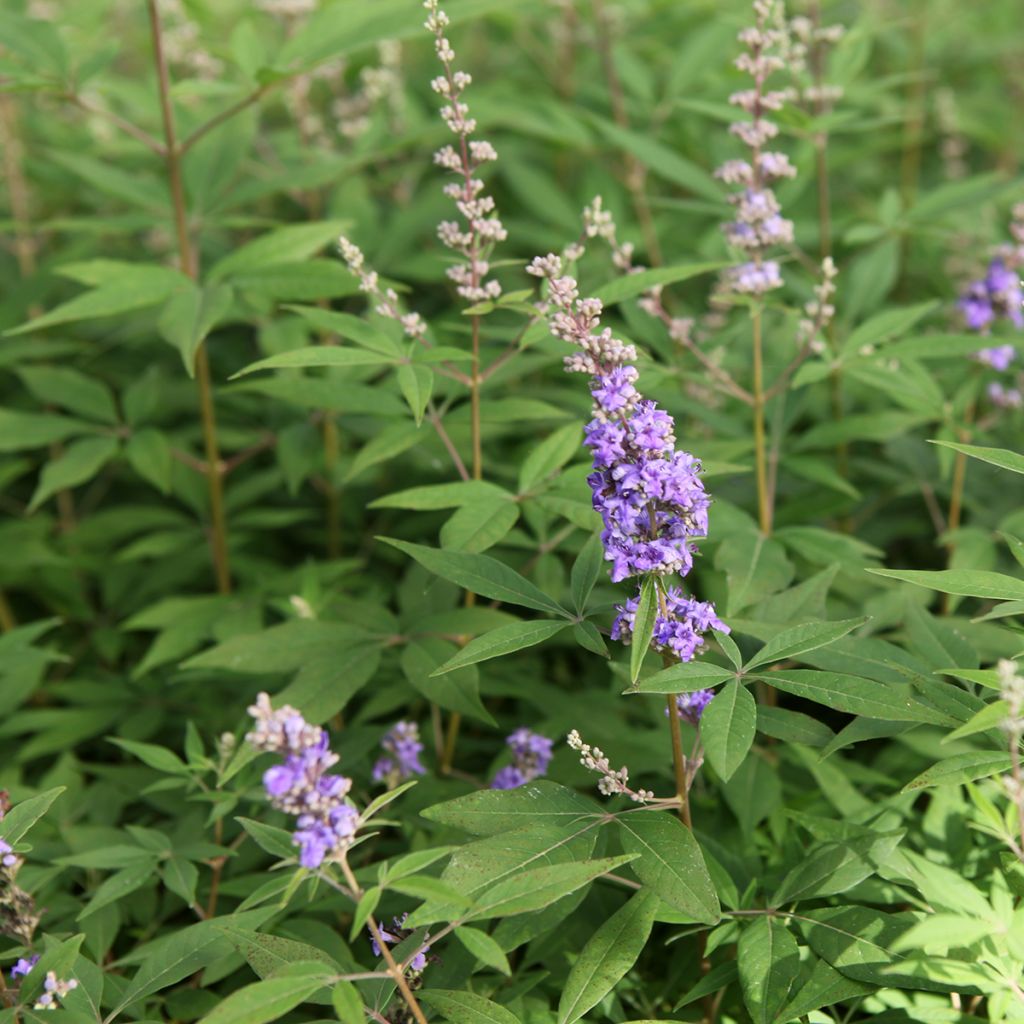
Vitex agnus-castus Queen Bee - Chaste Tree
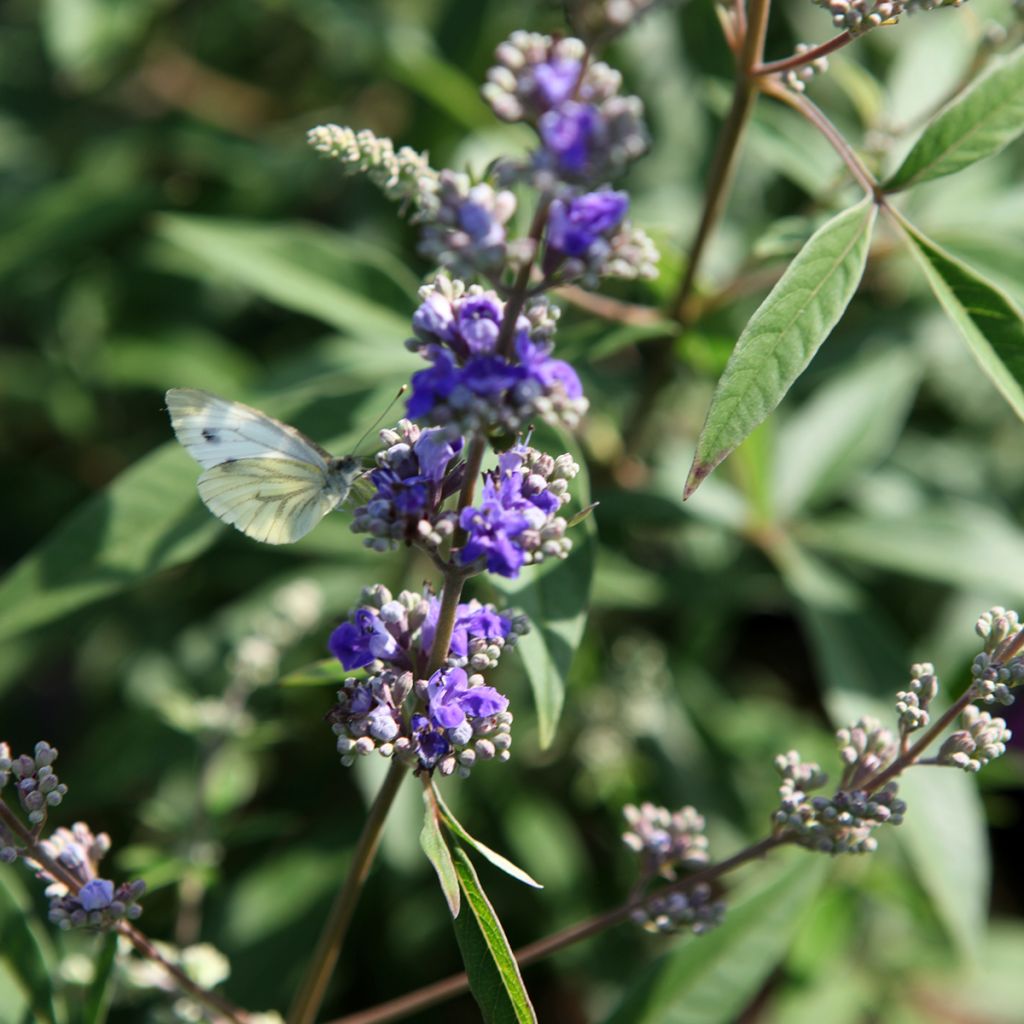
Vitex agnus-castus Queen Bee - Chaste Tree
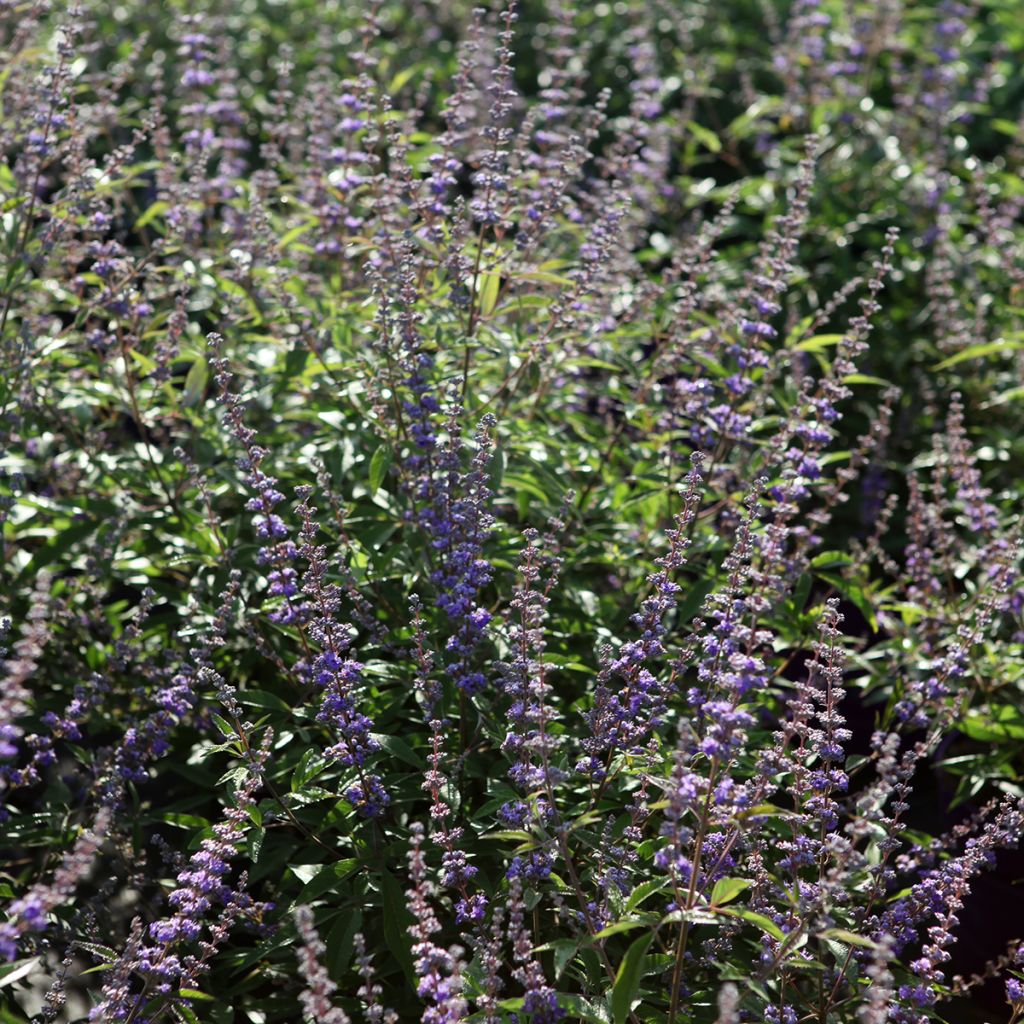
Vitex agnus-castus Queen Bee - Chaste Tree
Vitex agnus-castus Queen Bee - Chaste Tree
Vitex agnus-castus ‘Bailtexthree’ Queen Bee
Chaste Tree, Monk's Pepper, Chasteberry, Chaste Lamb
Back-to-school special offer!
Get €10 off for every €50 you spend! And get up to €40 off on a single order.
How does it work?
1. Shop your favourites
Add your favourite plants to your basket. For every €50 you spend (excluding delivery charges, store credit and the plastic-free option), you’ll receive a €10 voucher.
€50 spent = €10 voucher
€100 spent = €20 voucher
€150 spent = €30 voucher
€200 spent = €40 voucher
2. Place your order
Once your basket reaches one of the spending thresholds, place your order. You can even choose your delivery date!
3. Receive your voucher
As soon as your order has been shipped, you’ll receive an email containing your personal voucher code and its value.
4. Use it on your next order
Your voucher is valid for 90 days from the date you receive it. It can be used once only, on a new order worth at least the value of the voucher, excluding delivery charges.
Please note: Vouchers can be combined with other offers, but cannot be split or refunded.
Why not try an alternative variety in stock?
View all →
Available in 1 sizes
Available in 1 sizes
Available in 1 sizes
Available in 2 sizes
Available in 1 sizes
Available in 2 sizes
Available in 1 sizes
Available in 1 sizes
This plant carries a 24 months recovery warranty
More information
We guarantee the quality of our plants for a full growing cycle, and will replace at our expense any plant that fails to recover under normal climatic and planting conditions.
Would this plant suit my garden?
Set up your Plantfit profile →
Description
The Vitex agnus-castus Queen Bee is a selection of a compact and particularly floriferous chaste tree that excels in sunny, dry gardens. It is a deciduous bush with a naturally rounded habit, whose lavender-mauve flower spikes renew themselves from mid-June until the end of summer. It can be integrated into a low hedge or placed at the centre of a dry garden bed. Very melliferous, it provides a source of nectar appreciated in late summer. In open ground, it establishes quickly and requires little maintenance.
The chaste tree belongs to the Lamiaceae family. The botanical species Vitex agnus‑castus is native to Mediterranean regions and Western Asia, found near watercourses, on pebbles and sunny edges of coastal areas. The genus name Vitex comes from the Latin vireo/vieo ("to weave"), referring to the ancient use of its branches in basketry; the epithet agnus‑castus carries the idea of "chastity" associated with the fruits, known as "monk's pepper".
Queen Bee 'Bailtexthree' originates from the Bailey Innovations breeding programme (First Editions®). It is distinguished by naturally lower growth, excellent repeat flowering, and better tolerance to stress (heat, drought, cold) compared to more vigorous selections.
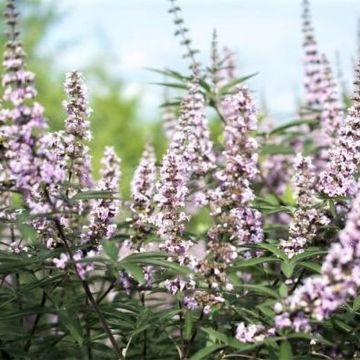
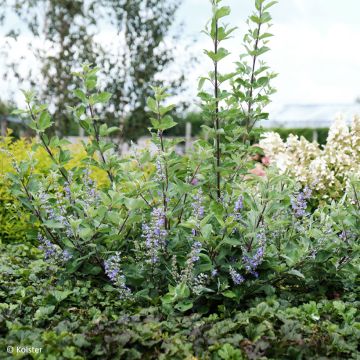
Its habit is bushy, very dense, and distinctly rounded; its growth is rapid in the first few years. In open ground, it reaches 1.50 to 1.80 m in height with a spread of 2 to 2.70 m at ripeness, that is, within 5 to 7 years; at 10 years, the plant stabilises around these dimensions. Pot cultivation is possible but not well-suited due to its spread; in open ground, this bush does not produce suckers.
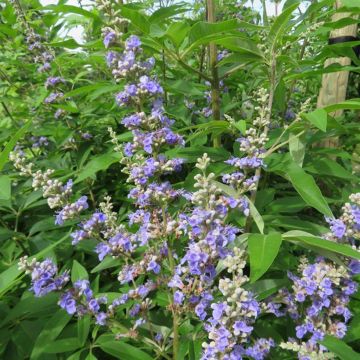
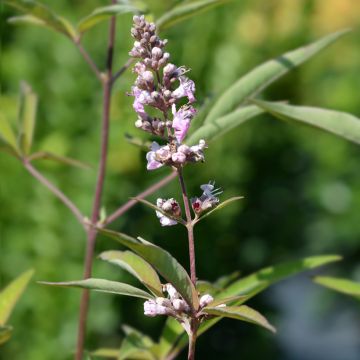
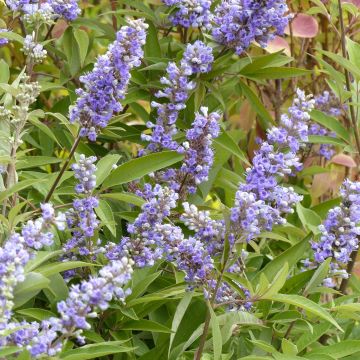
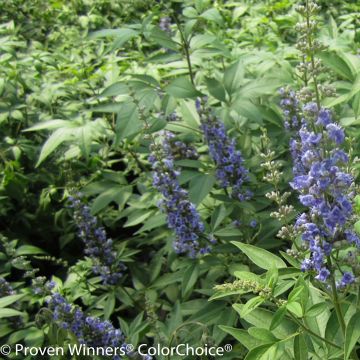
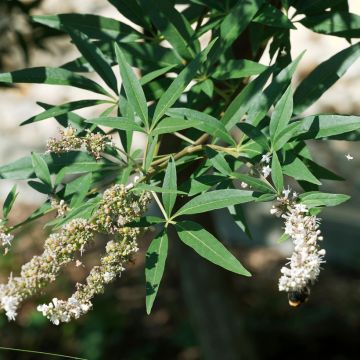
The first wave of flowers occurs from mid‑June to July, followed by summer flushes until September. The inflorescences are upright or slightly arching spikes 15 to 25 cm long, composed of small tubular lavender to mauve-blue flowers, pleasantly aromatic. The fruits are small grey-brown drupes, about 3–4 mm in diameter, resembling peppercorns. The foliage is deciduous and aromatic, palmate, divided into 5 to 7 lanceolate leaflets, grey‑green with a lighter underside; it contributes to the plant's light appearance. The root system is quite deep, well-adapted to dry summers.
Plant this Queen Bee chaste tree in full sun, in well-drained soil, even if calcareous. This bush withstands drought well once deeply rooted. After a cold winter, the plant regrows from the base in spring and reflowers on the current year's wood. You can use it in a flowering hedge, including in coastal areas. For this use, combine it with Tamarisks, hardy oleanders, ceanothus 'Concha' and Mexican orange blossoms (Choisya ternata) for example. It can also be planted in groups of 3 on a large, dry slope; halfway up the slope, you could plant Cistus pulverulentus ‘Sunset’ and creeping rosemary.
The "monk's pepper", derived from the chaste tree's drupes, was used as a condiment and in traditional Mediterranean herbalism; the species was often planted near dwellings and apiaries for its melliferous value in late summer.
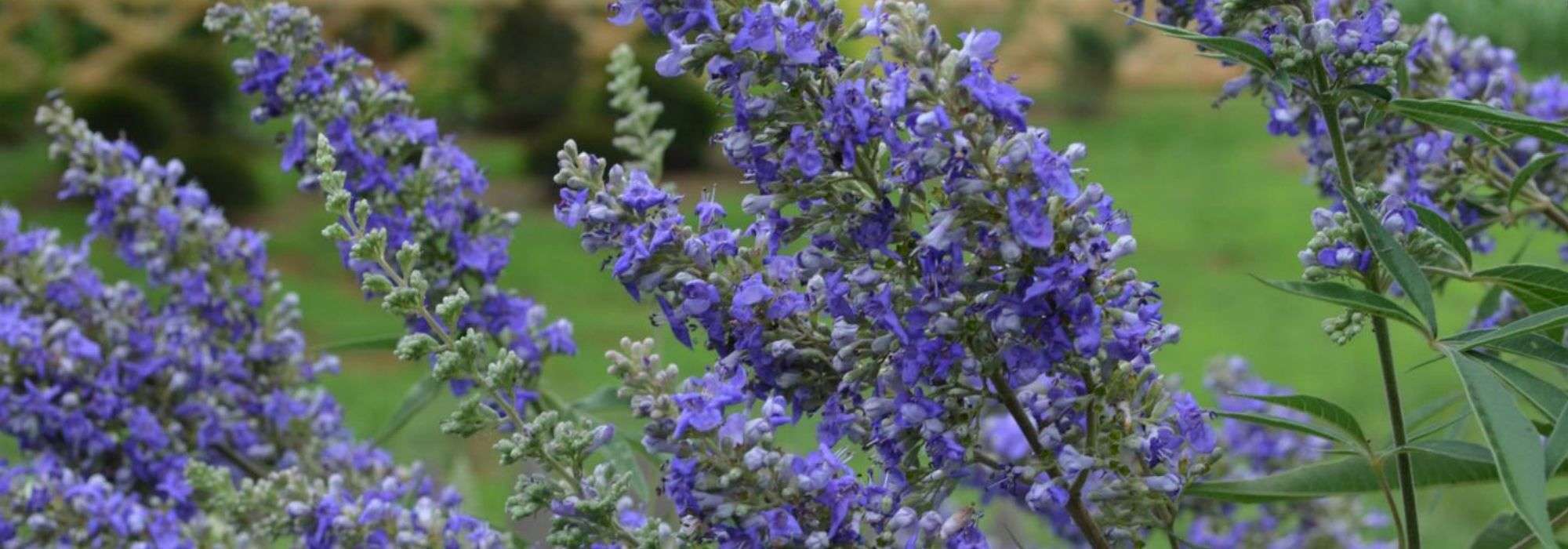
Vitex agnus-castus Queen Bee - Chaste Tree in pictures
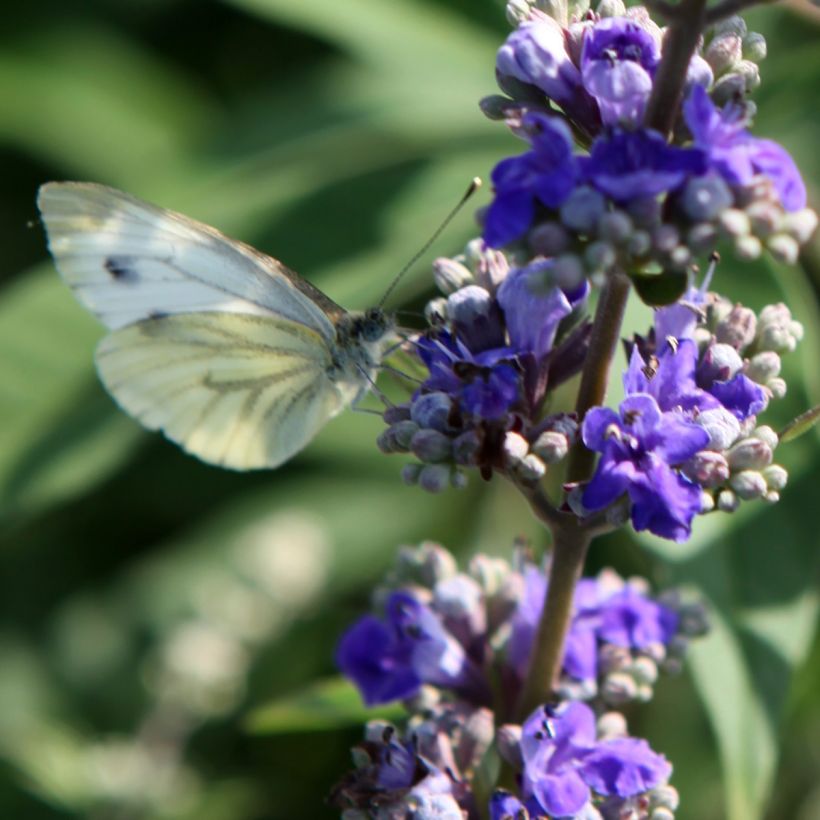
Plant habit
Flowering
Foliage
Botanical data
Vitex
agnus-castus
‘Bailtexthree’ Queen Bee
Lamiaceae
Chaste Tree, Monk's Pepper, Chasteberry, Chaste Lamb
Cultivar or hybrid
Planting and care
Plant the Vitex Queen Bee in full sun in ordinary, well-drained, fairly deep soil. This bush is not demanding regarding soil type, whether it is calcareous, neutral or slightly acidic, sandy, loamy. It withstands sea spray and brackish water upwellings very well. Shelter it from cold, drying winds and water during prolonged drought for the first 2 or 3 years. Fully hardy in the southern half of France, it is still susceptible to very severe frosts, particularly if the soil it is in is waterlogged. Its foliage may be destroyed by heavy frosts, but it will regrow stems from its stump in spring.
The Vitex is rarely affected by diseases and pests.
Planting period
Intended location
Care
Planting & care advice
-

-
-
-
-
-
-

-
This item has not been reviewed yet - be the first to leave a review about it.
Recently viewed products
Haven't found what you were looking for?
Hardiness is the lowest winter temperature a plant can endure without suffering serious damage or even dying. However, hardiness is affected by location (a sheltered area, such as a patio), protection (winter cover) and soil type (hardiness is improved by well-drained soil).

The flowering period indicated on our website applies to countries and regions located in USDA zone 8 (France, the United Kingdom, Ireland, the Netherlands, etc.)
It will vary according to where you live:- In zones 9 to 10 (Italy, Spain, Greece, etc.), flowering will occur about 2 to 4 weeks earlier.
- In zones 6 to 7 (Germany, Poland, Slovenia, and lower mountainous regions), flowering will be delayed by 2 to 3 weeks.
- In zone 5 (Central Europe, Scandinavia), blooming will be delayed by 3 to 5 weeks.
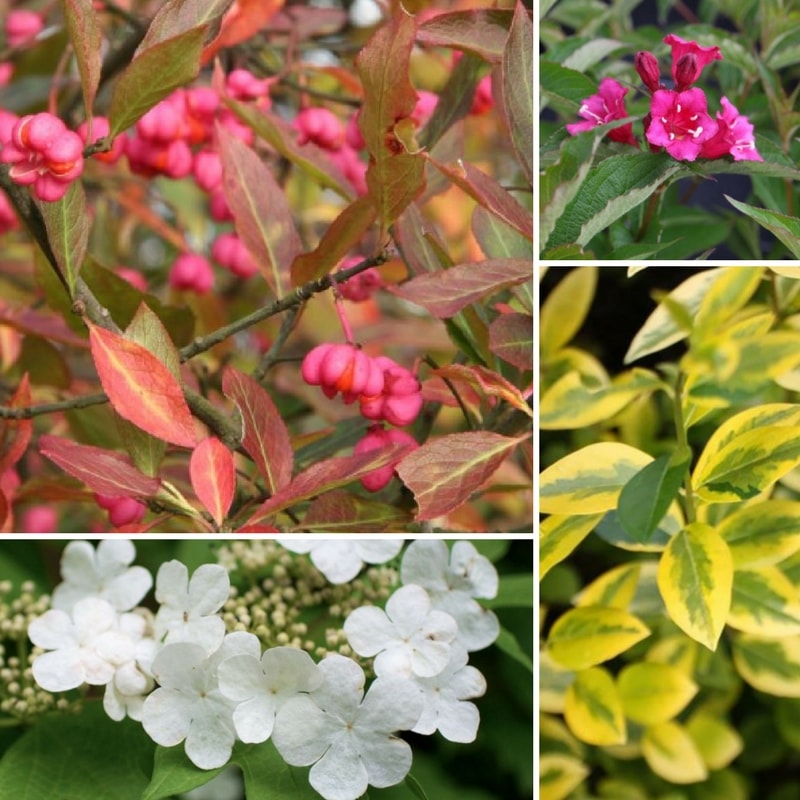
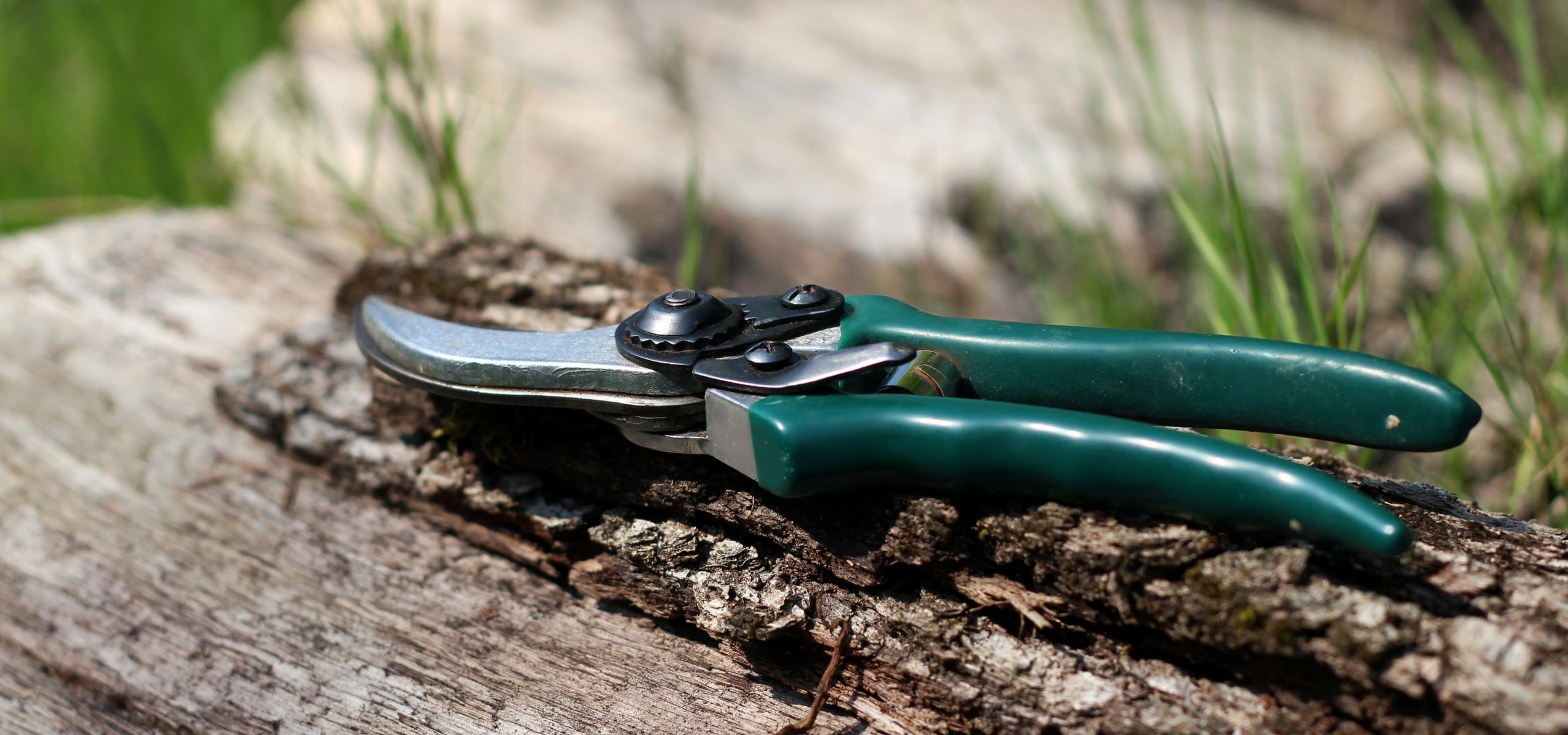
In temperate climates, pruning of spring-flowering shrubs (forsythia, spireas, etc.) should be done just after flowering.
Pruning of summer-flowering shrubs (Indian Lilac, Perovskia, etc.) can be done in winter or spring.
In cold regions as well as with frost-sensitive plants, avoid pruning too early when severe frosts may still occur.
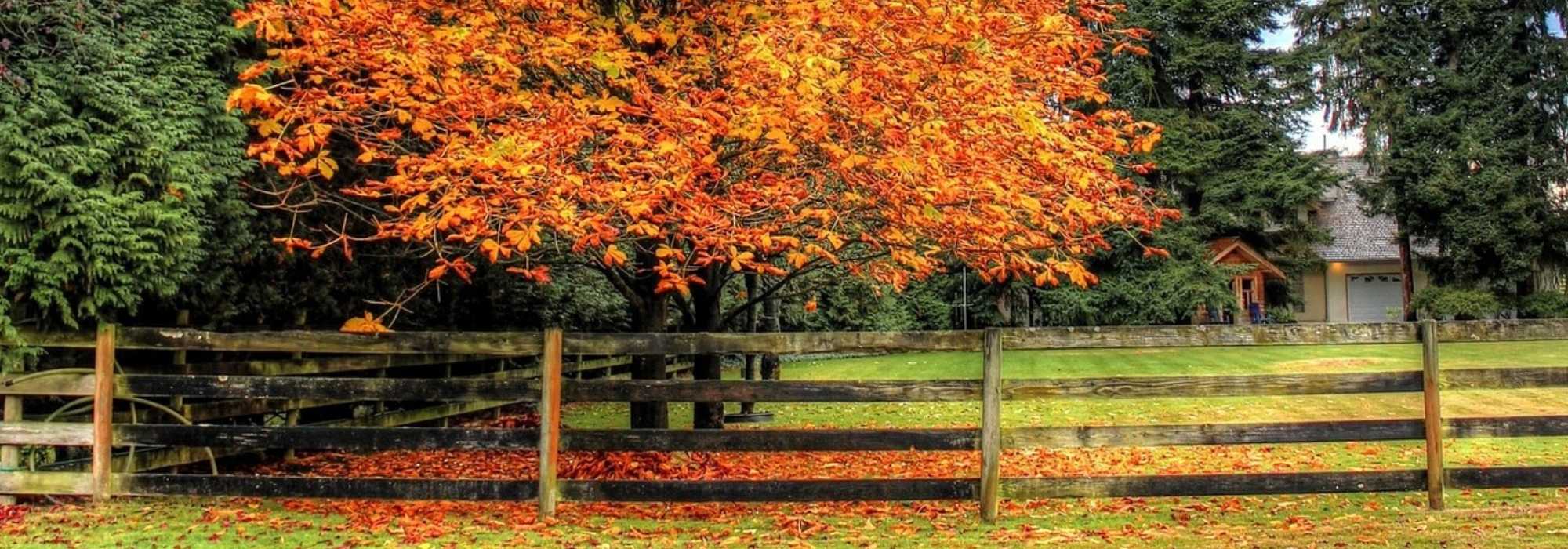
The planting period indicated on our website applies to countries and regions located in USDA zone 8 (France, United Kingdom, Ireland, Netherlands).
It will vary according to where you live:
- In Mediterranean zones (Marseille, Madrid, Milan, etc.), autumn and winter are the best planting periods.
- In continental zones (Strasbourg, Munich, Vienna, etc.), delay planting by 2 to 3 weeks in spring and bring it forward by 2 to 4 weeks in autumn.
- In mountainous regions (the Alps, Pyrenees, Carpathians, etc.), it is best to plant in late spring (May-June) or late summer (August-September).
The harvesting period indicated on our website applies to countries and regions in USDA zone 8 (France, England, Ireland, the Netherlands).
In colder areas (Scandinavia, Poland, Austria...) fruit and vegetable harvests are likely to be delayed by 3-4 weeks.
In warmer areas (Italy, Spain, Greece, etc.), harvesting will probably take place earlier, depending on weather conditions.
The sowing periods indicated on our website apply to countries and regions within USDA Zone 8 (France, UK, Ireland, Netherlands).
In colder areas (Scandinavia, Poland, Austria...), delay any outdoor sowing by 3-4 weeks, or sow under glass.
In warmer climes (Italy, Spain, Greece, etc.), bring outdoor sowing forward by a few weeks.
Shipping country and language
Your country of residence may be:
Your country of residence is:
For a better user experience on our website, you can select:
Your shipping country:
-
 Austria
-
 Belgium
-
 Bosnia & Herzegovina
-
 Bulgaria
-
 Croatia
-
 Cyprus
-
 Czechia
-
 Denmark
-
 Estonia
-
 Finland
-
 France
-
 Germany
-
 Greece
-
 Hungary
-
 Iceland
-
 Ireland
-
 Italy
Italy
-
 Latvia
-
 Liechtenstein
-
 Lithuania
-
 Luxembourg
-
 Malta
Malta
-
 Netherlands
-
 Poland
-
 Portugal
-
 Romania
-
 Serbia
-
 Slovakia
-
 Slovenia
-
 Spain
Spain
-
 Sweden
-
 Switzerland
Language:
-
French
-
 English
-
Spanish
-
Italian
-
German
-
Portuguese
-
Dutch
-
Finnish
My Account
Hello
My wish lists
My cart
Log in / Register
Existing customer?
This form is protected by reCAPTCHA - the Google Privacy Policy and Terms of Service apply.
New customer?
Create an account to track your orders, access our customer service and, if you wish, make the most of our upcoming offers.