Further reading…
Fancy strong contrasts in garden? Against pastel harmonies of Unicorn, saturated crimsons of Dark Acadomia, or teal blues of Transformative Teal, primary colour trend plays with cyan, magenta and yellow, a striking trio of the three base colours of the colour wheel. Elementary, almost childish, this colour mix divides opinion, but can fit into different styles. Judge for yourself with these pairing ideas!
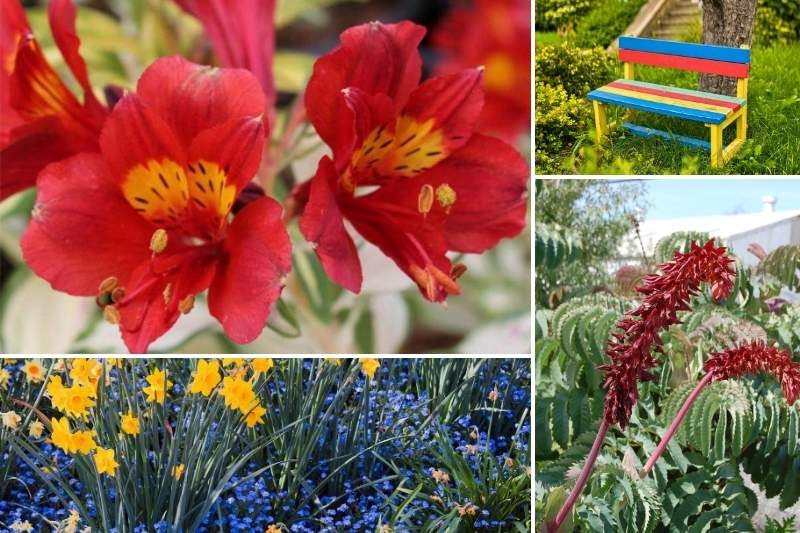
Primary colours: how to use them well ?
Red, blue and yellow flowerings are among most common in garden. Combining them is quite rare, most gardeners preferring harmonies, tonal ranges or colour gradients, or complementary pairings between two colours.
To avoid gaudy, unflattering and slightly cold combinations, finesse is required, pairing vermilion to crimson reds, very pale yellows to more orangey golds, gentian blues to periwinkle blues.
Surround these vivid colours with golden, bluish or purplish foliage. All variegated foliage or bicolour flowerings will help diffuse these strong-contrast tones. Finally, <strong:white, added in small touches in flowers or on foliage also helps attenuate this primary trio, as does play of green flowerings…
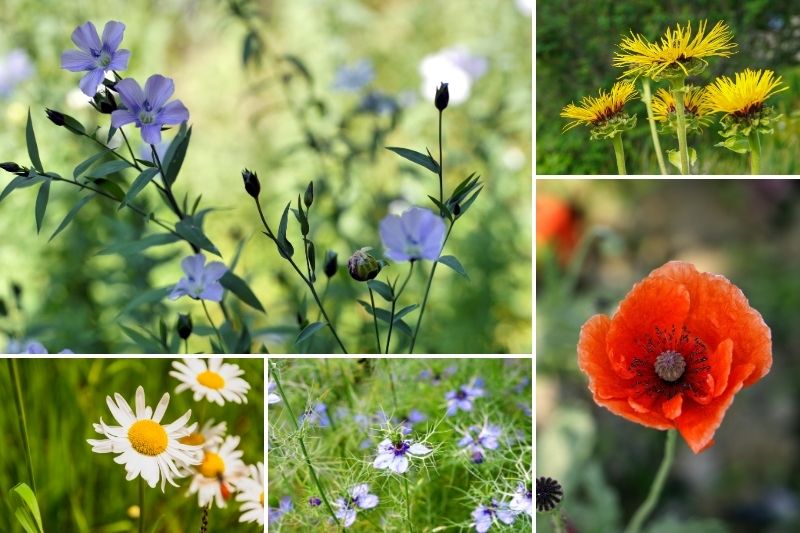
Freshness in the country garden
A cottage garden is a place where all colours often meet in a joyful jumble.
In this example, we bring together simple plants that will produce a very natural, refreshing effect in a country border. We will combine wildflowers, grandmother’s garden plants and cottage-garden plants.
For blues, try cornflower, flax, nigella, chicory, forget-me-nots, campanulas, heliotropic for its fragrance, and China aster 'King Size Mid Blue' for late season. All these plants are delightful and very effective.
Yellows here are provided by generous perennials such as Leucanthemum (large daisy) combining whiteness, mullein with grey‑green foliage, and inulas with more golden tones. One can equally seek paler yellows from charming hollyhocks, or bicolours with Anthemis.
For the red wave, opt for poppies and oriental poppies, spring tulips, sweet williams, peonies and cosmos.
Surround them with a few plants of wild fennel, very airy with greenish flowers, and a few white thalictrums to blur the effect.
A surprising trio in an exotic garden
Yellow and red, warm colours, are musts in exotic or tropical gardens. Putting them near blue tempers them, while keeping spirit of that foreign garden alive.
Think of Protea 'Clark's Red' or Leucadendron 'Devil's Bush' for magenta notes in mild‑winter regions, elsewhere yellow or red Alstroemerias and Kniphofias for the yellow.
Plant together, as in example illustrated below, a common Rose mallow, agapanthus, a fine Hedychium gardenarium, yellow and red Tigridia, a Melianthus with strange reddish‑brown inflorescences. Blue will be represented, besides agapanthus, by a beautiful passion flower, an Abutilon vitifolium or some Canary viper's buglosses with giant spikes.
To avoid leaving area bare once summer season has passed, plant among these exotic beauties some evergreen foliage, perennials, grasses and a few shrubs: Taiwan Schefflera, evergreen ferns, and a Daphniphyllum, perfect in semi‑shade. A Pennisetum setaceum 'Rubrum' or an Uncinia rubra 'Everflame' are best placed in full sun.
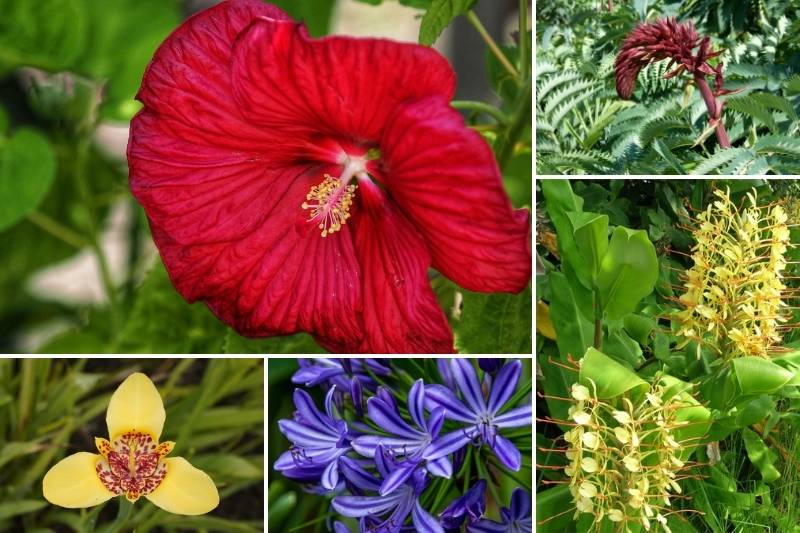
Colour explosion in the cutting garden
It’s easy to compose a cutting garden with countless plants in blue, yellow and red shades.
Depending on bouquet preferences, place summer perennials side by side with dahlias, blue delphiniums and yellow lupins. Don’t hesitate to combine very different plants here: old roses, eccentric love lies bleeding, capge gooseberry, a few annuals such as zinnias and antirrhinums, all‑yellow solidagos and greenish alchemillas, graceful sweet peas, thistles, narcissi and tulips for spring bouquets, Cosmos 'Lemonade' and 'Rubenza'… choices are endless!
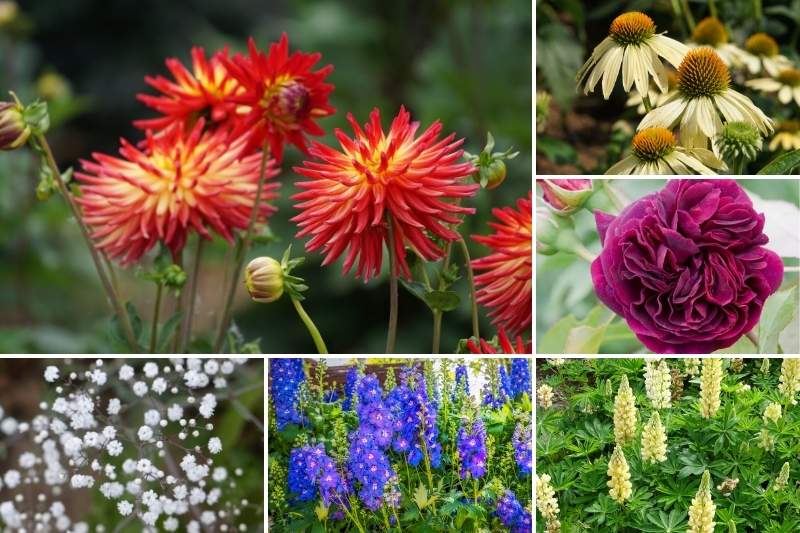
A joyfully colourful area around the play zone
Blue, red, yellow… a little like Rubik’s Cube or building blocks, don’t you think?
Near swing, pétanque pitch, children’s den or tipi, the play area can be designed around these three colours they love. Recreate their naïve, playful world, again based on yellow, red and blue as ultra‑cheerful emblems.
Choose robust plants able to withstand children’s rough play… and of course that won’t hurt or tempt them (avoid ornamental red berries that are toxic, such as those of heavenly bamboo or holly).
Physocarpus, blue hibiscus like Hibiscus syriacus 'Azurii', plumbago as climbing, herbaceous salvias, rosemary… Brooms and St John’s wort are also tough and will resist occasional ball throws. Some sunny achilleas with flat flowerheads, such as 'Golden Plate' or paler 'Desert Eve Yellow' are musts to bring cheer to the play area.
Finally add a few fluffy plants so children can play safely during summer such as Lagurus ovatus, those soft childhood ears, or simply lavender they will enjoy touching and smelling!
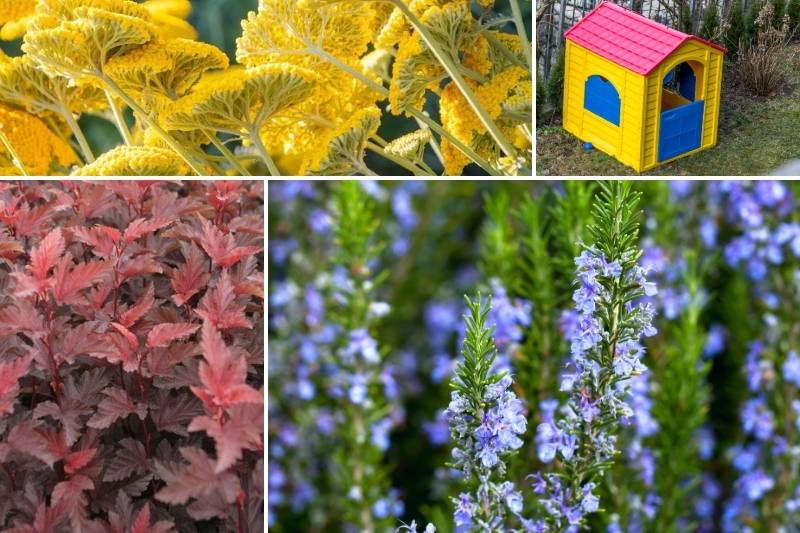
Find inspiration on the "Primary Shock" in our trend booklet!
All major garden trends for 2026 are here: Garden: What are five major trends for 2026?
See our tips on Colour Inspiration page for many more pairing ideas.
Attracted to yellow, blue and red flowers? Here are some of our articles on the finest representatives:
- Red hydrangea: best varieties
- Most beautiful passion flowers with red blooms
- 6 red‑flowered peonies
- 10 essential spring bulbs with yellow flowers
- 5 yellow‑flowered oleanders for bright garden
- 7 yellow‑flowered Alstroemerias
- Blue Ceanothus: most beautiful varieties
- 7 blue salvias to adopt in garden
- 8 climbing flowers you must have in garden
Fancy strong contrasts in garden? Against pastel harmonies of Unicorn, saturated crimsons of Dark Acadomia, or teal blues of Transformative Teal, primary colour trend plays with cyan, magenta and yellow, a striking trio of the three base colours of the colour wheel. Elementary, almost childish, this colour mix divides opinion, but can fit into different […]
Making a garden resilient, stronger in the face of the repeated heatwaves our countries now suffer, is one of the challenges of the Chaparral garden, which draws on flora from extreme climates, such as those found in New Mexico or California. The multiple heatwaves of summer 2026 confirm this reality and will certainly steer us towards undemanding plants that are also hardy in our winters. Discover this new type of garden, inherently waterwise, low-maintenance and very promising.
What is a chaparral?
Chaparro is a Spanish word referring to several oak species (Quercus ilex, holm oak, but also Quercus coccifera and sometimes cork oak). The term also covers less well-known species such as Castela tortuosa, a shrub native to arid areas of Mexico and southern United States.
Chaparral is nothing more than an area of scrub and shrubs, forming a specific ecosystem in Mediterranean climates. It generally resembles a stand of holm oaks, in other words a garrigue or maquis, terms and landscapes more familiar to us. The name in Spanish denotes a biome found mainly from Mexico to California, and in Europe around the Mediterranean such as Andalusia or Sardinia. These areas are wooded, populated by shrubs and undershrubs able to withstand very hot conditions.
Plants able to grow in chaparral are often sclerophyllous (small, leathery leaves covered by a protective cuticle), sharing unique adaptations to this dry environment: deep roots, grey-green leaves that reflect light, and essential oils that limit evaporation.
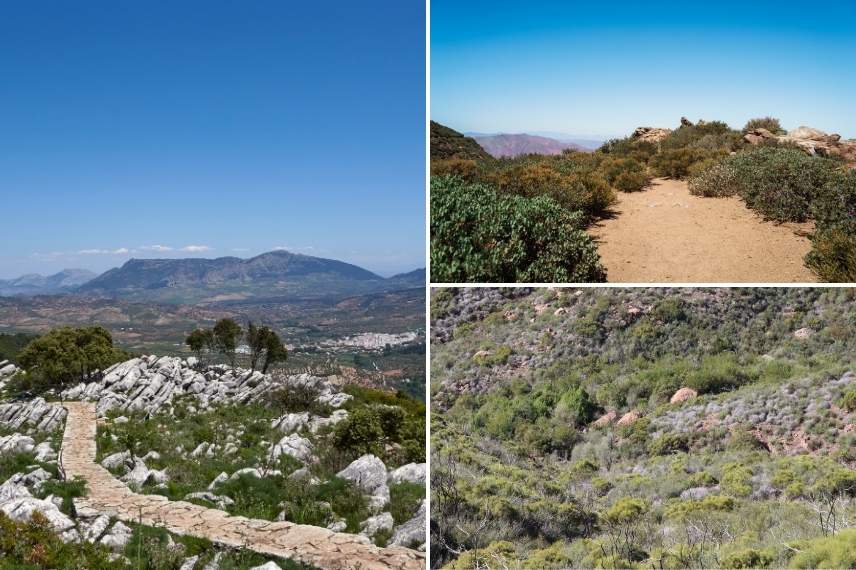
We imagined three scenes to reproduce, in spirit, this ultra-resilient type of landscape. You can create a single area of the garden that receives particularly strong summer sun, or treat the whole garden in this style, provided you live in temperate valleys or mild zones of the country.
Adapting the chaparral to a dry exotic garden
A dry garden can create a sublime scene with exceptional plants.
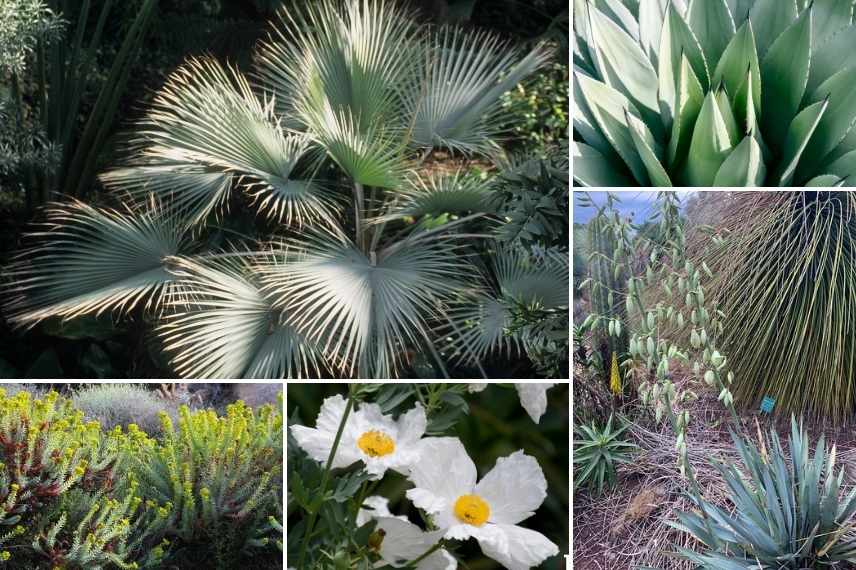
Here we play with a palette of blue-tinged foliage using plants surprisingly resistant to short frosts in winter, not exceeding −10°C. The tree poppy, a Californian and Mexican plant with wonderful white flowers, and the Mexican blue palm for an original backdrop, have proven able to withstand very dry summers. Once well established, Romneya poses no real hardiness issues. A Yucca pallida joins them to form that superb silvery-blue base, accompanied by an agave hardy enough such as Agave parryi or Agave montana.
A Mediterranean perennial, Euphorbia pithyusa, a Balearic spurge that stays low, and a Mexican-origin plant, Mathiasella bupleuroides 'Green Dream' with jade-green flowers, naturally fit among these plants. We bring in chartreuse and blue-green tones for a duet of colours evoking Mediterranean aridity.
NB: this blue planting can easily be part of a blue garden, located in the sunniest, driest part of the garden!
Transport yourself to Lanzarote
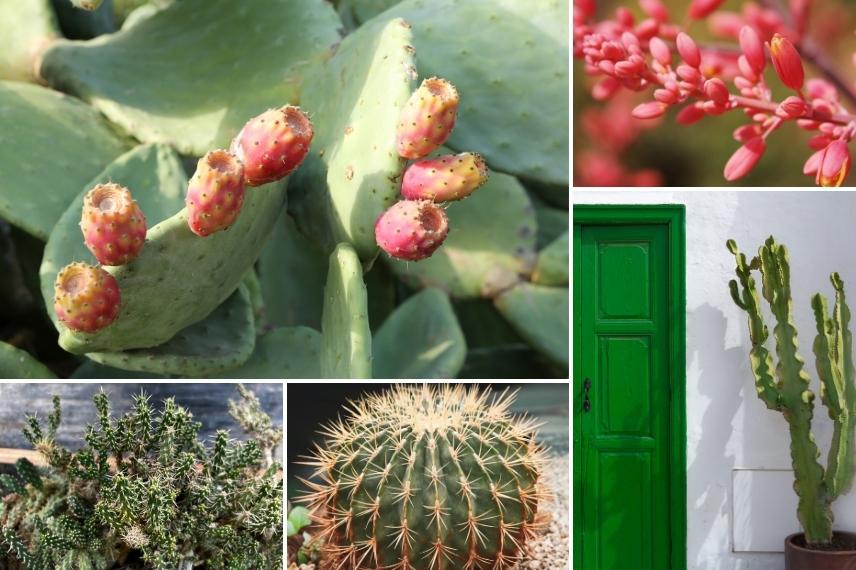
Lanzarote's cactus gardens are exceptionally photogenic. On this volcanic archipelago grow sclerophyllous plants with small leathery leaves adapted to drought, and spiny cacti. Drawing inspiration from them, while carefully selecting cacti cold-hardy enough for our winters, allows creation of a unique area within a dry garden, ready to face repeated summer heat spikes. Ensure perfect drainage, as this type of garden cannot tolerate any standing moisture in winter.
A prickly pear, well adapted to sea spray, is interesting for its slightly greater hardiness (down to around −15°C for some) and its unique habit with large spiny pads. Plant them liberally; choices include Opuntia scheeri or Opuntia engelmannii var. rastrera, among many others. In this distinctive setting, succumb to oddity of Cylindropuntia kleiniae, a cousin of opuntias, quite cold-hardy and producing a beautiful magenta summer bloom. Complement the area with a Hesperaloe parviflora and an Echinocactus grusonii, the golden barrel cactus often seen on the island.
This type of garden is intended for warm, mild regions of the country with less severe winters and dry summers.
Use pumice or black volcanic stones to simulate island soils and to ensure drainage. Finishing touch? a whitewashed house with green shutters to reproduce another characteristic of this island close to African coasts.
... or to landscape a poor, unproductive slope
A south-facing, dry and unproductive slope can also be transformed into a resilient space by imitating the chaparral, an ecosystem adapted to extreme conditions.
To turn poor soil into a semi-desert rockery, favour low, hardy shrubs such as cistus (Cistus), a California lilac like the ceanothus ' Pacific Wave' or its groundcover form (C. thyrsiflorus 'Repens'), a prostrate rosemary and some sempervivums. These plants, with deep roots and leathery or fleshy leaves, tolerate drought and poor soils perfectly. Add a golden thyme, and some sages (such as Canary Island sage 'Lancelot'), aromatic plants that will scent the garden while attracting pollinators.
Once established, these plants require little watering and maintenance. Their dense foliage will protect soil from erosion and limit growth of weeds that are unwanted on the slope. A mineral mulch will help conserve moisture and enhance the slope's natural appearance. A few ochre or orange boulders placed here and there will also help evoke Californian or Andalusian maquis while enhancing the area.
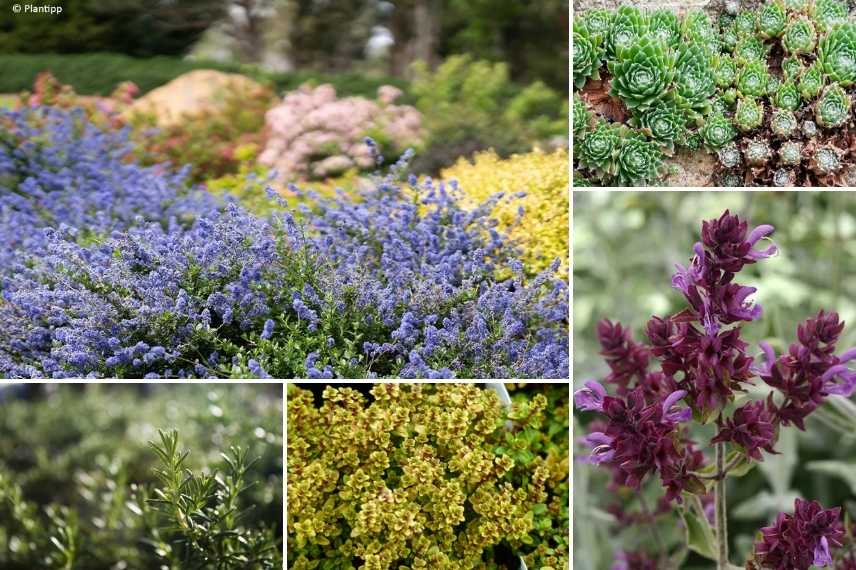
Discover our selection of succulents and perennials on our "Dry garden" page online, and our inspiration in the trend booklet 2026!
Since Beth Chatto, the dry garden movement has increasingly been seen among landscapers and in gardening magazines and books. We cover it in detail in Designing a dry exotic garden, Laying out a gravel garden, the Californian-style garden and the garrigue garden, as well as strong trends recently seen at the Chelsea Flower Show in London, such as the antipodal garden and the sand garden.
Find all garden trends for 2026 in: What are the five major trends for 2026?
Making a garden resilient, stronger in the face of the repeated heatwaves our countries now suffer, is one of the challenges of the Chaparral garden, which draws on flora from extreme climates, such as those found in New Mexico or California. The multiple heatwaves of summer 2026 confirm this reality and will certainly steer us […]
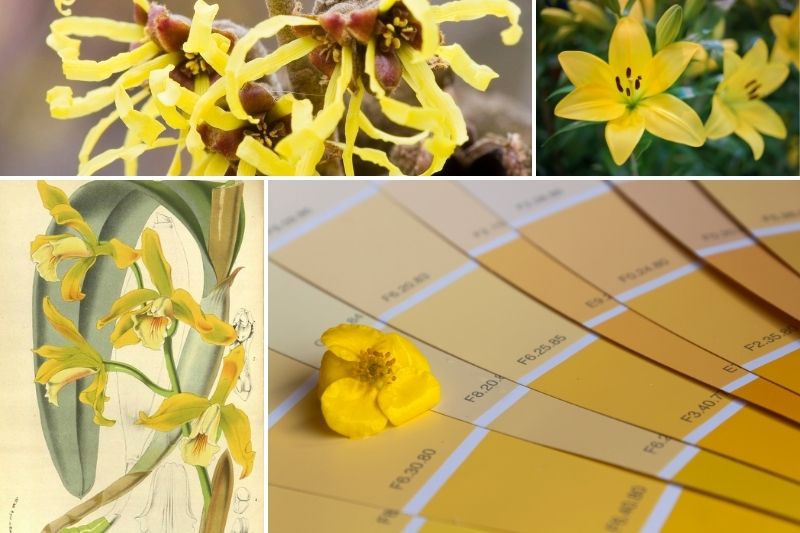
The idea for this personal take came to me from a thought I had at a recent plant swap. While a charming lady was offering some perennial plants, I asked her straight out: 'What colour are the flowers?' — 'Yellow,' she replied. And I retorted, rather bluntly: 'Oh no, no yellow for me.' I immediately felt bad, finding myself oddly rude and not very respectful. If she reads this article, may she forgive me, because yellow is one of the most radiant colours there is! Proof in pictures…
Yellow in the garden: why such hostility?
One could almost speak of a divisive colour in the garden, so much does yellow provoke either rejection or genuine passion. Even though it evokes the image of the sun and is a symbol of cheerfulness and dynamism, it is one of the colours gardeners often shun. Yet yellow is the colour of wonderful shrubs and blooms such as winter-flowering mimosa or Laburnum, those delightful yellow laburnum arches in spring that usually win unanimous praise.
This lack of enthusiasm even shows up, I find when looking into the subject, in our articles at Promesse de fleurs, where we address yellow flowering far less than the popular themes of blue, pink or white gardens.
Yellow has a bad reputation in many fields. It is rarely chosen as a dominant colour in décor. A primary colour with blue and red, yellow stands apart in our plant choices, and some refuse even to have a single yellow flower in their beds. Is that because it is associated with certain weeds (dandelion, sow-thistle, buttercup, celandine and others) or because it is said to be hard to pair? I would lean towards the latter reason, to which I return below.
In art, it was one of the major colours of the Fauvist movement, brought to its height by Vincent Van Gogh with his vivid yellow blocks on sunflowers or by Klimt.
But, once associated with the sacred, yellow declined from the Middle Ages, gradually evolving into a negative symbol, until it became the colour of the yellow Star of David. Even language turned on it with a few unflattering expressions, such as a forced laugh or the "Yellow Peril". In the West, offering yellow roses long signified infidelity and, more broadly, separation. Yellow therefore evokes deceit and betrayal, whereas it carries a very positive connotation in the East.
Yellow and yellows
Yet there is not one yellow but many yellows, just like the gradients in all colours.
From very pale, almost white yellow to saffron yellow, it is a wide spectrum! Let us set aside yellow or golden foliage here, which is generally better accepted by many gardeners.
St John's-wort, forsythia, mahonia: the vivid yellow of these shrubs, often considered mundane, may be one reason for the contempt shown towards yellow. Or is it still too closely associated in our minds with 1970s gardens that featured rather unnatural yellow roses, almost artificial chrysanthemums and overly gilded conifers? Finally, some summer bedding displays seen in parks or roundabouts, at times almost garish, put many people off…
Unless the lemon-yellow of the few adventitious weeds mentioned earlier puts us off this delightful colour. But it is more likely the difficulty of combining yellow flowers well with other garden blooms that makes us hesitate to use it. In short: people often fear that saturated yellow will jar with other plants in the garden.
My favourite yellow flowers
I am one of those who do not plant too many yellow flowers in the garden. My view has nevertheless evolved with my wanderings through English gardens that dare, in some cases, a monochrome yellow garden, less common than the famous white garden at Sissinghurst. Marvels can be found there, as at Burton Agnes Hall.
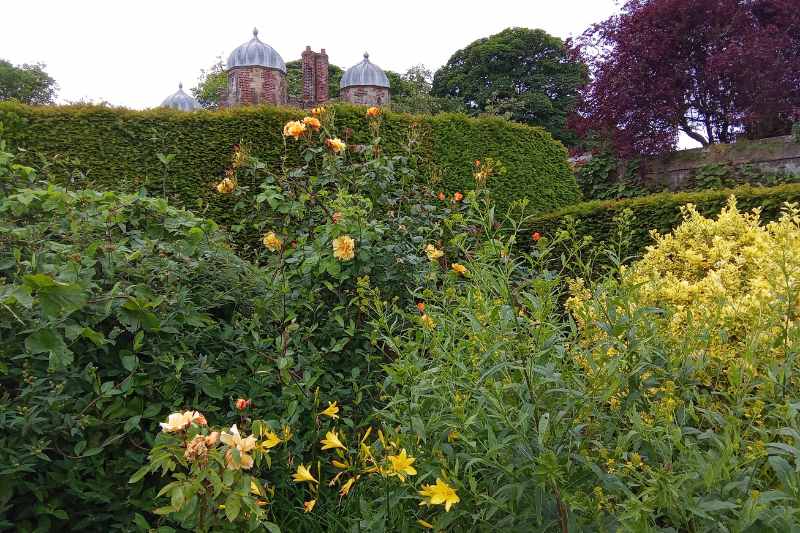
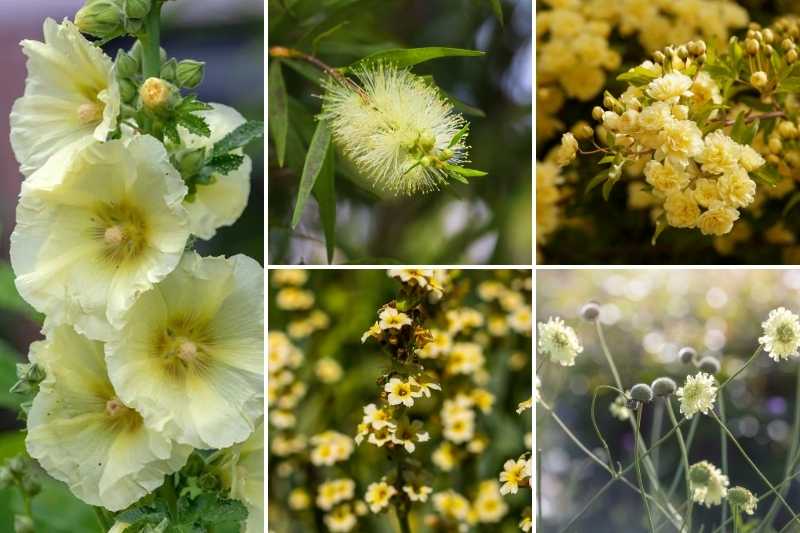
For my part, special mention goes to pale and pastel yellow blooms that are so easy to pair. Light, creamy, butter, anise, straw or slightly apricot yellows actually harmonise with many garden flowers: all blues, pinks and oranges, mauves and purples, from pale lavender to plum. They are found in some old or species roses like 'Mermaid', many honeysuckles, oleander luteum 'Plenum', Liriodendron, some magnolias and exquisite Michelia, of great delicacy, and many other shrubs and perennial plants.
I admit that brilliant yellow is also the colour of spring! Daffodils are its true ambassadors. And if you do not want to incorporate yellow elsewhere in the garden throughout the year, spring is a real opportunity to punctuate the early fine days with a Banks' rose, some sunlit tulips and other bulbs or chartreuse-flowered euphorbias, or an azalea 'Harvest Moon' that pair wonderfully with the many blue and white spring blooms.
Using yellow: how not to go wrong?
I also like to see brighter yellow blooms parade through summer beds, in a naturalistic planting with rudbeckias or sunlit achilleas, in English hot borders that blend all warm colours of the colour wheel. It is also perfect in exotic gardens, alongside orange blooms, with which it creates a beautiful gradient. Finally, many marginal or aquatic plants flower in yellow, making them excellent choices for water gardens or pond edges, enhanced by yellow-flag iris, ligularias, yellow water lilies and a few touches of purple foliage. Last option for this much-maligned yellow: it is a standout colour in dry gardens, appearing alongside senecios, Helychrisum and other succulent plants paired with greyed and silvery foliage and some blue or orange blooms.
My final tip: avoid adding yellow blooms to beds that are already richly coloured (except in a naturalistic context). The result can be a garish effect not in the best taste. It's better to stick to a successful two-colour combination, or three colours, and play with contrasting foliage or work in gradients. Introduce it in small doses, unless aiming for a monochrome garden — to me, that is the best way to exalt it!
Not convinced? Still hesitating? Do you tend to use yellow mainly in handsome winter-flowering shrubs? What are your experiences with yellow in the garden? Tell us how you use it, and feel free to comment to continue this age-old debate about yellow in the garden.
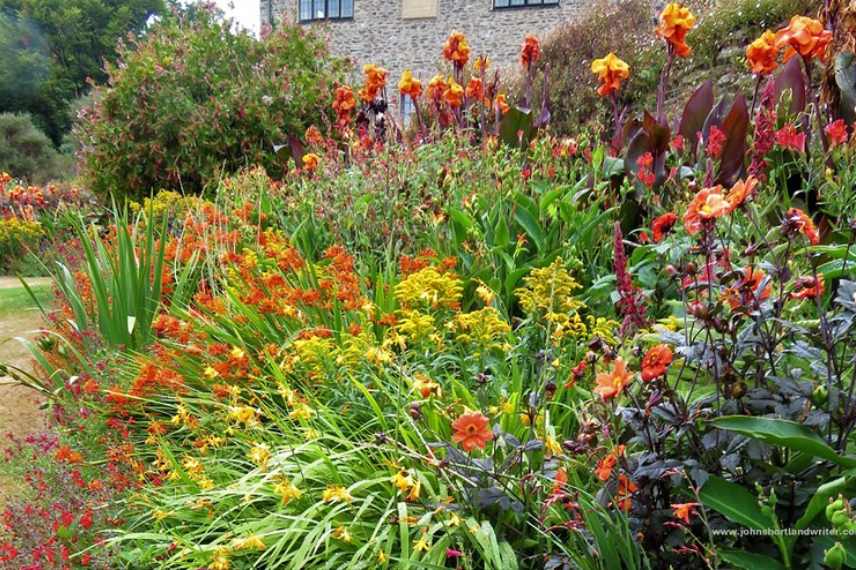
a successful trilogy of yellow, orange and purple
Further reading…
Top up your ideas with tips and inspiration from the editorial team in our dedicated section on the Yellow garden. On our online shop, discover our wide range of yellow-flowering shrubs, as well as our yellow roses, and our yellow-flowering bulbs.
Leïla tackled this subject in How to pair yellow flowers in the garden? and Michaël in Toning down yellow flowers in the garden.
And if, like me, you enjoy history and the symbolism of colours, add French author Michel Pastoureau's work on the colour yellow to your summer reading: Yellow: A History of a Colour, published by Points in France.
The idea for this personal take came to me from a thought I had at a recent plant swap. While a charming lady was offering some perennial plants, I asked her straight out: ‘What colour are the flowers?’ — ‘Yellow,’ she replied. And I retorted, rather bluntly: ‘Oh no, no yellow for me.’ I immediately […]
Are you watching colour trends, and do you like to experiment not only indoors but also in your garden or on your terrace?
The very latest is Transformative Teal, often described as teal or turquoise. Some plants naturally display this colour, mainly in their foliage and more rarely in their flowers. This <strong shade that sits between blue and green can be used in the garden with a few colourful pots set against a more neutral palette.
See how to introduce this teal outside the home!
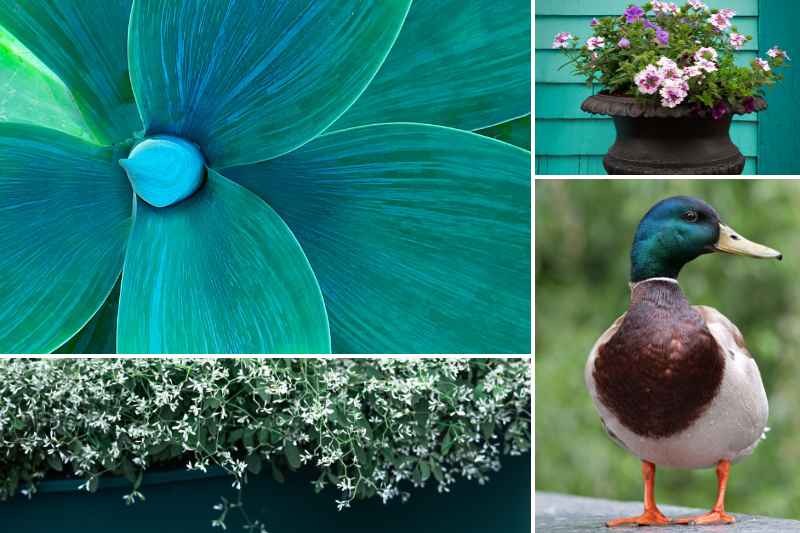
What is this new trend? How to use it in the garden?
Blue and green are cool colours on the colour wheel. Combining the two gives a very aquatic note, which can almost seem artificial in a garden setting. The English term 'teal' appears from the 1950s in interior design, where it is most often seen. This blue‑green is the colour that highlights the eyes of teals, the small freshwater ducks. Here, the expression 'bleu canard' seems best to express this intense shade.
It is mainly foliage that approaches this colour, described in botany as a glaucous blue: it is often found in hostas, many blue‑tinged conifers or some perennials, and in the pruinose leaves of certain shrubs. Among the rare flowers, look to distant beauties such as the Chilean Puya or the Asian Strongylodon macrobotrys.
The most flattering combinations for flowers or pots are white, very soft yellows and orange or brick tones, as well as all shades flirting with chartreuse green (see green flowers).
Avoid saturating the scene with overly cool tones like grey or silver; instead, enliven it with neighbouring colours on the colour wheel such as sulphur yellow, acid green or jade green.
Finally, rely on accessories: choose glazed pots in matching hues to reflect the light effectively, or furniture and seating in aniseed tones.
In an exotic‑style garden
This is perhaps the easiest way to reveal the subtleties of teal, since the exotic plant palette – tropical or dry exotic – offers several options for sunny areas. With centre stage given to the extraordinary flowers of Puya berteroniana, Puya alpestris or the jade vine in the least frost‑prone gardens, and the white spikes on glaucous foliage of some Yucca (notably Yucca aloifolia or Yucca rostrata), count on the striking blue‑green foliage of Melianthus major and the bluer, greyer leaves of Eucalyptus and Pinus parviflora. A bicolour arum, white and green, Zantedeschia 'Green Goddess' planted in sufficiently cool soil will wrap the scene in its refreshing trumpets.
In a dry exotic garden, an unusually blue senecio, Senecio serpens 'Dwarf Blue', can take pride of place and nearly steal the show from Dasylirion, such as Dasylirion glaucophyllum.
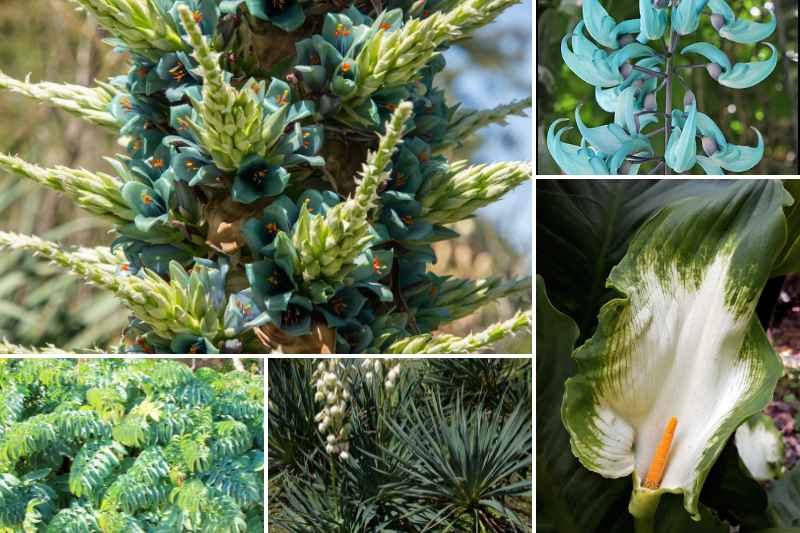
In a mixed border or English garden
Different mood, different style: a cottage‑style garden planted with large borders is also well suited to playing the teal note, as several attractive perennials carry this almost turquoise shade, often in a lighter tone. Representative plants include Mertensia maritima (also called oysterleaf), Crambe beloved in cottage gardens, rue (Ruta graveolens) and Cerinthe major.
A few selected flowers in soft tones, from white to mauve‑pink, will provide the necessary link so the planting does not slip into a dull bluish monochrome: catananche for a rustic touch, Erigeron karvinskianus, mauve or white hosta spikes, etc.
Bring in almond‑green and yellow‑greens such as the downy Ballota pseudodictamnus or the inflorescences of giant Cephalaria. A graceful grass such as Sesleria nitida will add the lightness suited to this ambience.
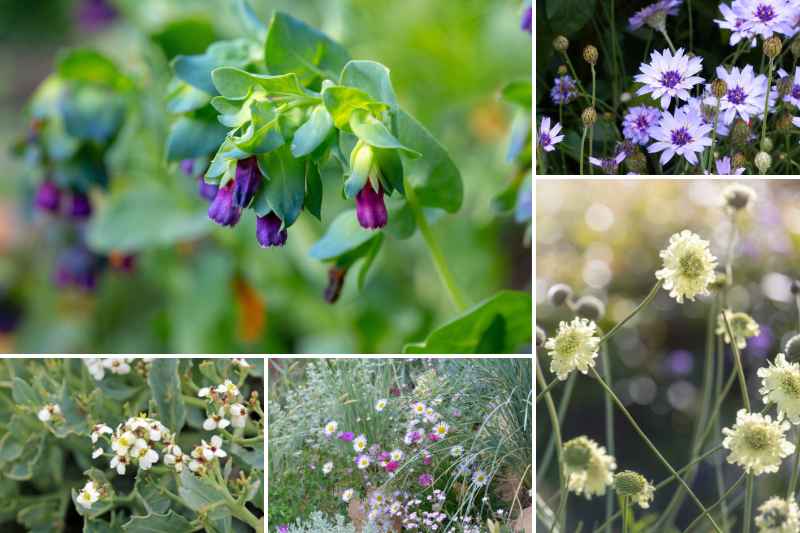
In a pot garden of succulents
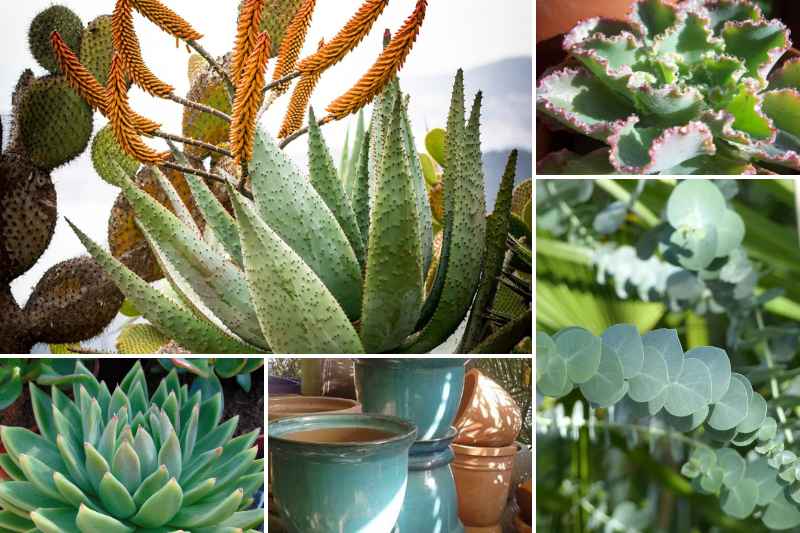
Here, opt for tone‑on‑tone plants in matching pots. The result is perfect on a south‑facing balcony or a terrace that basks in hot summer sun. Many cacti and succulents have that characteristic pruinose blue that protects them from heat. Start with agaves and some handsome echeverias, such as Echeveria 'Miranda', Echeveria peacockii 'Urban Orange' and Echeveria 'Blue Curls'. Don't forget Euphorbia x pseudovirgata 'Redwing' 'Charam' with its bluish young shoots.
An aloe completes this mini dry garden perfectly, for example Aloe marlothii, or, for small spaces, a dwarf aloe such as 'Aloe nain' (Aloe aristata).
Terracotta pots, raw or glazed, will provide either a flattering orange contrast or a very chic monochrome. In this small world, adding a few orange blooms is perfect: Bulbine or dwarf day‑lilies, for example.
In shade for an aquatic feel
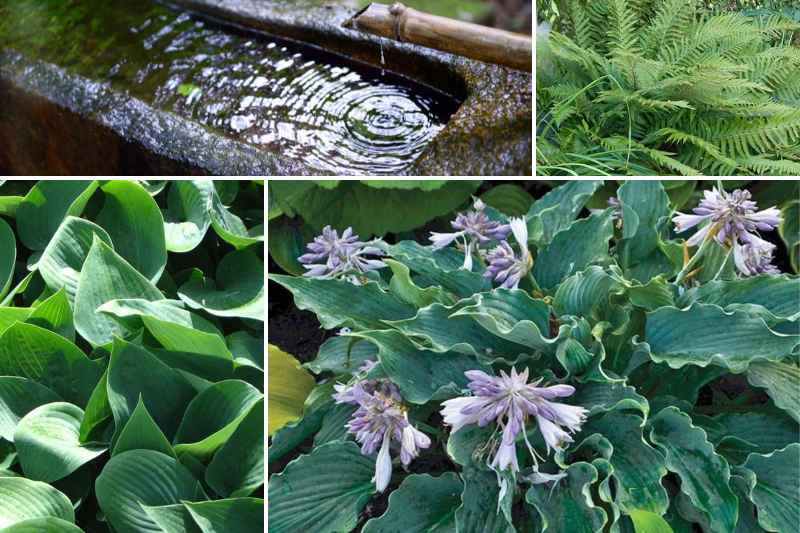
It is in shade or partial shade that glaucous green holds up best against heat in certain perennials such as hostas. There they show colours whose subtle nuances are especially highlighted in standout varieties like Hosta 'Canadian Blue', Hosta 'Drinking Gourd' and Hosta 'Waterslide' with greyer tones. Add some equally bluish sedges (Carex 'Bunny Blue'), evergreen ferns (Polystichum polyblepharum), white flower spikes to pair ideally with astilbes, a water trough used as a drinking bowl or fountain… and enjoy this very relaxing atmosphere.
Discover many more plants to achieve this turquoise palette in our "Transformative Teal" selection online, and in our 2026 trend booklet!
Do you love blue and green in the garden? Great — we explain everything you need to know about designing a blue garden and using blue in Elevate your garden with indigo blue. Marion also shares useful tips in How to create the illusion of water with plants?
Are you watching colour trends, and do you like to experiment not only indoors but also in your garden or on your terrace?The very latest is Transformative Teal, often described as teal or turquoise. Some plants naturally display this colour, mainly in their foliage and more rarely in their flowers. This <strong shade that sits […]
Bali, the island of the Gods, is a unique place in the Indonesian archipelago. A paradisiacal vision of distant horizons, it has inspired many landscapers seeking exoticism and refinement in the garden. The Balinese garden is one of the current trends to explore for gardeners looking for paradise on earth!
By opting for plants that withstand climatic conditions of our northern-hemisphere gardens, the Balinese garden becomes an atypical inspiration to adapt at home, interesting for dedicated, sheltered areas. Let’s see how to deploy lush foliage that transports us to the ends of the earth, from water garden to enclosed garden and poolside areas.

Design codes of the Balinese garden: colours and decorative elements
Anyone who has visited Bali knows this tiny Hindu enclave within vast Indonesia gathers architectural and natural treasures that have made it an extremely popular destination in recent years.
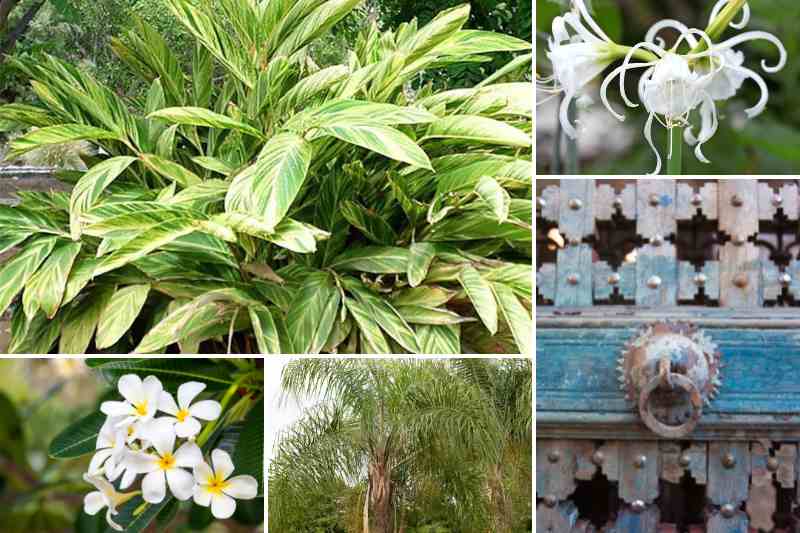
It can be described as a concentrate of nature, impressive rice terraces, but also a pervasive mineral quality due to its volcanic character, and a spirituality combined with a unique aesthetic. Everything here is refinement, and gardens hide, behind lush greenery, stone statues, omnipresent deities receiving daily offerings. Decorative elements also come from dark stone, local basalt, and polished black pebbles. Water in ponds or fountains, wooden terraces, rattan, bamboo or exotic wood furniture, carved Indian doors are all invitations to simulate, at home, an entrance to a second imaginary garden. Lava stone and basalt can easily be replaced by slate, schist, or suitable ceramics. Large pots and basins punctuate the spaces, and where possible a canopy adds an Asian spirit. The contrast between green foliage and dark mineral is often enhanced by a brightly coloured Balinese parasol with fringes. Finally, a mobile evoking sound of local gamelan (traditional Balinese orchestra) completes the Balinese atmosphere.

The jungle garden
This garden, essentially made up of foliage, fits perfectly with Balinese garden where lush foliage takes precedence over flowering, which is present but remains secondary to plant abundance.
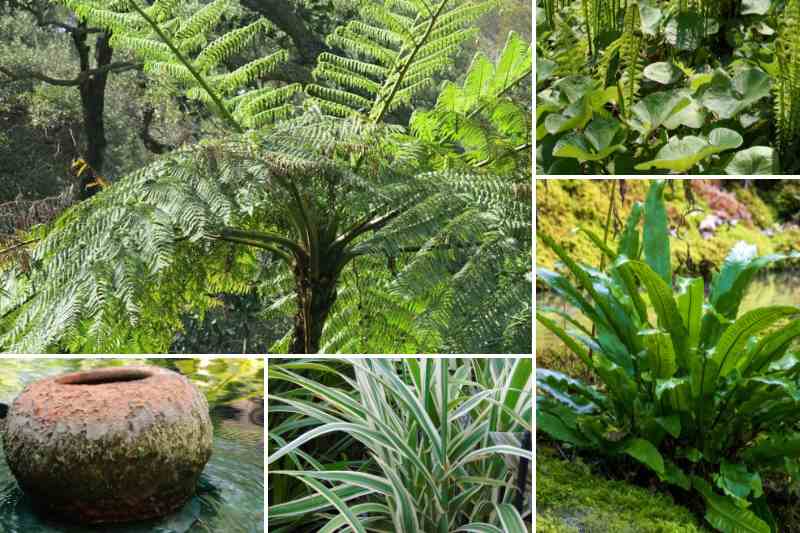
The Balinese garden integrates perfectly into an exotic or jungle garden: choose a sheltered part of the garden to transform into a Balinese green lounge, where hardy palm trees, giant ferns, Tetrapanax and other plants suited to our harsher climates will take place, planted en masse around a few perennials chosen for their XXL foliage or dissected leaves: evergreen ferns such as Asplenium scolopendrium and Matteuccia struthiopteris, Cyathea medullaris, variegated Arundo donax 'Variegata', and Petasites with large leaves. Here and there plant some Crinum asiaticum bulbs in damp soil to add delicate blooms.
Around a pool in a seaside garden
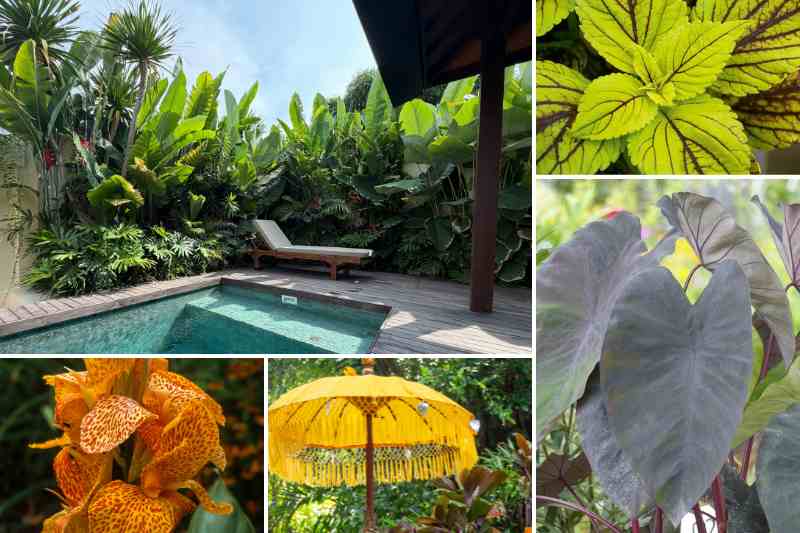
Framing a reserved garden area such as a pool is a great way to imagine being in Bali. Tropical plants from the island are too tender for our climate, so choose substitutes to recreate Balinese postcard. In our example, simplicity is expressed with evergreen plants required around pool, and splendid foliage.
Banana trees, cordylines, bamboo palm provide the structure, enhanced by Coleus in aniseed tones such as 'Copinto Caipirinha' or 'Margarita' and a black-leaved Colocasia.
Be sparing in contemporary layouts with three or four plants maximum and slightly more generous in a denser garden. Here, Balinese parasol and wooden sun lounger become must-have accessories for hot summer days.
In a sheltered garden with mild climate
This is certainly the most suitable place to establish a Balinese garden, especially if you live on the Brittany and Atlantic coasts, benefiting from sufficient humidity to approach island’s humid tropical climate, or around the Mediterranean basin by adapting some plants. You can enjoy plants with beautiful foliage, a little tender but that will survive mild winters in these regions or that can be planted in large pots: Alpinia zerumbet 'Variegata', showy variegated gingers, replacing colours of local Cordylines. A queen palm (Syagrus romanzoffiana), a frangipani (Plumeria obtusa) chosen for its delicacy and intoxicating fragrance can join the scene.
In Mediterranean areas, a traveler's tree and tropical palm trees can even be considered! Also think of a beautiful exotic climber such as pink bignonia and some ismenes for an extra exotic touch.
By planting densely, you recover the jungle effect described above. Decorative elements complete scene such as an ornate door or a painted shutter, and a bamboo chime.
Water garden in the Balinese style
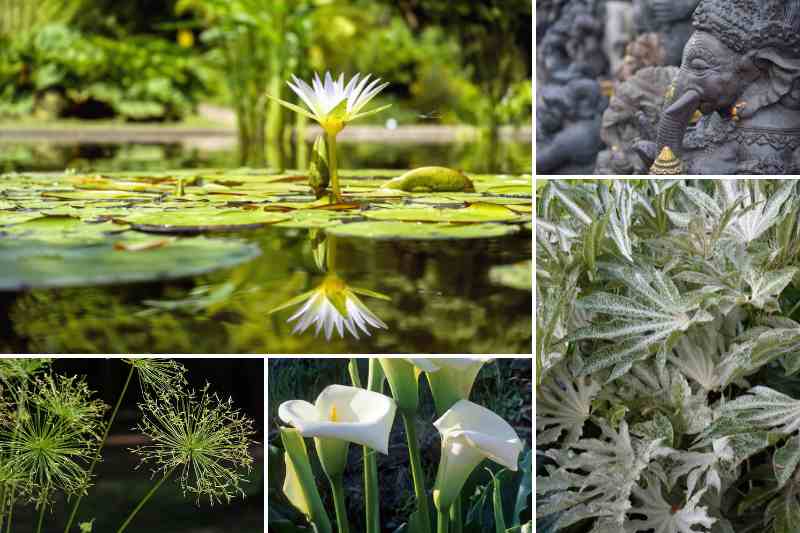
Water is omnipresent in Bali and in its finest gardens. You can easily imagine a Balinese garden centred on a water scene, whether a mini-pond or larger wet area. Plant species that like damp soil or can be partly submerged such as papyrus, lotus (Nelumbo nucifera) and water lilies are perfect. Arums, rodgersias and ligularias work well with their large foliage to infuse tropical atmosphere beyond their white or yellow blooms. For a larger area add a Gunnera, Brazilian rhubarb, impressive once established, or Astilboides tabularis. Here we like variegated foliage of Fatsia japonica 'Spider Web' near the water to add more exceptional foliage.
Decor is important here too: a single Hindu statuette, some pebbles or black paving and a rain chain are perfect!
Tropical escape in a courtyard, patio or walled garden
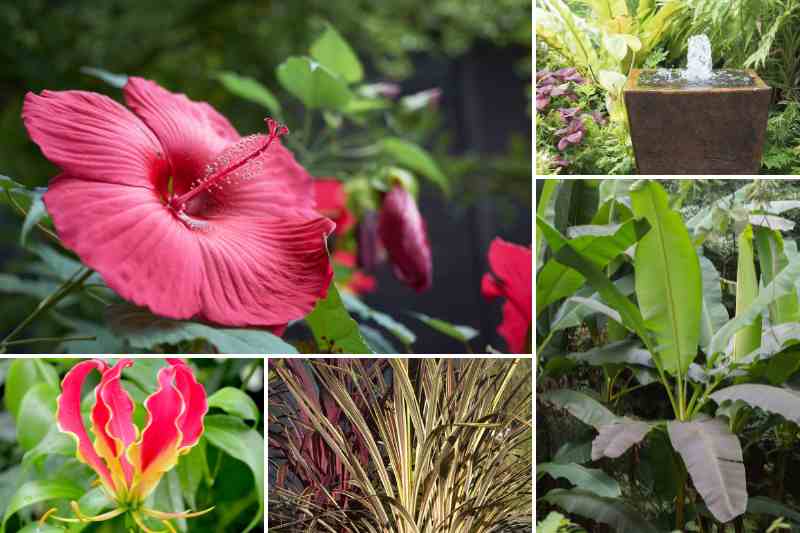
These very sheltered spots allow installation of plants that would not survive elsewhere. Presence of walls creates microclimate beneficial to Balinese garden. Selection below suits a sunny spot, and all these plants also grow well in pots and can be overwintered if necessary.
By replacing Cordyline fruticosa found in Bali with Cordyline banksii, equally colourful but hardier, you bring maximum colour, enhanced for example by bright red or pink of a common Rose mallow that performs well in a pot when substrate is kept moist. Beside them an essential banana, Musa 'Basjoo', interesting for cold tolerance and eventual size, or large unicolour cannas that also bring exotic feel. A compact climber can also slip in, such as Gloriosa rothschildiana. Bring out a Monstera or bird of paradise from the living room for summer and install a small temporary fountain to perfect tropical ambience.
Find Find our selection of plants suited to exotic spirit on our online nursery as well as our Balinese Garden inspiration page in our 2026 trend booklet !
Do you enjoy these lush, transporting atmospheres? Discover other inspiring scenes in these articles that address the theme:
- Design a garden inspired by Madeira, the island of flowers
- A banana tree in a small garden? our tips for integrating it well
- How to create a tropical atmosphere in a small garden?
- How to create a refreshing oasis in the garden or on the terrace?
And all our tips to create at home an atmosphere of exotic or tropical gardens:
Bali, the island of the Gods, is a unique place in the Indonesian archipelago. A paradisiacal vision of distant horizons, it has inspired many landscapers seeking exoticism and refinement in the garden. The Balinese garden is one of the current trends to explore for gardeners looking for paradise on earth!By opting for plants that withstand […]
Terraces, courtyards, patios and small bohemian balconies are the new stars of summer! This very colourful "boho" trend that has invaded our interiors and wardrobes also appears in our summer green retreats. It matches the sunny cheerfulness of a season when we spend a lot of time outdoors.
Let’s take inspiration from the gypsy world to prepare bright alcoves on balconies, terraces and inner courtyards from the first fine days, with planting ideas and decorative elements. We explore this Boho Patio in three scenes easy to recreate at home!
Boho Patio codes
The bohemian atmosphere dresses itself in vivid, deep and variegated colours that answer one another, but also in associations of warm tones in the blooms: intense reds, deep violets, Indian pinks and spicy oranges, not forgetting bicoloured flowers. Bluish, golden or purplish foliage helps to reinforce this playful mood, bringing red or variegated splashes.
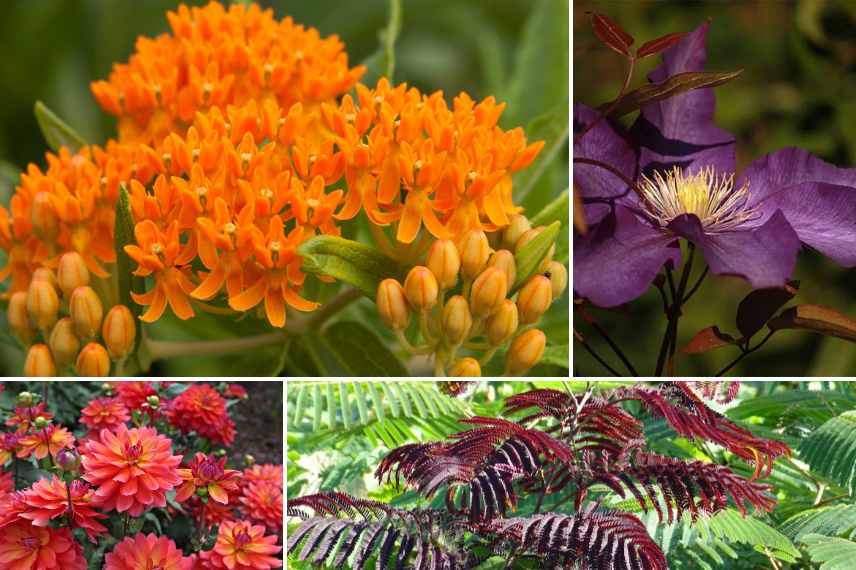
This mixed-up planting borrows from gypsy culture a festive, hybrid universe that laughs at convention and pairs a whole spectrum of colours, provided they are warm and bright.
This style is also based on improvisation, like manouche music, and on bold accents. This temperament appears in the garden in temporary scenes created especially for the summer months, and in the accumulation of mismatched small objects (side tables, stools, small cushions, etc.).
On the décor side, important for dining and relaxation areas, have fun with mismatched pairings: rustic furniture repainted turquoise or green, rattan chairs, fabric pouffes, Provençal floral and ethnic patterns juxtaposed with strong colours: turquoise, pink, orange and bright yellow. The advantage of this bohemian décor is that you can mix disparate objects and accessories, using what you already have at home or stored in the attic, to give them a second life: bring out granny’s lace and embroidery for the summer, macramé and trimmings, old rattan armchairs, baskets and fruit crates, airy curtains. In a joyful mix of materials, the décor is done!
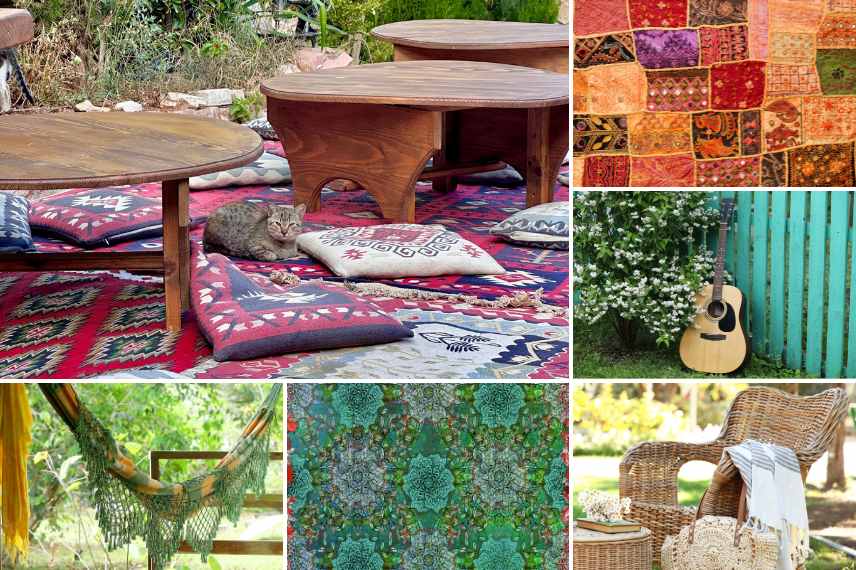
On a sun-drenched terrace
Terrace or balcony are often west- or south-facing. They can be radically transformed into an ultra-cheerful cocoon with sun-tolerant plants that do well in pots. Explore a plant colour palette ranging from saffron yellow to violet for a truly bohemian vibe.
Alstroemerias 'Indian Summer', orange and yellow contrasting against bronze foliage, will look stunning alongside Coreopsis 'Cosmic Eye', a bright yellow spotted with purple, or the pretty all-yellow 'Full Moon Madness'. Add other long-flowering plants such as a common Rose mallow 'Pink Passion' with giant flowers and dark purple foliage, and provide more foliage interest with a pomegranate that can be grown in a pot, such as Punica granatum 'Nana', whose brilliant flowers will pair beautifully with the other perennials. For snacking at aperitif time, invite, for example, the surprising cherry tomatoes 'Akoya', whose fruits turn almost black.
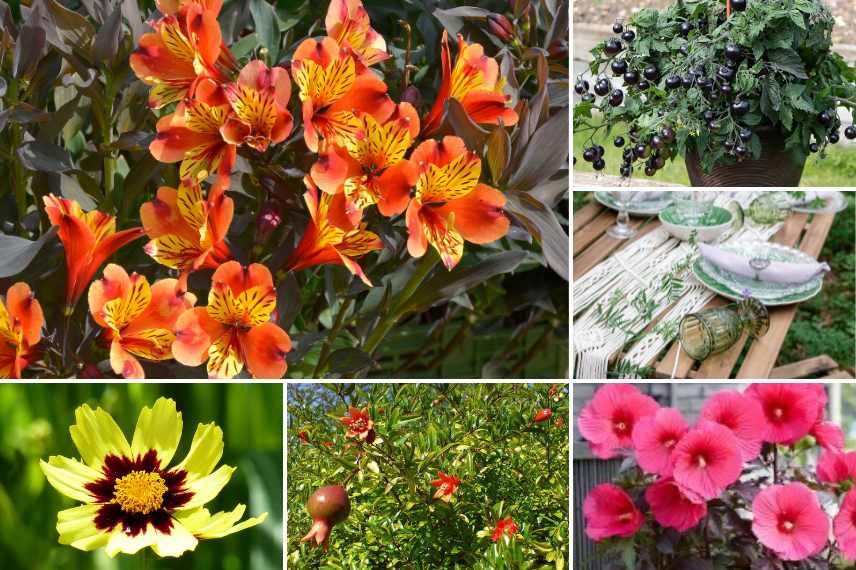
In a semi-shaded urban patio
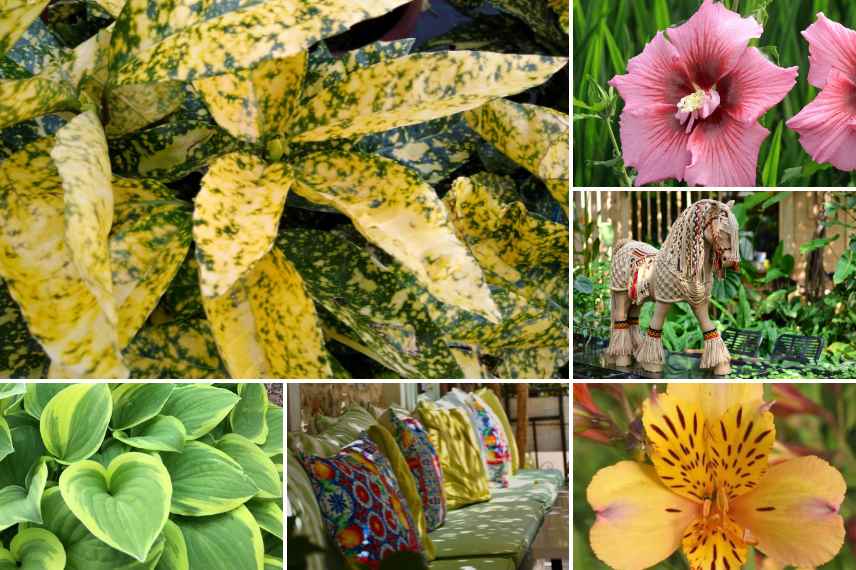
Small city courtyards benefit from focusing on colour and variegated or golden foliage to lift them out of the shade. In a semi-shaded patio receiving enough light and warmth in summer, opt for sunny flowers and a few "indestructibles":
Hosta 'The King', Hakonechloa macra and an Aucuba japonica 'Crotonifolia' for their golden and variegated foliage (Aucuba will reward you with pretty red berries a little earlier) together with the bold flowers of Hibiscus syriacus 'Hibisa rosada', and the Peruvian lily 'Duc d'Anjou'.
The bohemian spirit will also be present in accessories, essential in less bright areas and in smaller spaces.
Beyond plants, bring colour without fearing the boldest mixes. Dare genre-mixing: antique rug + Italian ceramics + small disparate or oversized objects and a cosy bench, etc. Here, the evening atmosphere will be especially worked on: lanterns, paper lanterns and candles, and don’t forget a crochet throw in these patios that are often cooler at night.
Garden refuge as an improvised alcove
This bohemian trend can also be expressed in a corner of the garden used as an improvised summer retreat.
In front of a shed, garden shelter or at the foot of a fine tree from which a rattan chair is hung, set up a summer hideaway using bohemian codes. A temporary terrace, improvised with clip-together wooden decking tiles readily available from DIY stores, is easy to install. In summer it becomes a true green cocoon perfect for relaxing on a garden sofa made of a few stacked pallets or large pouffes, in a fairground style.
Here, a few colourful annuals join the party: multicoloured zinnias and orange calendulas (marigolds) sown in pots in spring, or beds of African marigold 'Mango Tango' around the area, as well as sun-loving perennials such as the charming Delosperma 'Ocean Sunset Orange Glow'. Count on two striking pots of dahlias with evocative names, the fiery 'Bohemian Spartacus' and the more restrained compact 'Melody Gipsy', for a long and remarkable display. Sunflowers 'Mongolian Giant' will bring pep and height, while a pot of basil 'Everleaf Emerald Tower' will be handy for salads at barbecues or sunny lunches.
Gather your most colourful pots, bring in lace, hangings, vintage crockery and cushions: job done!
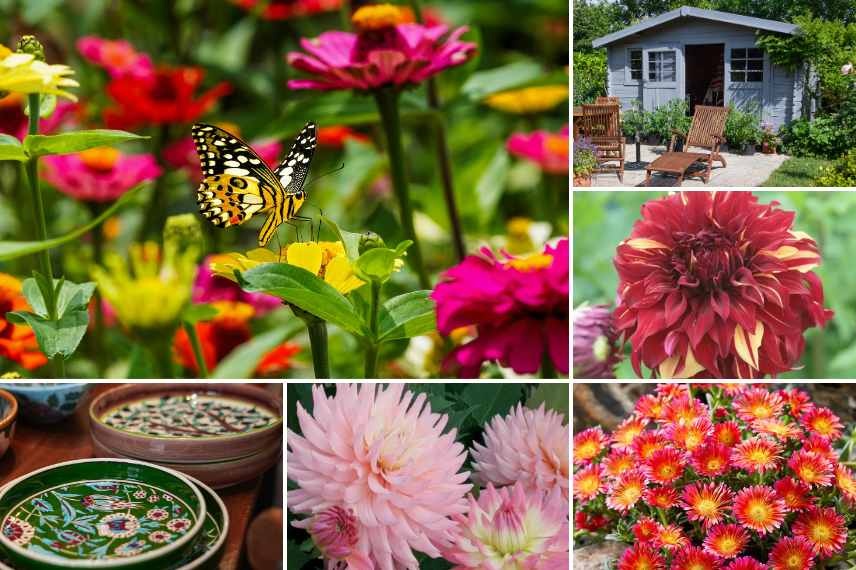
Discover other plants ideal for composing this bohemian green décor on a terrace in our "Boho Patio" selection online and in our trend booklet!
Feeling the bohemian spirit? Find our advice on creating a bohemian garden, and our inspirational sequences: Catalane and Peach Raspberry.
This Boho Patio trend also draws on recycling second‑hand objects. Explore our topics to let your creativity run free: Decor idea: plants in unusual containers; How to make a planter from a pallet?; Recycling in the garden and How to use and properly integrate terracotta pots in the garden?
Terraces, courtyards, patios and small bohemian balconies are the new stars of summer! This very colourful “boho” trend that has invaded our interiors and wardrobes also appears in our summer green retreats. It matches the sunny cheerfulness of a season when we spend a lot of time outdoors. Let’s take inspiration from the gypsy world […]
Here’s a distinctive trend emerging in outdoor spaces, and not only among landscapers fond of conceptual gardens or in coastal areas! While a sand garden is particularly suited to coastal gardens, it proves to be an undemanding, on-trend garden, halfway between a gravel garden and a dry garden, perfectly in tune with current climate upheavals.
We invite you to discover it in three scenes that demonstrate its aesthetic appeal and sunny atmosphere!
Sand garden: a landscaping trend between frugality and aesthetics
Far from the image of the traditional Japanese zen garden with raked gravel or pale sand, the sand garden imposes itself as a new version of the garden. It retains a sense of serenity but transposes it into a warmer register, where maintenance and watering are reduced to an absolute minimum. It answers a need created by climate change: how to introduce more Mediterranean plants into northern regions? Even if rising temperatures allow it, the problem of waterlogged winter soils, often fatal to these plants, remains. The sand garden is one solution, providing effective drainage.
It is a functional garden, still experimental globally, which showcases plants that ripple in the wind, like a reminder of a sea that is not always present. It also emphasises contrasting materials and textures, often using Corten steel as a support, woven willow in tontines or sculptures, large stones or retaining walls.
Undemanding plants grow in a substrate made up of a thick layer of sand. They therefore need to draw water from deep down to survive. For this reason we choose the most drought-tolerant plants and xerophilous plants, those whose taproot systems mean they will withstand heatwave summers.
We also seek to enhance the golden aspect of the sand using a palette of warm tones available to us, both in plants and materials. Plants will generally be low-growing, mat-forming or supple, also incorporating some greyed foliage to reinforce the impression of warmth.
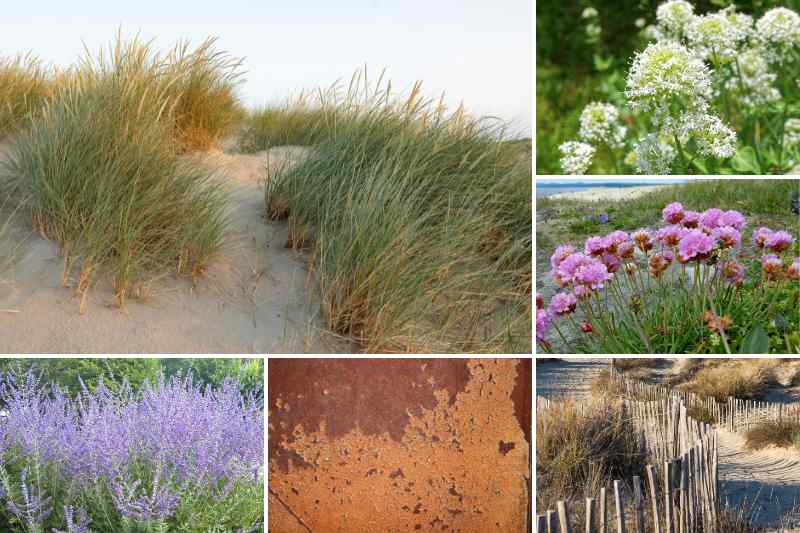
A holiday feel
Coastal gardens, and especially those located right on the coastline, are difficult to plant because of the omnipresence of sand on site. They are perfectly suited to the constraints of a sand garden. In a beach-return spirit, the focus is fully on the sand-and-beach duo, taking inspiration from the dune ecosystem.
Essential plants: valerian, Lagurus ovatus and oyat (Ammophila arenaria), Armeria maritima 'Vesuvius' (sea thrift), sandwort, Erigeron glaucus 'Sea Breeze' or Erigeron karvinskanius, sand carnations, Perovskia, blue fescue, sea holly (Eryngium maritimum), milk thistle, etc.
To bring back vegetal blond tones, use wooden slats as decking, mini sand fences, and pair with coppery accents such as a brazier, useful for summer evenings.
Our tip: take care not to multiply beach clichés. Restrict decoration to sand alone, without superfluous additions of pebbles, shells or other seaside trimmings to avoid caricature. Plants create the scene, not the other way round!
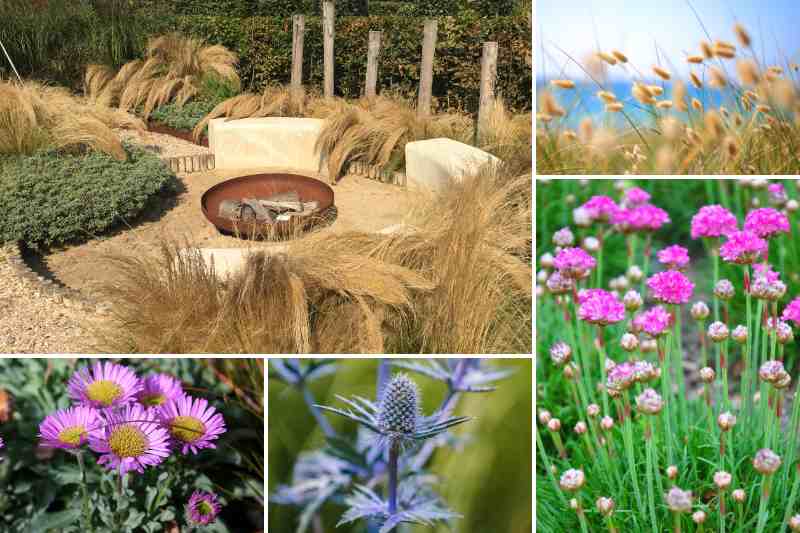
Contemporary sand garden
At the opposite end from the dune garden that naturally links to its environment, the idea of undemanding plants and sand also evokes minimalism and the mineral feel of modernist gardens. The sobriety of the sand, combined with an appropriate plant palette, allows creation of a sand garden that suggests a coast not necessarily nearby, in perfect harmony with contemporary architecture.
Here, colour is conceived in monochrome, or in white/black, white/mauve or purple and green duos, to name a few pertinent combinations. Plants are chosen for their prostrate habit, their original textures or the shapes of their inflorescences. Greyed tones for foliage are also favoured to blend well with often anthracite outdoor furniture. Corten steel, used for boards or attractive windbreaks, stands out as a material that enhances the sand’s sheen, as does brick, which can serve as a path.
Essential plants: silver santolina, Artemisia 'Powis Castle', Ballota pseudodictamnus, medium to tall grasses such as coppery Carex (Carex testacea), the movement of Hordeum jubatum, graphic silhouettes (Cordylines, Yuccas) on flat ground, and low to medium plants as on a shaped sand mound (sea thrift, creeping gypsophila, wild thyme, etc.).
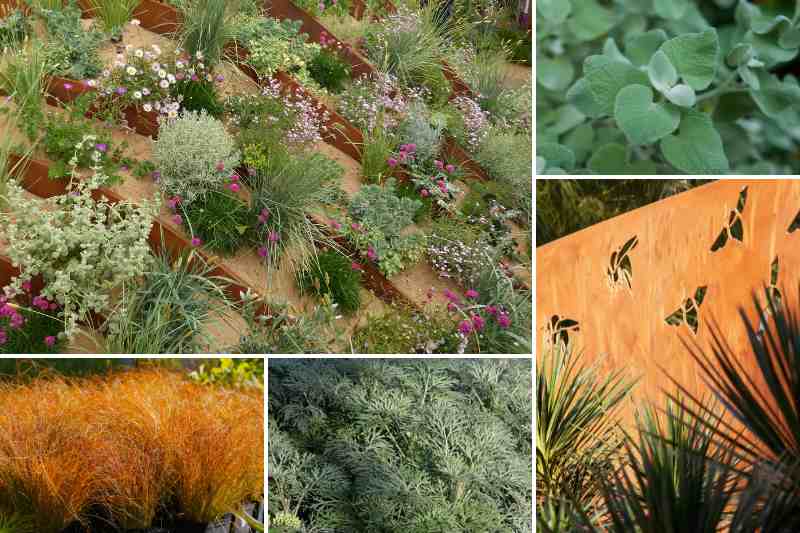
South African atmosphere
One attractive idea with the sand garden is to travel to an arid, heat-baked world. You can plant stunning perennials and ultra-resilient grasses and lean towards a Californian vibe, or, as here, a South African feel.
Let’s take inspiration from Léon Kluge’s work, the world-renowned South African landscaper, at Domaine de Chaumont-sur-Loire in France: few plants for a spectacular effect in this full-sun garden. The scene draws from the African bush, where red sand and oversized stylised baobab sculptures mainly make up the decor, with waves of Stipa tenuifolia and torch lilies. At home, imagine tall red-willow tontines or large woven willow spheres to add volume and blend into this atmosphere.
Key plants: succulents and light grasses (Aloes, Euphorbia myrsinites, Stipas, Sesleria argentea, Lomandra longifolia), and perennials with sunny yellow to orange blooms (Kniphofias, Euryops pectinatus, bulbines, Leonotis leonurus, gazanias…). Plants native to South Africa, Patagonia or Tasmania are favoured, some tolerating down to -8°C in sheltered conditions.
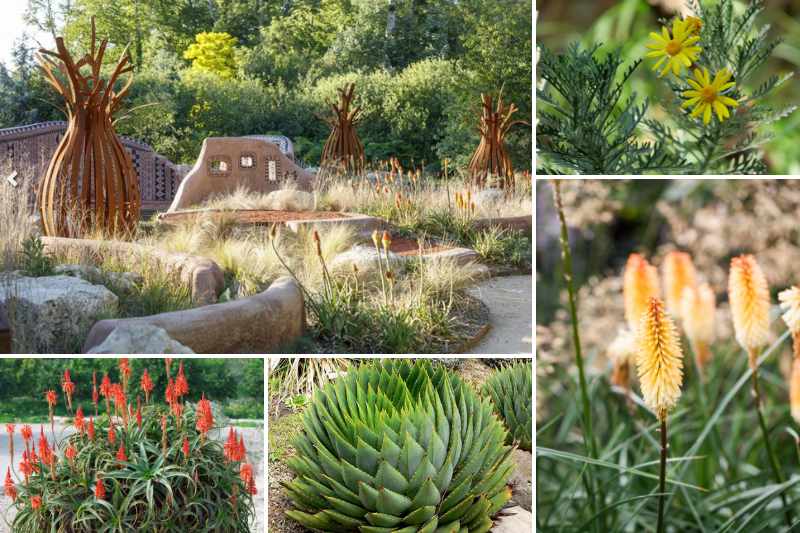
The naturalistic garden and the English garden also draw on this avant-garde technique, and we could just as well have developed scenes in these two worlds, which lend themselves to experimentation currently being carried out notably across the Channel.
Find our selection of plants suited to the Sand Garden spirit on our online nursery as well as on our inspiration page in the 2026 Trend Book !
Do you enjoy these distinctive atmospheres? Discover other inspiring scenes in related worlds:
Here’s a distinctive trend emerging in outdoor spaces, and not only among landscapers fond of conceptual gardens or in coastal areas! While a sand garden is particularly suited to coastal gardens, it proves to be an undemanding, on-trend garden, halfway between a gravel garden and a dry garden, perfectly in tune with current climate upheavals.We […]
Garden, rarely short of inspiration, suggests enticing colour trends each year to imagine new borders.
For romantics who favour softness and pastel tones in the garden, here is the Unicorn trend, a new hue devised by promesse de fleurs, blending graduated and iridescent shades from pink to straw-yellow.
What exactly is the Unicorn colour for the garden?
Inspired by the legendary white, pure animal, the "Unicorn in the garden" trend actually draws on the enchanted world of childhood, which associates pink and yellow hues, through to mauve, as if straight from a fairytale.
The garden introduces these fairy-like, very girly notes — powdered and old-rose tones, marshmallow to lavender, touched with very soft yellows — to create a decidedly romantic atmosphere. This garden universe aims to be both poetic and very feminine, approaching a "cotton candy" aesthetic but more subtle, with less acidity and more pastel nuances.
Among plants ticking all boxes of this subtle palette are many perennial plants and shrubs softly salmon, apricot and butter-fresh shaded, tones that catch the light and recall gentle spring colours.
We suggest some planting combination ideas for different garden styles and enticing borders!
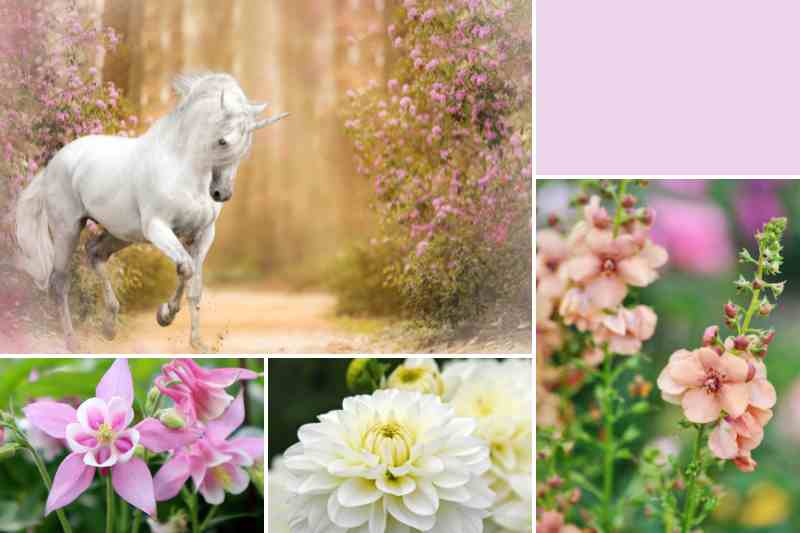
In a cottage garden
This border, both rustic and sophisticated, remains very natural thanks to soothing colours from pink to apricot, with a well-measured touch of yellow. It suits a south- or west-facing position.
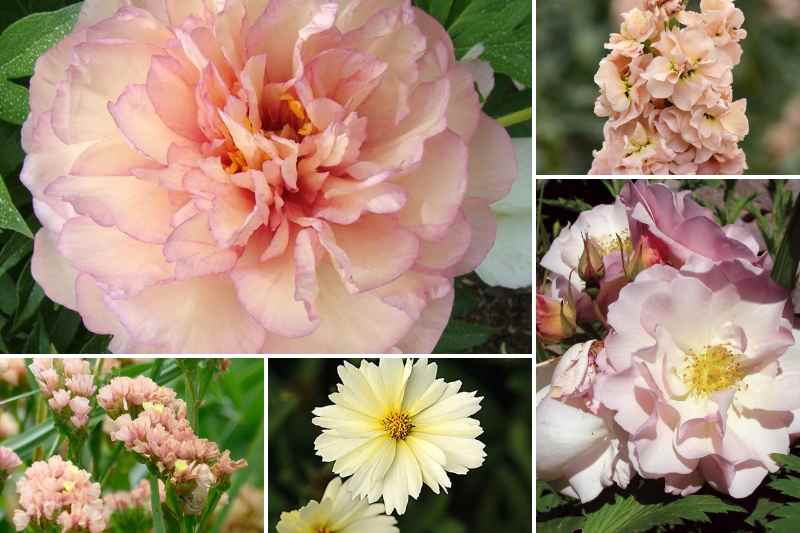
Here we showcase an intersectional peony Scrumdidleyumptious, indispensable in a country garden for its elegance. As its flowering is fleeting, we surround it with some long-flowering perennials and shrubs: an old-fashioned rose such as the heirloom 'Pénélope', statices and apricot wallflowers. A large drift of Coreopsis 'Uptick Cream' adds further softness…
Also consider adding a few Verbascum 'Jackie' or 'Southern Charm' in a blotting-paper pink that will make you swoon! Also think of adding some olive-green or greyed foliage.
In a spring border
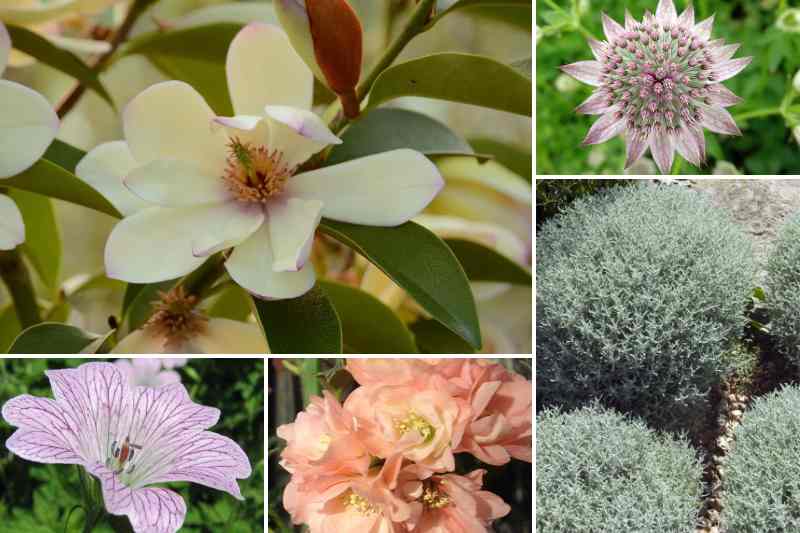
A gradient of soft colours will awaken garden in early fine days with these pastel blooms. Gather in a sunny or semi-shaded border a few favourites admired for their simplicity and grace: a Michelia 'Fairy Lime', a small magnolia with evergreen foliage and delicate cream-yellow flowers with a hint of pink, Astrantia 'Florence' for a mauve bloom a little later around June, and hardy geraniums as groundcover such as Geranium 'Katherine Adele', flowering for months from May, nicely veined with dark pink. Another charming small shrub, Japanese quince Chaenomeles 'Falconnet Charlet', will bring salmon tones in March–April alongside the Michelia. A silvery evergreen foliage, for example that of Santoline chamacyparissus if border is in full sun, is an essential complement to the soft ambience.
In a secret garden
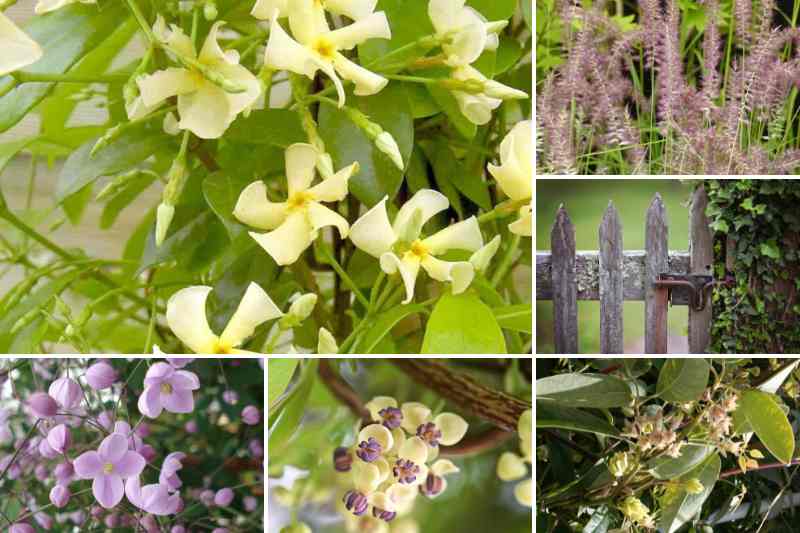
In the intimate, often shadier setting of a secret garden, invite pale luminous yellow blooms to combine with a few pastel tones, from pearly pink to iridescent mauve.
Rely on a base of climbers to screen views and some supple ornamental grasses, perfect here: Chinese fountain grass orientale 'Karley Rose', a very fragrant yellow star jasmine (Trachelospermum asiaticum), Thalictrum delavayi 'Splendide', tall and lilac-pink, and two thoroughly voluble climbers: Akebia quinata chosen in a superb bicolour form 'Cream Form', and a persistent Holboellia latifolia. To enliven the base of climbers earlier in the season, plant in autumn a few bulbs of pink or pale-blue grape hyacinths like 'Baby's Breath', some miniature daffodils and Greek anemones 'Charmer'.
In a bohemian garden
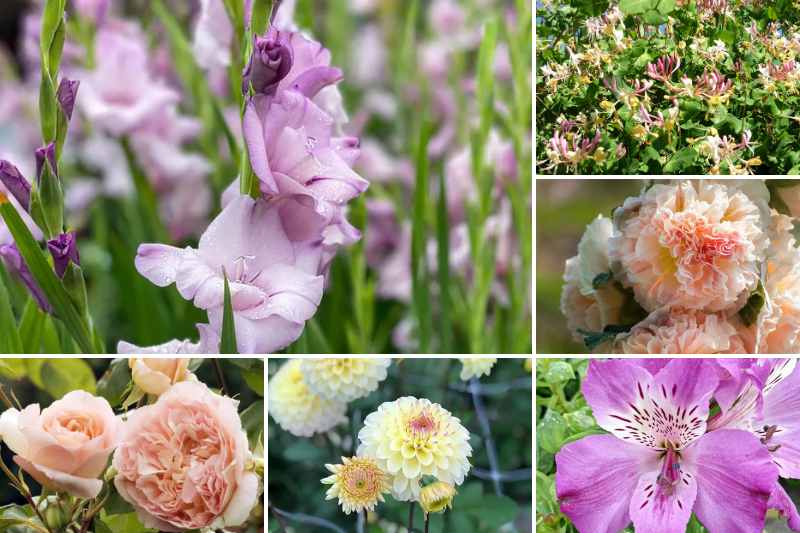
The bohemian garden that explores a wide palette of plants also fits perfectly with the Unicorn garden universe. Ultra-soft, soothing colours will be gathered in the joyful mix and abundance of the bohemian garden! It's a garden that comes alive best in summer, in a profusion of flowers and foliage.
Here we've chosen sorbet tones, old-rose and vanilla-yellow to evoke the Unicorn trend. A honeysuckle skilfully blends pink and yellow, double-flowered hollyhocks 'Chater's Double' and a climbing rose 'Papi Delbard' play the apricot notes, delightful gladioli, 'Blue Tropic', and dwarf alstroemerias 'Pitchoune Lucas' reveal a desaturated mauve. In sun, add a few pom-pom dahlias 'Isa's Favorite', preceded in spring by late double tulips 'Charming Lady'. Add a base of foliage to bridge to summer, such as common sage and a dwarf abelia: charm guaranteed!
Find our selection of plants in the Unicorn spirit on our online nursery as well as our inspiration in the Trendbook 2026!
Do you love these very soft garden tones? Discover other inspirational scenes in these closely related colour universes:
- Peach Fuzz: Colour of the Year 2024
- Soft on-trend colour: how to lay out a nude garden?
- Pinkish Lemon: the new zesty garden trend
- "Coffee colour" inspiration
- and Rose and khaki inspiration for a soft, on-trend garden.
Garden, rarely short of inspiration, suggests enticing colour trends each year to imagine new borders.For romantics who favour softness and pastel tones in the garden, here is the Unicorn trend, a new hue devised by promesse de fleurs, blending graduated and iridescent shades from pink to straw-yellow. What exactly is the Unicorn colour for the […]
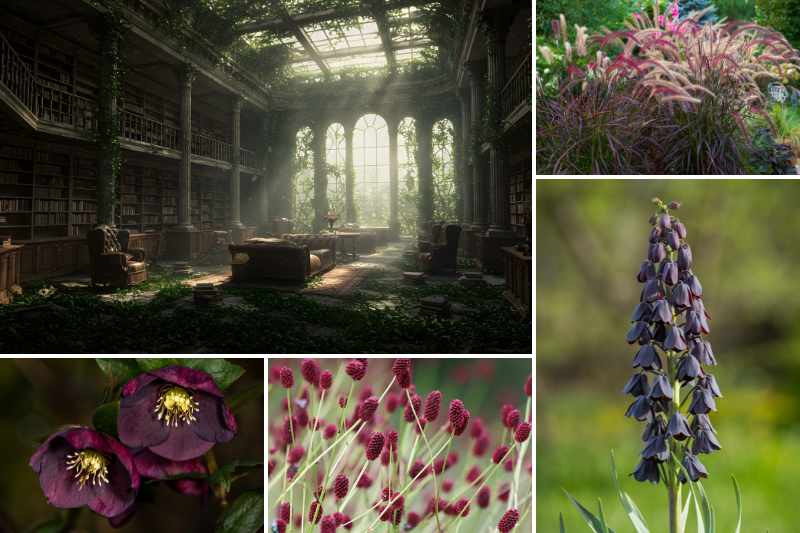
Among the colour trends of the year that spark the imaginations of our most creative gardeners, Dark Academia offers an immersion into garnet, purples, crimsons and plum, edging toward an almost-black depth. These bold, dark tones originate from a baroque aesthetic, that of the hushed and mysterious world of old libraries and the hit series Wednesday.
In the garden, adopting such a romantic and melancholic palette requires a neat setting and scenes with subtle harmonies to soften the sombre colour and the intensity of the blooms and foliage.
Here are three borders imagined for you with this new trend in mind, updated for today!
How to pair it with the garden?
The dark tones, from purple to black, should always be used with great care in plantings. They can overwhelm the eye and, if misused, impart a mood that is too sombre for a garden.
We therefore often pair them with a few neutral, diaphanous touches, drawing from the palette of white, pearly, cream and green blooms, as well as bronzy, greyed foliage. Don’t forget light, ribboned foliage, iridescent or variegated to diffuse the light around the deeper tones.
Some plants are thus particularly useful, especially those that work in a pointillist manner with their inflorescences, such as some grasses and airy perennials or the plush plants. In small doses, they instantly lighten the colour composition of a border.
A naturalistic scene: the poetry of black flowers and wild grasses
Dark-toned flowers can certainly suit a section of the garden treated as a large meadow or flowering border. In this case, favour beautiful wildflowers, such as Scabiosa 'Chile Black', and Cirsium rivulare 'Atropurpureum'. A mass of Penstemon with purplish flowers such as the variety 'Raven' will visually support the border, enriching it with a multitude of blooms right through to frosts.
The perfect accompaniment to temper, without masking, the depth of purple tones will simply come from a few very light grasses such as the Hordeum jubatum, or taller Panicum, or airy fennel. In mild climates, opt without hesitation for the Pennisetum setaceum 'Rubrum'. The presence of statice (Limonium latifolium) with tiny pale mauve flowers softens the scene and brings the essential gentleness to the dark colours.
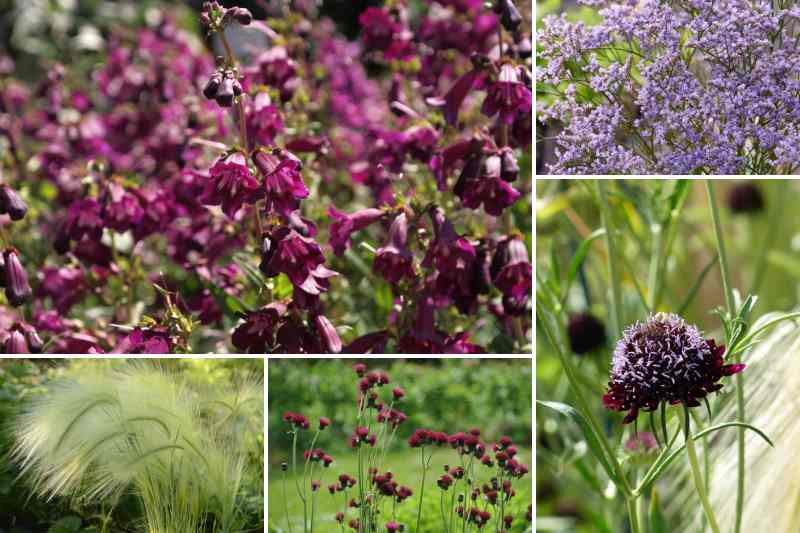
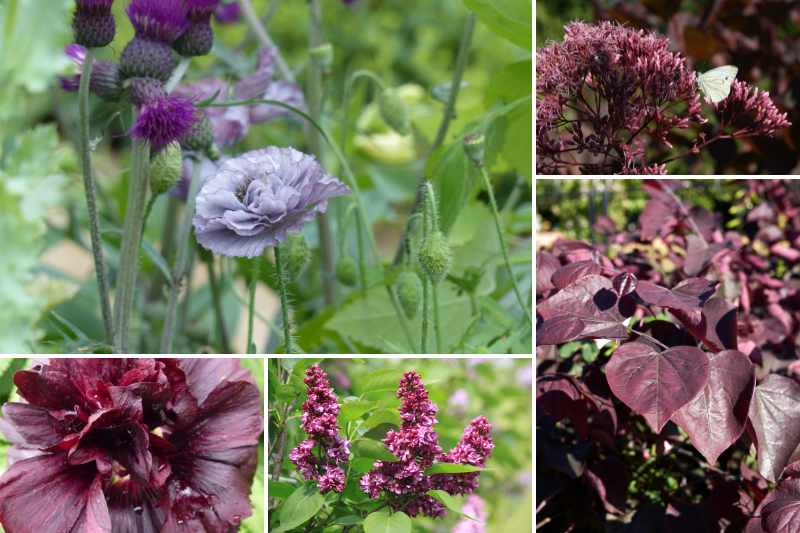
Clockwise from top left: Penstemon 'Raven', statice, Scabiosa 'Chile Black', Cirsium rivulare 'Atropurpureum' and Hordeum jubatum
A shrub border between lilac and burgundy
Around two fine shrubs chosen, one for its burgundy flowering with double blossoms—the lilac 'Charles Joly'—the other for its striking heart-shaped foliage, Cercis canadensis 'Forest Pansy', invite a few perennials in the same warm tones, and greyed foliage for softness. In our example, the lightness of the purplish inflorescences of a purple Eupatorium sits beside the delicate lavender-grey of a refined poppy (Papaver rhoeas 'Amazing Grey'), and the utterly graceful verticality of double-flowered hollyhocks 'Chater's Violet'.
Pensée to include some soft, greyed and silvery foliage such as Artemisia ludoviciana (Valerie Finnis) that will thread at the foot of the shrubs, and respond to the romantic colours of the poppies.
N.B. : other shrubs just as spectacular in their purple hues would work brilliantly in this border, such as certain varieties of the famous smoke tree (Cotinus coggygria) and its wispy summer flowering, a black elder, a physocarpus or Magnolia 'Black Tulip' for a poetic spring effect.
Velvety sophistication in partial shade
The two previous moods are envisaged in sunny settings. The purple-to-chocolate hues can also be used in a bright partial shade in the garden. In that case, work on an enveloping ambience, softening the dark impression with discreet touches of chartreuse green, together with pearly and iridescent whites.
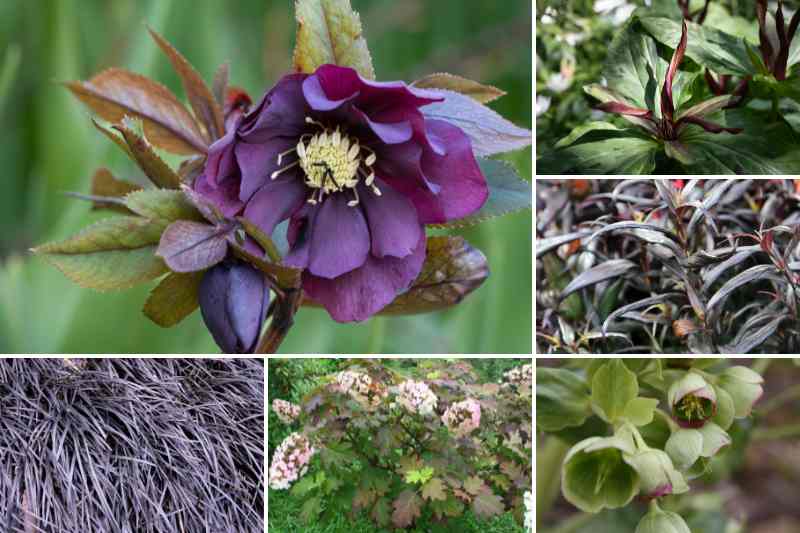
The purple flowers of Hellebores will be the stars of this corner, with infinite grace and a very long flowering season, akin to botanical cousins such as Helleborus foetidus and its pistachio flowers. Invest here in a few purple foliage plants, such as Strobilanthes anisophyllus 'Brunetthy', a magnificent almost-black shrub, whose pale pink late-spring flowers contrast nicely, and a groundcover with marbled leaves like Trillium cuneatum and a mass of black Ophiopogons. Finally, for a touch of volume in the scene, use the assets of an oak-leaved hydrangea: distinctive foliage that clings on well into winter, taking crimson autumn tones, and white, anise-scented flowers, ranging from white through pink, in spectacular yet light panicles.
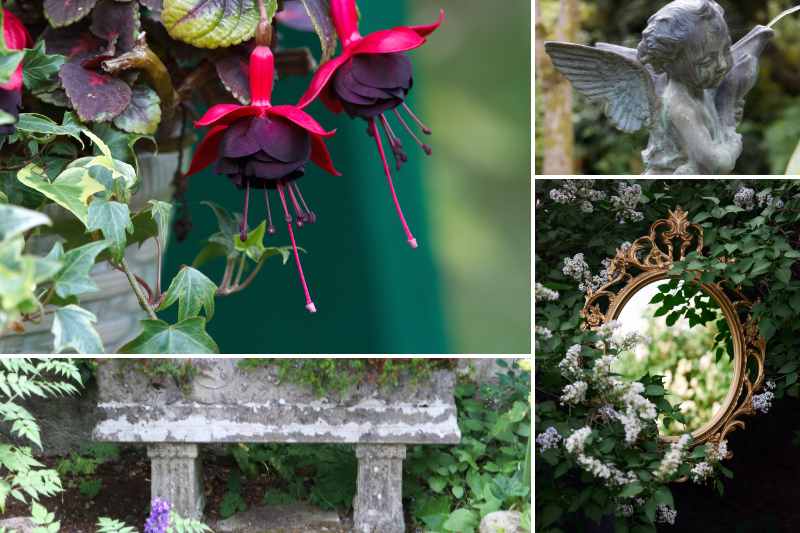
To refine this baroque ambience, why not insert one or two refined accessories: a latticed frame with a beautiful gilded patina or a mirror to reflect the light, a romantic vintage metal lantern or a statue representing a poet, an angel or a muse? A stone bench will also invite sitting and resting.
Discover our selection of plants in the Dark Academia spirit on our online nursery, as well as inspiration in the Trend Notebook 2026!
Also read on the topic: How to combine black-flowered perennials? ; 6 border ideas for a red/purple garden, Purple foliage: how to use it and pair it in the garden, and Pairing red or purple flowers.
Among the colour trends of the year that spark the imaginations of our most creative gardeners, Dark Academia offers an immersion into garnet, purples, crimsons and plum, edging toward an almost-black depth. These bold, dark tones originate from a baroque aesthetic, that of the hushed and mysterious world of old libraries and the hit series […]
Discover exclusively our Garden Trends 2026 booklet identified by our experts! Green Generation, Retro Garden or Augmented Garden, we reveal five emerging trends that are reinventing garden practices and imaginations. Drawing on its monitoring, Promesse de fleurs shares a forward-looking perspective and field observations of tomorrow's garden.
Green generation
Millennials: new plant-loving tribe born on Instagram! Aged 28 to 44, often city-dwellers, they have turned houseplants into an art of living. Ficus lyrata, Calathea, Alocasia, Colocasia and Monstera – houseplants are becoming icons, iconic organic design pieces. Plants here become emotional, identity markers and graphic. This green frenzy is hyper-connected, Instagrammable, viral yet deeply emotional.
It’s called "Plant Parenting": 33% of Millennials talk to their plants, 19% give them a name, 29% consider them sentient beings.
People collect spectacular foliage (Monstera 'Thai Constellation', Caladium, Begonias 'Rex'), style interiors and share urban jungle on TikTok (#planttok) or Instagram (#urbanjungle, 8M posts).

Nostalgic Garden
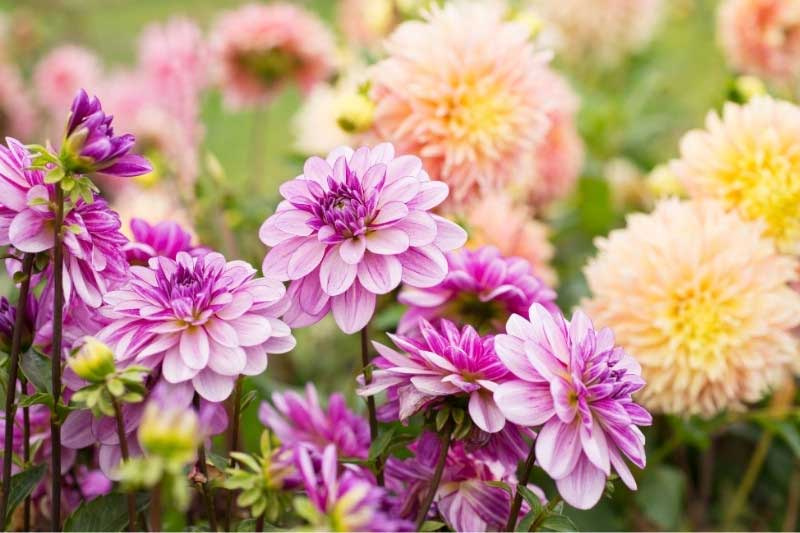
Here is a distinctly regressive, comforting gardening trend! In the face of global uncertainty and at a time when AI generates artificial worlds, the garden evokes a nostalgic vogue reflecting a deep desire for reassurance and tenderness. People sow, take cuttings, forage and arrange homemade bouquets. Retro flowers enjoy a second youth. Double ranunculus, gladioli but above all dahlias (+12% sales) and peonies (+37%) at Promesse de fleurs, which are exploding on social networks, are the star flowers of this vintage wave. The craze for seeds has sparked a revival of cut-flower varieties, straight from garden to vase! Statice, everlasting flowers, oxeye daisies, snapdragons and phlox are already part of our collection of over 1,500 varieties of flower seeds.
Nomadic Escapes
The garden becomes itinerant, mixed, adaptive, a mirror of a world on the move. 42% of recent landscaping projects draw direct inspiration from distant cultures. They combine a longing for elsewhere with climate-consciousness, are nomadic in their evocations, resilient in their choices and economical with water. Sales of hardy succulents have risen 45% in Europe since 2023, a sign that these plants from elsewhere resonate with very local concerns. Trends spotted include:
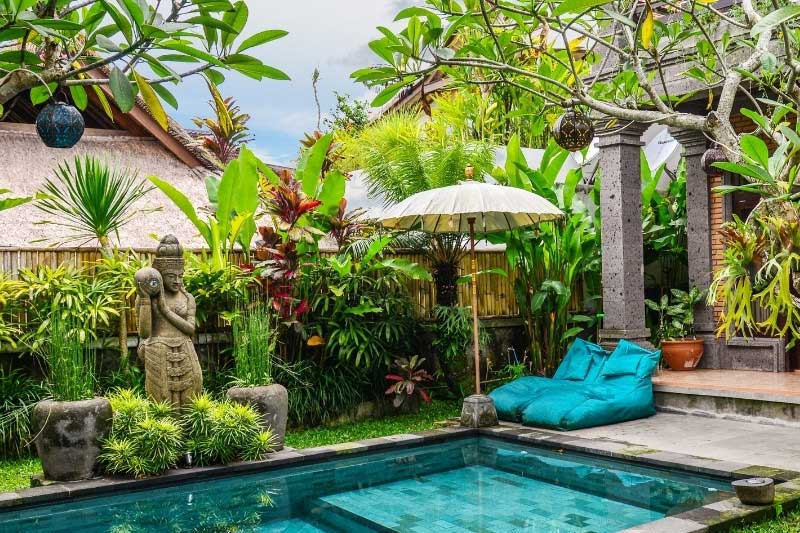
- Balinese Garden: tropical luxuriance and sacred lotus (85k posts #lotusgarden) inspired by tropical sanctuaries of Southeast Asia.
- Antipodean Garden: euphorbias, crassulas, aloes or senecios acclimatised to extremes evoke landscapes of southern Africa.
- Chaparral Garden: Dasylirion longissimum, Echinocactus grusonii, blue Mexican palm, Opuntia cacanapa 'Ellisiana'... Species from semi-desert areas of California or Mexico shape a graphic, sun-soaked and radically frugal garden.
- Sand Garden : on 20 cm of pure sand, Gypsophila 'Rosea', blue fescue, Lomandra 'White Sands', silver santolina or Salvia 'Caradonna' create carefree scenes with no watering or feeding. Inspired by Peter Korn and climate-resilient gardens, this new-generation dry garden combines lightness, robustness and modernity.
Sanctuary Garden
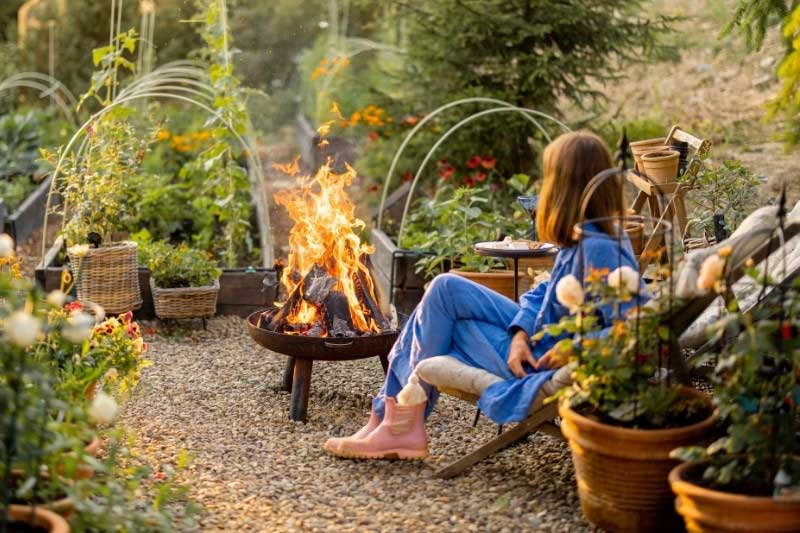
In response to hyperconnectivity, the garden becomes an emotional refuge, an open-air cocoon where people slow down, wrap themselves up and breathe. Throws, cushions, natural materials, deep seating… domestic comfort is transposed into a calming plant-filled setting.
- Japandi: fusion of Japanese minimalism and Scandinavian softness, inspiring sober, vegetal, meditative atmospheres. Japanese maple 'Bloodgood', black Ophiopogon, Pittosporum tobira 'Nana', Arisaema consanguineum, Clematis 'Pistachio' flourish within a contemplative, low-maintenance garden. (+160% searches for "Japandi garden" in 3 years).
- Chill Soft: soft design, velvety palette, flowing ornamental grasses such as Pennisetum 'Lumen Gold', Perovskia 'Prime Time', Panicum 'Hot Rod'… The garden becomes fluid, sensory and enveloping.
- Boho Patio : bohemian terraces, bright colours and gypsy spirit. Giant sunflowers, dahlias, purslanes, red popcorn maize, and black pomegranate settle in for a sunny, joyful garden for lazing and impromptu partying.
Augmented Garden
The garden is entering the era of assisted gardening: tutorials, apps, connected devices, AI…
Cordless tools are becoming mainstream, mini-greenhouses are appearing in cities, and social networks popularise gardening techniques.
Uninhibited and autonomous, the garden appeals to a new urban generation. 40% of urban households are already equipped with an intelligent device.
Our podcast Branché au jardin has accumulated 18,000 listens, and our Plantfit app has 80,000 users.

Colours 2026
Emotional hues, between mineral freshness, dark romanticism and pastel dream.
- Transformative Teal: between muted blue and aquatic green, this refined, mineral hue establishes itself as the colour of 2026. It evokes deep waters and is embodied by Eucalyptus ‘Baby Blue’, Agave americana, Senecio serpens 'Dwarf Blue', or Dasylirion glaucophyllum.
- Cloud Dancer : a vapoury, restful, almost silent white, crowned Pantone's colour of the year. A chromatic antidote to saturation, Agapanthus 'Ever White', Hydrangea 'FlowerWOW', Iris 'Glacier' and Clematis 'Guernsey Flute' soothe the eye.
- Dark Academia : dramatic romanticism with Victorian accents. Purple, garnet and misty mauve blooms and wine-coloured foliage create a dark, sophisticated atmosphere. Dianthus 'Sooty', Rose 'Charles de Mills', Poppy 'Lauren’s Grape' and Lupin 'Masterpiece' embody this poetic gloom.
- Unicorn: an iridescent pastel breath on the border of digital dream. Apricot sorbet, frosted lavender, sky blue or vanilla yellow compose a dreamlike, joyfully offbeat garden populated by Wallflower ‘Classic Apricot’, Delphinium ‘Misty Lavender’, Rose ‘Koko Loko’.

Discover exclusively our Garden Trends 2026 booklet identified by our experts! Green Generation, Retro Garden or Augmented Garden, we reveal five emerging trends that are reinventing garden practices and imaginations. Drawing on its monitoring, Promesse de fleurs shares a forward-looking perspective and field observations of tomorrow’s garden. Green generation Millennials: new plant-loving tribe born on […]
































