




























Cookies help us to offer you a personalised browsing experience and to measure our audience. You can configure them at any time and consult our privacy policy.
This website uses cookies to improve your experience when browsing the website. Of these, cookies classified as necessary are stored on your browser because they are essential for the basic functionality of the website to work. We also use third-party cookies to help us analyse and understand how you use this website. These cookies will only be stored on your browser with your consent. You also have the option of refusing these cookies. However, deactivating some of these cookies may have an effect on your browsing experience.
Would this plant suit my garden?
Set up your Plantfit profile →
Filter
Sort by:
Display
4results
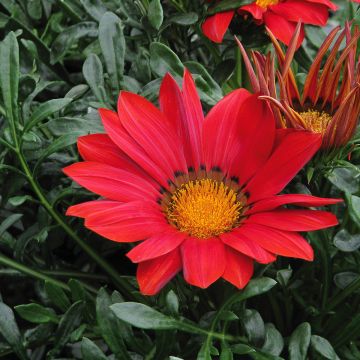
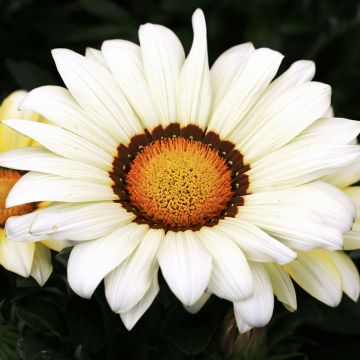
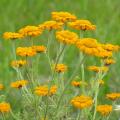
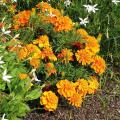
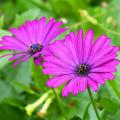
Gazanias are tender perennials or annuals native to South Africa in the Asteraceae family, cultivated for their vividly coloured flowers that open in the sun. Gazanias are appreciated for their long flowering period, drought resistance, and easy maintenance. They are available in a beautiful range of colours, including orange, red, yellow, and pink, and can be single or double. These relatively short plants are commonly used for borders and rockeries. Among the most commonly used species in horticulture are Gazania rigens with yellow flowers marked with a black central zone, slightly taller Gazania splendens which produces yellow, orange, or red flowers with a black central zone, Gazania linearis with white or pink flowers circled in black near the centre, and Gazania krebsiana with white flowers. There are a multitude of hybrids and improved varieties, selected for their stronger stems and neater appearance... These annuals should be planted in small groups along borders to fully appreciate them, combined with taller and monochrome plants.
Note: Please be aware, our plug plants are products intended for experienced gardeners: upon receipt, transplant and store them in sheltered areas (veranda, greenhouse, frame...) at a temperature above 14 °C (57.2°F) for a few weeks before planting them outdoors once the risk of frost has definitively passed.
Gazanias are tender perennials or annuals native to South Africa in the Asteraceae family, cultivated for their vividly coloured flowers that open in the sun. Gazanias are appreciated for their long flowering period, drought resistance, and easy maintenance. They are available in a beautiful range of colours, including orange, red, yellow, and pink, and can be single or double. These relatively short plants are commonly used for borders and rockeries. Among the most commonly used species in horticulture are Gazania rigens with yellow flowers marked with a black central zone, slightly taller Gazania splendens which produces yellow, orange, or red flowers with a black central zone, Gazania linearis with white or pink flowers circled in black near the centre, and Gazania krebsiana with white flowers. There are a multitude of hybrids and improved varieties, selected for their stronger stems and neater appearance... These annuals should be planted in small groups along borders to fully appreciate them, combined with taller and monochrome plants.
Note: Please be aware, our plug plants are products intended for experienced gardeners: upon receipt, transplant and store them in sheltered areas (veranda, greenhouse, frame...) at a temperature above 14 °C (57.2°F) for a few weeks before planting them outdoors once the risk of frost has definitively passed.
The flowering period indicated on our website applies to countries and regions located in USDA zone 8 (France, the United Kingdom, Ireland, the Netherlands, etc.)
It will vary according to where you live:
In zones 9 to 10 (Italy, Spain, Greece, etc.), flowering will occur about 2 to 4 weeks earlier.
In zones 6 to 7 (Germany, Poland, Slovenia, and lower mountainous regions), flowering will be delayed by 2 to 3 weeks.
In zone 5 (Central Europe, Scandinavia), blooming will be delayed by 3 to 5 weeks.
In temperate climates, pruning of spring-flowering shrubs (forsythia, spireas, etc.) should be done just after flowering.
Pruning of summer-flowering shrubs (Indian Lilac, Perovskia, etc.) can be done in winter or spring.
In cold regions as well as with frost-sensitive plants, avoid pruning too early when severe frosts may still occur.
The planting period indicated on our website applies to countries and regions located in USDA zone 8 (France, United Kingdom, Ireland, Netherlands).
It will vary according to where you live:
In Mediterranean zones (Marseille, Madrid, Milan, etc.), autumn and winter are the best planting periods.
In continental zones (Strasbourg, Munich, Vienna, etc.), delay planting by 2 to 3 weeks in spring and bring it forward by 2 to 4 weeks in autumn.
In mountainous regions (the Alps, Pyrenees, Carpathians, etc.), it is best to plant in late spring (May-June) or late summer (August-September).
The harvesting period indicated on our website applies to countries and regions in USDA zone 8 (France, England, Ireland, the Netherlands).
In colder areas (Scandinavia, Poland, Austria...) fruit and vegetable harvests are likely to be delayed by 3-4 weeks.
In warmer areas (Italy, Spain, Greece, etc.), harvesting will probably take place earlier, depending on weather conditions.
The sowing periods indicated on our website apply to countries and regions within USDA Zone 8 (France, UK, Ireland, Netherlands).
In colder areas (Scandinavia, Poland, Austria...), delay any outdoor sowing by 3-4 weeks, or sow under glass.
In warmer climes (Italy, Spain, Greece, etc.), bring outdoor sowing forward by a few weeks.