Beeches, oaks, but also hornbeams and chestnuts are already losing their leaves in summer well before autumn arrives, in August, but sometimes as early as mid‑July. This unusual phenomenon gives forests an early autumn appearance… and our gardens a prematurely autumnal look, with a carpet of dead leaves already covering the ground. Two heatwaves, a significant water deficit and parched soil have weakened these trees, causing premature leaf drop. A visible symptom of water stress and climate disruption, browning is now observed each summer with increasing frequency. Which species are most sensitive? Sun‑scorched leaves on trees, leaf yellowing in summer — does this early browning mean the tree will die? And above all, what can be done to mitigate these effects? We explain.
Why do tree leaves turn yellow in the middle of August?
August 2025 spared little vegetation. In many regions, notably Nouvelle‑Aquitaine, trees began to defoliate well ahead of time. This phenomenon is not due to an early season but to physiological stress caused by extreme climatic conditions.
In summer, foliage would normally display a deep green, fuelled by chlorophyll that captures solar energy and enables the tree to build reserves via photosynthesis. But repeated heatwaves, combined with ever drier soils, deeply disrupt this cycle.
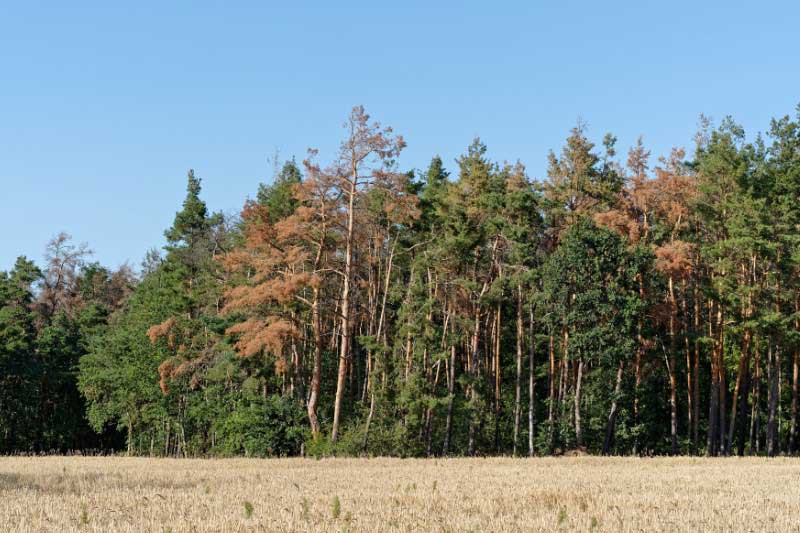
The figures are telling: over the 2021–2023 period, an estimated 8% of trees in French forests (living or standing dead for less than five years) were physiologically affected — some 186 million trees out of 2,270 million. This is not an isolated incident: IGN (National Institute of Geographic and Forest Information) also reports a 54% increase in tree mortality between 2012 and 2022.
And this is only the beginning. Projections indicate that by 2050, summer droughts will last on average two to four months, compared with two months currently, having more lasting effects on soils. If warming continues, some regions could face up to 39 additional drought days per year, and in the south soils could remain dry for seven to eight consecutive months.
In France, native species, adapted for millennia to a temperate climate, struggle to keep pace with this disruption. Some adapt partially, others show clear signs of exhaustion.
Lack of water, combined with very high temperatures, forces trees to close their stomata to limit water loss. This survival reflex halts photosynthesis and leads to a rapid loss of vigour. Leaves deprived of water and nutrients brown, dry out and fall. The phenomenon of leaves yellowing in summer is not natural: it is a defence mechanism to reduce evaporative surface area. This is known as water stress.
Certain species, such as beech, are particularly vulnerable: they suffer leaf scorch, bark lesions and even micro‑cracks that block sap rise or cause embolisms (air bubbles). All these troubles interrupt water functioning, compromise photosynthesis — and weaken the tree in the long term.
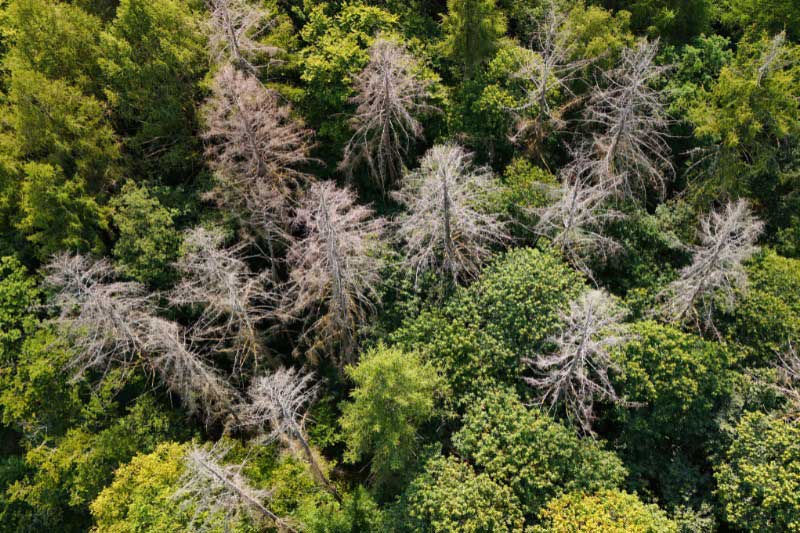
What happens after premature leaf drop?
When a tree loses its leaves as early as summer, it enters a kind of early dormancy, as if self‑protecting in a critical situation. This defence mechanism reduces its water and energy needs, but has medium‑ and long‑term consequences.
1. Photosynthesis stopped = reserves not replenished
Normally, leaves remain active until autumn to produce sugars via photosynthesis. These sugars reinforce root reserves, essential to survive winter and restart in spring. Summer defoliation prevents this process. The tree therefore enters the cold season with insufficient reserves, making it more vulnerable to disease, frost or pest attacks.
2. Growth halted
Without leaves, the tree can no longer grow in height or diameter. Over several successive seasons this results in slowed development, a thinner crown and a progressive decline in vitality.
3. Risk of long‑term weakening
If the stress episode is isolated, the tree can recover, especially if well established. But if stress recurs (as increasingly happens), the tree has no time to rebuild its reserves and weakens progressively. This process can take several years before leading to total decline.
4. Delayed consequences visible in spring
A tree that lost its leaves in August may appear alive in winter but fail to leaf out in the following spring, or do so only partially. This lack of foliage then reflects internal exhaustion, often irreversible.
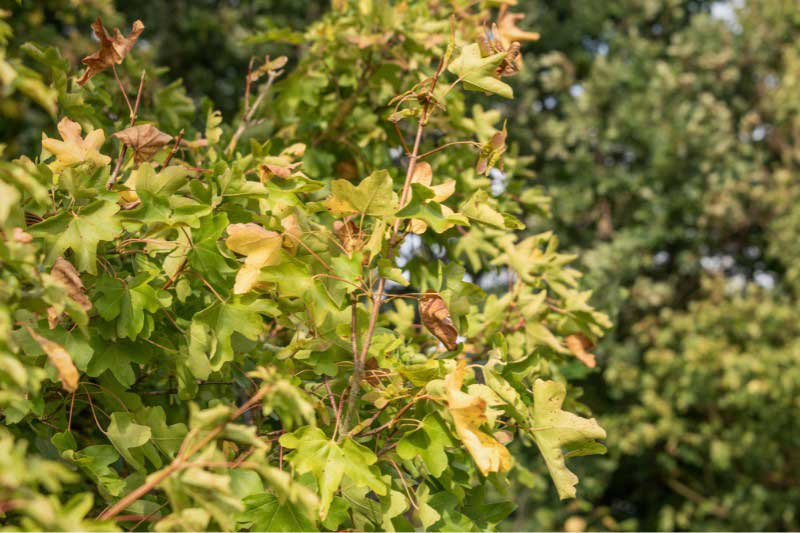
Does this mean the tree will die?
Not necessarily, but it is worrying. Early browning and defoliation are signs of acute stress, not an irreversible sentence. However, if these episodes repeat year after year, they can cause lasting weakening, loss of carbon reserves, reduced resistance to pests and an increased risk of mortality.
Most sensitive species
Not all species respond the same way to these extreme climatic episodes. Some are more vulnerable than others:
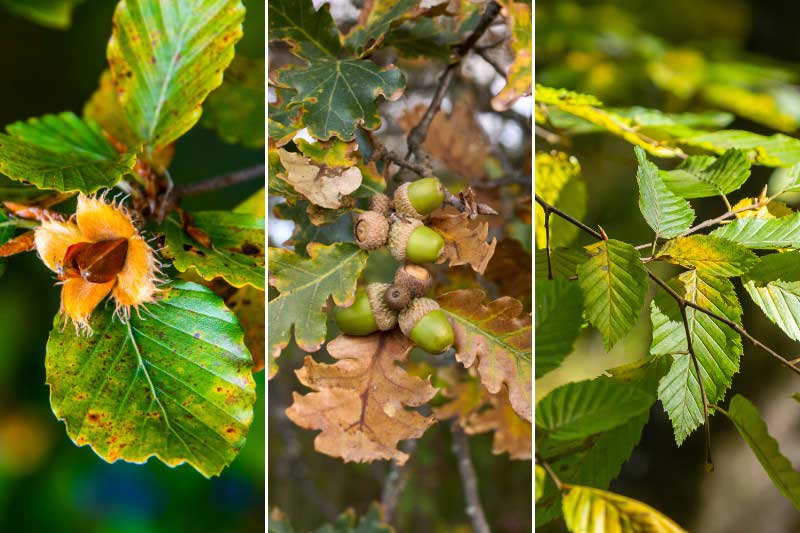
- The beech (Fagus sylvatica): one of the most affected species. Native to humid, temperate climates, it quickly suffers from lack of water and heat stress. Browning of its foliage is common in summer, even in dense forest. Leaf deficit — the proportion of missing foliage compared with normal — rose from about 15% between 1997 and 2003 to nearly 35% between 2017 and 2023. This increase illustrates a worrying trend, even if the species sometimes shows the ability to recover when conditions improve.
- Oaks (Quercus robur, Q. petraea): among them, the pedunculate oak (Quercus robur) proves more sensitive to summer water stress, while the sessile oak and downy oak display better resistance. However, repeated weakening makes them more vulnerable to pests such as jewel beetles or certain pathogenic fungi. They account for nearly 25% of France’s forest area — a significant share.
- The hornbeam (Carpinus betulus) and the chestnut (Castanea sativa): these too show weakness from the end of summer, with premature leaf drop during prolonged drought.
- Conifers such as spruce: poorly adapted to dry summers, they suffer marked weakening, often exploited by pests such as bark beetles.
This reflects a general deterioration affecting all tree categories. It is estimated that one third of oaks (sessile and pedunculate), two thirds of beeches, 60% of firs at low and mid altitudes, and 90% of spruces may no longer be able to develop in their current zones by 2050.
What can be done?
Faced with this situation, several actions can be considered:
- Plant species better adapted to conditions
In the current context, it makes sense to rethink species choices without abandoning local vegetation. Some species show better tolerance to repeated summer droughts. It is advisable to favour resilient but diverse species, and adapt plantings to local pedoclimatic conditions: soil type, aspect, water‑holding capacity, altitude…
Among species better suited to dry conditions are downy oak, the Atlas cedar, and the European nettle tree, as well as Mediterranean species such as Aleppo pine or the holm oak. These species can resist heat when planted in suitable exposures and climates. Species such as Japanese pagoda tree (Styphnolobium japonicum) or the Siberian elm (Ulmus pumila) also show good adaptive capacity.
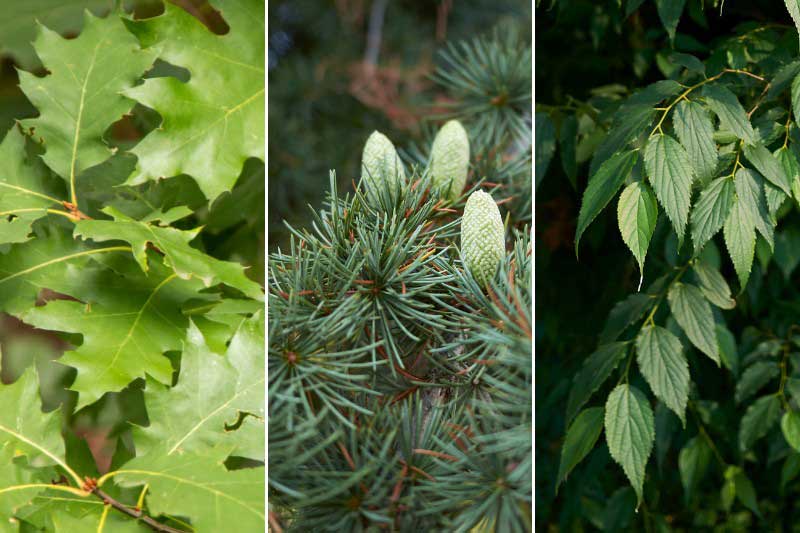
- Encourage plant biodiversity: diversifying species is an effective strategy to strengthen overall resilience. Mixed stands (species with different root systems and needs) cope better with climatic hazards.
- Preserve the soil: living soil rich in organic matter retains water better. Mulch, leave dead leaves in place and avoid soil compaction — simple but effective measures.
- Limit interventions during stress periods: avoid heavy pruning, transplanting or applications of nitrogenous fertilisers in mid‑summer. Do not rush to prune or fell a stressed tree: with time and improved conditions it can sometimes recover.


































Comments