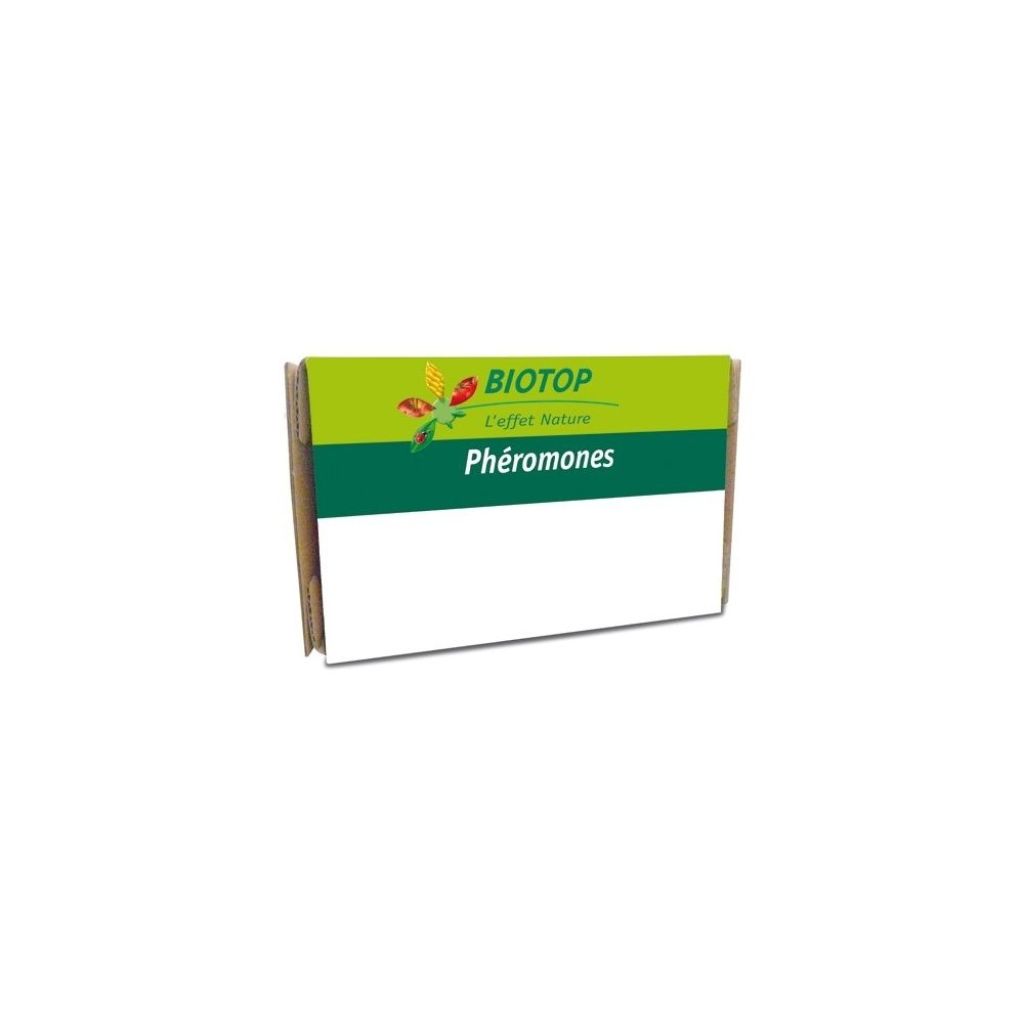
Biotop Pheromones for Pear Tree Borer Zeuzera pyrina (leopard moth) - 2 capsules
Biotop Pheromones for Pear Tree Borer Zeuzera pyrina (leopard moth) - 2 capsules
Back-to-school special offer!
Get €10 off for every €50 you spend! And get up to €40 off on a single order.
How does it work?
1. Shop your favourites
Add your favourite plants to your basket. For every €50 you spend (excluding delivery charges, store credit and the plastic-free option), you’ll receive a €10 voucher.
€50 spent = €10 voucher
€100 spent = €20 voucher
€150 spent = €30 voucher
€200 spent = €40 voucher
2. Place your order
Once your basket reaches one of the spending thresholds, place your order. You can even choose your delivery date!
3. Receive your voucher
As soon as your order has been shipped, you’ll receive an email containing your personal voucher code and its value.
4. Use it on your next order
Your voucher is valid for 90 days from the date you receive it. It can be used once only, on a new order worth at least the value of the voucher, excluding delivery charges.
Please note: Vouchers can be combined with other offers, but cannot be split or refunded.
Home or relay delivery (depending on size and destination)
Important: You may be charged customs duties by your country’s customs authorities upon delivery.
Schedule delivery date,
and select date in basket
We guarantee the quality of our plants for a full growing cycle, and will replace at our expense any plant that fails to recover under normal climatic and planting conditions.
Biotop Pear Tree Leopard Moth Pheromones are part of a biological control system against this orchard pest, which helps the gardener avoid having to resort to spraying or using pesticides. It is the adult male that is targeted, to prevent the fertilisation of females which produce caterpillars which destroy vegetation. These capsules, impregnated with synthetic pheromones, mimic the olfactory signals emitted by females during their reproductive phase. Placed in a Biotop butterfly trap (sold separately), they attract males to neutralise them. The effective duration of one capsule is 4 to 6 weeks. Optimal period of use: from June to August. Packaged in a box of 2 capsules.
Targeted Pests:
- Zeuzera pyrina: the leopard moth or "coquette", a pretty butterfly with a wingspan of 5 to 6 cm for the female, the male reaching only 3.5 to 4 cm. The wings are white, dotted with bluish spots. The white, cottony thorax bears six blue spots. The larva is a handsome caterpillar, 5 cm long, bright yellow in colour, with small black spots. The biological cycle of this butterfly spans 1 year in favourable climates, or 2 years in the North. The butterflies live for 10 days. A fertilised female lays 1000 eggs, which quickly turn into voracious caterpillars: they bore into trunks, buds, twigs and branches where they dig tunnels that severely disrupt sap flow and lead to the dieback of entire branches. Their entry hole is identified by small reddish piles of sawdust and excrement, as well as a trail of sap. The activity of one caterpillar can lead to the death of a young tree. The adults fly at night from June to August. Trees weakened by leopard moth attacks often become the target of other wood-boring insects, which can lead to their premature death. The leopard moth is present almost everywhere in Europe, up to 1200 m altitude.
Susceptible Crops: a large number of woody species. Fruit trees: pear, apple, plum, cherry, citrus trees, walnut, olive, quince... Ornamental trees: oak, ash, lime, plane, maple, tulip tree...
The pheromone capsule must be placed in one of the butterfly traps developed by Biotop: the delta trap (detection), or the funnel trap with vanes (high-capacity detection).
Pheromones and attractants are sold separately from the traps so they can be kept cold for optimal effectiveness throughout their diffusion period.
Instructions for Use:
- The capsules must be handled with gloves or tweezers to avoid "contaminating" the pheromone contained in the capsule and thus preserve its effectiveness. Wash your hands after use.
- Place the pheromone or attractant in the designated location: butterfly trap / Delta-type house or: funnel butterfly trap with vanes.
- The pheromone (or attractant) capsules (diffusers) are soaked in a bath of pheromones, which impregnate the material and will then gradually diffuse. The liquid pheromone solution is not visible. Regardless of its shape or colour, place the diffuser in the location defined above.
- Allow for 1 - 2 traps per tree or 1 - 2 traps per hectare (for detection, at the start of the season)
- Unless stated otherwise on the packaging, if there is a cap, it should not be opened.
- Replace the capsule after 4 to 6 weeks, depending on weather conditions (diffusion is faster in very hot weather).
Storage and Handling:
- Awaiting use: store in the refrigerator (3-5°C) for 1 year.
- For use next season: store in the freezer (-18°C) for 2 years.
Uses and advantages
Tips
Tips
This item has not been reviewed yet - be the first to leave a review about it.
Recently viewed products
Haven't found what you were looking for?
Hardiness is the lowest winter temperature a plant can endure without suffering serious damage or even dying. However, hardiness is affected by location (a sheltered area, such as a patio), protection (winter cover) and soil type (hardiness is improved by well-drained soil).

The flowering period indicated on our website applies to countries and regions located in USDA zone 8 (France, the United Kingdom, Ireland, the Netherlands, etc.)
It will vary according to where you live:- In zones 9 to 10 (Italy, Spain, Greece, etc.), flowering will occur about 2 to 4 weeks earlier.
- In zones 6 to 7 (Germany, Poland, Slovenia, and lower mountainous regions), flowering will be delayed by 2 to 3 weeks.
- In zone 5 (Central Europe, Scandinavia), blooming will be delayed by 3 to 5 weeks.
In temperate climates, pruning of spring-flowering shrubs (forsythia, spireas, etc.) should be done just after flowering.
Pruning of summer-flowering shrubs (Indian Lilac, Perovskia, etc.) can be done in winter or spring.
In cold regions as well as with frost-sensitive plants, avoid pruning too early when severe frosts may still occur.
The planting period indicated on our website applies to countries and regions located in USDA zone 8 (France, United Kingdom, Ireland, Netherlands).
It will vary according to where you live:
- In Mediterranean zones (Marseille, Madrid, Milan, etc.), autumn and winter are the best planting periods.
- In continental zones (Strasbourg, Munich, Vienna, etc.), delay planting by 2 to 3 weeks in spring and bring it forward by 2 to 4 weeks in autumn.
- In mountainous regions (the Alps, Pyrenees, Carpathians, etc.), it is best to plant in late spring (May-June) or late summer (August-September).
The harvesting period indicated on our website applies to countries and regions in USDA zone 8 (France, England, Ireland, the Netherlands).
In colder areas (Scandinavia, Poland, Austria...) fruit and vegetable harvests are likely to be delayed by 3-4 weeks.
In warmer areas (Italy, Spain, Greece, etc.), harvesting will probably take place earlier, depending on weather conditions.
The sowing periods indicated on our website apply to countries and regions within USDA Zone 8 (France, UK, Ireland, Netherlands).
In colder areas (Scandinavia, Poland, Austria...), delay any outdoor sowing by 3-4 weeks, or sow under glass.
In warmer climes (Italy, Spain, Greece, etc.), bring outdoor sowing forward by a few weeks.
Shipping country and language
Your country of residence may be:
Your country of residence is:
For a better user experience on our website, you can select:
Your shipping country:
-
 Austria
-
 Belgium
-
 Bosnia & Herzegovina
-
 Bulgaria
-
 Croatia
-
 Cyprus
-
 Czechia
-
 Denmark
-
 Estonia
-
 Finland
-
 France
-
 Germany
-
 Greece
-
 Hungary
-
 Iceland
-
 Ireland
-
 Italy
Italy
-
 Latvia
-
 Liechtenstein
-
 Lithuania
-
 Luxembourg
-
 Malta
Malta
-
 Netherlands
-
 Poland
-
 Portugal
-
 Romania
-
 Serbia
-
 Slovakia
-
 Slovenia
-
 Spain
Spain
-
 Sweden
-
 Switzerland
Language:
-
French
-
 English
-
Spanish
-
Italian
-
German
-
Portuguese
-
Dutch
-
Finnish
My Account
Hello
My wish lists
My cart
Log in / Register
Existing customer?
This form is protected by reCAPTCHA - the Google Privacy Policy and Terms of Service apply.
New customer?
Create an account to track your orders, access our customer service and, if you wish, make the most of our upcoming offers.