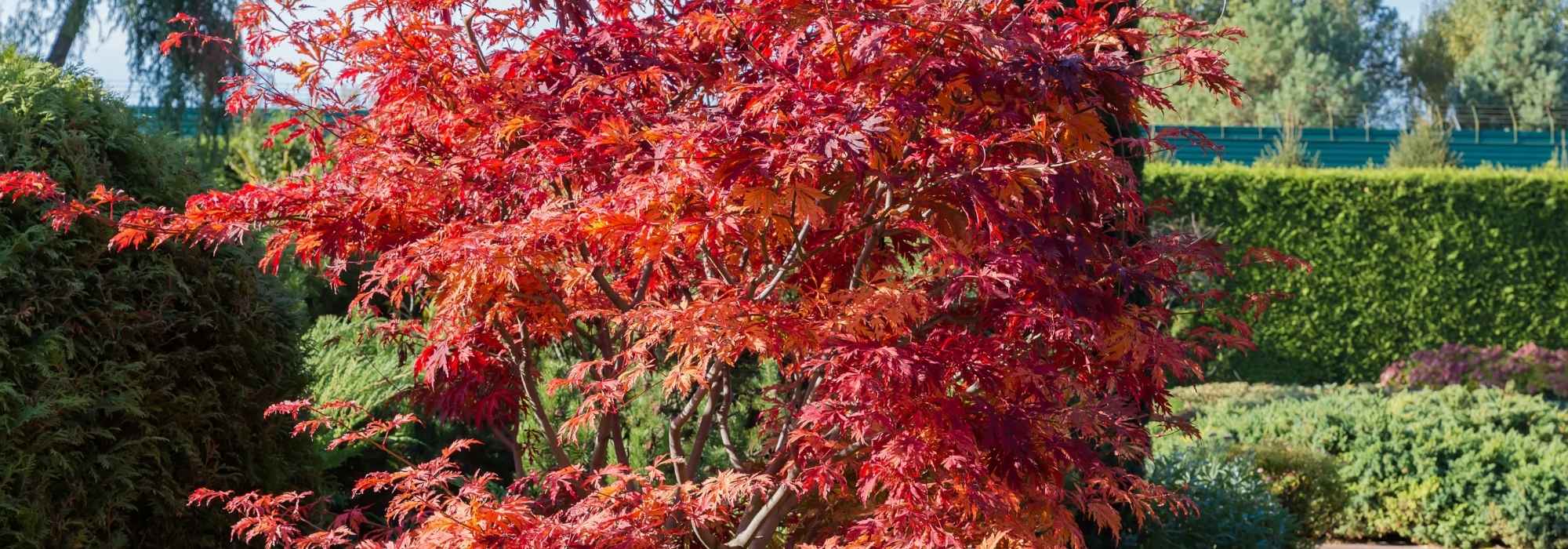
Which Japanese maples can tolerate sun?
Those that tolerate heat and sunshine best
Contents
A true shade and partial-shade plant, some Japanese maples, such as ‘Crimson Queen’, can tolerate a little more sun, allowing them to be planted in areas of the garden that receive more sunlight. However, this claim should be treated with caution, and in this article we explain why, while also outlining which Japanese maples tolerate this aspect better than others.

The essentials
|
Read also
Maples: planting, pruning and careSun for some Japanese maples… under certain conditions
To say that some Japanese maples can tolerate sunshine is bold. A few essential precautions are needed to avoid real disappointment:
- We are talking here about planting in non-scorching sunshine! The sun’s rays are not the same in Dieppe as they are in Nîmes. Nor are its intensity or the heat it generates. Planting in sunshine means adapting conditions so that the shrub does not suffer from the repeated heat of the sun, which can be devastating for this genus. So avoid the blazing midday sun from 3pm or 4pm;
- Plant Japanese maples, whatever their foliage and colouring, only in temperate climates (which rules out many regions in the south of France, as well as zones 9 and above in general). None of them can withstand repeated heatwaves, and it would be dishonest to claim that Japanese maples can tolerate repeated attacks from the sun, especially excessive heat.
Hot, dry climates should therefore avoid planting them in full sun, or risk being very disappointed by their performance. - When we say that they tolerate sunshine, this comes with one strict condition: the soil must remain moist, so mulch correctly around the root collar.
- Finally, the icing on the cake: the sunnier position must not be exposed to wind either. Any resulting drying out would cause irreversible damage to the foliage.
Other things to bear in mind when growing Japanese maples in a sunny position:
- Japanese maples in the dissectum group show greater tolerance of heat and sunshine, as do red and purple foliage. Always avoid variegated foliage in full sun, as it is considerably more susceptible to scorching;
- A sunnier-than-standard position for these shrubs requires more frequent watering.
- Planting must take place in autumn so that the shrub has time to produce a reasonable root system before summer.
The varieties featured here suffer less than others, but they will still suffer from excessive sunshine and, above all, heat, particularly at the tips of their foliage, which will eventually scorch or fall.
The best Japanese maples for sunny positions
It is the red-leaved Japanese maples that are the most tolerant of sun, but some green-leaved varieties can also cope with it, provided they are planted in the right conditions:
Japanese maple ‘Crimson Queen’
Acer palmatum ‘Crimson Queen’ is undoubtedly the Japanese maple that tolerates sun and heat best (up to 38 °C in the right conditions!). It belongs to the Dissectum group, whose leaves are deeply lobed and toothed. It is prized for its ability to keep its foliage bright red in summer, without turning green prematurely like many maples. It is therefore red all year round, with a more orange to bronze shade in autumn.
Another of its appealing characteristics is its weeping habit as it matures. This trailing habit, and the fact that it spreads increasingly over the years, are further qualities that make it a popular choice, particularly in small and medium-sized gardens. ‘Crimson Queen’ eventually reaches 3 m in height and 4 m in width. It is worth noting that it received an Award of Garden Merit from the RHS in 1993.
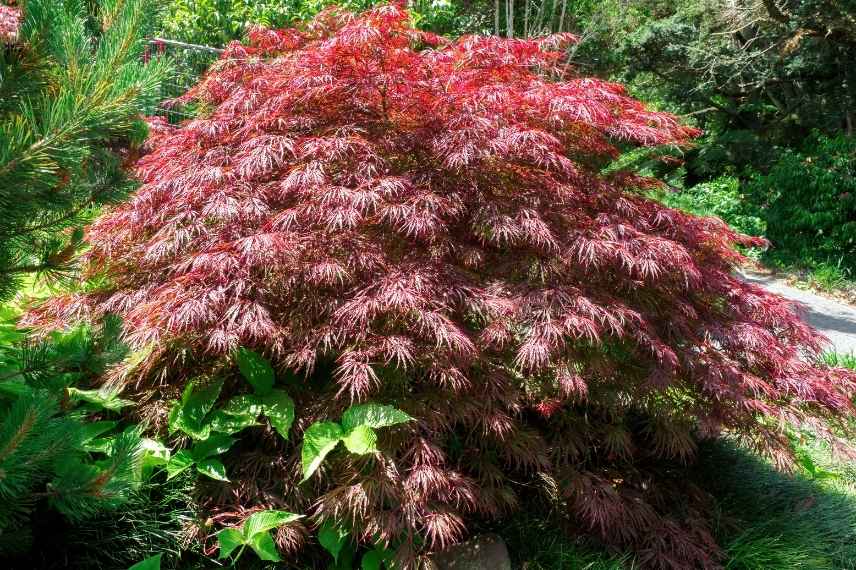
Acer palmatum subsp. dissectum ‘Crimson Queen’
Japanese maple ‘Bloodgood’
Larger in size (4 m tall and just as wide, or even wider in some conditions), Japanese maple ‘Bloodgood‘ also received an award from the RHS in 1993. It is one of the best-known maples among enthusiasts of dark-leaved Acers. It belongs to the Amoenum group (the leaf lobes divide only two-thirds of the way towards the base). This beautiful Japanese maple will reach 2 to 4 metres at maturity.
Its habit is more upright, and it also retains its red foliage well until the end of summer. It copes well with sustained heat, as long as it is planted in moist soil.
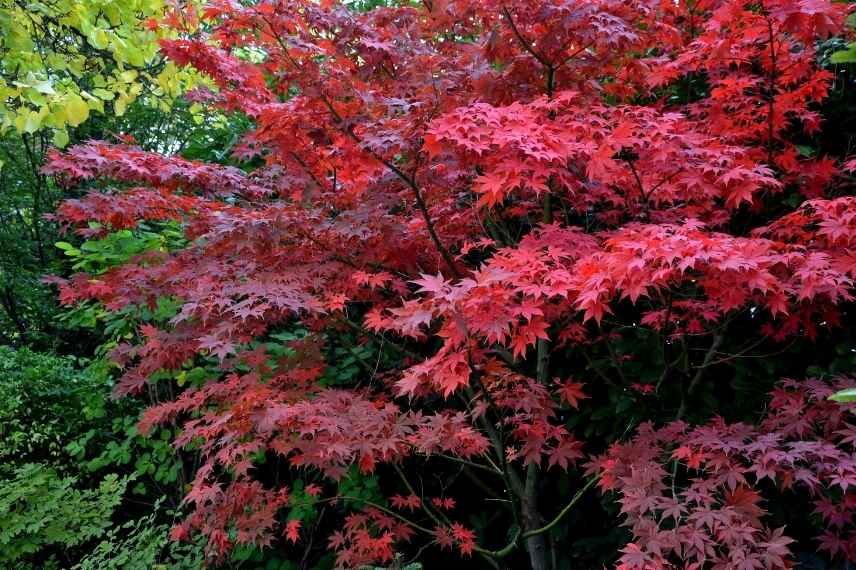
Acer palmatum ‘Bloodgood’
Japanese maple ‘Fireglow’
The small Japanese maple ‘Fireglow’ has palmate, purplish-red foliage all year round, with a brighter shade in spring. It is one of the varieties that can tolerate slightly more sun and heat, and its name gives an indication of its brilliance when it catches the sun’s rays. In autumn, the leaves turn purple.
It has an upright habit, growing taller than it is wide (3 m by 2 m wide), is smaller at maturity than ‘Bloodgood’, and is very hardy.
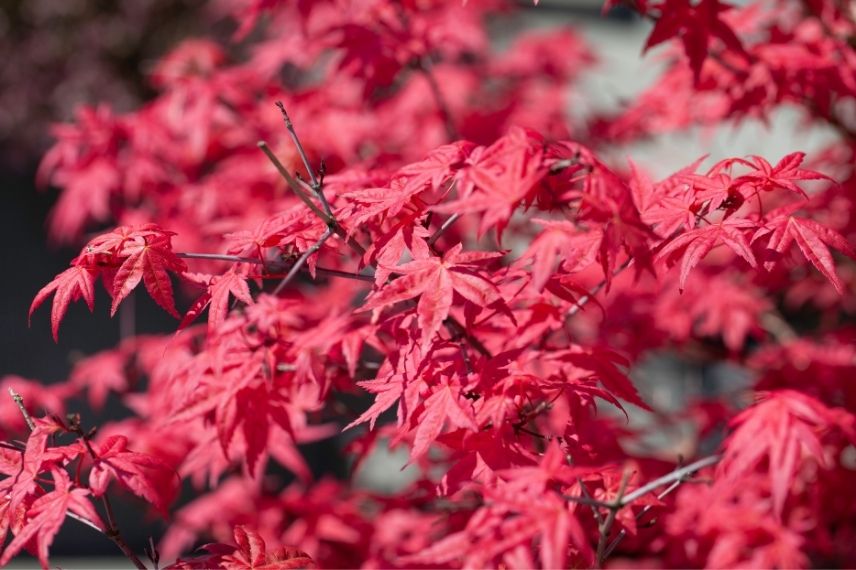
Acer palmatum ‘Fireglow’
Green-leaved Japanese maples are more sensitive to strong sunlight, as are golden and variegated forms. There are, however, two notable exceptions:
Japanese maple ‘Osakazuki’
This very attractive variety ‘Osakazuki‘ (also found under the names ‘O sakazuki’ or ‘Taihai’) is one of the few green-leaved Acers that can tolerate a sunnier position, provided it is planted in soil that remains consistently moist. Its autumn colour is superb, gradually changing from red to orange. Some people rank it among the maples with the most vivid autumn colour.
It is distinguished by its rounded, ball-shaped habit and its large 10cm leaves. It generally reaches 4 m in height, with a narrower spread. It is another cultivar to have received the prestigious RHS Award of Garden Merit in 1993.
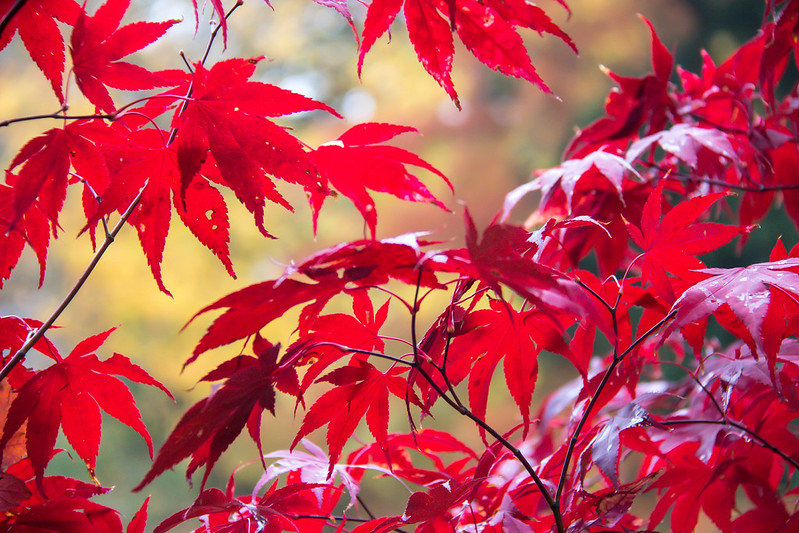
Acer palmatum ‘Osakazuki’ (Flickr photo – Suzanne Nilsson)
Japanese maple ‘Shishigashira’
Acer palmatum ‘Shishigashira’ takes its name from a lioness in traditional Japanese theatre. That gives you some idea of its appeal in autumn. Here, the leaves are unusually crinkled and toothed, light green in spring, and retain this colour well through the summer despite intense heat. It stands up well to sun scorch for a green-leaved maple. In autumn, the shrub takes on colouring ranging from yellow and pink to crimson red.
With a spreading habit, ‘Shishigashira’ is particularly well suited to small gardens because of its compact dimensions (approximately 2 m by 1.50 m, although it can sometimes grow larger). It can even be trained as a bonsai and grown in a large container without any difficulty. Its sculptural appearance will look wonderful there!
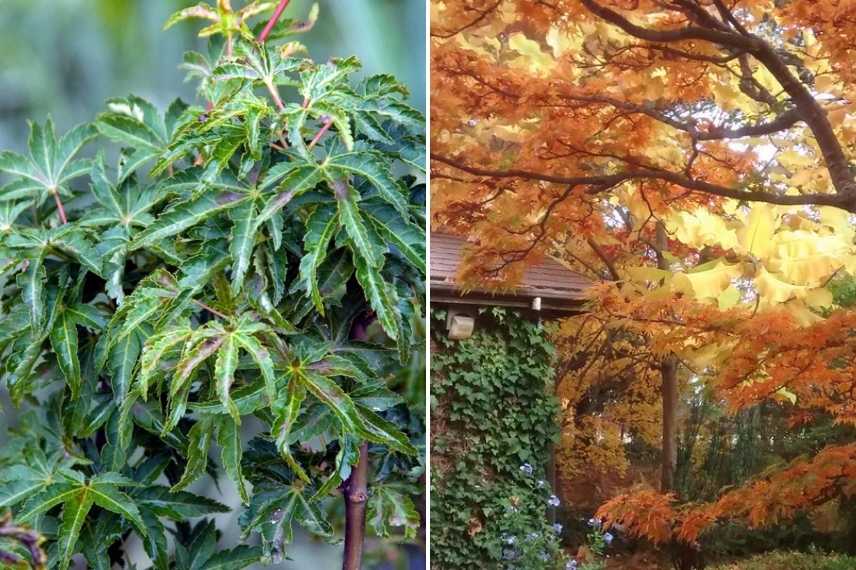
Summer foliage on the left, and autumn foliage on the right (Flickr photo, Allen C. Haskell)
Our tips for successfully growing a Japanese maple in full sun
- Mulching is essential for all Japanese maples, especially for those mentioned here that will be exposed to more sunlight. A thick cover of organic mulch is vital to protect them properly.
- Watering will need to be more frequent than for Japanese maples growing in partial shade. Always water more generously and less frequently, rather than the other way round.
- For growing in a container, water adequately, as this type of growing is always more drying for the growing medium. Follow our advice on growing Japanese maples in containers and the ABC of planting in containers.
- Subscribe!
- Contents
This form is protected by reCAPTCHA - the Google Privacy Policy and Terms of Service apply.

































Comments