Ficus microcarpa Ginseng - bonsai

Ficus microcarpa Ginseng - bonsai
Ficus microcarpa Ginseng - bonsai
Ficus microcarpa
Indian Laurel, Chinese Banyan, Malayan Banyan, Curtain Fig, Gajumaru
Back-to-school special offer!
Get €10 off for every €50 you spend! And get up to €40 off on a single order.
How does it work?
1. Shop your favourites
Add your favourite plants to your basket. For every €50 you spend (excluding delivery charges, store credit and the plastic-free option), you’ll receive a €10 voucher.
€50 spent = €10 voucher
€100 spent = €20 voucher
€150 spent = €30 voucher
€200 spent = €40 voucher
2. Place your order
Once your basket reaches one of the spending thresholds, place your order. You can even choose your delivery date!
3. Receive your voucher
As soon as your order has been shipped, you’ll receive an email containing your personal voucher code and its value.
4. Use it on your next order
Your voucher is valid for 90 days from the date you receive it. It can be used once only, on a new order worth at least the value of the voucher, excluding delivery charges.
Please note: Vouchers can be combined with other offers, but cannot be split or refunded.
Why not try an alternative variety in stock?
View all →
Available in 1 sizes

Available in 1 sizes

Available in 1 sizes

Available in 1 sizes

Available in 1 sizes
Available in 1 sizes
Available in 2 sizes
This plant carries a 30 days recovery warranty
More information
We guarantee the quality of our plants for a full growing cycle, and will replace at our expense any plant that fails to recover under normal climatic and planting conditions.
Description
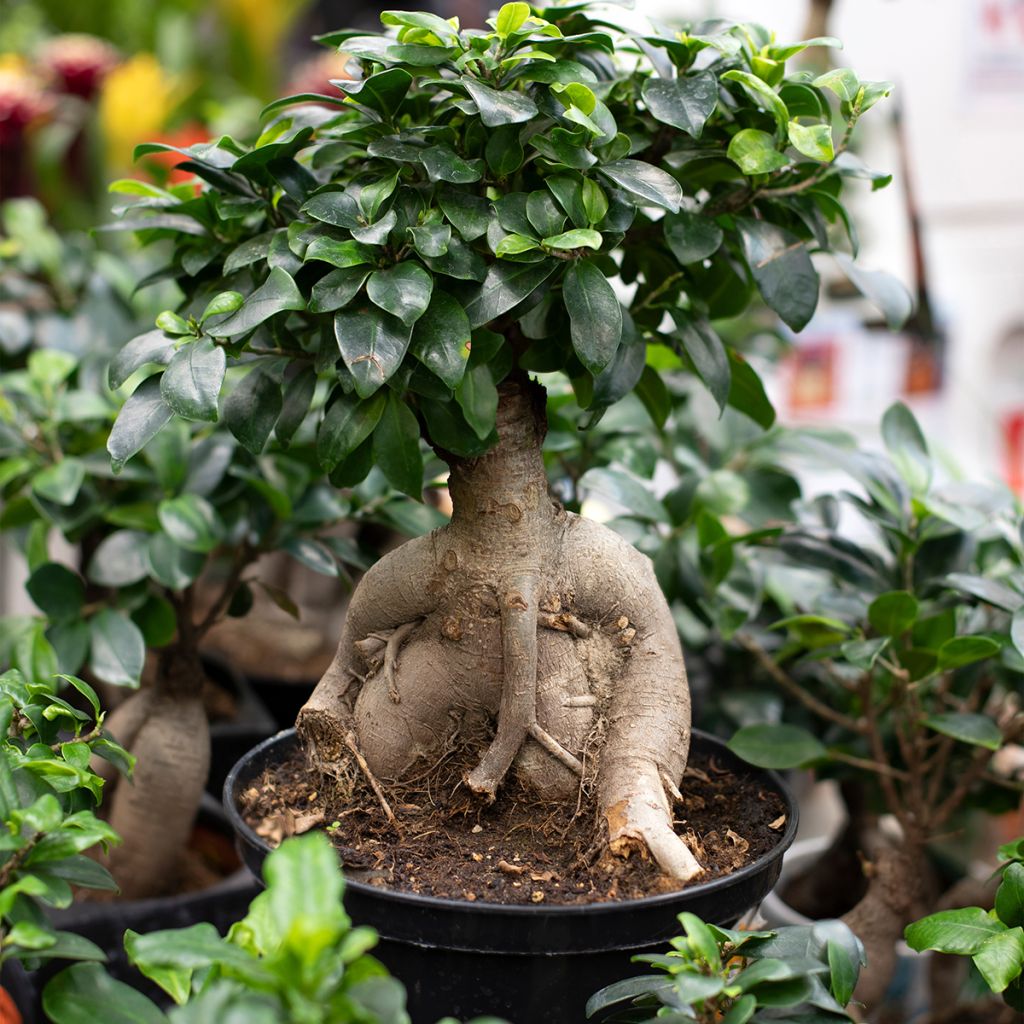
Ficus microcarpa Ginseng, is a tree native to tropical and subtropical Asia, too frost-tender to be planted outdoors in colder climates. It is therefore grown in pots, and most often trained as a bonsai, due to its interesting morphology. It displays a pseudo trunk, composed of large roots often overlapped with each other, which gives it a very sculptural look. Its evergreen foliage, consisting of small shiny dark green leaves, has perfect dimensions to visually enhance this dwarf tree. This frost-tender species must be overwintered indoors.
Ficus microcarpa belongs to the Moraceae family. This prolific genus includes more than 750 species, including our delicious Mediterranean fig tree. This tree is native to tropical and subtropical Asia (India, Sri Lanka, southern China, Malaysia) and Oceania (Australia, New Caledonia). It generally grows in humid climates, which promotes the formation of aerial roots, like many other species. It is found in humid tropical forests and other environments with high humidity (riverbanks, swamps, mangroves...), especially at low altitudes. Its good adaptability to different living conditions makes it a useful ornamental plant in urban environments.
Under these favourable development conditions, this species can reach up to 30 m in height and occupy a lot of space on the ground, due to its multiple aerial roots that descend from the trunks and anchor themselves in the soil. The tree then resembles giant plant organs, creating a spectacular scene. Ficus microcarpa is one of the strangler figs. Its seeds sometimes germinate on other trees, and it begins its life as an epiphyte, like many orchids or bromeliads. But over time, adventitious roots are emitted and they begin to progress towards the ground, firmly anchoring themselves. Gradually, they end up encircling and suffocating the unfortunate tree that served as their support!
Pollinated by a specific wasp species, this tree can produce millions of seeds when it reaches adulthood, which can make it invasive. It has been introduced in different countries or states such as Florida, California and South America, where it has adapted to local climates.
It should be grown in a pot and brought indoors in winter to a bright, frost-free room. However, it can tolerate occasional cold temperatures of around 0°C, so in mild climates, it can be left on a well-sheltered balcony during winter, exposed to the sun. Trained as a (pseudo) bonsai, this small Ficus will never reach the "tropical" dimensions it is known for. With a rather slow growth, it can be easily kept in reduced dimensions. Its fleshy roots, with beautiful grey bark, which are often mistaken for multiple trunks, give it a very venerable appearance. The trunk itself is very short and branches out into many limbs, forming a dense crown. It is possible to prune it to give it a particular and distinctive shape. Its foliage, with dimensions suitable for bonsai making, consists of leaves generally measuring 4 to 6 cm long and 2 to 3 cm wide. They are elliptical, carried by short petioles and different leaf sizes coexist on the branches. They are dark green, covered with a shiny glossy cuticle and decorative all year round, as the plant is evergreen.
This Ficus can be permanently grown indoors, in an environment that is not too dry, otherwise the tips of the leaves may turn brown and curl up, or even fall off. Although it appreciates atmospheric humidity, it does not tolerate excess water at the roots. While it is accommodating regarding the nature of the substrate, it should be well-drained. A good solution is to bring it indoors to a frost-free conservatory, for example, or near a glass door to ensure good sunlight, when nighttime temperatures drop below about 5°C. In spring, it will be possible to take it back outside after the last frosts. Care should be taken not to expose it to full sun immediately, as this would scorch the leaves accustomed to lower light levels for months... Watering should be regular during the growing season, allowing the substrate to dry out slightly, but not waiting for it to dry completely. However, in winter, watering should be reduced and spaced out.
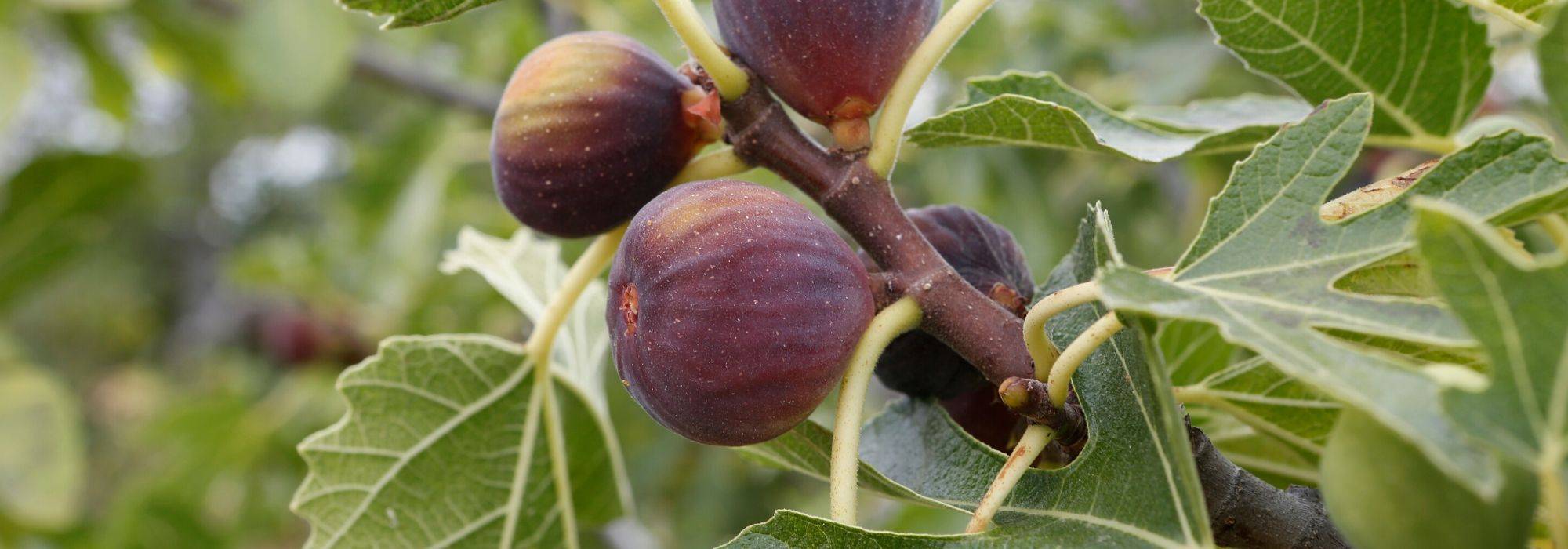
This cute little Ficus is quite easy to grow, as long as the atmosphere is not too dry. In warm climates, it should be placed in light shade, ideally under taller plants. These will maintain a favourable environment by transpiring. It will decorate a terrace or even a balcony, combined with other sculptural plants such as Operculicarya decaryi, which also often trained as a bonsai with compound and delicate foliage. Caudex plants like Pachypodium lamerei will help create a decorative and high-quality architectural scene. Why not associate it with a dwarf Fig tree (with fruits) such as Figality, a horticultural variety that can also be grown in a pot in a small space and will give you sweet fruits.
For a little history, Ginseng is purely a commercial name, derived from the Chinese ren shen ("man" and "root"), mispronounced by Anglo-Saxons as ginseng, and refers to Panax ginseng, whose roots often take a humanoid shape...
Foliage
Plant habit
Botanical data
Ficus
microcarpa
Moraceae
Indian Laurel, Chinese Banyan, Malayan Banyan, Curtain Fig, Gajumaru
Southeast Asia
Safety measures
ingestion
Cette plante est toxique si elle est ingérée volontairement ou involontairement.
Ne la plantez pas là où de jeunes enfants peuvent évoluer, et lavez-vous les mains après l'avoir manipulée.
Pensez à conserver l'étiquette de la plante, à la photographier ou à noter son nom, afin de faciliter le travail des professionnels de santé.
Davantage d'informations sur https://plantes-risque.info
Location
Location
Maintenance & care
Watering tips
Potting advice, substrates and fertilisers
Houseplant care
Disease and pest advice
Maintenance & care
Planting & care advice
-
-
-
-
-
-
-

-

This item has not been reviewed yet - be the first to leave a review about it.
Recently viewed products
Haven't found what you were looking for?
Hardiness is the lowest winter temperature a plant can endure without suffering serious damage or even dying. However, hardiness is affected by location (a sheltered area, such as a patio), protection (winter cover) and soil type (hardiness is improved by well-drained soil).

The flowering period indicated on our website applies to countries and regions located in USDA zone 8 (France, the United Kingdom, Ireland, the Netherlands, etc.)
It will vary according to where you live:- In zones 9 to 10 (Italy, Spain, Greece, etc.), flowering will occur about 2 to 4 weeks earlier.
- In zones 6 to 7 (Germany, Poland, Slovenia, and lower mountainous regions), flowering will be delayed by 2 to 3 weeks.
- In zone 5 (Central Europe, Scandinavia), blooming will be delayed by 3 to 5 weeks.
In temperate climates, pruning of spring-flowering shrubs (forsythia, spireas, etc.) should be done just after flowering.
Pruning of summer-flowering shrubs (Indian Lilac, Perovskia, etc.) can be done in winter or spring.
In cold regions as well as with frost-sensitive plants, avoid pruning too early when severe frosts may still occur.
The planting period indicated on our website applies to countries and regions located in USDA zone 8 (France, United Kingdom, Ireland, Netherlands).
It will vary according to where you live:
- In Mediterranean zones (Marseille, Madrid, Milan, etc.), autumn and winter are the best planting periods.
- In continental zones (Strasbourg, Munich, Vienna, etc.), delay planting by 2 to 3 weeks in spring and bring it forward by 2 to 4 weeks in autumn.
- In mountainous regions (the Alps, Pyrenees, Carpathians, etc.), it is best to plant in late spring (May-June) or late summer (August-September).
The harvesting period indicated on our website applies to countries and regions in USDA zone 8 (France, England, Ireland, the Netherlands).
In colder areas (Scandinavia, Poland, Austria...) fruit and vegetable harvests are likely to be delayed by 3-4 weeks.
In warmer areas (Italy, Spain, Greece, etc.), harvesting will probably take place earlier, depending on weather conditions.
The sowing periods indicated on our website apply to countries and regions within USDA Zone 8 (France, UK, Ireland, Netherlands).
In colder areas (Scandinavia, Poland, Austria...), delay any outdoor sowing by 3-4 weeks, or sow under glass.
In warmer climes (Italy, Spain, Greece, etc.), bring outdoor sowing forward by a few weeks.
Shipping country and language
Your country of residence may be:
Your country of residence is:
For a better user experience on our website, you can select:
Your shipping country:
-
 Austria
-
 Belgium
-
 Bosnia & Herzegovina
-
 Bulgaria
-
 Croatia
-
 Cyprus
-
 Czechia
-
 Denmark
-
 Estonia
-
 Finland
-
 France
-
 Germany
-
 Greece
-
 Hungary
-
 Iceland
-
 Ireland
-
 Italy
Italy
-
 Latvia
-
 Liechtenstein
-
 Lithuania
-
 Luxembourg
-
 Malta
Malta
-
 Netherlands
-
 Poland
-
 Portugal
-
 Romania
-
 Serbia
-
 Slovakia
-
 Slovenia
-
 Spain
Spain
-
 Sweden
-
 Switzerland
Language:
-
French
-
 English
-
Spanish
-
Italian
-
German
-
Portuguese
-
Dutch
-
Finnish
My Account
Hello
My wish lists
My cart
Log in / Register
Existing customer?
This form is protected by reCAPTCHA - the Google Privacy Policy and Terms of Service apply.
New customer?
Create an account to track your orders, access our customer service and, if you wish, make the most of our upcoming offers.