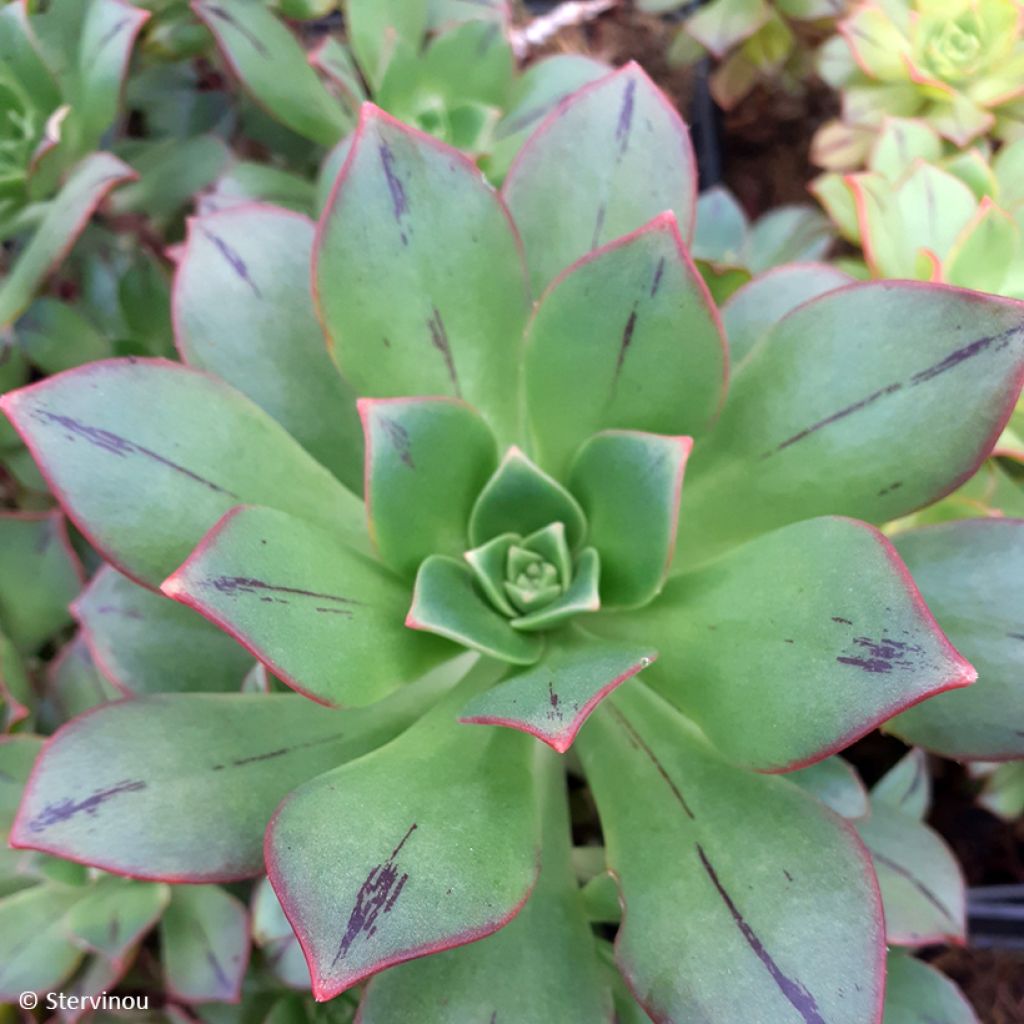
Aeonium Mary Ann Kunkel
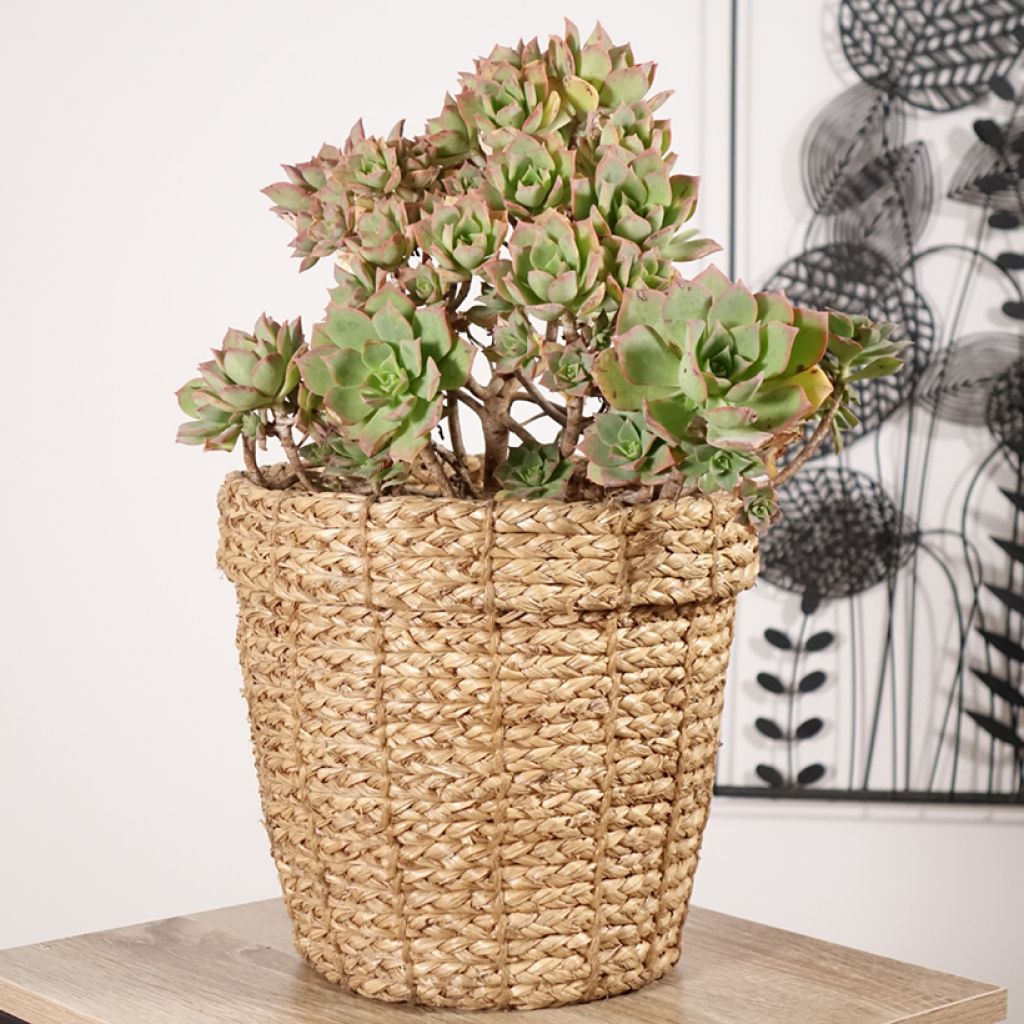
Aeonium Mary Ann Kunkel
Aeonium Mary Ann Kunkel
Aeonium percarneum var. guiaense x mascaense. Mary Ann Kunkel
Tree Aeonium, Tree Houseleek, Irish Rose
Back-to-school special offer!
Get €10 off for every €50 you spend! And get up to €40 off on a single order.
How does it work?
1. Shop your favourites
Add your favourite plants to your basket. For every €50 you spend (excluding delivery charges, store credit and the plastic-free option), you’ll receive a €10 voucher.
€50 spent = €10 voucher
€100 spent = €20 voucher
€150 spent = €30 voucher
€200 spent = €40 voucher
2. Place your order
Once your basket reaches one of the spending thresholds, place your order. You can even choose your delivery date!
3. Receive your voucher
As soon as your order has been shipped, you’ll receive an email containing your personal voucher code and its value.
4. Use it on your next order
Your voucher is valid for 90 days from the date you receive it. It can be used once only, on a new order worth at least the value of the voucher, excluding delivery charges.
Please note: Vouchers can be combined with other offers, but cannot be split or refunded.
Home or relay delivery (depending on size and destination)
Important: You may be charged customs duties by your country’s customs authorities upon delivery.
Schedule delivery date,
and select date in basket
This plant carries a 12 months recovery warranty
More information
We guarantee the quality of our plants for a full growing cycle, and will replace at our expense any plant that fails to recover under normal climatic and planting conditions.
Would this plant suit my garden?
Set up your Plantfit profile →
Description
Aeonium 'Mary Ann Kunkel' is a succulent plant native to the Canary Islands, with a strikingly attractive architectural silhouette. With its very upright habit and short, branched stems ending in rosettes of leaves of various sizes, this perennial eventually resembles a bonsai. Its thick, overlapping leaves have a bright green or slightly bluish colour, often enhanced by a pinkish-purple margin. Only tolerating brief frosts down to -4°C, this Aeonium can only be planted outdoors in very mild climates. Very compact, it can easily be grown in a pot elsewhere, to be sheltered in winter.
Aeoniums belong to the Crassulaceae family, which includes 30 genera and nearly 1400 species. Often small, these plants are particularly well adapted to drought conditions, due to their unique metabolism in the plant kingdom. Many genera therefore thrive in warm regions around the world, like Echeveria, widely found in Mexico and commonly used in mosaic planting. Others are perfectly cold-resistant, such as Sedum (Stonecrop), which embellishes our gardens and is suitable for green roofs. There are 45 Aeonium species, all sharing a family resemblance, especially as some have hybridised with each other.
This is the case with Aeonium 'Mary Ann Kunkel', named in honour of his wife by the German botanist Günther W.H. Kunkel, a specialist in arid zones and a prolific author with 70 books to his name. While the exact parentage of this Aeonium is not known, it is likely the result of a cross between A. percarneum var. guiaense and A. mascaense. The former, native to Gran Canaria, has many branches and is not overly sensitive to humidity. The latter, which seems to have disappeared in the wild, originated from Tenerife and now only exists in cultivation, appreciated for its numerous rosettes that give it an extremely dense appearance.
'Mary Ann Kunkel' has a very unusual very upright habit for this type of plant, forming a highly ornamental cone shape. The fleshy main stems rise almost vertically, branching laterally to produce short shoots. Each is terminated by a rosette of leaves, of varying diameters, giving this hybrid its unique character. Like in other species, the leaves are overlapped in an almost mathematical geometric pattern that adds interest to the plant. The succulent leaves are spatulate. Narrow at the point of insertion, they widen significantly in the upper third, ending in a V-shape at their tips. Their colour is usually a beautiful bright green, but depending on the individuals, season, or climate, they may also display a slight glaucous or greyish aspect. The leaf is often edged with an elegant pink-to-purple margin, enhancing the leaf's architectural design. Additionally, the leaf may bear a dark midrib line during summer, often disappearing in winter. While the foliage is the plant's main attraction, it can also produce a summer flowering with stalks bearing corymbs of small white-yellow star-shaped flowers.
Aeonium 'Mary Ann Kunkel' is particularly appealing for its contemporary look, thanks to its highly sculptural appeal. You can cultivate it in a pot to protect it in winter and decorate your terrace in the warmer months, alongside other orangery plants, such as Calamondin (Citrus madurensis) or Indoor Orange Tree, with its pleasantly fragrant white blooms and tangy fruits appreciated in cooking. In the mildest areas, it will be a standout feature in a well-exposed and sheltered rockery. Plant it in the foreground of a Dasylirion, whose equally striking silhouette will elegantly contrast with it. Place beside it an Aloe 'Safari Sunrise', with its dark green, slender foliage and generous white to salmon-tinged flowering, for a stunning scene.
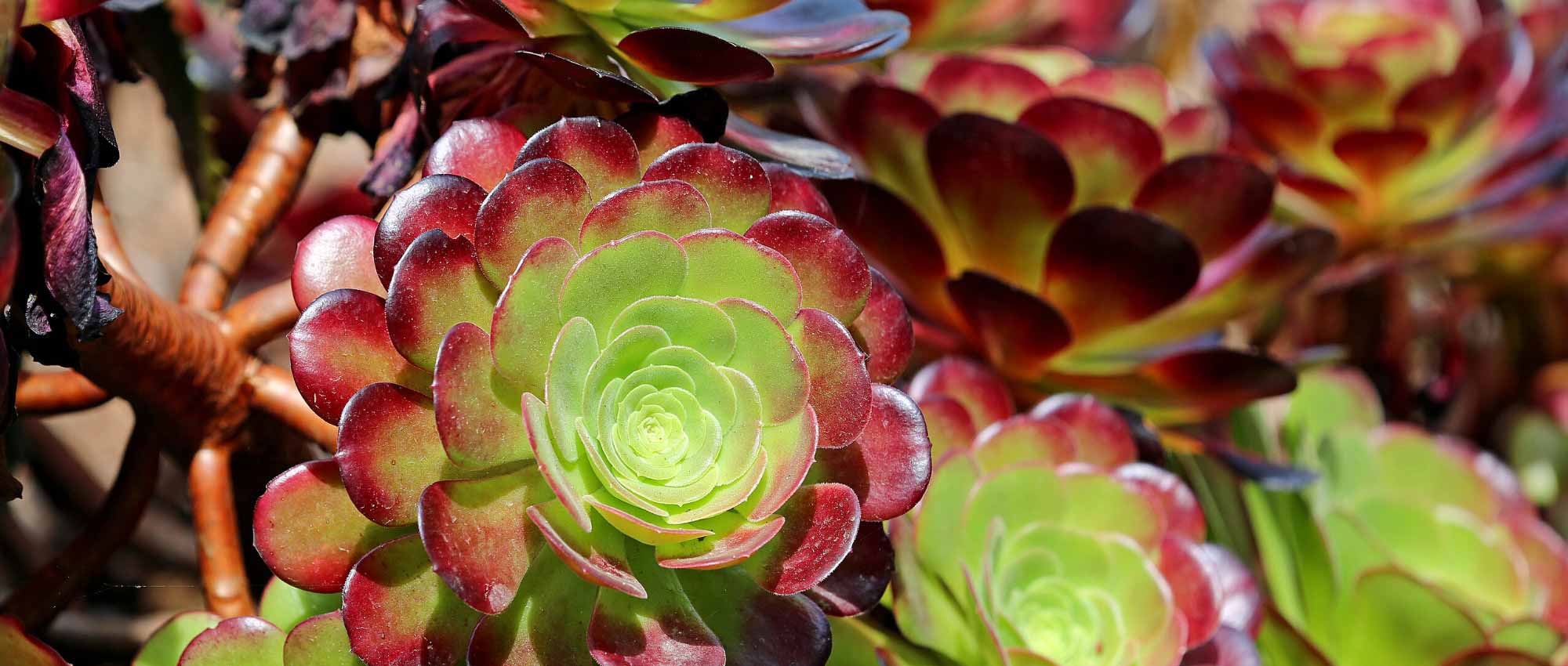
Aeonium Mary Ann Kunkel in pictures
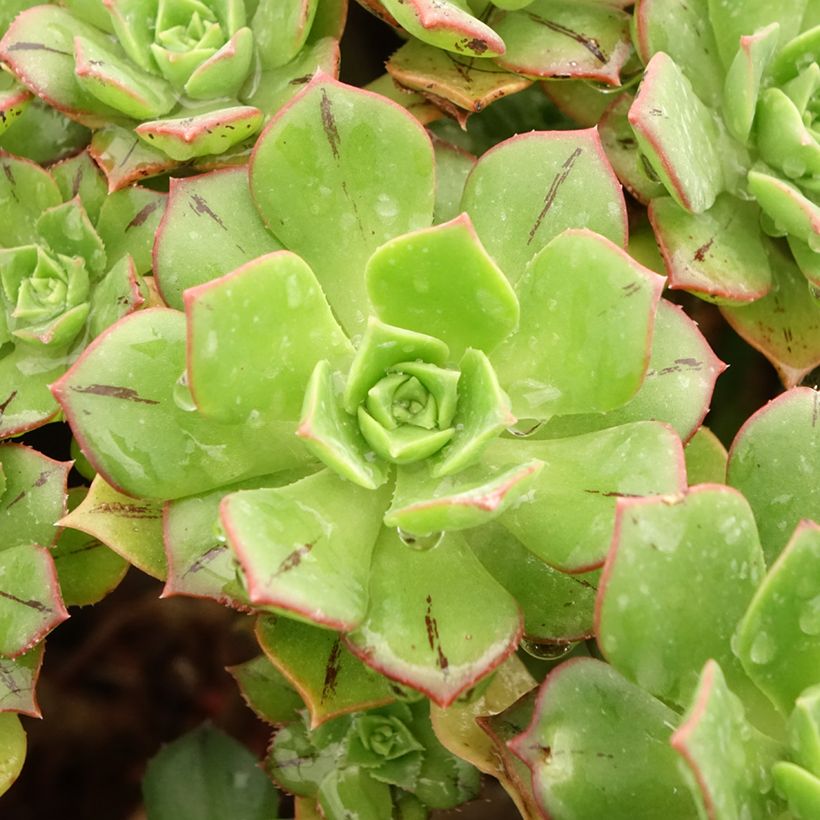
Flowering
Foliage
Plant habit
Botanical data
Aeonium
percarneum var. guiaense x mascaense.
Mary Ann Kunkel
Crassulaceae
Tree Aeonium, Tree Houseleek, Irish Rose
Mediterranean
Planting and care
Aeonium 'Mary Anne Kunkel' is resistant to heat and drought and needs light, well-drained, sandy, poor, even slightly chalky soil. Plant it in spring, after the last frosts, in open ground, in a mild, coastal, or hot and dry climate. It can be grown in pots all year round, sheltered from frost of course. It thrives in the sun (or in partial shade far south), and likes to have its roots warm. Originating from the Canaries, it is sensitive to frost and can only be planted outdoors in very mild climates, where frost is occasional and not intense. Overwinter this plant in an unheated, but frost-free, and very bright location. Water moderately from autumn to spring, and sparingly in summer. Remove faded inflorescences and dead branches.
Planting period
Intended location
Care
Planting & care advice
-
-
-
-
-

-

-

-

This item has not been reviewed yet - be the first to leave a review about it.
Recently viewed products
Haven't found what you were looking for?
Hardiness is the lowest winter temperature a plant can endure without suffering serious damage or even dying. However, hardiness is affected by location (a sheltered area, such as a patio), protection (winter cover) and soil type (hardiness is improved by well-drained soil).

The flowering period indicated on our website applies to countries and regions located in USDA zone 8 (France, the United Kingdom, Ireland, the Netherlands, etc.)
It will vary according to where you live:- In zones 9 to 10 (Italy, Spain, Greece, etc.), flowering will occur about 2 to 4 weeks earlier.
- In zones 6 to 7 (Germany, Poland, Slovenia, and lower mountainous regions), flowering will be delayed by 2 to 3 weeks.
- In zone 5 (Central Europe, Scandinavia), blooming will be delayed by 3 to 5 weeks.
In temperate climates, pruning of spring-flowering shrubs (forsythia, spireas, etc.) should be done just after flowering.
Pruning of summer-flowering shrubs (Indian Lilac, Perovskia, etc.) can be done in winter or spring.
In cold regions as well as with frost-sensitive plants, avoid pruning too early when severe frosts may still occur.
The planting period indicated on our website applies to countries and regions located in USDA zone 8 (France, United Kingdom, Ireland, Netherlands).
It will vary according to where you live:
- In Mediterranean zones (Marseille, Madrid, Milan, etc.), autumn and winter are the best planting periods.
- In continental zones (Strasbourg, Munich, Vienna, etc.), delay planting by 2 to 3 weeks in spring and bring it forward by 2 to 4 weeks in autumn.
- In mountainous regions (the Alps, Pyrenees, Carpathians, etc.), it is best to plant in late spring (May-June) or late summer (August-September).
The harvesting period indicated on our website applies to countries and regions in USDA zone 8 (France, England, Ireland, the Netherlands).
In colder areas (Scandinavia, Poland, Austria...) fruit and vegetable harvests are likely to be delayed by 3-4 weeks.
In warmer areas (Italy, Spain, Greece, etc.), harvesting will probably take place earlier, depending on weather conditions.
The sowing periods indicated on our website apply to countries and regions within USDA Zone 8 (France, UK, Ireland, Netherlands).
In colder areas (Scandinavia, Poland, Austria...), delay any outdoor sowing by 3-4 weeks, or sow under glass.
In warmer climes (Italy, Spain, Greece, etc.), bring outdoor sowing forward by a few weeks.
Shipping country and language
Your country of residence may be:
Your country of residence is:
For a better user experience on our website, you can select:
Your shipping country:
-
 Austria
-
 Belgium
-
 Bosnia & Herzegovina
-
 Bulgaria
-
 Croatia
-
 Cyprus
-
 Czechia
-
 Denmark
-
 Estonia
-
 Finland
-
 France
-
 Germany
-
 Greece
-
 Hungary
-
 Iceland
-
 Ireland
-
 Italy
Italy
-
 Latvia
-
 Liechtenstein
-
 Lithuania
-
 Luxembourg
-
 Malta
Malta
-
 Netherlands
-
 Poland
-
 Portugal
-
 Romania
-
 Serbia
-
 Slovakia
-
 Slovenia
-
 Spain
Spain
-
 Sweden
-
 Switzerland
Language:
-
French
-
 English
-
Spanish
-
Italian
-
German
-
Portuguese
-
Dutch
-
Finnish
My Account
Hello
My wish lists
My cart
Log in / Register
Existing customer?
This form is protected by reCAPTCHA - the Google Privacy Policy and Terms of Service apply.
New customer?
Create an account to track your orders, access our customer service and, if you wish, make the most of our upcoming offers.