Heatwave: should sun‑scorched branches be pruned?
Don't take out the pruning shear just yet!
Contents
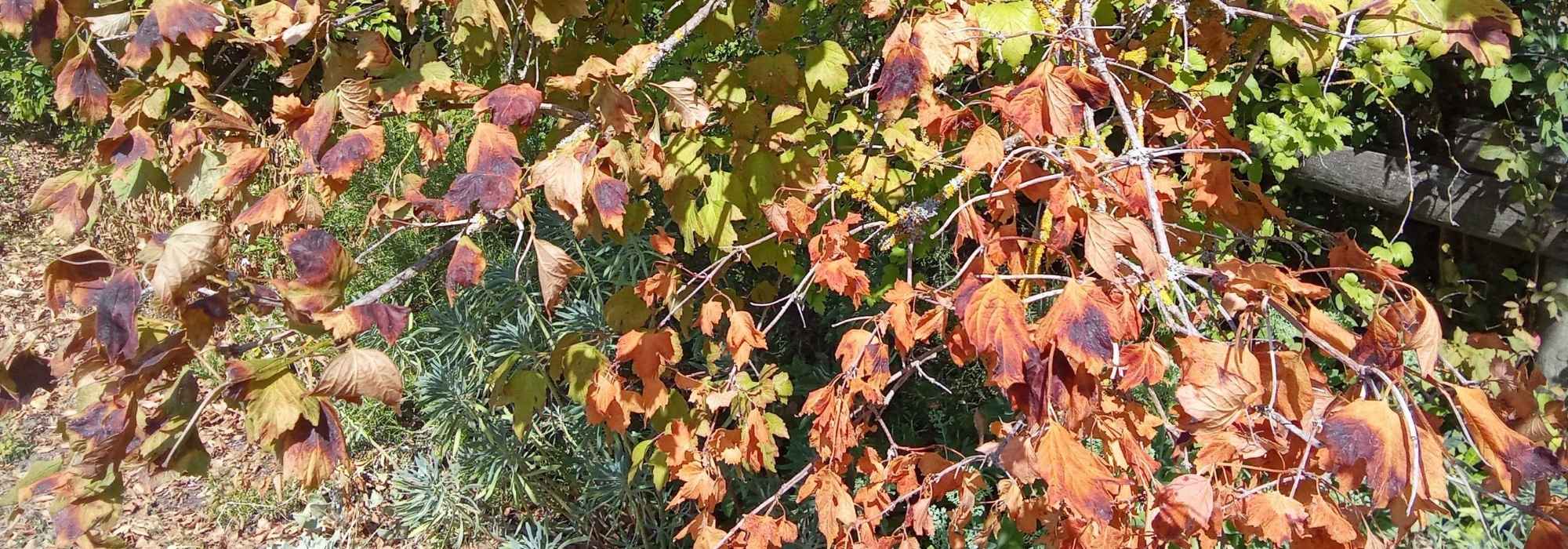
One, two, three, four… five heatwaves! This summer will be etched in our memories and in the annals. Our trees and shrubs paid the price and suffered terribly. The most vulnerable had their branches literally cook on the spot, leaving a sight of burnt leaves and branches, gingerbread-coloured. This raises the question of whether to prune these branches, and if so when and how?

Effects of heatwaves on trees and shrubs
Some of our shrubs and trees were hit head-on by the heatwave, notably after the hairdryer effect. The result is painful to see on the most vulnerable: those recently planted, some already weakened, and species more sensitive to drought.
Curiously, sometimes it’s a single branch and its offshoots that have taken a battering from the desiccating effects of the heatwave, other times a large part of the tree or shrub has dried out, leaving either browned leaves hanging limply or a bare framework across the branches.
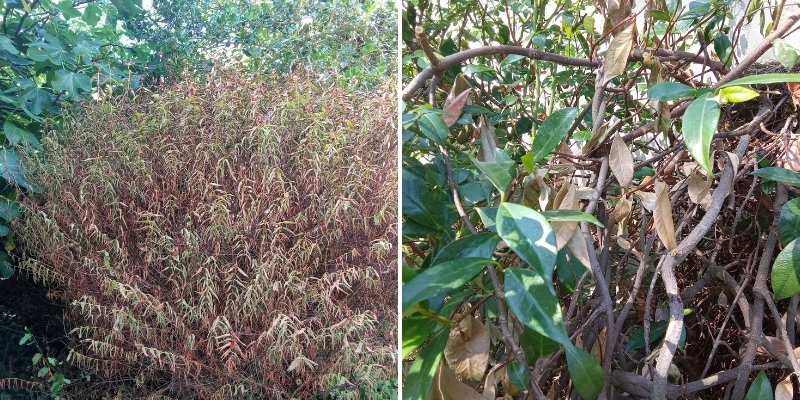
On the left, a largely dried-out St John’s wort; on the right, a star jasmine with some apparently dead branches
While woody plants adopt survival strategies during such intense weather—often shedding part or all of their foliage to reduce evapotranspiration and thus water loss—we must avoid delivering the final blow by overdoing things. Some shrubs and trees demonstrate resilience by producing buds a short time after a heatwave, completely out of season, as an ultimate mechanism of regeneration.
Most of the time you’ll need to be patient and accept having unattractive shrubs and trees in the garden before reaching for a saw or loppers…
→ Olivier looks back at the phenomenon of leaf loss after a heatwave in Drought: my tree is losing its leaves, what’s happening?
Check vigour and wait before pruning
Pruning is always stressful for woody plants. That’s why pruning is carried out at a suitable time for each plant to disturb it as little as possible (usually late winter before sap rise, or after main flowering in spring).
Drastic pruning of all dead branches, or even part of the plant, immediately after a heatwave in mid-summer is the final straw, traumatic while plants are barely recovering from severe water stress.
Leave this bare framework, even if it looks unsightly, because :
- Pruning means wound healing for the plant, and healing is extra effort we ask of it (it must produce scar tissue without water or nutrients available, because it is weakened) ;
- The little green foliage that remains still provides some shade, useful in case of another heatwave ;
- Poorly executed pruning is an entry point for various pests or diseases, which would further weaken this fragile structure.
An easy test lets you tell whether a shrub is dead or not: simply scrape the wood of a branch lightly with a fingernail. You can prune everything that is brown and no longer green. Branches should remain flexible, not brittle. I explain this in more detail in How to tell if a plant survived a heatwave? Olivier shows you in this video to help you understand the action to take.
What to do while drought periods last
You can take small-scale action to help plants that are still alive recover as soon as you observe, helplessly, that a plant has been scorched in place :
- Water deeply at base, early morning, to restore maximum root hydration. Watering heavily equates to 10 to 20 litres per m² for shrubs, and up to 50 litres for an adult tree, applied in a single session to encourage deep rooting. Create a basin around the shrub if it does not have one to make the most of this water;
- Mulch more, but only once watering is completed: root system and stump will be better protected and will stay cooler.
Then, once heatwave episode(s) have passed (although this is now unpredictable, but normally around September), you can prune, taking some precautions, in stages, cutting back along the branch until live, green wood is reached. Ingrid explains the process in detail in How to prune dried‑out parts of a plant after heat stress?, and when autumn weather permits.
Also read our more general advice in our article: To prune or not to prune, our tips to avoid mistakes.
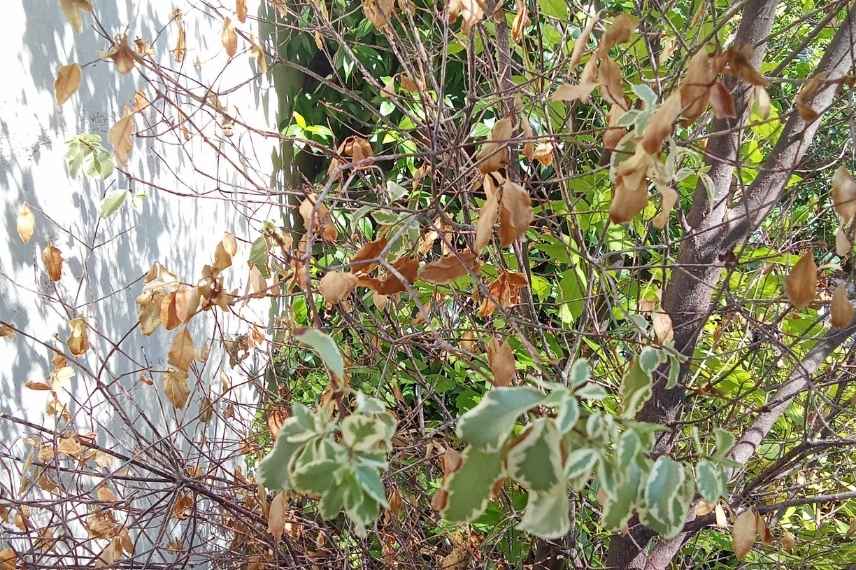
Pittosporum in poor condition, but be patient as it usually reshoots well in autumn (photo Gwenaëlle Authier)
Spent flowerheads and burnt evergreen plants: prune or not?
In case of flowers left to dry in place, it’s a little different. There are pros and cons, because, as we know, inflorescences left in situ have many advantages (notably protecting future flower buds and providing winter refuge for microfauna). But this year hydrangeas in particular were among those worst hit by repeated heatwaves. Walking past them with their brown heads, looking lifeless, is disheartening. The garden gets us down… One can decide to prune on a slant just below the inflorescences, and indeed, the bark test still shows the stem to be alive, flexible and green under light scraping superficial. Other browned inflorescences on some shrubs, such as buddleias that have likewise been scorched by the heatwaves, can also be pruned (even if they will flower less next year).
Evergreen shrubs and conifers that are completely scorched are often unlikely to recover: little chance of seeing them regrow unless they are cut back almost completely in autumn. This is possible on those with growth described as basiscopic or mesotonous (Abelia, oleander, Pittosporum, yew, juniper). They can regrow from the stump or by producing new branches from the plant’s centre (this is also true for deciduous ones such as hazel, for example). For the others, never perform drastic pruning!
Final tip: make the most of autumn to move some shrubs
Scorching summers will not only recur but grow more intense. Summer 2026 is therefore an opportunity, so to speak, to reconsider some planting areas in our gardens. Young shrubs that have been too severely tested would benefit from being transplanted in autumn, from late September until mid-November, to spare them the same stress each year and growth held back by an overly exposed location.
Virginie revisits this issue in: Plants scorched by drought: should they be replaced?
- Subscribe!
- Contents
This form is protected by reCAPTCHA - the Google Privacy Policy and Terms of Service apply.

































Comments