Silphium perfoliatum - Cup plant
Silphium perfoliatum - Cup plant
View more pictures
Hide images
Renée O.
Silphium perfoliatum - Cup plant
Renée O. • 63 FR
Silphium perfoliatum - Cup plant
Silphium perfoliatum
Cup plant, Cup rosin weed, Indian cup
This spring we have a small leafy start, in the hope that it will grow.
Nath44, 29/04/2025
Back-to-school special offer!
Get €10 off for every €50 you spend! And get up to €40 off on a single order.
How does it work?
1. Shop your favourites
Add your favourite plants to your basket. For every €50 you spend (excluding delivery charges, store credit and the plastic-free option), you’ll receive a €10 voucher.
€50 spent = €10 voucher
€100 spent = €20 voucher
€150 spent = €30 voucher
€200 spent = €40 voucher
2. Place your order
Once your basket reaches one of the spending thresholds, place your order. You can even choose your delivery date!
3. Receive your voucher
As soon as your order has been shipped, you’ll receive an email containing your personal voucher code and its value.
4. Use it on your next order
Your voucher is valid for 90 days from the date you receive it. It can be used once only, on a new order worth at least the value of the voucher, excluding delivery charges.
Please note: Vouchers can be combined with other offers, but cannot be split or refunded.
Home or relay delivery (depending on size and destination)
Important: You may be charged customs duties by your country’s customs authorities upon delivery.
Schedule delivery date,
and select date in basket
This plant carries a 12 months recovery warranty
More information
We guarantee the quality of our plants for a full growing cycle, and will replace at our expense any plant that fails to recover under normal climatic and planting conditions.


Would this plant suit my garden?
Set up your Plantfit profile →
Description
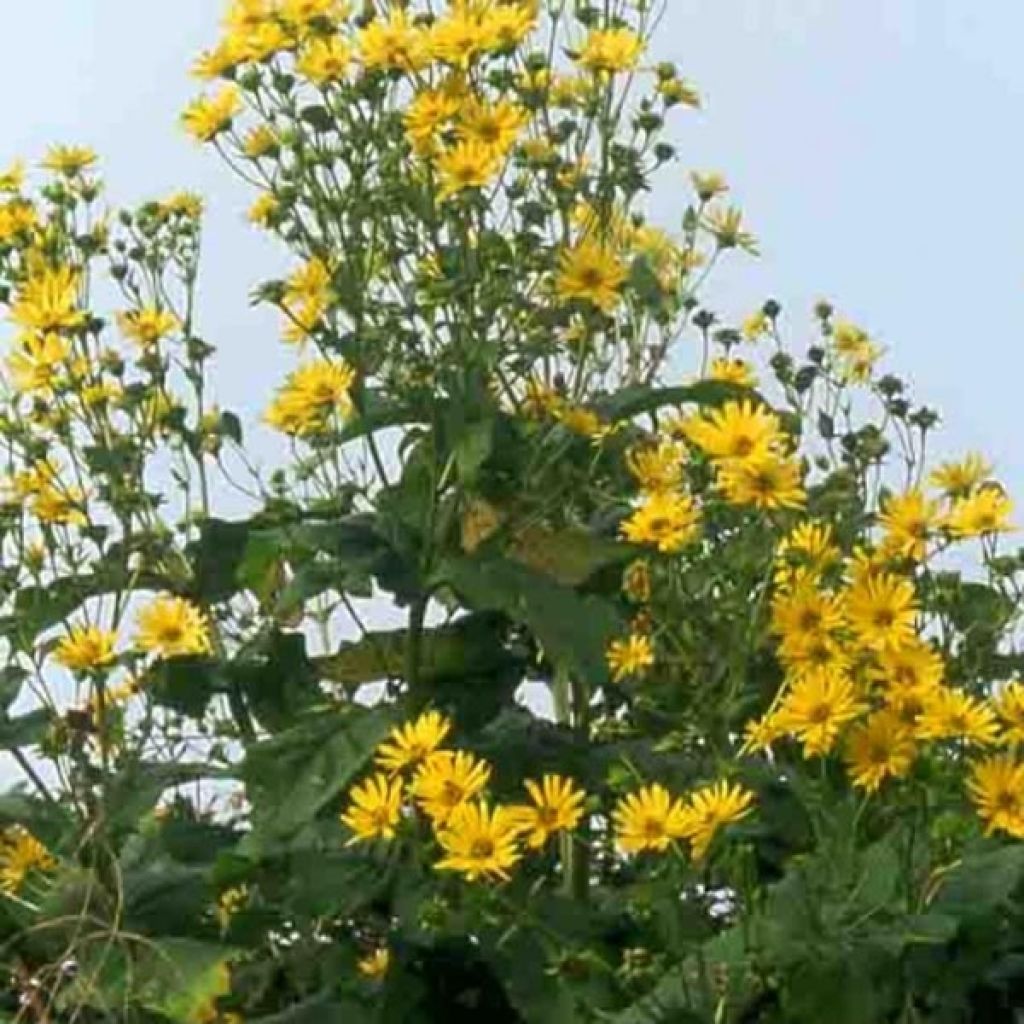
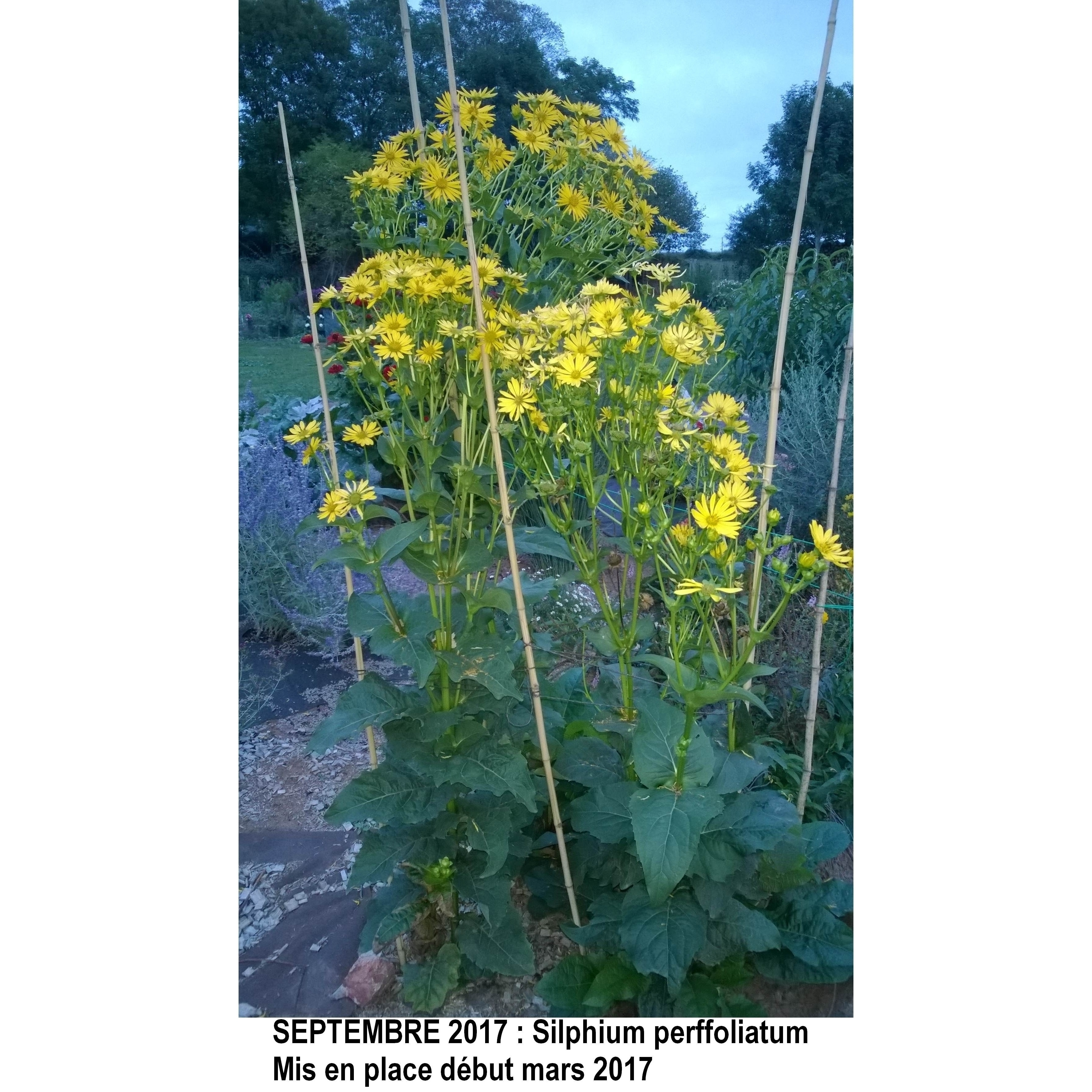
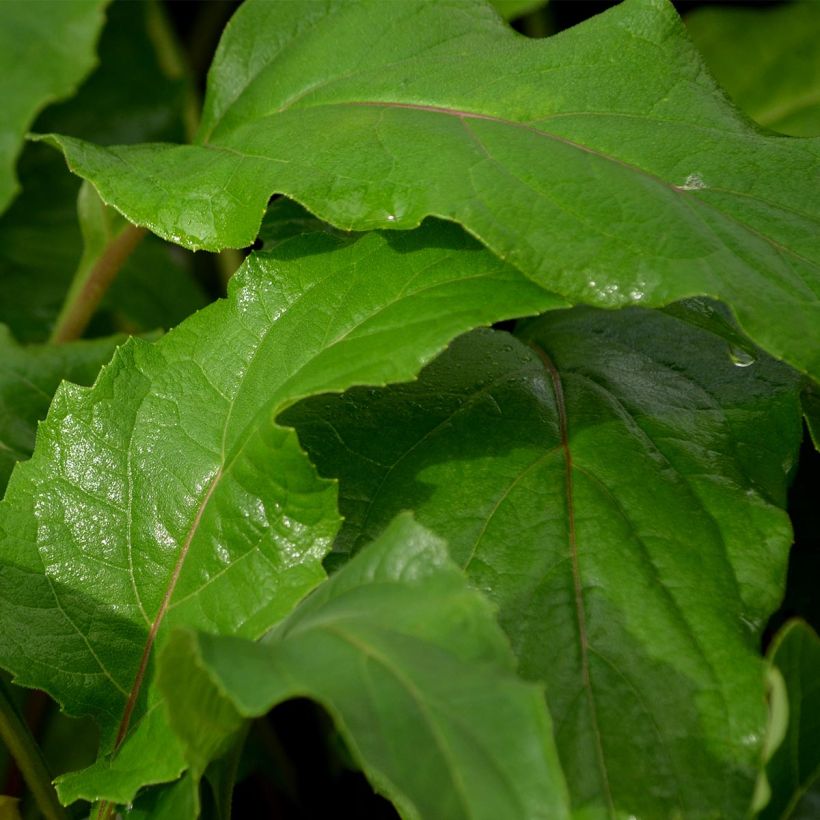
Silphium perfoliatum, the cup plant, is a giant perennial with sturdy stems that bear numerous bright yellow daisy-like flowers in high summer. Its ample foliage has a remarkable feature: the leaves join around the stems, forming small cups capable of holding rainwater. This very hardy, long-lived plant is visited by pollinating insects and is at home in a naturalistic meadow, on a bank, or in a spot in the garden where its roots can spread at will.
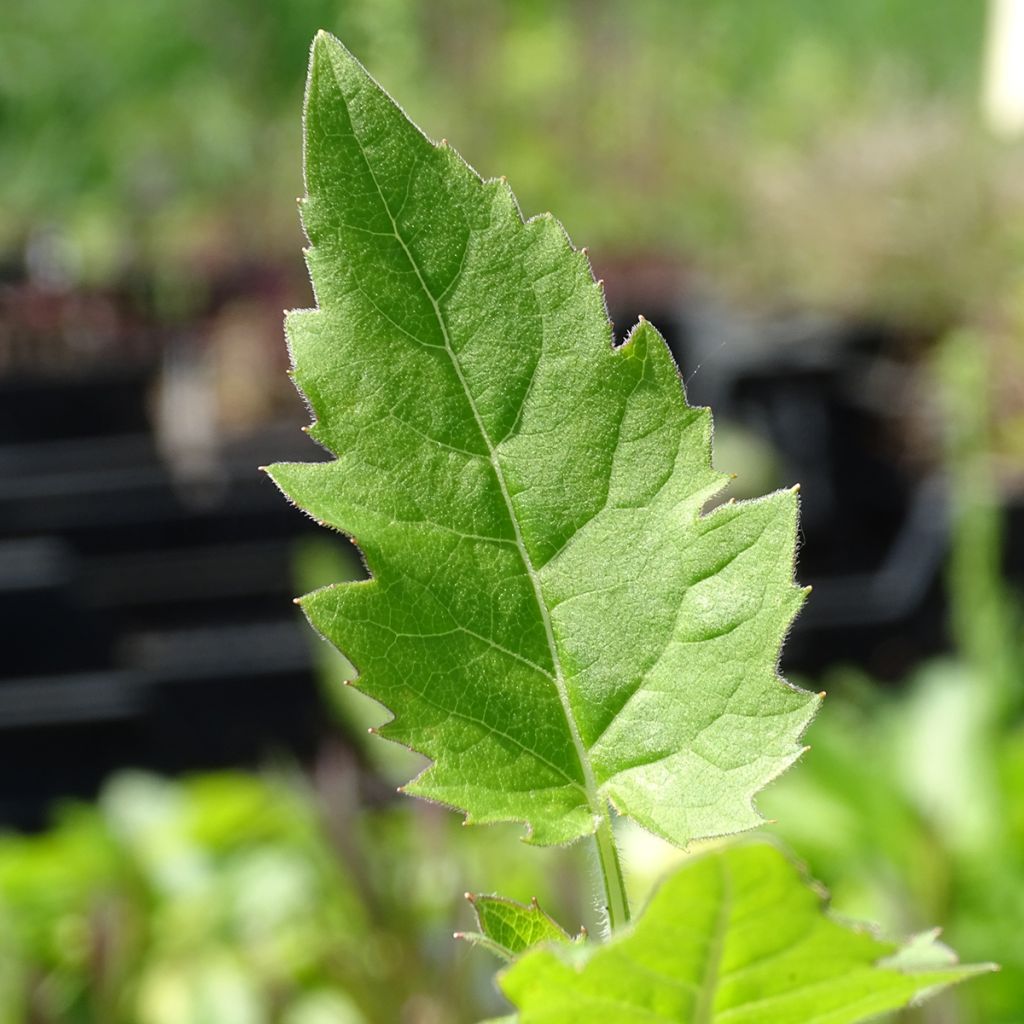
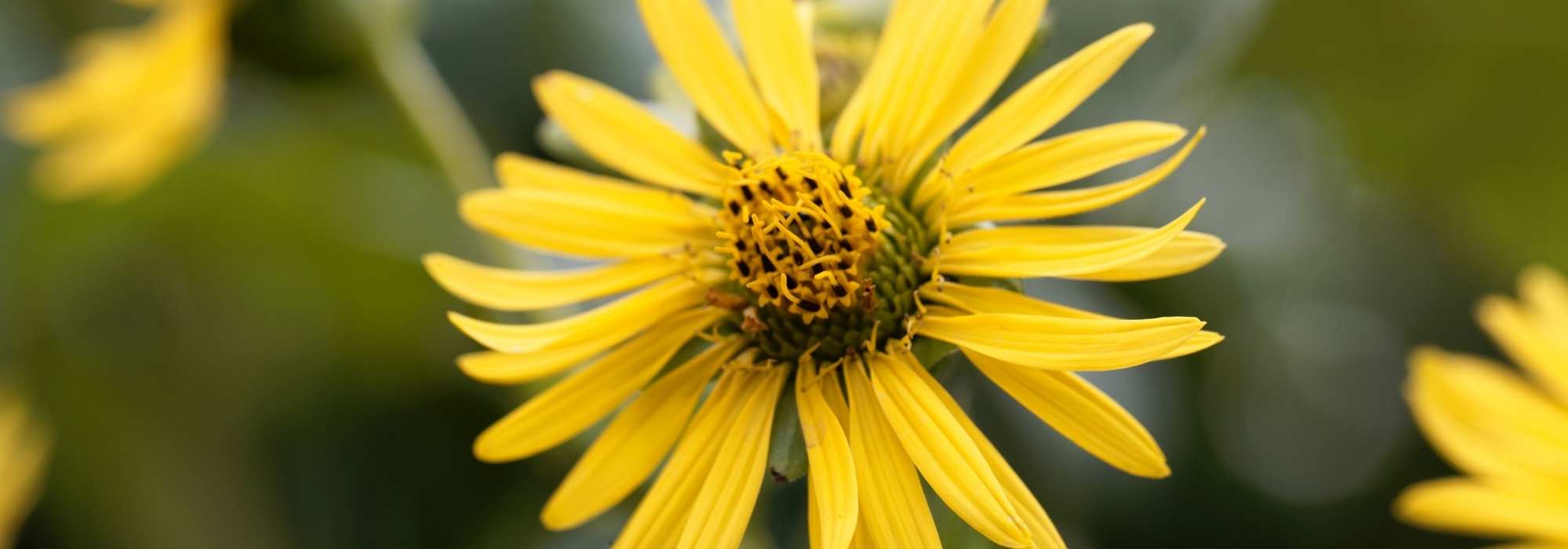
The cup plant belongs to the Asteraceae family, like sunflowers, rudbeckias and asters. It is a herbaceous deciduous perennial: its stems die back in autumn, and new shoots emerge from the rhizome in spring. This wild plant is native to south-eastern Canada and much of the central and eastern United States. It grows in damp meadows, meadows near rivers, ditches, damp woodland edges and around lakes. Its rhizome develops deep roots as well as superficial rhizomes that spread gradually. A mature plant reaches 2 to 2.50m in height with a spread of 80cm to 1m, but several plants can eventually form a much larger colony. The thick, upright stems have four well-marked angles. They are sparingly branched in their lower part, then divide at the top to bear the flowers. The medium green leaves are arranged in pairs. Oval to broadly lanceolate, coarsely toothed and rough to the touch, they measure 15 to 25cm in length. The base of each pair of leaves surrounds the stem: the leaf appears to be pierced by it, which explains the name perfoliatum. The small cavity they form collects dew and rainwater; birds come to drink there, and ripe seeds are loved by goldfinches. Flowering extends from July to September; the terminal branches bear golden-yellow heads 7 to 9cm in diameter. They are composed of numerous ligulate florets, resembling petals, arranged around a yellow heart. Bees, bumblebees, butterflies and hoverflies visit them for their pollen and nectar. The plant tolerates temperatures below –25 °C. The stems are heavy when in flower and can be laid flat by strong winds or a storm. The cup plant self-seeds readily on bare ground; unwanted young plants should be removed early, as their root system quickly becomes difficult to extract.
It is the perfect type of plant to accompany large grasses such as Miscanthus and Panicum in an open, sunny garden. This cup plant can also be paired with other tall plants for moist ground such as Vernonia crinita 'Mammuth' and Persicaria polymorpha, a robust knotweed bearing large white inflorescences in summer. Its cut stems can be used in large country-style flower arrangements, with large daisies, for example. Cut them when the first flowers are open, then remove the lower leaves, which are too bulky and rough.
```
Silphium perfoliatum - Cup plant in pictures
Flowering
Foliage
Plant habit
Botanical data
Silphium
perfoliatum
Asteraceae
Cup plant, Cup rosin weed, Indian cup
Resinocaulon perfoliatum, Silphium conjunctum, Silphium petiolatum, Silphium scabrum
North America
Planting and care
Plant Silphium perfoliatum from February to April or from September to November. Spring planting is preferable in cold regions where the soil remains waterlogged in winter. Choose full sun and deep, fertile, moist to wet soil. It tolerates clay and chalk, but water must not stagnate for long periods around the crown during winter. Loosen the soil deeply and incorporate well-rotted compost. Water regularly during the first two summers, then during prolonged dry spells. A mulch limits evaporation. In windy situations, discreet staking prevents the flowering stems from lodging during storms. Rhizomes that spread beyond the allotted space can be sliced off with a spade in spring. Division is possible on the peripheral parts of the crown, but an older plant is difficult to transplant due to its deep root system.
Planting period
Intended location
Care
Planting & care advice
-
-
-
-
-

-
-
-
-
, onOrder confirmed
Reply from on Promesse de fleurs
Recently viewed products
Haven't found what you were looking for?
Hardiness is the lowest winter temperature a plant can endure without suffering serious damage or even dying. However, hardiness is affected by location (a sheltered area, such as a patio), protection (winter cover) and soil type (hardiness is improved by well-drained soil).

The flowering period indicated on our website applies to countries and regions located in USDA zone 8 (France, the United Kingdom, Ireland, the Netherlands, etc.)
It will vary according to where you live:- In zones 9 to 10 (Italy, Spain, Greece, etc.), flowering will occur about 2 to 4 weeks earlier.
- In zones 6 to 7 (Germany, Poland, Slovenia, and lower mountainous regions), flowering will be delayed by 2 to 3 weeks.
- In zone 5 (Central Europe, Scandinavia), blooming will be delayed by 3 to 5 weeks.
In temperate climates, pruning of spring-flowering shrubs (forsythia, spireas, etc.) should be done just after flowering.
Pruning of summer-flowering shrubs (Indian Lilac, Perovskia, etc.) can be done in winter or spring.
In cold regions as well as with frost-sensitive plants, avoid pruning too early when severe frosts may still occur.
The planting period indicated on our website applies to countries and regions located in USDA zone 8 (France, United Kingdom, Ireland, Netherlands).
It will vary according to where you live:
- In Mediterranean zones (Marseille, Madrid, Milan, etc.), autumn and winter are the best planting periods.
- In continental zones (Strasbourg, Munich, Vienna, etc.), delay planting by 2 to 3 weeks in spring and bring it forward by 2 to 4 weeks in autumn.
- In mountainous regions (the Alps, Pyrenees, Carpathians, etc.), it is best to plant in late spring (May-June) or late summer (August-September).
The harvesting period indicated on our website applies to countries and regions in USDA zone 8 (France, England, Ireland, the Netherlands).
In colder areas (Scandinavia, Poland, Austria...) fruit and vegetable harvests are likely to be delayed by 3-4 weeks.
In warmer areas (Italy, Spain, Greece, etc.), harvesting will probably take place earlier, depending on weather conditions.
The sowing periods indicated on our website apply to countries and regions within USDA Zone 8 (France, UK, Ireland, Netherlands).
In colder areas (Scandinavia, Poland, Austria...), delay any outdoor sowing by 3-4 weeks, or sow under glass.
In warmer climes (Italy, Spain, Greece, etc.), bring outdoor sowing forward by a few weeks.
Shipping country and language
Your country of residence may be:
Your country of residence is:
For a better user experience on our website, you can select:
Your shipping country:
-
 Austria
-
 Belgium
-
 Bosnia & Herzegovina
-
 Bulgaria
-
 Croatia
-
 Cyprus
-
 Czechia
-
 Denmark
-
 Estonia
-
 Finland
-
 France
-
 Germany
-
 Greece
-
 Hungary
-
 Iceland
-
 Ireland
-
 Italy
Italy
-
 Latvia
-
 Liechtenstein
-
 Lithuania
-
 Luxembourg
-
 Malta
Malta
-
 Netherlands
-
 Poland
-
 Portugal
-
 Romania
-
 Serbia
-
 Slovakia
-
 Slovenia
-
 Spain
Spain
-
 Sweden
-
 Switzerland
Language:
-
French
-
 English
-
Spanish
-
Italian
-
German
-
Portuguese
-
Dutch
-
Finnish
My Account
Hello
My wish lists
My cart
Log in / Register
Existing customer?
This form is protected by reCAPTCHA - the Google Privacy Policy and Terms of Service apply.
New customer?
Create an account to track your orders, access our customer service and, if you wish, make the most of our upcoming offers.