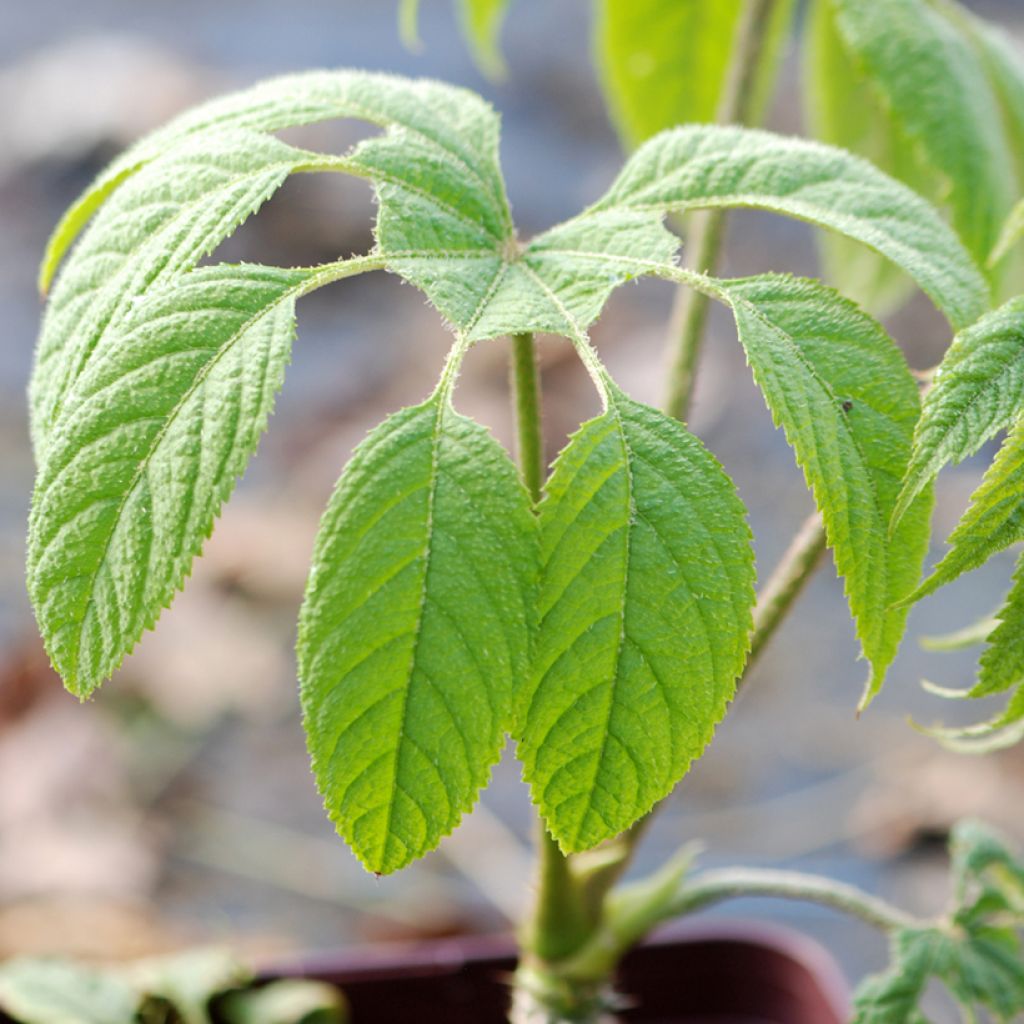
Brassaiopsis mitis Artic Jungle - Philippine umbrella plant
Brassaiopsis mitis Artic Jungle - Philippine umbrella plant
Brassaiopsis mitis 'CHB & CM08SIK87' Artic Jungle
Philippine umbrella plant, false aralia
Back-to-school special offer!
Get €10 off for every €50 you spend! And get up to €40 off on a single order.
How does it work?
1. Shop your favourites
Add your favourite plants to your basket. For every €50 you spend (excluding delivery charges, store credit and the plastic-free option), you’ll receive a €10 voucher.
€50 spent = €10 voucher
€100 spent = €20 voucher
€150 spent = €30 voucher
€200 spent = €40 voucher
2. Place your order
Once your basket reaches one of the spending thresholds, place your order. You can even choose your delivery date!
3. Receive your voucher
As soon as your order has been shipped, you’ll receive an email containing your personal voucher code and its value.
4. Use it on your next order
Your voucher is valid for 90 days from the date you receive it. It can be used once only, on a new order worth at least the value of the voucher, excluding delivery charges.
Please note: Vouchers can be combined with other offers, but cannot be split or refunded.
Why not try an alternative variety in stock?
View all →
Available in 3 sizes

Available in 2 sizes
Available in 3 sizes
Available in 3 sizes
This plant carries a 24 months recovery warranty
More information
We guarantee the quality of our plants for a full growing cycle, and will replace at our expense any plant that fails to recover under normal climatic and planting conditions.
Would this plant suit my garden?
Set up your Plantfit profile →
Description
Brassaiopsis mitis 'Arctic Jungle', also called the Cut-leaved False Aralia, is a tropical shrub prized for its immense palmate leaves, reminiscent of those of a giant fig or an architectural aralia. It forms an erect, even slightly slender silhouette, punctuated by deeply cut leaves that give it a unique sculptural presence. Ideal for exotic-themed gardens or shady to partially shaded spots, it can be grown in the ground in mild regions or in a large pot to be protected in winter elsewhere. This original plant, with an almost prehistoric appearance, requires a humus-rich, moist but well-drained soil, sheltered from dry winds and prolonged frost.
Brassaiopsis mitis, a species of the family Araliaceae, was described in 1879 and has several synonyms, such as Euaraliopsis mitis and Pseudobrassaiopsis mitis. Native to the moist, shaded forests of the Himalayan foothills: Nepal, Sikkim, Bhutan and northern India, generally between 1 830 and 2 350m altitude, this species thrives in a cool, misty environment. The horticultural form available in Europe, often called Arctic Jungle, corresponds to the selection 'CHB&CM08SIK87' collected in 2008 in Sikkim by Christian Monnet and Charles Boulanger, reported as hardy to −18 °C in the Jardin Jungle in Normandy. This form is distinguished by its greyish juvenile leaves that become broad and cut. It has an erect habit with one or several light grey trunks covered in short prickles or thorns, supporting a dense crown of palmate leaves. Growth is slow to moderate, requiring several years to reach its adult size. In the ground, it can reach between 4 and 7 m in height (usually 3 to 5 m) with a spread of 2.5 to 4 m. The foliage is evergreen (semi-evergreen in cold climates), composed of palmatilobate leaves with 7–11 deep lobes, reaching 50 to 80 cm in diameter, dark green above and lighter underneath, hairy on the underside. The petiole can measure up to 60 cm. The insignificant flowers appear in late summer, around August-September, in the form of panicles of small cream or greenish flowers, followed by globose blue-black fruits 5 to 6 mm in diameter. The stems become woody with age and retain their prickly texture, forming a clean vertical structure. The root system consists of a relatively limited taproot, associated with a superficial network of roots, not producing any suckering offshoots. The cultivar CHB&CM08SIK87, introduced in France, is, according to the experience of the Jardin Jungle in Normandy, capable of surviving cold down to −18 °C, although most of the leaves drop as early as −2 °C and the stems freeze at around −8 to −12 °C.
In a shade or partial shade garden, Brassaiopsis mitis ‘Arctic Jungle’ raises its cut leaves like an ancient plant motif, both rigid and flexible, almost unreal. This plant imposes a sculptural rhythm that can be counterbalanced with more diffuse foliage, such as that of Aralia cordata ‘Sun King’, or the coppery highlights of Fatsia japonica ‘Spider’s Web’. In the understorey, the textured foliage of Polystichum setiferum or the dark depth of Ophiopogon planiscapus ‘Nigrescens’ add relief and depth. In a pot on a shaded terrace, it becomes a showpiece in a plain container. Placed like this, the plant evokes a Japanese-style shade garden, both ordered and mysterious.
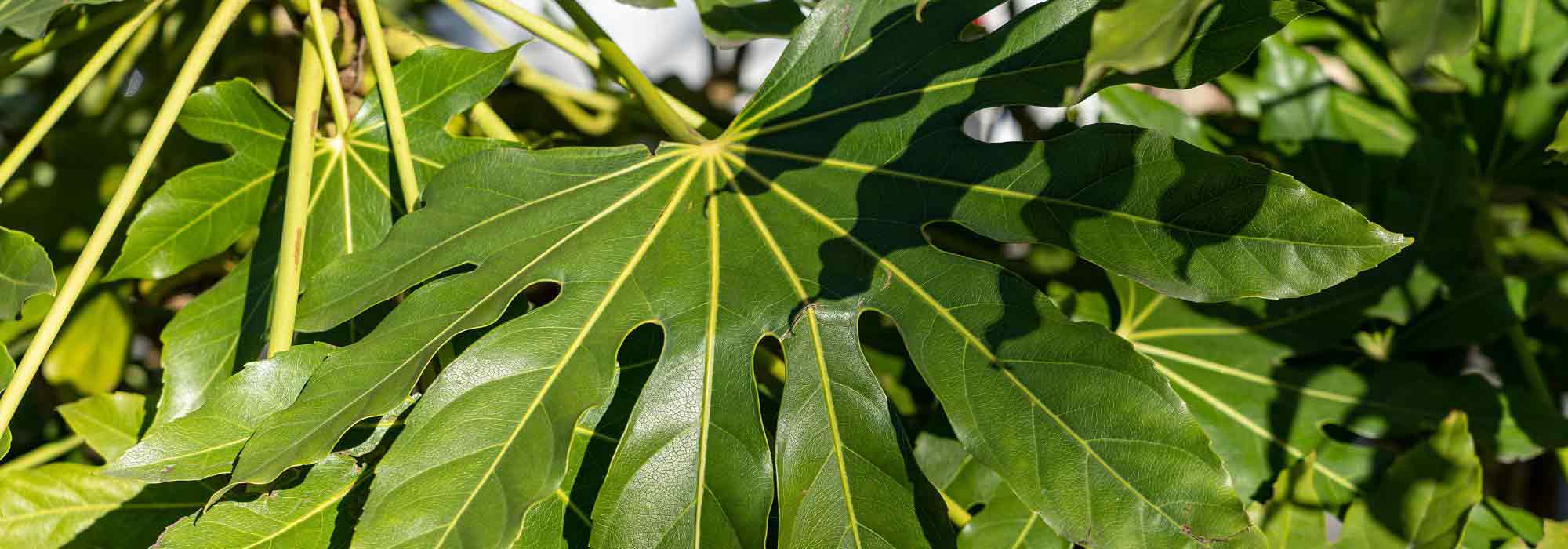
Plant habit
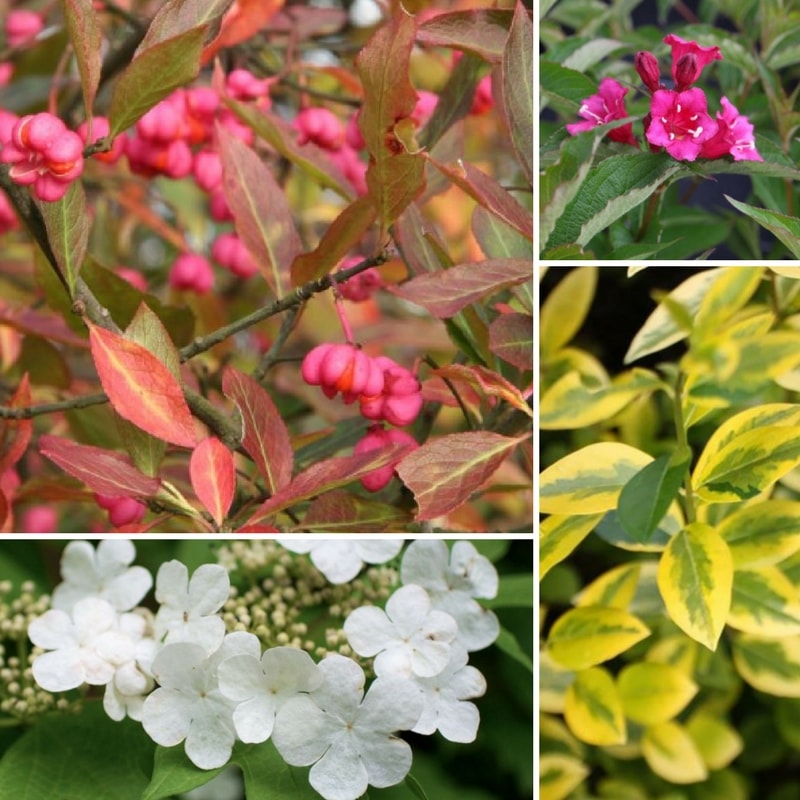
Flowering
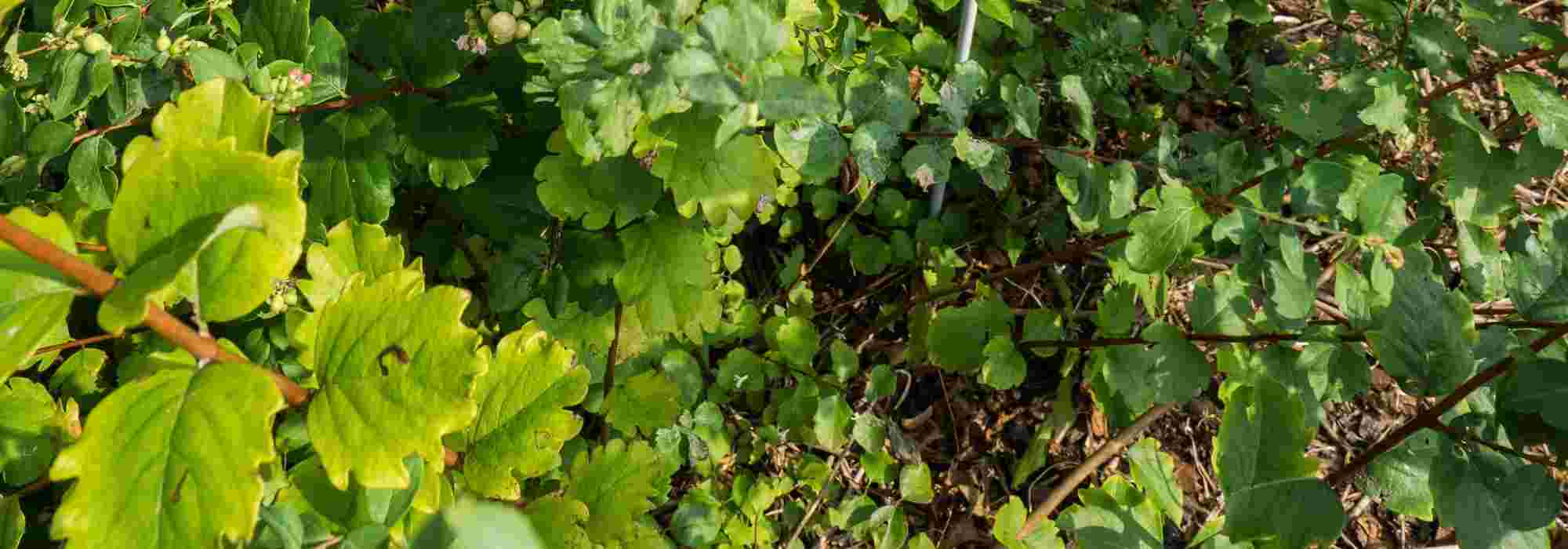
Foliage
Botanical data
Brassaiopsis
mitis
'CHB & CM08SIK87' Artic Jungle
Araliaceae
Philippine umbrella plant, false aralia
Euaraliopsis mitis, Pseudobrassaiopsis mitis
Cultivar or hybrid
Planting and care
Brassaiopsis mitis ‘Arctic Jungle’ enjoys a position in partial shade or full shade, sheltered from cold, drying winds. It prefers humus-bearing, moist, well-drained soil that is slightly acidic to neutral, regularly enriched with well-rotted compost or leaf mould. Although it is relatively cold-hardy, its leaves freeze at –2 °C; winter protection is recommended (mulching at the base, fleece around the trunk, or growing in a container brought indoors for the winter).
When grown in a pot, choose a deep, wide container with good drainage (a layer of gravel or clay balls at the bottom) and water regularly to keep the soil consistently moist, but not waterlogged. In summer, it tolerates heat as long as the soil remains moist; in winter, avoid waterlogged conditions. As growth is slow, apply fertiliser sparingly, only in spring and summer. Pruning is unnecessary, except to remove damaged leaves or balance the plant’s shape.
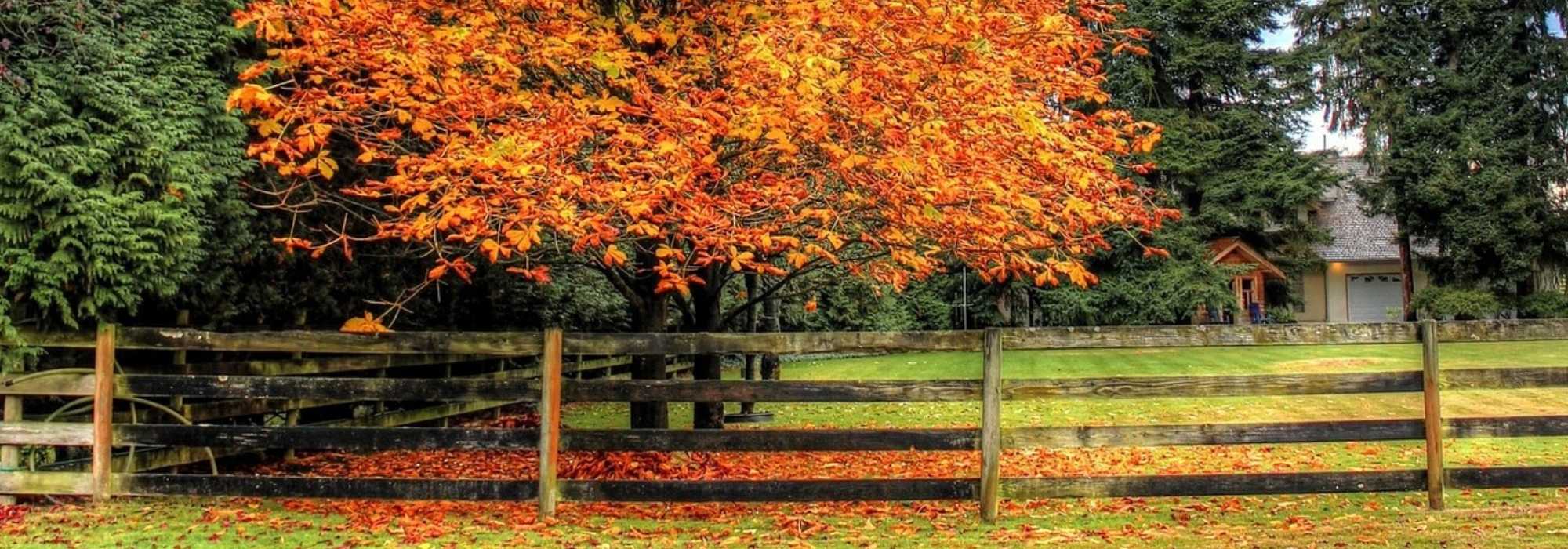
Planting period
Intended location
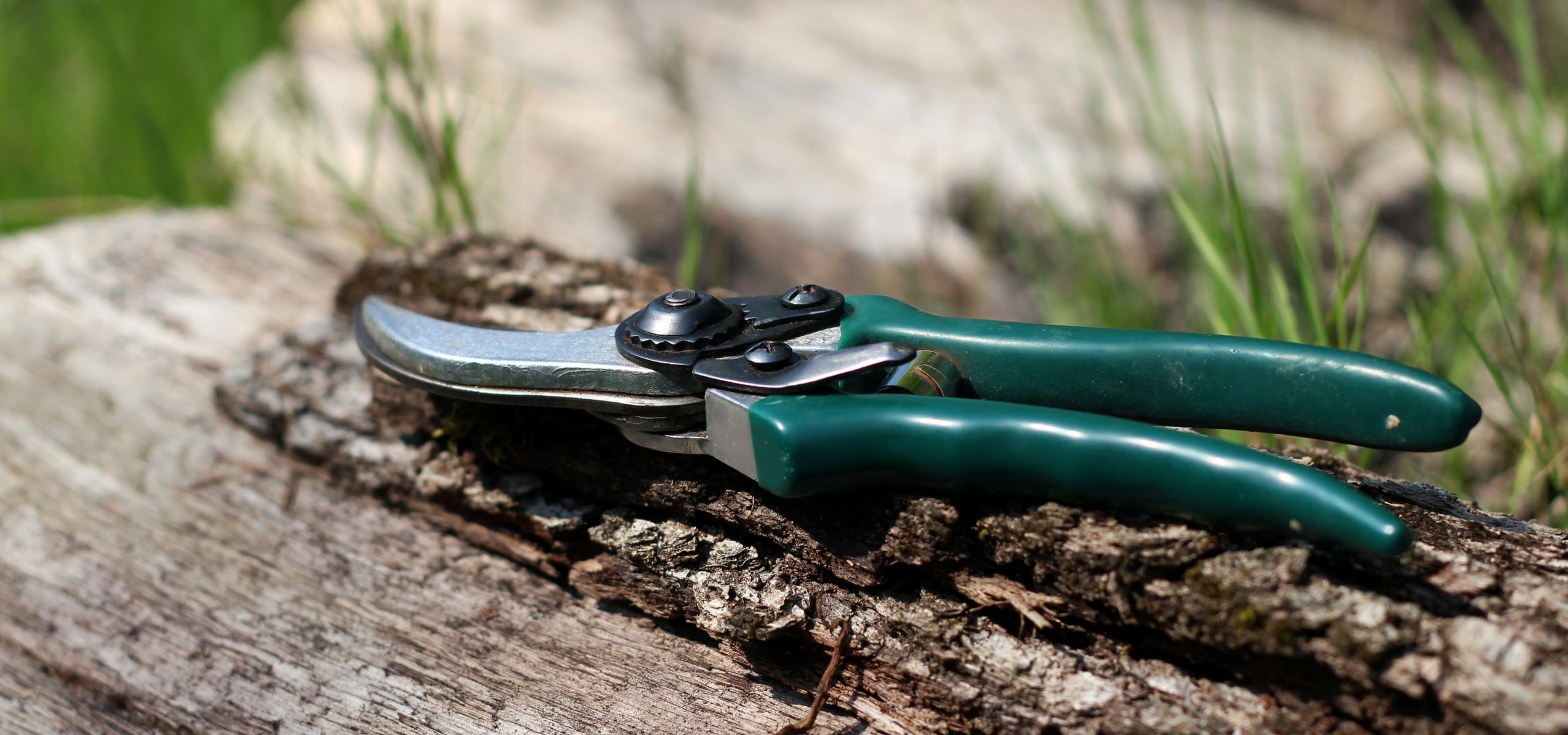
Care
Planting & care advice
-

-
-
-
-
-
-

-
This item has not been reviewed yet - be the first to leave a review about it.
Recently viewed products
Haven't found what you were looking for?
Hardiness is the lowest winter temperature a plant can endure without suffering serious damage or even dying. However, hardiness is affected by location (a sheltered area, such as a patio), protection (winter cover) and soil type (hardiness is improved by well-drained soil).

The flowering period indicated on our website applies to countries and regions located in USDA zone 8 (France, the United Kingdom, Ireland, the Netherlands, etc.)
It will vary according to where you live:- In zones 9 to 10 (Italy, Spain, Greece, etc.), flowering will occur about 2 to 4 weeks earlier.
- In zones 6 to 7 (Germany, Poland, Slovenia, and lower mountainous regions), flowering will be delayed by 2 to 3 weeks.
- In zone 5 (Central Europe, Scandinavia), blooming will be delayed by 3 to 5 weeks.
In temperate climates, pruning of spring-flowering shrubs (forsythia, spireas, etc.) should be done just after flowering.
Pruning of summer-flowering shrubs (Indian Lilac, Perovskia, etc.) can be done in winter or spring.
In cold regions as well as with frost-sensitive plants, avoid pruning too early when severe frosts may still occur.
The planting period indicated on our website applies to countries and regions located in USDA zone 8 (France, United Kingdom, Ireland, Netherlands).
It will vary according to where you live:
- In Mediterranean zones (Marseille, Madrid, Milan, etc.), autumn and winter are the best planting periods.
- In continental zones (Strasbourg, Munich, Vienna, etc.), delay planting by 2 to 3 weeks in spring and bring it forward by 2 to 4 weeks in autumn.
- In mountainous regions (the Alps, Pyrenees, Carpathians, etc.), it is best to plant in late spring (May-June) or late summer (August-September).
The harvesting period indicated on our website applies to countries and regions in USDA zone 8 (France, England, Ireland, the Netherlands).
In colder areas (Scandinavia, Poland, Austria...) fruit and vegetable harvests are likely to be delayed by 3-4 weeks.
In warmer areas (Italy, Spain, Greece, etc.), harvesting will probably take place earlier, depending on weather conditions.
The sowing periods indicated on our website apply to countries and regions within USDA Zone 8 (France, UK, Ireland, Netherlands).
In colder areas (Scandinavia, Poland, Austria...), delay any outdoor sowing by 3-4 weeks, or sow under glass.
In warmer climes (Italy, Spain, Greece, etc.), bring outdoor sowing forward by a few weeks.
Shipping country and language
Your country of residence may be:
Your country of residence is:
For a better user experience on our website, you can select:
Your shipping country:
-
 Austria
-
 Belgium
-
 Bosnia & Herzegovina
-
 Bulgaria
-
 Croatia
-
 Cyprus
-
 Czechia
-
 Denmark
-
 Estonia
-
 Finland
-
 France
-
 Germany
-
 Greece
-
 Hungary
-
 Iceland
-
 Ireland
-
 Italy
Italy
-
 Latvia
-
 Liechtenstein
-
 Lithuania
-
 Luxembourg
-
 Malta
Malta
-
 Netherlands
-
 Poland
-
 Portugal
-
 Romania
-
 Serbia
-
 Slovakia
-
 Slovenia
-
 Spain
Spain
-
 Sweden
-
 Switzerland
Language:
-
French
-
 English
-
Spanish
-
Italian
-
German
-
Portuguese
-
Dutch
-
Finnish
My Account
Hello
My wish lists
My cart
Log in / Register
Existing customer?
This form is protected by reCAPTCHA - the Google Privacy Policy and Terms of Service apply.
New customer?
Create an account to track your orders, access our customer service and, if you wish, make the most of our upcoming offers.