Calanthe sieboldii - Garden orchid
Calanthe sieboldii - Garden orchid
Calanthe sieboldii
Garden orchid
Good recovery so far
michele bastide, 17/06/2016
Back-to-school special offer!
Get €10 off for every €50 you spend! And get up to €40 off on a single order.
How does it work?
1. Shop your favourites
Add your favourite plants to your basket. For every €50 you spend (excluding delivery charges, store credit and the plastic-free option), you’ll receive a €10 voucher.
€50 spent = €10 voucher
€100 spent = €20 voucher
€150 spent = €30 voucher
€200 spent = €40 voucher
2. Place your order
Once your basket reaches one of the spending thresholds, place your order. You can even choose your delivery date!
3. Receive your voucher
As soon as your order has been shipped, you’ll receive an email containing your personal voucher code and its value.
4. Use it on your next order
Your voucher is valid for 90 days from the date you receive it. It can be used once only, on a new order worth at least the value of the voucher, excluding delivery charges.
Please note: Vouchers can be combined with other offers, but cannot be split or refunded.
Home or relay delivery (depending on size and destination)
Important: You may be charged customs duties by your country’s customs authorities upon delivery.
Schedule delivery date,
and select date in basket
This plant carries a 12 months recovery warranty
More information
We guarantee the quality of our plants for a full growing cycle, and will replace at our expense any plant that fails to recover under normal climatic and planting conditions.

Would this plant suit my garden?
Set up your Plantfit profile →
Description
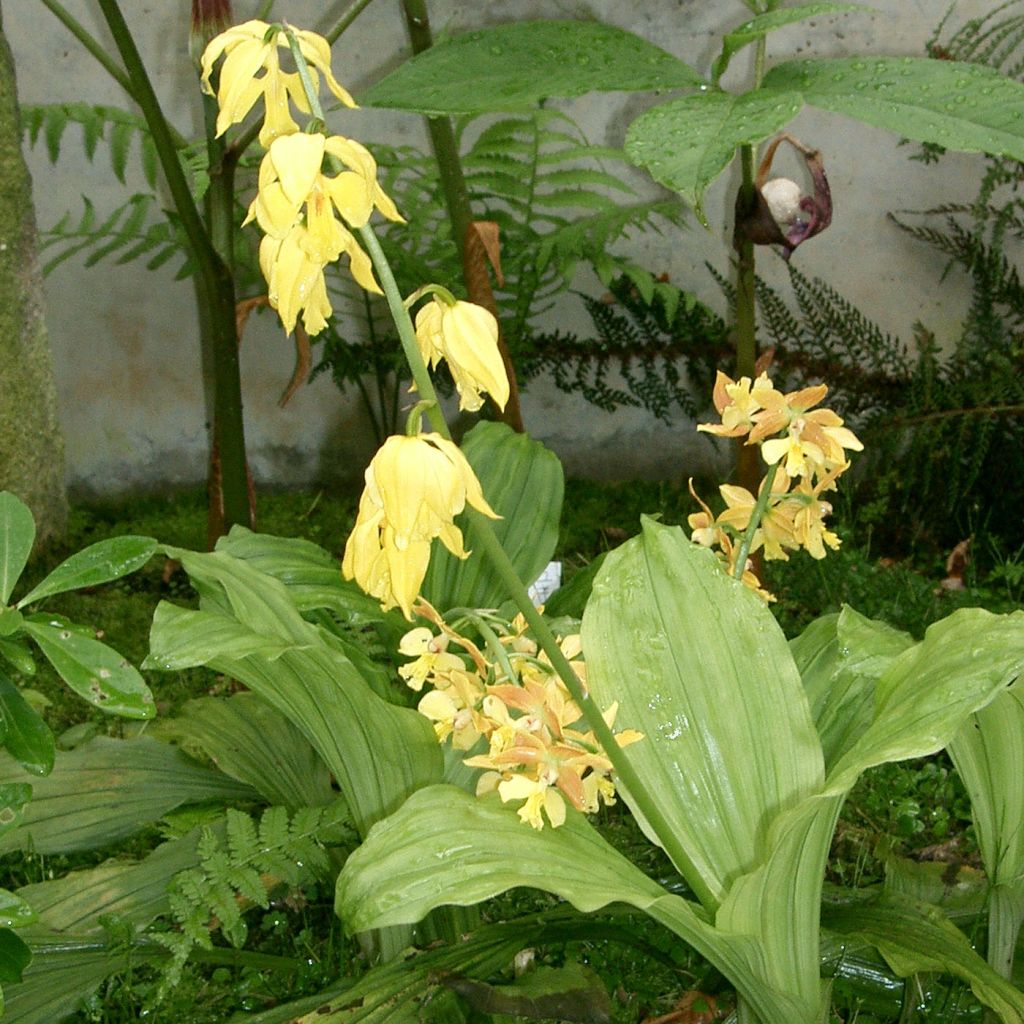
Calanthe sieboldii is a beautiful terrestrial orchid that comes from Japan, which is a bit tricky to grow. It is a perennial, flowering and vigorous plant that produces a floral stem carrying large, pale yellow to lemon yellow, long-lasting, flowers in late spring sometimes speckled with brown on the labellum and more or less fragrant depending on the plants. It is best grown in mild and humid climates, in thick and well-drained humus, remaining moist from spring to the end of summer, but dry in winter, and in partial shade. Growing in pots allows for easier control of the composition and humidity of the growing medium. In dry soil, protected by mulch, it can withstand temperatures down to around -10 °C.
Originally from Japan and very close to Calanthe discolor, the Calanthe sieboldii has the largest flowers among this group of Japanese orchids. Its flowering period is particularly long for a perennial orchid. This species grows in humid forests, along mountain streams and wet slopes, in high mountain meadows and among the thickets of the warm and humid regions of western Japan.
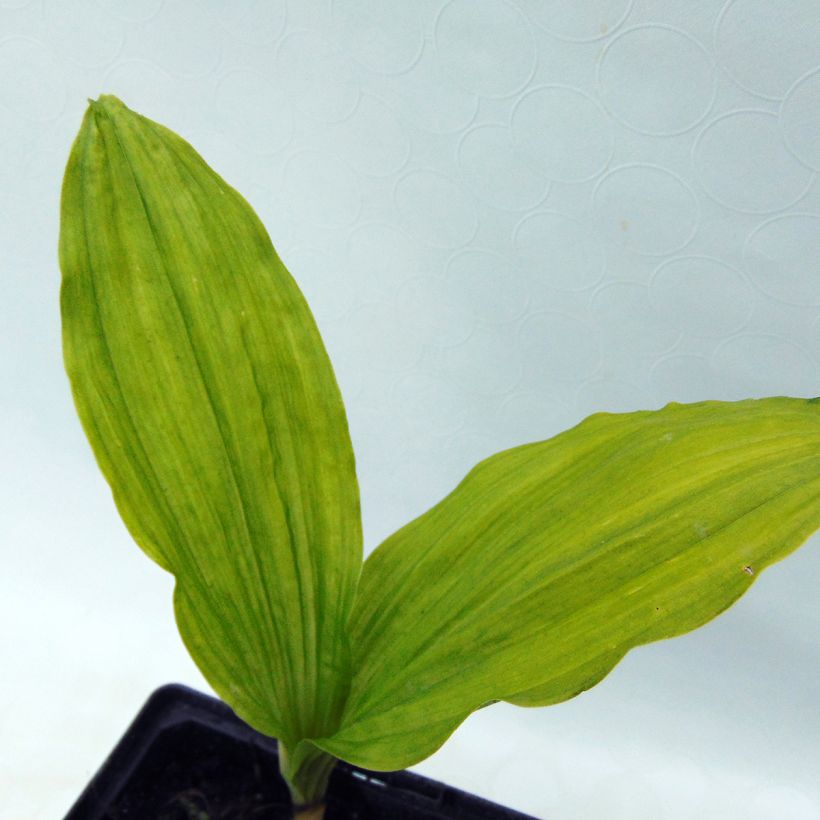
The deciduous vegetation emerges from the ground in spring and dries up in autumn. The plant forms a tuft of foliage about 35 cm (14in) in all directions. This orchid develops a pseudobulb, from which large light green leaves, measuring 15 to 40 cm (6 to 16in) long and 8 to 15 cm (3 to 6in) wide, emerge in early spring. They are pleated and broadly ovate, with strongly impressed parallel veins. The foliage resembles that of veratrum. In late spring, around May-June, the plant produces beautiful inflorescences reaching a height of 45 cm (18in), bearing 5 to 25 pale yellow to bright lemon yellow flowers, measuring 3 to 5 cm (1 to 2in) in diameter and fragrant. They are widely open, composed of elongated, slightly pointed sepals and petals and a trilobed labellum (lip). The central lobe is deeply veined and has a variable number of linear protrusions. Some plants have reddish-brown marks on the underside of the column and the projections of the lip. The root system is weakly suckering. The plant goes dormant in winter when its foliage has completely turned yellow.
In favourable climates, plant Calanthe sieboldii in partial shade, sheltered from the wind, in light, humus-rich soils, tending towards neutral or slightly acidic. Plant it in the shade in a cool rockery between rocks, or at the edge of a cool understory alongside Arisaema, Cypripedium, Paris, Bletilla and ferns. Given its poor hardiness, it will be necessary to protect the root system from harsh winter conditions and excess moisture. This plant grows well in large pots, which can be overwintered in a cold greenhouse.
When receiving your orchids, handle them with care: these plants produce few roots and are delicate!
Calanthe sieboldii - Garden orchid in pictures
Flowering
Foliage
Plant habit
Botanical data
Calanthe
sieboldii
Orchidaceae
Garden orchid
Southeast Asia
Planting and care
Calanthe sieboldii likes protected environments, semi-shade, thick and airy humus in the undergrowth, light soils, moderately moist from spring to the end of summer and drier in winter. In winter wet, the rootstock will rot, especially if there are pronounced frosts. Plant it in semi-shade, at the edge of large trees, with west being the best exposure. In heavy soil, add 1/3 of leaf compost and 1/3 of non-limestone gravel, mixed with your topsoil to a depth and width of 40 cm (16in). In regions with cold winters, protection against the cold and wet is essential. Place a 20 cm (8in) layer of leaves or crushed bark on the crown, and, if necessary, an impermeable protection on top of this. Growing in pots or containers is possible, in a mix of 60% ericaceous soil, 20% horticultural compost and 20% coarse sand. Terrestrial calanthes are quite demanding plants during the growing season: a weekly dose of geranium-type fertilizer at half strength from mid-May to mid-September will be very beneficial.
Planting period
Intended location
Care
Planting & care advice
-
-
-
-
-

-
-
-
-
, onOrder confirmed
Reply from on Promesse de fleurs
Recently viewed products
Haven't found what you were looking for?
Hardiness is the lowest winter temperature a plant can endure without suffering serious damage or even dying. However, hardiness is affected by location (a sheltered area, such as a patio), protection (winter cover) and soil type (hardiness is improved by well-drained soil).

The flowering period indicated on our website applies to countries and regions located in USDA zone 8 (France, the United Kingdom, Ireland, the Netherlands, etc.)
It will vary according to where you live:- In zones 9 to 10 (Italy, Spain, Greece, etc.), flowering will occur about 2 to 4 weeks earlier.
- In zones 6 to 7 (Germany, Poland, Slovenia, and lower mountainous regions), flowering will be delayed by 2 to 3 weeks.
- In zone 5 (Central Europe, Scandinavia), blooming will be delayed by 3 to 5 weeks.
In temperate climates, pruning of spring-flowering shrubs (forsythia, spireas, etc.) should be done just after flowering.
Pruning of summer-flowering shrubs (Indian Lilac, Perovskia, etc.) can be done in winter or spring.
In cold regions as well as with frost-sensitive plants, avoid pruning too early when severe frosts may still occur.
The planting period indicated on our website applies to countries and regions located in USDA zone 8 (France, United Kingdom, Ireland, Netherlands).
It will vary according to where you live:
- In Mediterranean zones (Marseille, Madrid, Milan, etc.), autumn and winter are the best planting periods.
- In continental zones (Strasbourg, Munich, Vienna, etc.), delay planting by 2 to 3 weeks in spring and bring it forward by 2 to 4 weeks in autumn.
- In mountainous regions (the Alps, Pyrenees, Carpathians, etc.), it is best to plant in late spring (May-June) or late summer (August-September).
The harvesting period indicated on our website applies to countries and regions in USDA zone 8 (France, England, Ireland, the Netherlands).
In colder areas (Scandinavia, Poland, Austria...) fruit and vegetable harvests are likely to be delayed by 3-4 weeks.
In warmer areas (Italy, Spain, Greece, etc.), harvesting will probably take place earlier, depending on weather conditions.
The sowing periods indicated on our website apply to countries and regions within USDA Zone 8 (France, UK, Ireland, Netherlands).
In colder areas (Scandinavia, Poland, Austria...), delay any outdoor sowing by 3-4 weeks, or sow under glass.
In warmer climes (Italy, Spain, Greece, etc.), bring outdoor sowing forward by a few weeks.
Shipping country and language
Your country of residence may be:
Your country of residence is:
For a better user experience on our website, you can select:
Your shipping country:
-
 Austria
-
 Belgium
-
 Bosnia & Herzegovina
-
 Bulgaria
-
 Croatia
-
 Cyprus
-
 Czechia
-
 Denmark
-
 Estonia
-
 Finland
-
 France
-
 Germany
-
 Greece
-
 Hungary
-
 Iceland
-
 Ireland
-
 Italy
Italy
-
 Latvia
-
 Liechtenstein
-
 Lithuania
-
 Luxembourg
-
 Malta
Malta
-
 Netherlands
-
 Poland
-
 Portugal
-
 Romania
-
 Serbia
-
 Slovakia
-
 Slovenia
-
 Spain
Spain
-
 Sweden
-
 Switzerland
Language:
-
French
-
 English
-
Spanish
-
Italian
-
German
-
Portuguese
-
Dutch
-
Finnish
My Account
Hello
My wish lists
My cart
Log in / Register
Existing customer?
This form is protected by reCAPTCHA - the Google Privacy Policy and Terms of Service apply.
New customer?
Create an account to track your orders, access our customer service and, if you wish, make the most of our upcoming offers.